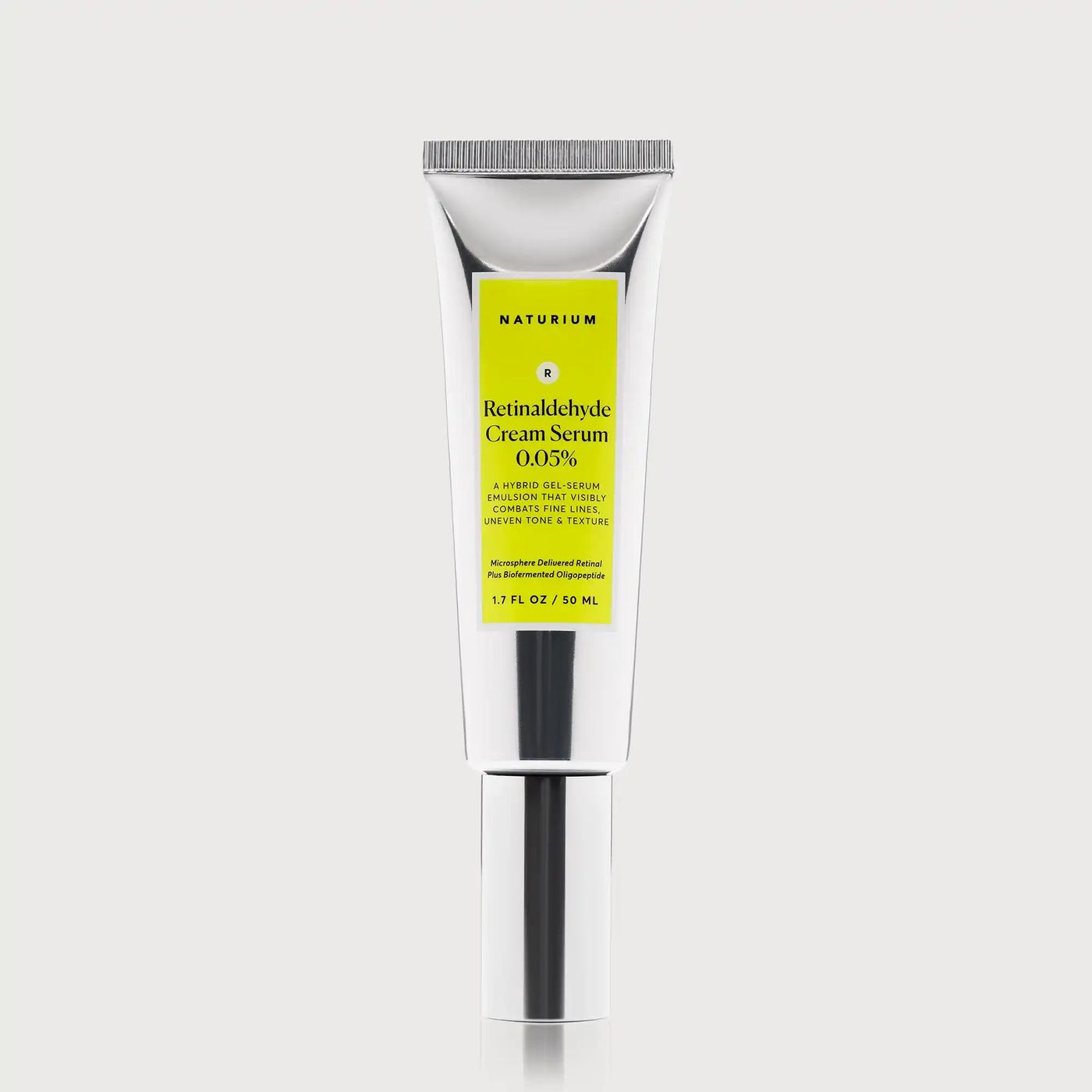
Retinaldehyde sits in an awkward middle ground in the retinoid family. It is one conversion step closer to retinoic acid (the active form your skin actually uses) than retinol, which on paper should make it more potent at lower concentrations. But for years it was hard to find at meaningful percentages outside of expensive prescription-adjacent brands. Naturium's Retinaldehyde Cream Serum 0.05% is one of the few mass-market formulas that puts the molecule front and center at a defensible price.
After ten weeks of nightly use, this is my honest take on whether the math actually works out — and where the formula falls short of what its marketing suggests.
TL;DR
Naturium Retinaldehyde Cream Serum 0.05% is a well-formulated, well-tolerated retinaldehyde product at a fair price. After ten weeks of nightly use it produced visible texture improvement, modest fine line reduction around the eye area, and minimal irritation — better tolerated than tretinoin and on par with a higher-percentage retinol in real-world results. Worth the spend for someone wanting a retinoid step-up that does not require prescription paperwork.
Overall Score: 8.4/10
Best for: Mid-thirties and older skin focused on early photoaging, retinol graduates wanting a stronger but tolerable next step, anyone wanting a retinaldehyde formula without prescription gatekeeping.
Skip if: You have severe inflammatory acne (tretinoin is more effective), very reactive or rosacea-prone skin (lower-strength retinol may be more tolerable), or are pregnant or breastfeeding.
What It Is
Retinaldehyde (also called retinal) is the intermediate molecule between retinol and retinoic acid in the conversion pathway. Topical retinol must be converted twice in the skin (retinol → retinaldehyde → retinoic acid) before becoming biologically active. Retinaldehyde skips the first step, which means it acts faster and at lower concentrations than equivalent retinol percentages.
The clinical evidence supports retinaldehyde as a meaningfully effective topical retinoid for photoaging and texture concerns at lower concentrations than retinol (PMID 10473961). It is also better tolerated than tretinoin (prescription retinoic acid) in most direct-comparison studies — fewer reports of stinging, peeling, and persistent erythema during the introduction phase (PMID 18046911).
Naturium's formulation pairs 0.05% retinaldehyde with squalane, bisabolol, and a microsphere delivery system. The microsphere delivery is meaningful — retinaldehyde is notoriously unstable and the encapsulation is one reason the product remains effective through its full open-bottle life. Cosmetically, the texture is a hybrid gel-cream that absorbs cleanly with a slightly satin finish.
The Science
Retinoids work by binding to nuclear retinoic acid receptors, which initiates a cascade of effects: normalization of follicular keratinization, increased epidermal cell turnover, suppression of melanin production, and stimulation of dermal collagen synthesis (PMID 18046911). The cumulative effect over months of consistent use is a measurable reduction in fine lines, photopigmentation, and surface roughness — backed by decades of dermatology research.
Retinaldehyde specifically has been shown in clinical trials to produce comparable improvements in fine wrinkles, photodamage, and skin texture to retinol but at lower concentrations and with similar or improved tolerability profiles (PMID 10473961). The 0.05% concentration in this product corresponds roughly to a 0.5-1.0% retinol formula in functional output — meaningful, not transformative.
The trade-off versus prescription tretinoin is straightforward: tretinoin produces faster and more dramatic results but with substantially more irritation, peeling, and barrier compromise during the introduction phase. For someone who has not been through tretinoin or has tried and abandoned it because of intolerance, retinaldehyde is a credible alternative.
How It Compares to Other OTC Retinoids
The over-the-counter retinoid landscape includes retinol esters (the weakest), retinol, retinaldehyde, and adapalene 0.1% (Differin, the only OTC prescription-strength retinoid). The relative potency, simplified:
Retinol esters (retinyl palmitate, retinyl propionate, granactive retinoid): mildest, slowest, often used in introductory or "sensitive" formulations. Reasonable starting point for retinoid-naive skin.
Retinol: the workhorse OTC retinoid. Effective at 0.5-1.0% over 12-24 weeks. Most clinical evidence in the broader retinoid literature is on retinoid effect generally, with retinol producing meaningful results at well-tolerated concentrations.
Retinaldehyde (this product): roughly 1 conversion step closer to active retinoic acid than retinol. Functionally produces results similar to retinol at half to a third of the concentration, with similar or better tolerability in most people.
Adapalene 0.1% (Differin): synthetic third-generation retinoid, originally prescription-only. Strong evidence for inflammatory acne and texture improvement; somewhat less well-tested specifically for photoaging endpoints. Best for acne-prone skin first, anti-aging second.
For someone choosing between a 0.5% retinol and a 0.05% retinaldehyde, the choice is largely about tolerability and how the textures suit your routine. Both will produce comparable results within a normal 8-12 week consistency window.
Personal Testing — 10 Weeks
I introduced this product at twice-weekly application for the first two weeks, building to alternate nights from week three onwards. By week six I was using it nightly with no significant tolerance issues — only one mild peeling episode in week two that resolved within three days.
The most consistent improvement was around the eye area: small fine lines that appear when smiling were visibly softer by week eight, and the slight orange-peel texture I sometimes get on the upper cheek smoothed out by week ten. The improvement on photopigmentation was real but modest — a small dark mark on my left jawline that has been persistent for years lightened by maybe 20-30% over the testing period, which is consistent with what the literature would predict.
What did not change as much: deeper expression lines around the forehead, the overall skin tone, or the texture of the chin area where I get hormonal congestion. These are areas where prescription tretinoin or in-clinic procedures would do more than any topical retinoid.
The cosmetic experience is the strongest part of this product. The texture is genuinely pleasant — it does not pill under sunscreen, layers cleanly with a thicker night cream, and absorbs without the stickiness that some retinol serums leave behind.
The Honest Caveats
Retinaldehyde is unstable. Even with the microsphere encapsulation, this product needs to be used within roughly six months of opening for full efficacy. The opaque packaging helps but the air exposure with each use compounds. Buy what you will use, not a stockpile.
Sunscreen during retinoid use is non-negotiable. The increased epidermal turnover means newer, less photoprotected cells are at the surface; UV exposure during this state accelerates the damage you are trying to undo. SPF 30 or higher daily, applied in the right amount, is the price of admission for any retinoid routine.
Retinoids are contraindicated during pregnancy and breastfeeding. This includes over-the-counter retinaldehyde and retinol formulations — pause use if you fall into either category.
Pros and Cons
Pros: - Effective concentration of retinaldehyde at a reasonable price - Better tolerated than tretinoin in most users - Microsphere delivery improves stability of the unstable molecule - Pleasant texture, layers cleanly - Visible texture and fine line improvement within 8-10 weeks of consistent use
Cons: - Unstable molecule — limited shelf life after opening - Effect on deeper expression lines and structural concerns is modest - Not appropriate for pregnancy or breastfeeding - Requires committed sunscreen use - A small subset of users will still experience irritation during introduction
Final Verdict
Naturium Retinaldehyde Cream Serum 0.05% is one of the better-formulated mass-market retinaldehyde products. The price-to-efficacy ratio is favorable, the cosmetic experience is good, and the clinical reasoning behind the active is sound. It will not replace prescription tretinoin for someone seeking maximum anti-aging effect, and it will not transform deeper structural concerns. Within those limits, it is a credible step-up from drugstore retinol and a reasonable destination for retinol graduates. After ten weeks, I have no plans to stop using it.
Medical Disclaimer
This article is for informational purposes and does not replace personalized advice from a board-certified dermatologist. Retinoids are contraindicated during pregnancy and breastfeeding. If you experience persistent irritation, peeling, or barrier compromise that does not resolve within two weeks of routine adjustment, stop use and consult a clinician. Retinoids significantly increase photosensitivity — daily broad-spectrum sunscreen is mandatory.
Affiliate Disclosure
Some links in this article may be affiliate links. If you purchase through them, BeautySift may earn a small commission at no additional cost to you. We only recommend products we have personally tested and would use ourselves. Affiliate revenue does not influence which products we choose to feature.


