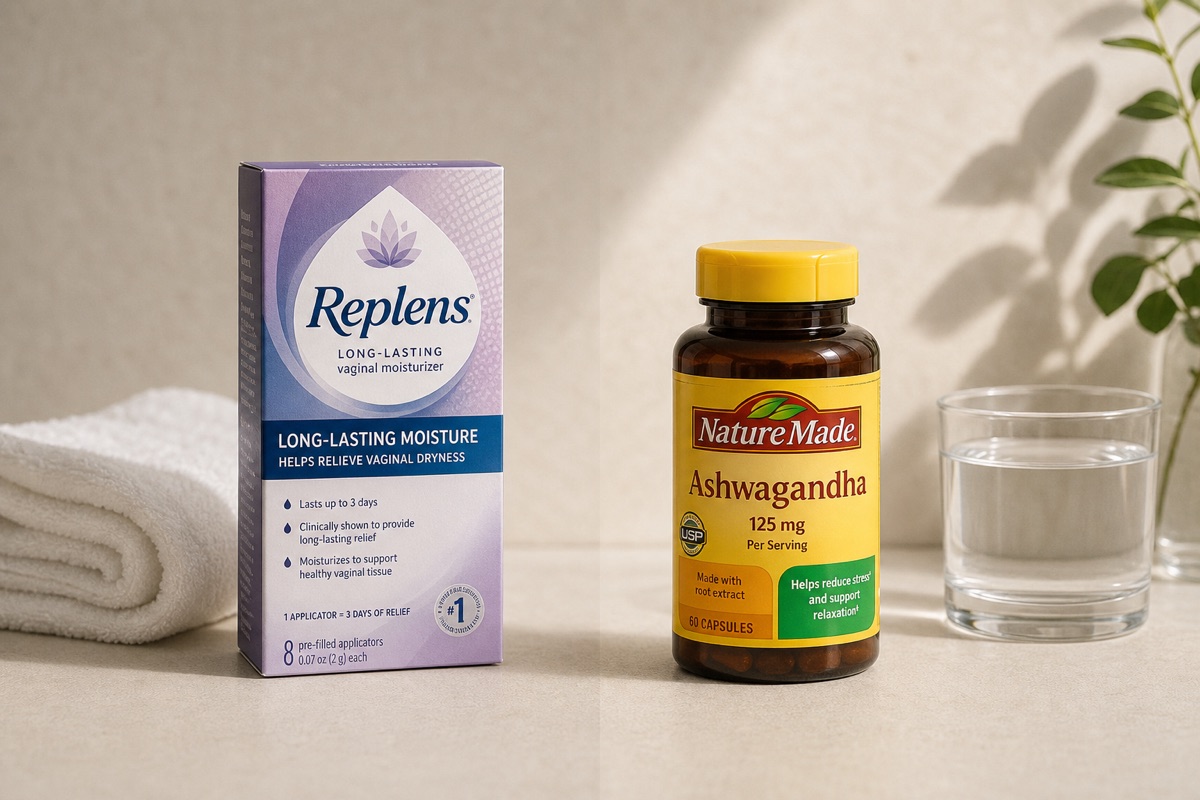
Ashwagandha for Perimenopause vs Vaginal Moisturizers for Sensitive Skin
Evidence-weighted comparison of ashwagandha supplements and vaginal moisturizers for sensitive perimenopause dryness, stress, sleep, and hot-flash support.
We analyzed 37,000+ Amazon US ratings across 6 products, FDA supplement guidance, and PubMed menopause-dryness evidence. For sensitive skin, vaginal moisturizers win for direct dryness support; ashwagandha is better framed as stress or sleep support, not local moisture.
| Criterion | Ashwagandha supplements Category comparison $16.99 | 🏆 Winner Vaginal moisturizers Category comparison $12.98 |
|---|---|---|
| Sensitive-skin symptom match How directly the category addresses vaginal dryness, friction, and irritation-prone comfort without relying on indirect systemic effects. | 4.4/10 | 8.9/10 |
| Evidence quality Peer-reviewed and regulatory context behind the active category, with higher scores for evidence that matches the exact symptom. | 6.5/10 | 8.5/10 |
| Amazon rating volume Combined Amazon US rating signal from 3 representative products on each side. | 8.7/10 | 8.1/10 |
| Tolerability and interaction risk Local topical exposure versus systemic supplement exposure, plus sensitivity flags and FDA dietary-supplement cautions. | 5.6/10 | 7.8/10 |
| Price and ease of trial Representative entry price, dosing clarity, repeat-use cost, and how quickly a shopper can judge fit. | 7.1/10 | 8.3/10 |
| Hot-flash adjacent fit Relevance when hot flashes disrupt sleep or stress, without claiming either category is a proven hot-flash treatment. | 6.8/10 | 2.8/10 |
| Overall score | 6.52 | 7.40 |
🏆 Winner: Vaginal moisturizers
Vaginal moisturizers win for sensitive-skin dryness because their symptom-match score is 8.9 versus 4.4 for ashwagandha, and the moisturizer side is supported by 13,932 Amazon ratings across Replens, Good Clean Love, and K-Y. Ashwagandha leads hot-flash-adjacent stress and sleep fit, 6.8 versus 2.8, but FDA supplement guidance and PubMed evidence do not make it a targeted vaginal-dryness solution.
Best on a budget
Replens Long-Lasting Vaginal Moisturizer
Best for results
Vaginal moisturizers for dryness; ashwagandha only when stress or sleep support is the primary goal
Bottom line for sensitive skin
Choose a vaginal moisturizer first if your main perimenopause symptom is sensitive dryness: friction, tightness, discomfort with intimacy, or irritation that feels worse when tissue is dry. Choose ashwagandha only if the main problem is stress load, sleep disruption, or feeling wired at night, and only if it fits your health history and medications.
BeautySift analyzed 37,165 Amazon US ratings across 6 representative products, PubMed-indexed evidence on genitourinary syndrome of menopause, a 2024 PubMed systematic review on ashwagandha for stress and anxiety, and FDA dietary supplement guidance. The result is clear: vaginal moisturizers are more targeted for sensitive dryness; ashwagandha is too indirect to be the first answer for local comfort.
The distinction matters for women 35-55 because perimenopause often bundles symptoms together. A hot flash can wreck sleep. Poor sleep can raise stress. Stress can make every skin and body sensation feel louder. But sensitive vaginal dryness still needs a local dryness strategy, not just a calming supplement.
What we compared
This is a category comparison, not a BeautySift test. We compared 3 ashwagandha supplements and 3 vaginal moisturizers that are available on Amazon US and have public rating snapshots. The ashwagandha side includes Nature Made Ashwagandha 125 mg, Gaia Herbs Ashwagandha Root, and Organic India Ashwagandha. Together, those 3 listings account for about 23,233 Amazon ratings in our source set.
The vaginal-moisturizer side includes Replens Long-Lasting Vaginal Moisturizer, Good Clean Love Rehydrate Ultra Moisturizing Vaginal Gel, and K-Y Liquibeads. Together, those 3 listings account for about 13,932 Amazon ratings in our source set. Rating volume is not clinical proof, but it is useful for understanding how much real-world shopper feedback exists in the US market.
We also weighted the claim-to-symptom match. A product can have thousands of favorable reviews and still be the wrong first choice for a specific concern. Ashwagandha has a better evidence conversation for stress and anxiety than for vaginal dryness. Vaginal moisturizers have a more direct evidence and use-case line for dryness, friction, and daily comfort.
Why vaginal moisturizers win for sensitive dryness
Vaginal moisturizers win because they address the surface problem directly. Replens shows 4.4/5 across 6,346 Amazon ratings, Good Clean Love Rehydrate shows 4.2/5 across 1,386 ratings, and K-Y Liquibeads shows 4.4/5 across 6,200 ratings. More important than the star averages is the category function: these products are designed to add moisture locally and reduce dryness-related discomfort.
The PubMed evidence is also more aligned with the primary question. The North American Menopause Society’s 2020 genitourinary syndrome of menopause position statement is directly relevant to perimenopause and menopause-related vulvovaginal symptoms. A 2018 PubMed systematic review and meta-analysis looked at vaginal therapies alternative to vaginal estrogens, which makes the category more relevant than a general adaptogen for local dryness.
For sensitive skin, the best starting point is usually the simplest compatible format, not the strongest-sounding marketing claim. Good Clean Love’s official US positioning around pH balance is useful for shoppers who dislike heavy residues. Replens has the lowest entry price in this comparison at $12.98 and the largest moisturizer-side rating count. K-Y Liquibeads may suit shoppers who prefer an insert format over gel.
Where ashwagandha fits better
Ashwagandha is not a vaginal moisturizer. It is a botanical dietary supplement most often positioned around stress, calm, and sleep. The 2024 PubMed systematic review and meta-analysis on Withania somnifera and stress or anxiety gives the ingredient a more serious evidence trail than many wellness trends, but that evidence does not make it a local dryness product.
Amazon US popularity is strong. Nature Made Ashwagandha shows 4.5/5 across 8,433 ratings, Gaia Herbs Ashwagandha Root shows 4.6/5 across 6,900 ratings, and Organic India Ashwagandha shows 4.5/5 across 7,900 ratings. Those numbers helped ashwagandha score 8.7 for Amazon rating volume, slightly ahead of vaginal moisturizers at 8.1.
The sensitive-skin issue is systemic exposure. A vaginal moisturizer can still sting or disagree with you, but the exposure is local and product-specific. Ashwagandha is swallowed, so the decision has more medication, thyroid, liver, autoimmune, pregnancy, and surgery-related caveats. FDA dietary supplement guidance also matters: supplements are regulated differently from drugs and are not preapproved by FDA for effectiveness before marketing.
Sensitive-skin tolerability: local versus systemic risk
For sensitive vaginal tissue, tolerability is not just about whether a formula sounds gentle. It is about how quickly you can identify a mismatch and stop. With a moisturizer, a shopper often knows within a few uses whether a gel, applicator, bead, or balm format is comfortable. Burning, unusual discharge, bleeding, pelvic pain, or symptoms that resemble infection should not be self-managed with another product trial.
With ashwagandha, the feedback loop can be harder to interpret. Sleep may shift for reasons unrelated to the supplement. Stress may improve because of schedule changes, therapy, exercise, or fewer night wakings. If side effects appear, they may not feel like a skin reaction at all. That is why our tolerability score favors vaginal moisturizers, 7.8 versus 5.6, even though either category can be a poor fit for an individual.
Sensitive shoppers should also avoid stacking too many new variables at once. If dryness is the main issue, start with one vaginal moisturizer and follow the label. If stress and sleep are the main issue, discuss ashwagandha with a clinician before adding it, especially if prescriptions or endocrine concerns are involved.
Price and value
On entry price, vaginal moisturizers also have the edge. Replens is $12.98 in the Amazon snapshot, K-Y Liquibeads is $15.29, and Good Clean Love Rehydrate is $22.99. The category earned 8.3 for price and ease of trial because the use case is clear: apply or insert as directed, then judge local comfort.
The ashwagandha side ranges from $16.99 for Nature Made to $25.19 for Gaia Herbs and $33.99 for Organic India. Those prices are reasonable for supplement shoppers, but value depends on whether stress or sleep support is actually the goal. If you buy ashwagandha hoping it will fix friction or sensitive dryness, even a low bottle price is poor value.
This is also where the affiliate context belongs: BeautySift may earn a commission from Amazon links, but the scoring did not favor the higher-priced products. The budget winner is Replens because it is the lowest-cost representative product and the category winner for dryness.
Hot flashes, sleep, and the overlap problem
The topic includes hot flashes because many women do not experience perimenopause symptoms in neat boxes. A night sweat can interrupt sleep; poor sleep can make stress feel sharper; stress can make irritation feel harder to ignore. Ashwagandha scored higher for hot-flash-adjacent fit, 6.8 versus 2.8, because stress and sleep are part of the lived experience for many shoppers.
That does not mean ashwagandha treats hot flashes. It means the supplement side is more relevant when the complaint sounds like stress, rumination, or sleep quality. Vaginal moisturizers are not hot-flash products at all; they win this article because the primary query asks which works for sensitive skin and dryness.
If hot flashes are frequent, intense, new, or affecting work and sleep, the better next step is a menopause-informed clinician conversation. Over-the-counter products can support comfort, but they should not delay care when symptoms are escalating.
Decision guide
Pick vaginal moisturizers if your top words are dry, tight, irritated, friction, uncomfortable, or intimacy hurts. In this comparison, that category has the stronger symptom-match score, 8.9 versus 4.4 for ashwagandha. Replens is the budget pick, Good Clean Love is the pH-positioned gel pick, and K-Y Liquibeads is the insert-format pick.
Consider ashwagandha only if your top words are stressed, wired, restless, or not sleeping. Nature Made is the accessible starter pick in this comparison, Gaia Herbs is the herbal capsule option, and Organic India is the large-bottle option. Do not use the supplement side as a substitute for evaluating persistent vulvovaginal symptoms.
If you are highly reactive, introduce only one product at a time. Keep notes for 1-2 weeks on symptoms, timing, and triggers. That simple record is often more useful than adding multiple supplements and moisturizers at once.
When to involve a clinician
Sensitive dryness is common in perimenopause, but not every irritation pattern is routine dryness. If discomfort comes with bleeding, unusual odor, new discharge, pelvic pain, urinary symptoms, sores, or pain that does not improve after stopping a product, skip the supplement aisle and book medical care. The North American Menopause Society’s 2020 position statement treats genitourinary symptoms as a legitimate menopause-care topic, not a cosmetic inconvenience.
A clinician can also help separate low-estrogen dryness from yeast, bacterial vaginosis, urinary issues, dermatitis, medication effects, or pelvic-floor pain. That matters because the wrong over-the-counter product can add more stinging. For shoppers who cannot use or do not want vaginal estrogen, nonhormonal moisturizers may still be part of the conversation, but the safest plan starts with the right diagnosis.
Related reading
Both winners on Amazon
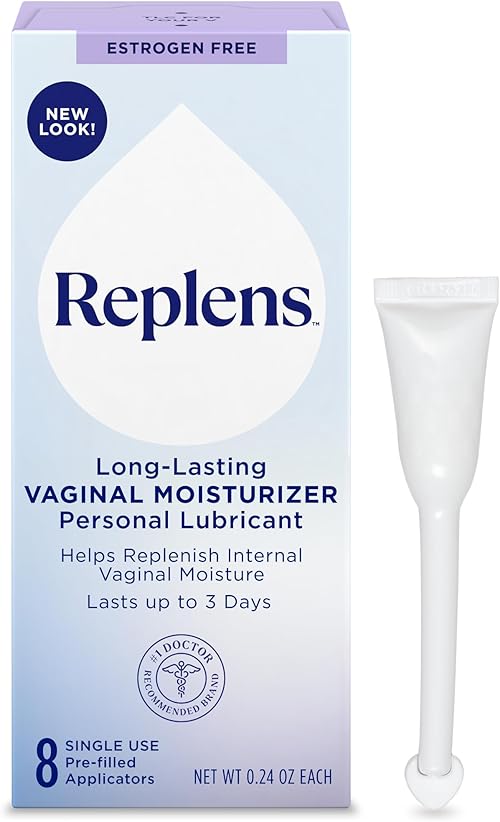
Replens
Replens Long-Lasting Vaginal Moisturizer, 8 Pre-Filled Applicators
$12.98
"Most direct sensitive-dryness fit in this comparison; Amazon shows 4.4/5 across 6,346 ratings and the format is designed for multi-day moisture."
What real Amazon buyers say
4.4★· 6,346 reviews"Instant relief from the dryness. You'll realize you've exhaled!"
"It helped so much. Much less pain and irritation."

Good Clean Love
Good Clean Love Rehydrate Ultra Moisturizing Vaginal Gel
$22.99
"Water-based, pH-positioned gel with 4.2/5 across 1,386 Amazon ratings; relevant when sensitive shoppers want a less occlusive format."
What real Amazon buyers say
4.2★· 1,386 reviews"It absorbs well, leaves no mess, and the applicator makes it simple and discreet to use."
"Women in menopause truly need this. I feel its safe and helpful."

Nature Made
Nature Made Ashwagandha Capsules 125 mg, 60 Count
$16.99
"Accessible single-ingredient ashwagandha option with 4.5/5 across 8,433 Amazon ratings; best fit is stress or sleep support, not local dryness."
What real Amazon buyers say
4.5★· 8,433 reviews"Small pill, easy to swallow. Does not smell bad or anything."
"I purchased it for help with sleep and immediately noticed a change in my sleep quality."

K-Y
K-Y Liquibeads Vaginal Moisturizer, 6 Suppositories
$15.29
"Insert format for shoppers who dislike gels; Amazon shows 4.4/5 across 6,200 ratings, with a lower entry price than premium hyaluronic acid inserts."

Gaia Herbs
Gaia Herbs Ashwagandha Root, 60 Vegan Liquid Phyto-Caps
$25.19
"Herbal capsule with 4.6/5 across 6,900 Amazon ratings; better for supplement-tolerant shoppers than those who react to botanicals."

Organic India
Organic India Ashwagandha Capsules, 180 Count
$33.99
"Large-count organic ashwagandha bottle with 4.5/5 across 7,900 Amazon ratings; value is strongest when stress support is the main goal."