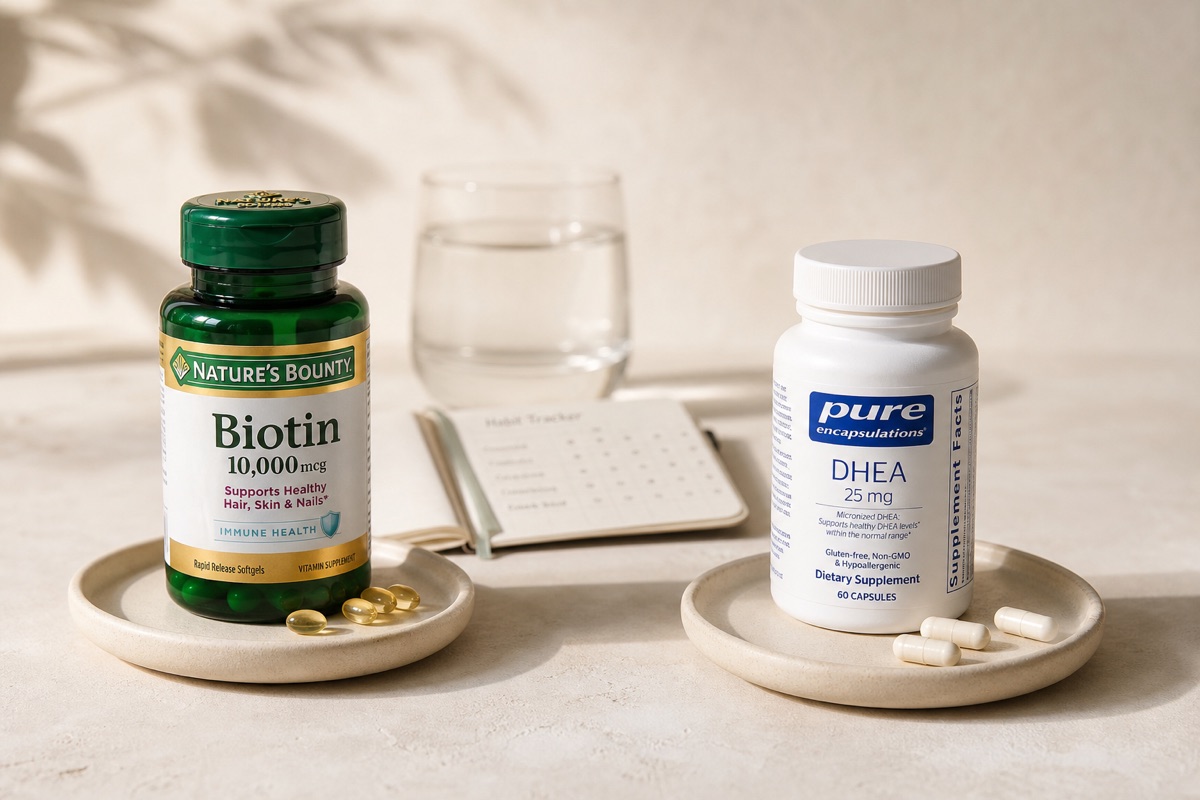
Biotin Supplements vs DHEA Hormone-Balancing Supplements for Fine Lines
Evidence-weighted comparison of biotin supplements and DHEA hormone-balancing supplements for fine lines, dryness, hair thinning, and hormonal acne.
We analyzed 267,100 Amazon ratings across 6 US supplement listings, NIH ODS biotin guidance, and a Cochrane review of 28 DHEA trials. Biotin is the lower-risk beauty-support pick for hair and nails; DHEA is hormone-active and not a default fine-line or acne choice without clinician guidance.
| Criterion | 🏆 Winner Biotin beauty supplements Multi-brand category $8.88 | DHEA and hormone-balancing supplements Multi-brand category $20.50 |
|---|---|---|
| Fine-line relevance How directly the category is supported for visible fine lines, collagen-related skin aging, or dryness-linked creasing. | 3.2/10 | 4.8/10 |
| Hair-thinning fit Weighted toward plausible hair and nail support, clinical relevance, and consumer-category alignment. | 7.1/10 | 4.6/10 |
| Hormonal acne risk Higher score means lower concern for androgenic acne or oily-skin worsening in acne-prone users. | 7.4/10 | 3.1/10 |
| Tolerability and safety complexity Penalizes lab-test interference, hormone activity, drug-interaction concerns, and need for clinician supervision. | 6.8/10 | 3.8/10 |
| Amazon US rating volume Representative Amazon rating volume: 221,700 ratings across three biotin products and 43,900 ratings across three DHEA or hormone-balance products. | 9.2/10 | 6.9/10 |
| Value Representative entry prices: $8.88 for Nature's Bounty Biotin and $20.50 for Pure Encapsulations DHEA 25 mg. | 8.7/10 | 7.3/10 |
| Evidence quality Prioritizes NIH guidance, PubMed clinical trials, Cochrane review quality, and whether evidence matches OTC oral supplement use. | 5.7/10 | 6.4/10 |
| Overall score | 6.87 | 5.27 |
🏆 Winner: Biotin beauty supplements
Biotin beauty supplements win for most US shoppers asking about fine lines plus hair thinning because they are non-hormonal, lower in acne-risk complexity, cheaper in representative Amazon pricing, and supported by much larger Amazon rating volume: 221,700 ratings across three biotin listings versus 43,900 across three DHEA or hormone-balance listings. DHEA has stronger hormone-pathway evidence, including a 2015 Cochrane review of 28 trials, but that same review found no quality-of-life improvement and a higher acne signal.
Best on a budget
Nature's Bounty Biotin 10,000 mcg
Best for results
Pure Encapsulations DHEA 25 mg only when a clinician is specifically evaluating hormone-active support; otherwise Sports Research Biotin is the more beauty-aligned pick
Bottom line
Choose biotin if you want a non-hormonal beauty supplement mainly for hair and nail support, and you understand that it is not a proven wrinkle treatment. Choose DHEA only when the goal is specifically hormone-pathway support and a clinician is involved. For women 35-55 managing fine lines, dryness, hair thinning, and hormonal acne at the same time, that distinction matters.
BeautySift analyzed six representative Amazon US supplement listings with 267,100 combined ratings, NIH Office of Dietary Supplements guidance on biotin, NCCIH guidance on menopause supplements, Memorial Sloan Kettering’s DHEA monograph, and PubMed-indexed clinical literature. The comparison is evidence-weighted, not a first-person test.
The short version: biotin wins for most beauty shoppers because it is cheaper, widely reviewed, and less likely to push acne-prone skin in the wrong hormonal direction. DHEA has more direct hormone activity and some menopause-related research, but that is exactly why it is not a casual fine-line supplement.
What biotin supplements are best at
Biotin is vitamin B7. NIH ODS lists the adult adequate intake at 30 mcg/day and notes that true deficiency can involve thinning hair, rash, brittle nails, and neurologic symptoms. That is the strongest beauty rationale for biotin: it can matter when low biotin status or a related nutrition issue is part of the picture.
The Amazon marketplace is much broader than the clinical evidence. Nature’s Bounty Biotin 10,000 mcg shows 4.7/5 across 120,800 Amazon ratings, while Sports Research Biotin 10,000 mcg shows 4.6/5 across 99,700 ratings. Those are large consumer-use signals, but they do not prove that high-dose biotin reverses perimenopause hair thinning or softens fine lines in people who are not deficient.
A 2022 Dermatologic Therapy randomized double-blind study by Samadi et al. included 50 people with diffuse hair loss and found improvements in hair fall count and total hair density after biotin plus dexpanthenol injections. BeautySift weights that as supportive but limited because it was not a clean placebo-controlled trial of over-the-counter oral biotin capsules. It also used injections, not the gummies and softgels most US shoppers buy.
For fine lines and dryness, biotin is indirect at best. If brittle nails, shedding, or a restricted diet are part of the story, it may be a reasonable low-drama category to discuss with a clinician. If the primary goal is smoother under-eye lines, forehead creasing, or crepey texture, topical sunscreen, moisturizers, retinoids, peptides, and barrier repair have a more direct cosmetic pathway.
What DHEA and hormone-balancing supplements are best at
DHEA is not a beauty vitamin. NCCIH describes it as a hormone that can convert into testosterone and estrogen. That mechanism is why DHEA is marketed for hormone balance, energy, libido, and menopause-adjacent concerns, but it also raises the stakes for acne-prone skin, androgen-sensitive hair thinning, and hormone-sensitive medical history.
The strongest clinical source in this comparison is the 2015 Cochrane review by Scheffers et al., which evaluated 28 trials and 1,273 peri- and postmenopausal women. Compared with placebo, DHEA did not improve quality of life in the review’s analysis: standardized mean difference 0.16, 95% confidence interval -0.03 to 0.34, P=0.10. It did show a small sexual-function signal, with SMD 0.31, 95% CI 0.07 to 0.55, P=0.01.
The acne caution is more relevant for BeautySift’s perimenopause reader. The same Cochrane review reported androgenic side effects, mainly acne, with an odds ratio of 3.77 versus placebo across five studies and 376 women. For someone already dealing with hormonal acne around the chin or jawline, that risk can outweigh the theoretical beauty upside.
There is some skin-aging biology around DHEA, but it does not map cleanly to oral supplements. Labrie et al. published a 2009 randomized double-blind placebo-controlled topical DHEA study in 60 postmenopausal women and reported dose-dependent gene-expression changes involving collagen-family genes and keratinocyte differentiation markers. Useful signal, yes. Proof that a 25 mg DHEA capsule improves fine lines for a 45-year-old Amazon shopper, no.
Head-to-head scoring
Biotin leads on Amazon rating volume, value, hair-and-nail category fit, and lower acne-risk complexity. Across three representative biotin products in this article, the Amazon rating set totals 221,700 ratings. DHEA and hormone-balance-adjacent products total 43,900 ratings across three listings. Rating volume is not efficacy proof, but it does show consumer familiarity and broad US accessibility.
DHEA leads only where hormone-pathway relevance matters. If a clinician is evaluating low DHEA, menopause symptoms, libido, or a specific hormone pattern, Pure Encapsulations DHEA 25 mg is the most conservative DHEA pick in our featured set because the dose is lower than 100 mg products. Horbaach DHEA 100 mg has a larger DHEA-side Amazon signal, 4.6/5 across 9,600 ratings, but the higher dose makes self-directed use harder to defend.
DIM sits in a different bucket. SMNutrition DIM 200 mg has 4.4/5 across 29,800 Amazon ratings and is often marketed around estrogen metabolism, but DIM is not DHEA and should not be treated as a direct substitute. It may be relevant to shoppers comparing the broader hormone-balance shelf, yet the evidence and contraindication questions are different.
For the stated query - biotin supplements vs DHEA hormone-balancing supplements for fine lines - BeautySift’s winner is biotin by risk-adjusted fit. Not because biotin is a strong fine-line active, but because DHEA’s hormone activity and acne signal make it a poor default beauty supplement when the shopper also has hormonal-acne concerns.
Who should choose biotin
Biotin is the better fit if your main concerns are shedding, brittle nails, a sparse-looking ponytail, or wanting a non-hormonal supplement category to discuss with your clinician. It also makes more sense if you are comparison-shopping on Amazon and want a low-cost starting point: Nature’s Bounty’s $8.88 snapshot is less than half the representative Pure Encapsulations DHEA price of $20.50.
The key caveat is lab work. NIH ODS summarizes FDA concerns that high-dose biotin can interfere with lab tests, including thyroid, hormone, vitamin D, and troponin tests. That matters in perimenopause because many women are already checking thyroid, ferritin, vitamin D, reproductive hormones, lipids, or cardiac markers. Tell your clinician and lab before testing; they may recommend a temporary pause.
Skip biotin as a wrinkle strategy if your skincare basics are not in place. Daily broad-spectrum sunscreen, a moisturizer that actually reduces dehydration lines, and a tolerable retinoid or peptide routine are more relevant to visible fine lines than 10,000 mcg biotin.
Who should consider DHEA only with guidance
DHEA is a better fit only when the question is hormone support, not general beauty maintenance. That could mean a clinician is reviewing symptoms, lab context, medications, cancer history, mood history, and acne or hair-loss pattern. Memorial Sloan Kettering describes DHEA as a precursor to estrogen and androgens and lists acne among reported adverse effects. NCCIH also emphasizes that usefulness for menopause symptoms remains unclear.
Be especially cautious if your hair thinning looks androgen-sensitive: widening part, temple recession, oily scalp, or acne flares. Adding an androgen-pathway supplement without diagnosis can muddy the picture. The same caution applies to PCOS history, hormone-sensitive cancer history, tamoxifen use, pregnancy, lactation, bipolar or mania vulnerability, and any prescription hormone therapy.
For fine lines and dryness, DHEA is not the clean shortcut it can appear to be in supplement marketing. The topical DHEA skin-aging study is interesting, but oral capsules sold on Amazon are a different exposure route, dose pattern, and risk profile.
Practical shopping notes
If you buy through Amazon, stay with real product detail pages, not shortened links or marketplace lookalikes. BeautySift uses Amazon Associates links and may earn a commission on qualifying purchases; that does not affect scoring. We also avoid repeating overused ASINs when the catalog has credible alternatives.
For biotin, compare dose, capsule format, allergen notes, and whether you can reliably pause before lab work. For DHEA, compare dose more carefully than price. A cheap 100 mg product is not automatically a better value if the right use case calls for a lower dose or no DHEA at all.
For hormone-balance-adjacent products such as DIM or vitex, do not assume the label language means the same thing as DHEA. Each ingredient has different mechanisms, interactions, and evidence gaps. If hormonal acne is active, bring the supplement bottle or label to your dermatologist or clinician before layering multiple endocrine-adjacent products.
Verdict
Biotin supplements are the better default choice for this BeautySift comparison because they match the hair-and-nail side of the brief, carry broader Amazon US user volume, and avoid DHEA’s direct androgen-estrogen pathway. The drawback is that biotin’s evidence for fine lines is weak and lab-test interference is real.
DHEA and hormone-balancing supplements are more specialized. They may belong in a clinician-guided menopause or endocrine conversation, but they are not the safer beauty-first answer for fine lines, dryness, hair thinning, and hormonal acne. If acne or androgen-sensitive shedding is part of your perimenopause pattern, DHEA deserves extra scrutiny.
Related reading
Both winners on Amazon
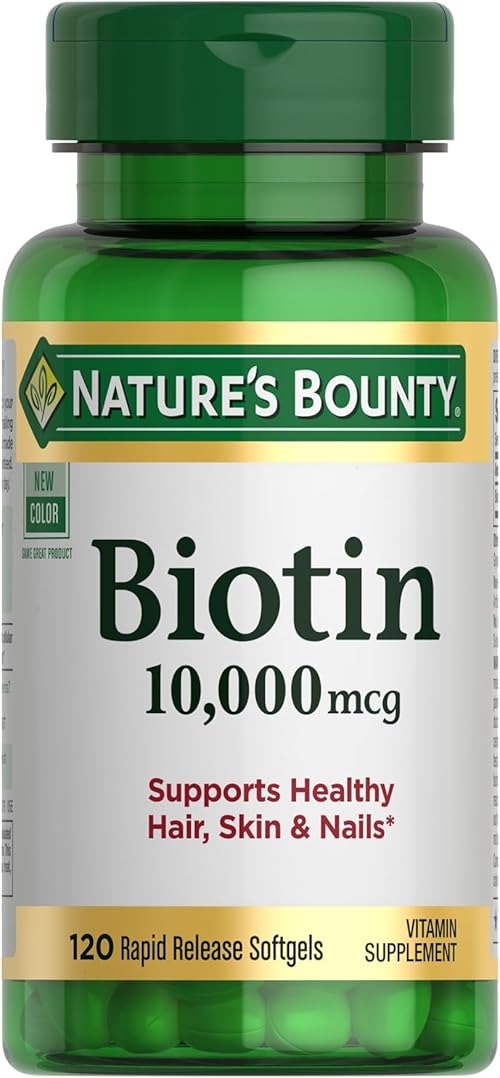
Nature's Bounty
Nature's Bounty Biotin 10,000 mcg
$8.88
"Lowest representative entry price and the largest Amazon signal in this comparison: 4.7/5 across 120,800 ratings."
What real Amazon buyers say
4.7★· 120,800 reviews"I have been using Nature's Bounty Biotin 10,000 mcg for a few months now, and the results are fantastic. My hair feels thicker and healthier, my skin has a noticeable glow, and my nails are stronger than ever."

Pure Encapsulations
Pure Encapsulations DHEA 25 mg
$20.50
"Lower-dose DHEA option with 4.7/5 across 4,500 Amazon ratings; best reserved for clinician-guided hormone support."
What real Amazon buyers say
4.7★· 4,500 reviews"High grade DHEA supplement. My energy has noticeably increased since I started taking this. Works great!"
"The brand quality is great, very effective, the dosage is what my functional medical doctor recommended, no taste, no side effects, great for hormone and mood balancing"

Sports Research
Sports Research Biotin 10,000 mcg with Organic Coconut Oil
$19.95
"High-volume biotin alternative with 4.6/5 across 99,700 Amazon ratings and a vegan softgel format."
What real Amazon buyers say
4.6★· 99,700 reviews"I've been taking this Sports Research Biotin for a few weeks now and I'm already seeing results. My nails feel much stronger and aren't peeling like they used to. I love that it's made with coconut oil and is vegan-friendly."

Horbaach
Horbaach DHEA 100 mg
$18.98
"High-dose DHEA listing with 4.6/5 across 9,600 Amazon ratings; the dose makes clinician review more important."

SMNutrition
SMNutrition DIM 200 mg
$23.95
"Hormone-balance-adjacent DIM product with 4.4/5 across 29,800 Amazon ratings; not the same mechanism as DHEA."

THORNE
THORNE Biotin
$28
"Lower-volume but practitioner-positioned biotin option with 4.7/5 across 1,200 Amazon ratings."