
Body Retinol vs Hand Creams: Evidence-Weighted Head-to-Head
Body retinol and hand creams solve different mature-skin problems. This evidence-weighted comparison weighs Amazon ratings, actives, price, and tolerability.
We analyzed 51,534 Amazon US ratings across 6 body-retinol and hand-cream products plus PubMed retinoid evidence from 2024. Body retinol is the stronger pick for crepey texture and fine lines on arms, legs, and chest; hand creams win for everyday dryness, cracking, price, and tolerability.
| Criterion | Body retinol lotions Multi-brand category $22.32 | Repair hand creams Multi-brand category $10.17 |
|---|---|---|
| Fine-line and crepey-texture relevance How directly the category addresses visible age-related texture, crepiness, and fine lines on mature skin. | 8.2/10 | 4.8/10 |
| Dryness and cracking support How well the category fits tight, rough, frequently washed, or cracked skin. | 6.8/10 | 9.0/10 |
| Amazon rating volume Representative Amazon US sample: 19,370 ratings for three body-retinol products versus 32,164 ratings for three hand creams. | 7.4/10 | 8.6/10 |
| Price and value Representative basket average: $22.32 for body retinol versus $10.17 for hand creams. | 6.8/10 | 9.1/10 |
| Tolerability Penalizes retinoid adjustment, dryness risk, fragrance issues, and hand-area sting on cracked skin. | 6.6/10 | 8.5/10 |
| Routine simplicity How easily the category fits into a realistic daily routine for US shoppers 35-55. | 6.9/10 | 9.0/10 |
| Evidence quality Weights PubMed active evidence, official product positioning, and concern-specific user rating patterns. | 8.3/10 | 7.4/10 |
| Overall score | 7.29 | 8.06 |
🏆 Winner: Repair hand creams for most dry-hand routines
Hand creams win the practical head-to-head because they lead on Amazon rating volume, 32,164 to 19,370 ratings, and price, $10.17 versus $22.32 across the representative baskets. Body retinol still wins fine-line and crepey-texture relevance, 8.2 to 4.8, supported by PubMed-indexed retinoid evidence, so it is the better pick when the goal is smoother-looking body skin rather than cracked hands.
Best on a budget
O'Keeffe's Working Hands Hand Cream
Best for results
Gold Bond Age Renew Retinol Overnight Body & Face Lotion for body crepiness; La Roche-Posay Cicaplast Hand Cream for dry, cracked hands
Bottom line
Choose body retinol if the visible problem is crepey texture, fine lines, or sun-weathered body skin on the arms, legs, chest, or backs of the hands. Choose a repair hand cream if the problem is dryness, cracking, tightness after washing, or rough cuticles. Those sound similar, but they are different shopping problems.
BeautySift analyzed 51,534 Amazon US ratings across six representative products: three body-retinol lotions and three hand creams. The body-retinol basket averaged $22.32 and 19,370 total Amazon ratings. The hand-cream basket averaged $10.17 and 32,164 total Amazon ratings. Rating volume is not clinical proof, but it is useful for judging how widely each category has been used by US shoppers.
The evidence split is clear. Retinoids have stronger ingredient logic for photoaging and fine lines; the 2024 PubMed-indexed systematic review on topical tretinoin and photoaging supports retinoids as a more directly age-sign-focused class. Hand creams have the stronger practical case for dryness: lower price, faster comfort, simpler use, and better tolerability when skin is cracked or over-washed.
What body retinol is best at
Body retinol lotions are designed for texture change, not instant comfort. They make the most sense when the concern is crepey-looking skin on upper arms, knees, thighs, chest, or the backs of hands. Gold Bond Age Renew Retinol Overnight Body & Face Lotion, the strongest body-retinol representative in this comparison, has 4.5/5 across 9,090 Amazon ratings. Medix 5.5 Retinol Cream + Collagen Cream Set adds 8,361 Amazon ratings at 4.4/5. Advanced Clinicals Retinol Body Lotion & Face Moisturizer adds 1,919 Amazon ratings at 4.4/5.
That gives the body-retinol side 19,370 Amazon ratings across the three products we analyzed. Its advantage is relevance to fine lines. In the scoring table, body retinol leads hand creams 8.2 to 4.8 for fine-line and crepey-texture relevance because retinoids are more directly connected to photoaging-focused routines than standard hand creams.
The trade-off is patience and tolerability. Retinoid body products can feel drying at first, especially on skin that is already itchy, freshly shaved, or compromised by winter air. They also add routine friction: night use, gradual frequency, sunscreen on exposed areas, and avoiding irritated patches. For shoppers 35-55 who already use facial retinoids, that may feel manageable. For someone with cracked knuckles today, it is the wrong first step.
What hand creams are best at
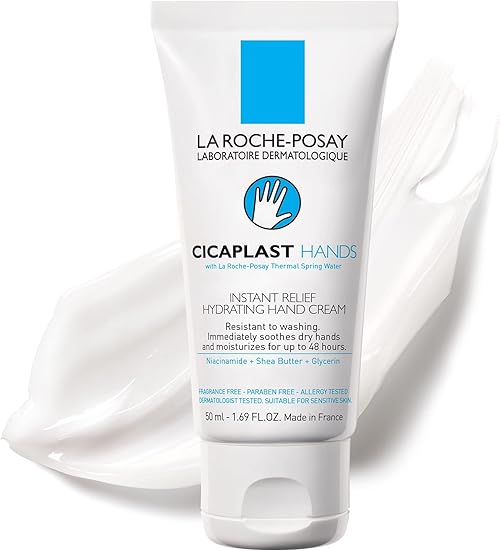
Repair hand creams are the better first purchase for uncomfortable dryness. O’Keeffe’s Working Hands has 4.7/5 across 10,450 Amazon ratings at $6.92. La Roche-Posay Cicaplast Hand Cream has 4.7/5 across 20,992 Amazon ratings at $12.99. Aveeno Skin Relief Intense Moisture Hand Cream has 4.6/5 across 722 Amazon ratings at $10.59.
That gives the hand-cream side 32,164 Amazon ratings across the three products analyzed, with a representative average price of $10.17. The category wins value, 9.1 to 6.8, and routine simplicity, 9.0 to 6.9. Hand cream can sit at a sink, in a bag, on a nightstand, or at a desk. It does not require a retinoid adjustment schedule.
Ingredient-wise, the best hand creams are not trying to behave like retinoids. They rely on barrier-supporting and water-binding ingredients such as glycerin, petrolatum, dimethicone, shea butter, niacinamide, colloidal oat, or ceramides. The 2021 PubMed-indexed review on ceramide-containing formulations and barrier function supports the logic behind barrier repair as a category. That matters for hands because repeated washing, dish soap, sanitizer, and cold Midwest winter air can make hand skin feel older than facial skin even when the issue is mainly barrier stress.
Fine lines: body retinol wins, with a caveat
If your question is specifically “what helps fine lines on body skin,” body retinol is the stronger category. The PubMed retinoid evidence is not a direct clinical trial of every Amazon body lotion in this article, and we are not claiming that these products perform like prescription tretinoin. But retinoids are still more relevant to photoaging than a standard hand cream.
Gold Bond’s official US page positions Age Renew Retinol Overnight as a body and face moisturizer with retinol and 24-hour hydration. Amazon reviewers also repeatedly describe smoother-looking, softer body skin. That does not prove collagen change in a controlled study, but it supports the product-category fit: body retinol is for people who are noticing texture and visible aging, not just dry skin.
Use it where the skin can tolerate it. Upper arms, thighs, chest, and the backs of hands are reasonable zones if the label allows. Avoid cracked knuckles, eczema flares, fresh shaving, sunburn, or any area that stings when plain moisturizer is applied. A body retinol used over damaged hand skin is more likely to irritate than to help.
Dryness and cracking: hand creams win
If your hands are dry, rough, or cracked, hand cream wins by a wide margin. In the scoring rubric, hand creams lead dryness and cracking support 9.0 to 6.8. That result is not only about ingredients; it is about product behavior. A hand cream is meant to be reapplied after washing, carried around, and layered thickly at night if needed.
O’Keeffe’s is the budget pick because its Amazon price snapshot was $6.92 and it has 10,450 ratings. La Roche-Posay is the more derm-style option in this set, with official US positioning for dry, cracked hands and shea butter plus niacinamide. Aveeno is the fragrance-free oat option, useful for shoppers who dislike scent or whose hands feel reactive.
Body retinol can moisturize, but dryness relief is usually secondary. Even a creamy retinol body lotion is still asking the skin to tolerate an active. For a shopper whose hands split around the cuticles or sting under warm water, the smarter sequence is repair first, retinol later if fine lines remain a concern.
Price and Amazon signal
The price gap is meaningful. The three body-retinol products we analyzed averaged $22.32: Gold Bond at $16.97, Medix 5.5 at $31.99, and Advanced Clinicals at $17.99. The three hand creams averaged $10.17: O’Keeffe’s at $6.92, La Roche-Posay at $12.99, and Aveeno at $10.59.
Hand creams also had the larger Amazon review base in this evidence set, 32,164 ratings compared with 19,370 for body retinol. La Roche-Posay Cicaplast Hand Cream alone accounted for 20,992 Amazon ratings. That broad usage signal favors hand creams for a general dryness query.
The Amazon signal does not answer every question. Higher rating volume does not mean a product is better for collagen, photoaging, or crepey texture. It does mean more shoppers have used the category for the immediate problem it promises to solve. For hands, that problem is usually dryness. For body retinol, it is visible texture over time.
Tolerability and mature-skin fit
For US women 35-55, the biggest mistake is treating all dryness as aging. Perimenopause and post-40 skin can become drier, but not every line needs an active. Sometimes the skin simply needs more consistent barrier support, especially on hands that touch water, soap, sanitizer, steering wheels, laundry detergent, and cold air.
Hand creams are more forgiving. They lead tolerability 8.5 to 6.6 because most users can apply them several times daily without building a retinoid schedule. Fragrance-free options like Aveeno and La Roche-Posay are also easier to recommend for scent-sensitive users.
Body retinol is more targeted but less forgiving. Start two or three nights per week, apply to dry skin, and add a plain moisturizer over it if needed. Do not combine it on the same area with harsh scrubs, strong exfoliating acids, or fresh shaving. If the skin burns, flakes heavily, or develops persistent redness, stop and return to a bland moisturizer.
Best way to use both categories
The most useful routine is often both, but not in the same role. Use hand cream every day, especially after washing and before bed. Keep it visible; a tube in a drawer does not help cracked hands. If the backs of your hands show fine lines or sun damage, you can add a small amount of body retinol to the backs of the hands at night two or three times weekly, then seal with hand cream.
Use body retinol on larger body zones at night. Arms, legs, and chest are more realistic than palms or fingertips. Apply sunscreen to exposed body areas the next day because a retinoid routine and casual sun exposure are a poor match.
For most shoppers, the sequence is: repair dryness first, then decide whether visible texture still bothers you. Hand cream is the base layer. Body retinol is the texture-focused upgrade.
Who should choose which
Choose body retinol if your body skin is comfortable but looks crepey, dull, or lined. It is especially relevant if you already tolerate facial retinol and want a lower-cost body option before moving into prestige body treatments. Gold Bond is the best starting point in this set because it combines the strongest body-retinol Amazon rating snapshot, 4.5/5 across 9,090 ratings, with a midrange $16.97 price.
Choose hand cream if your hands are dry, tight, cracked, or over-washed. O’Keeffe’s is the best budget pick at $6.92. La Roche-Posay is the strongest rating-volume pick at 20,992 Amazon ratings. Aveeno is the fragrance-free oat pick for shoppers who want a gentler-feeling hand cream.
Skip body retinol for now if your hands have open cracks, eczema flares, or burning. Skip rich hand creams only if you hate residue under keyboards, phones, or driving; in that case, use a lighter hand cream during the day and a thicker one before bed.
Affiliate disclosure
BeautySift may earn a commission from Amazon links in this article. Affiliate relationships do not affect the scoring rubric; the comparison is based on Amazon US rating snapshots, PubMed-indexed literature, official US brand positioning, and ingredient-category analysis.
Related reading
Both winners on Amazon

Gold Bond
Gold Bond Age Renew Retinol Overnight Body & Face Lotion
$16.97
"Best body-retinol representative here: 4.5/5 across 9,090 Amazon ratings, retinol positioning, and a lower price than the body-retinol basket average."
What real Amazon buyers say
4.5★· 9,090 reviews"Personally I love it. My skin leans dry, which is mostly taken care of with good serums and moisturizers, and consistent use of sunscreen. Overall my skin looks good. I'm knocking on 50's door with no wrinkles, nearly no lines or sagging."
"This is a great daily retinol for the body, doesn't irritate, leaves skin feeling soft and moisturized for a whole day."

O'Keeffe's
O'Keeffe's Working Hands Hand Cream
$6.92
"Best budget hand-cream representative: 4.7/5 across 10,450 Amazon ratings at $6.92, with strong fit for cracked, frequently washed hands."
What real Amazon buyers say
4.7★· 10,450 reviews"I picked this up because my hands get extremely dry, especially with constant washing and cleaning, and this stuff really works. A little goes a long way."
"Works well so far. My cracked skin is already feeling and looking much better. I had several cracked, bleeding places on my hand about 4 days ago and right now my hands are blissfully healing."

Medix 5.5
Medix 5.5 Retinol Cream + Collagen Cream Skincare Set
$31.99
"Higher-volume body-retinol set: 4.4/5 across 8,361 Amazon ratings, useful when body texture and a richer body-lotion routine matter more than lowest price."
What real Amazon buyers say
4.4★· 8,361 reviews"Medix 5.5 Retinol & Collagen Lotion is wonderful for improving skin texture and hydration. It absorbs easily, leaving my skin feeling soft and smooth without any greasy residue."
"Super creamy, rich, silky formula with a very light scent. Using it right after the shower while my skin is still damp really helps extend the product, I think."
La Roche-Posay
La Roche-Posay Cicaplast Hand Cream
$12.99
"Highest hand-cream rating volume in this set: 4.7/5 across 20,992 Amazon ratings, with official US positioning for dry, cracked hands."

Advanced Clinicals
Advanced Clinicals Retinol Body Lotion & Face Moisturizer
$17.99
"Lower-cost retinol body cream with 4.4/5 across 1,919 Amazon ratings; better for body texture than for painful hand cracks."

Aveeno
Aveeno Skin Relief Intense Moisture Hand Cream
$10.59
"Fragrance-free hand-cream option with prebiotic oat positioning and 4.6/5 across 722 Amazon ratings; a safer fit for scent-sensitive dry hands."