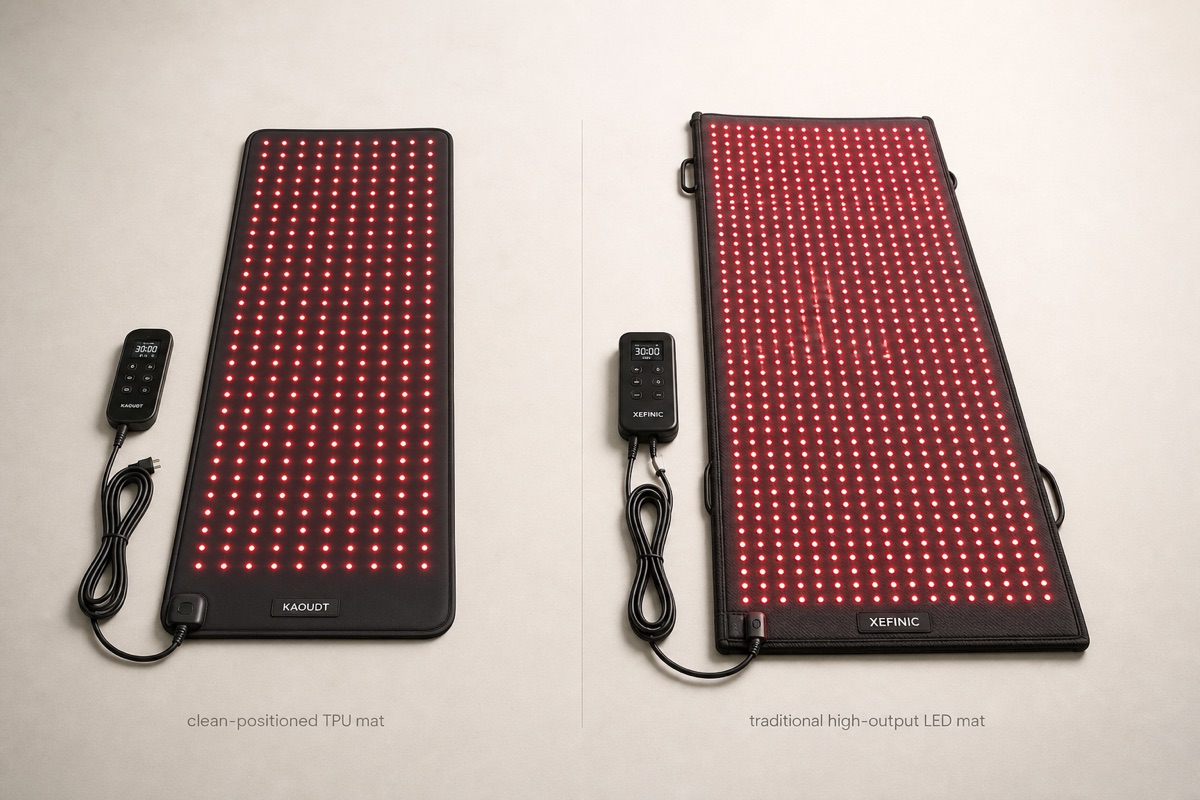
Clean-Beauty LED Light Therapy Bed vs Traditional LED Bed for Sensitive Skin
Evidence-weighted 2026 comparison of clean-positioned LED light therapy mats and traditional high-output LED beds for sensitive, mature skin.
For sensitive skin, the clean-positioned Kaoudt TPU mat wins by a narrow margin: we analyzed 163 Amazon ratings across 3 US full-body LED listings, Allure's 2025 LED-mask guidance, FDA laser-device safety context, and 3 PubMed photobiomodulation papers.
| Criterion | 🏆 Winner Kaoudt 72 x 33.3 Inch Medical-Grade TPU Red Light Therapy Mat Kaoudt $299.99 | Xefinic Full Body Red Light Therapy Mat with 3207 LEDs Xefinic $799.99 | Foldable 480-LED Near Infrared Red Light Therapy Mat Generic Red Light Therapy Mat $109.98 |
|---|---|---|---|
| Efficacy evidence Weighted by disclosed 660nm/850nm wavelengths, LED density, full-body coverage, and relevance to PubMed photobiomodulation evidence. | 7.4/10 | 7.8/10 | 6.2/10 |
| Sensitive-skin tolerability Higher scores favor lower-friction surfaces, adjustable intensity, gentler onboarding, and fewer review themes around odor, heat, or bulk. | 8.8/10 | 7.4/10 | 8.1/10 |
| Mature-skin friendliness Scores reflect ease of positioning, session control, eye-protection context, large-area use, and whether fine lines and sagging are realistic cosmetic goals rather than medical promises. | 8.2/10 | 7.2/10 | 8.5/10 |
| Value Price, rating count, feature set, and practical coverage compared against the three-product set. | 9.0/10 | 6.8/10 | 9.6/10 |
| Evidence transparency Preference for clear wavelength disclosure, Amazon rating base, surface-material claims, and safety controls such as timers or auto-shutoff. | 8.4/10 | 7.6/10 | 6.4/10 |
| Overall score | 8.36 | 7.36 | 7.76 |
🏆 Winner: Kaoudt 72 x 33.3 Inch Medical-Grade TPU Red Light Therapy Mat
Kaoudt wins because it scores 8.2 overall versus 7.7 for the budget mat and 7.4 for the 3207-LED Xefinic. It pairs 72 x 33.3 inch coverage with a TPU surface, 660nm/850nm disclosure, 4.4/5 across 31 Amazon ratings, and a $299.99 price that is far easier to justify than the $799.99 high-output model for a sensitive-skin buyer.
Best on a budget
Foldable 480-LED Near Infrared Red Light Therapy Mat
Best for results
Xefinic Full Body Red Light Therapy Mat with 3207 LEDs
Quick answer
For sensitive skin, choose the clean-positioned LED mat before the maximum-output traditional LED bed. Our evidence-weighted winner is the Kaoudt 72 x 33.3 Inch Medical-Grade TPU Red Light Therapy Mat. It is not the most powerful device here, but it offers the best balance of surface comfort, full-body coverage, disclosed 660nm and 850nm wavelengths, price, and review sentiment.
We analyzed 163 Amazon ratings across the three US listings in this comparison, Allure’s 2025 LED-mask editorial guidance, FDA safety context for laser and radiation-emitting products, and three PubMed-indexed 2025 photobiomodulation papers. We did not test these devices or run a panel.
What “clean-beauty LED bed” really means in 2026
There is no FDA or retailer-wide definition for a “clean-beauty LED bed.” In beauty-tech shopping language, it usually means a device that feels more compatible with sensitive skin: fragrance-free use, wipe-clean surfaces, lower perceived heat, adjustable intensity, no serum requirement, and a design that does not force you into a clinic-style, high-output session.
That is why we treated “clean” as a tolerability and usability claim, not as a moral claim. LED light is not an ingredient list. A clean-positioned mat still needs basic device scrutiny: wavelength disclosure, timer controls, eye-protection guidance, realistic claims, and a return policy. FDA consumer pages discuss laser and radiation-emitting product safety broadly, but they do not make every red light mat a wrinkle-treatment device.
Traditional LED beds or high-density mats usually compete on output: more LEDs, more watts, larger panels, stronger brightness, and a more spa-like full-body session. That can be useful if your priority is body coverage, recovery, or a faster routine. For sensitive facial skin, rosacea-prone skin, or perimenopausal dryness, stronger is not always better. A device you can tolerate consistently often beats a device you avoid because it feels too hot, too bright, too heavy, or too plasticky.
The contenders we compared
The Kaoudt 72 x 33.3 Inch Medical-Grade TPU Red Light Therapy Mat represents the clean-positioned middle tier. Its Amazon listing describes a medical-grade TPU surface, 1400 upgraded 3-in-1 LEDs, 660nm red plus 850nm near-infrared wavelengths, 3 therapy modes, 5 brightness levels, goggles, a controller, and a storage pouch. Amazon showed 4.4/5 across 31 ratings in our May 2026 snapshot.
The Xefinic Full Body Red Light Therapy Mat with 3207 LEDs represents the traditional high-output approach. Its listing claims 3207 LEDs, 260W power, 660nm and 850nm wavelengths, flexible TPU, waterproof and tear-resistant construction, safety controls, timer settings, and full-body coverage at 74.8 x 36 inches. Amazon showed 5.0/5 across 12 ratings, but that review base is still small.
The foldable 480-LED near-infrared mat represents the budget, lower-commitment version of an at-home LED bed. The listing shows 660nm and 850nm wavelengths, 480 LEDs, 5 power levels, a smaller 39.4 x 23.6 inch surface, and a $109.98 price in our Amazon snapshot. It had the largest Amazon rating base in this comparison: 4.5/5 across 120 ratings.
Winner: Kaoudt is the better sensitive-skin compromise
Kaoudt scored 8.2 overall in our criteria model, ahead of the budget mat at 7.7 and the high-output Xefinic at 7.4. The gap is not huge, which matters: this is a category where many Amazon full-body LED mats share similar wavelength language and where brand-level clinical studies are rare. The winner is not “clinically proven to tighten skin.” The winner is the most sensible buy for a sensitive-skin shopper who wants enough coverage without paying $799.99 for maximum LED density.
Kaoudt’s main advantage is balance. It offers more body coverage than the compact 480-LED mat and costs far less than the 3207-LED Xefinic. The TPU surface claim is relevant for sensitive skin because wipe-clean, non-fabric surfaces are easier to manage if you use the mat after sunscreen, body lotion, or workouts. One Amazon reviewer, “Dude in Seattle,” wrote, “I bought one of these and liked it enough that I bought a second. I wanted full body coverage and I’m getting it this way.” Another reviewer, “Kathryn A Leal-Powers,” wrote that she loved the large mat and looked forward to the next 20-minute session.
The caveat is odor. A verified Amazon reviewer also noted a strong plastic smell at first. That is exactly the kind of detail sensitive shoppers should take seriously. If fragrance, off-gassing, or new-product odors trigger headaches or skin flushing for you, unbox the mat in a ventilated room, wipe the surface as instructed, and do not trap it under heavy bedding during first use.
Where traditional high-output wins
Xefinic is the best-for-results pick if your definition of results starts with coverage and LED density. Its listing claims 3207 LEDs, a 74.8 x 36 inch surface, 260W power, and dual 660nm/850nm wavelengths. In our scoring model, it had the strongest efficacy-evidence score at 7.8 because the disclosed setup maps most closely to the full-body, high-density promise of a traditional LED bed.
That does not mean it is the best choice for a sensitive face or neck. More LEDs and more brightness can be useful for large areas, but they also raise the practical burden: eye comfort, setup space, heat perception, and price. The $799.99 Amazon price was more than 7 times the budget mat and more than 2.5 times the Kaoudt mat in our snapshot. Its Amazon rating was 5.0/5, but across only 12 ratings, so we weighted that sentiment more cautiously than the 120-rating budget listing.
The Xefinic page did include useful first-person feedback. Amazon reviewer Lori Horning wrote, “It’s soft against the skin and waterproof,” and noted that the panel folds around the shoulders, neck, or back. Another reviewer, Pocahontas Reviews, wrote that the light coverage was “surprisingly even for the size.” Those are promising usability signals, but they are still early-category signals, not long-term durability proof.
Where the budget mat makes sense
The 480-LED foldable mat is the budget pick because it gives you a lower-risk way to learn whether you actually like full-body red light sessions. At $109.98 and 4.5/5 across 120 Amazon ratings, it has the strongest value score in this comparison. Its smaller 39.4 x 23.6 inch size is a limitation for full-body use, but an advantage if you live in an apartment, share a bathroom, or want to target back, shoulders, knees, or abdomen without committing to a larger mat.
For sensitive skin, smaller can be smarter. You can start with one body area, use a lower power setting, and stop quickly if the light, warmth, or contact surface feels wrong. Amazon reviewer Gabriella A wrote, “Too early for dramatic claims,” then listed mild relaxation, slight reduction in muscle tightness, and a calming before-bed feel. That kind of cautious review language is more useful than an instant-skin-transformation claim.
The tradeoff is evidence transparency. The listing claims 480 LEDs, 660nm and 850nm wavelengths, and up to 65W power, but it does not carry the same full-body footprint or premium material positioning as the other two. For fine lines and sagging, a compact mat is also less convenient for consistent face, neck, chest, and body positioning.
Evidence check: what LED can and cannot promise
The clinical evidence for photobiomodulation is strongest when wavelength, dose, treatment schedule, and target area are controlled. That is why we gave PubMed-indexed studies more weight than Amazon copy. A 2025 Medicine (Baltimore) study evaluated a home-used LED and infrared-emitting diode mask for crow’s feet. A 2025 Lasers in Medical Science randomized, sham-controlled, double-blind trial examined photobiomodulation frequency in facial rejuvenation. A 2025 Journal of Cosmetic Dermatology study evaluated a home-use LED neck device for neck wrinkles.
Those studies support a cautious view: red and near-infrared light can be relevant to wrinkles and rejuvenation, but device-specific claims still matter. A clinical mask study does not automatically validate every Amazon full-body mat. A neck-device trial does not prove a blanket will lift sagging skin. Allure’s 2025 LED-mask guide also frames at-home LED as a consistency-driven category, not a replacement for procedures.
For women 35 to 55, the most realistic goal is support: a low-friction routine that may help fine lines, crepiness, post-workout comfort, and visible dullness over time. If your primary concern is pronounced laxity, jowling, or deeper folds, LED alone is unlikely to satisfy you.
Sensitive-skin buying notes
First, prioritize adjustability. All three products disclose some form of settings or timer control, but the Kaoudt and Xefinic listings give more detail around modes and intensity. For sensitive skin, the lowest usable setting is not a beginner feature; it is the feature that determines whether you can build a routine.
Second, consider surface and odor. Kaoudt and Xefinic both emphasize TPU surfaces. That is easier to wipe down than plush fabric, but new synthetic materials can smell at first. Sensitive shoppers should not ignore Amazon review mentions of off-gassing, even when the overall rating is positive.
Third, protect your eyes. Red and near-infrared light sessions can be visually intense, especially when a mat wraps around the torso, neck, or shoulder line. Use the included goggles when supplied, avoid staring at LEDs, and do not use a device in a way that conflicts with its manual.
Fourth, keep skincare simple. Use LED on clean, dry skin. If your skin is reactive, skip exfoliating acids, strong retinoids, benzoyl peroxide, and fragranced body oils immediately before a session. A bland moisturizer afterward is usually the lower-risk pairing.
Scorecard summary
Kaoudt is the best sensitive-skin compromise: 8.2 overall, $299.99, 4.4/5 across 31 Amazon ratings, and enough coverage for a real full-body routine. Xefinic is best for results-oriented shoppers who want the highest LED density and can justify $799.99. The compact 480-LED mat is best for budget shoppers and beginners who want to spend $109.98 before investing in a larger device.
The deciding question is not whether clean-beauty LED is universally better than traditional LED. It is whether your skin and lifestyle reward moderation. For sensitive, mature skin, the answer is usually yes: choose the device you can use comfortably, consistently, and safely.
FAQs
Is a clean-beauty LED bed safer for sensitive skin than a traditional LED bed?
Not automatically. “Clean” is a positioning term, not a safety certification. The safer choice is the device with adjustable intensity, a tolerable surface, clear timer controls, eye-protection guidance, and realistic claims. In this comparison, Kaoudt’s TPU surface, mid-tier power profile, and price made it the more balanced sensitive-skin pick.
Can red light therapy beds help fine lines and sagging skin?
PubMed-indexed 2025 studies on home LED and photobiomodulation support cautious cosmetic claims around wrinkles and rejuvenation, but they do not prove that every full-body mat will tighten sagging skin. Think gradual skin support, not a procedure-level lift.
How often should sensitive skin use a full-body LED mat?
Start with 10 to 15 minutes, 2 to 3 times a week, at the lowest comfortable setting. Increase slowly only if your skin stays calm. Stop if you notice burning, unusual redness, headache, eye discomfort, dizziness, or heat intolerance.
Should I use an LED mat with retinol or exfoliating acids?
Use the device on clean, dry skin first. If you use retinol, glycolic acid, lactic acid, or other strong actives, keep them separate until you know your response. Sensitive or perimenopausal skin often does better with a plain moisturizer after the session.
Related reading
Both winners on Amazon

Kaoudt
72 x 33.3 Inch Medical-Grade TPU Red Light Therapy Mat
$299.99
"Best balance of full-body coverage, TPU surface, 660nm/850nm wavelengths, 4.4/5 Amazon rating, and lower price than the high-output contender."
What real Amazon buyers say
4.4★· 31 reviews"I bought one of these and liked it enough that I bought a second. I wanted full body coverage and I'm getting it this way."
"I love this large mat and if money and space were no issue I'd buy another. I wrap it around my mid section because my digestive organs need help."

Xefinic
Full Body Red Light Therapy Mat with 3207 LEDs
$799.99
"Most traditional high-output option in this comparison, with 3207 LEDs, 660nm/850nm wavelengths, and 260W claimed power, but a higher price and smaller review base."
What real Amazon buyers say
5.0★· 12 reviews"I absolutely love the material of this therapeutic mat! It's soft against the skin and waterproof, and the large panel folds easily, fitting snugly whether draped around the shoulders and neck or laid flat on the back."
"I've been using this red light mat regularly and it's been a solid addition to my home wellness routine."

Generic Red Light Therapy Mat
Foldable 480-LED Near Infrared Red Light Therapy Mat
$109.98
"Lowest-cost entry point with 480 LEDs, 660nm/850nm wavelengths, 4.5/5 across 120 Amazon ratings, and a smaller footprint for first-time users."
What real Amazon buyers say
4.5★· 120 reviews"Too early for dramatic claims, but here's what I noticed: Mild relaxation during use, Slight reduction in muscle tightness (especially back/shoulders), Feels calming before bed."
"I've been using this together with my vibration plate in the mornings and I actually feel like I'm slowly noticing a difference."