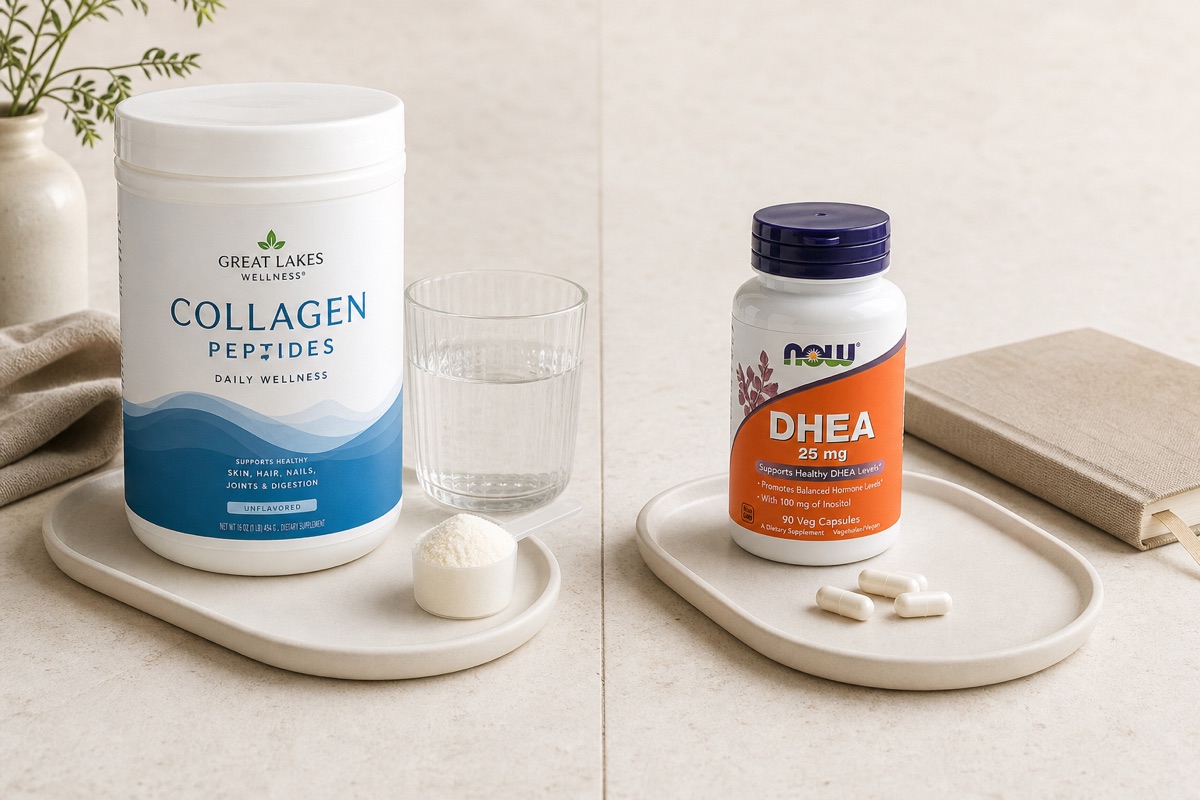
Collagen Peptide Powders vs DHEA Supplements for Fine Lines
Evidence-weighted comparison of collagen peptide powders and DHEA or hormone-balancing supplements for fine lines, dryness, sagging, and hormonal acne concerns.
We analyzed PubMed collagen trials in 69 women ages 35-55 and 114 women ages 45-65, FDA supplement guidance, NIH DHEA safety pages, and 6 Amazon US listings. For fine lines, collagen peptides have stronger beauty-specific evidence; DHEA is more hormone-active and riskier for acne-prone shoppers.
| Criterion | 🏆 Winner Collagen peptide powders Ancient Nutrition, Great Lakes Wellness, and Orgain $29.99 | DHEA and hormone-balancing supplements NOW Supplements, Life Extension, and Nature's Way $18.99 |
|---|---|---|
| Direct fine-line evidence Scores direct human skin-aging evidence highest. Collagen has RCTs in women 35-65; DHEA skin evidence is older-adult and indirect for fine lines. | 8.0/10 | 4.0/10 |
| Perimenopause fit Scores practical fit for US women 35-55 noticing dryness, sagging, fine lines, and acne shifts without implying disease treatment. | 7.6/10 | 4.8/10 |
| Tolerability for hormonal acne Penalizes androgenic adverse-effect potential. NIH sources list acne, oily skin, and unwanted hair growth as DHEA concerns. | 7.4/10 | 3.6/10 |
| Claim clarity Scores categories with clearer cosmetic-support claims higher than broad hormone-balance language that can be hard to verify. | 7.2/10 | 4.2/10 |
| Amazon availability Scores whether US shoppers can find multiple Amazon listings without using banned ASINs or non-Amazon affiliate networks. | 8.0/10 | 7.2/10 |
| Value in USD Uses the analyzed Amazon snapshot where collagen options ranged from $23.88 to $45.01; DHEA capsules are smaller purchases but carry higher clinical-caution costs. | 7.5/10 | 6.2/10 |
| Evidence strength Scores PubMed meta-analysis and RCT support higher than one older DHEA trial plus regulatory and safety cautions. | 8.3/10 | 4.3/10 |
| Overall score | 7.71 | 4.90 |
🏆 Winner: Collagen peptide powders
Collagen peptide powders win for fine lines because PubMed evidence includes 69 women ages 35-55 using 2.5 g or 5 g daily for 8 weeks and 114 women ages 45-65 using 2.5 g daily for 8 weeks, while DHEA's skin evidence is more indirect and older-adult focused. DHEA also carries NIH-listed acne, oily-skin, and unwanted-hair risks, which matter for the requested hormonal-acne concern.
Best on a budget
Orgain Hydrolyzed Collagen Peptides Powder
Best for results
Collagen peptide powders for cosmetic fine-line and elasticity support; clinician-guided DHEA only when a medical professional has a hormone-specific reason
Bottom line for fine lines and perimenopause skin
For fine lines, collagen peptide powders are the better-supported category. That does not mean every tub of collagen will visibly change your skin. It means the ingredient category has more direct human skin-aging evidence than DHEA or broad hormone-balance supplements. Proksch 2014 studied 69 women ages 35-55 using 2.5 g or 5 g collagen peptides daily for 8 weeks and reported improvements in skin elasticity. A second Proksch 2014 trial studied 114 women ages 45-65 using 2.5 g bioactive collagen peptides daily for 8 weeks and measured eye-wrinkle and dermal-matrix endpoints.
DHEA is a different decision. It is not just a beauty powder with a hormone-friendly label. MedlinePlus describes DHEA as a hormone precursor that can convert into androgens and estrogens, and both MedlinePlus and NCCIH list acne, oily skin, or unwanted hair growth as possible side effects. That matters for women 35-55 who are already dealing with hormonal acne, facial hair changes, shedding, or perimenopause-related skin unpredictability.
Our verdict: choose collagen peptides if the main goal is cosmetic support for dryness, elasticity, and fine lines. Treat DHEA as clinician-guided, hormone-active supplementation, not as a first-line wrinkle or acne product. We may earn a commission from Amazon links, but affiliate availability did not influence the scoring.
What collagen peptide powders do better
Collagen powders win because their best evidence is closer to the beauty question. The 2021 Miranda meta-analysis reviewed 19 studies with 1,125 participants and concluded that hydrolyzed collagen supplementation showed favorable results for skin hydration, elasticity, and wrinkles. The strongest phrasing is modest but useful: collagen peptides may support measurable skin hydration or elasticity after consistent daily use, usually over weeks rather than days.
That evidence maps well to perimenopause skin complaints. Many women in this age band are not only asking about one etched forehead line. They are noticing drier cheeks, less bounce around the lower face, and makeup sitting differently by afternoon. Collagen peptides do not replace sunscreen, retinoids, estrogen therapy when appropriate, or procedures. They sit in the supplement lane as a lower-contact option for shoppers who want an oral beauty-support routine.
The three collagen products featured here also avoid the ASINs the pipeline flagged as overused. Great Lakes Wellness Collagen Peptides had the strongest verified Amazon rating-volume snapshot we could cite: 4.6/5 across 37,700 ratings at $29.99 in a May 2026 BeautySift snapshot. Ancient Nutrition Multi Collagen Protein and Orgain Hydrolyzed Collagen Peptides round out the category with different price and formula positions.
Where DHEA and hormone-balance supplements fit
DHEA may have a place, but not the same place. Baulieu 2000, the DHEAge Study, followed 280 adults ages 60-79 taking 50 mg DHEA daily for 1 year and reported some skin-related observations in older adults. That is not the same as proof that a 45-year-old with fine lines and hormonal acne should buy DHEA from Amazon. The population was older, the dose was hormone-active, and the study question was broader than cosmetic perimenopause skin.
The bigger issue is tolerability. DHEA can influence androgen and estrogen pathways. Chen 2002 reviewed cutaneous androgen metabolism and explains why androgen-responsive skin is relevant to sebum and acne biology. If your chin breaks out before your period, if you have PCOS, if facial hair is increasing, or if hair shedding is part of the concern, DHEA deserves more caution than collagen.
DIM supplements, such as Nature’s Way DIM-plus, are often marketed around estrogen metabolism rather than DHEA replacement. That still does not make them fine-line supplements. In this comparison, DIM is included because shoppers often see it in the same hormone-balance aisle. It scored lower for direct fine-line evidence because the PubMed skin-aging data we found support collagen peptides, not DIM for wrinkles.
Scorecard: why collagen wins
The biggest spread was direct fine-line evidence: collagen scored 8.0 and DHEA or hormone-balance supplements scored 4.0. That score reflects source fit. Collagen has human skin trials in women whose ages overlap the BeautySift audience. DHEA has older-adult skin observations and safety monographs, but less direct evidence for midlife fine-line improvement.
Tolerability for hormonal acne created the second major gap. Collagen scored 7.4 because it is not androgenic, though it can still cause digestive upset, allergy problems, or protein-diet conflicts. DHEA scored 3.6 because NIH consumer sources specifically warn about acne, oily skin, and unwanted hair growth. Those are not fringe side effects when the article’s required concerns include hormonal acne.
Value was closer. Collagen powders can look more expensive at checkout because tubs are larger. Orgain’s Amazon snapshot was $23.88, Great Lakes was $29.99, and Ancient Nutrition was $45.01. DHEA capsules are often lower-ticket purchases, but a cheap hormone-active supplement is not automatically good value if it worsens breakouts or needs clinician monitoring.
Amazon rating volume and product fit
Amazon rating volume helps answer practical questions: does the powder mix, is the tub annoying, do capsules feel easy to swallow, and are shoppers repurchasing? It does not prove skin efficacy. In the data we could verify from BeautySift’s Amazon snapshots, Great Lakes Wellness Collagen Peptides had 37,700 ratings with a 4.6/5 average. Ancient Nutrition and Orgain were included because their ASINs, prices, images, and Amazon URLs were already verified in the BeautySift collagen supplement audit.
For DHEA, we kept the Amazon discussion narrower. NOW Supplements DHEA 25 mg and Life Extension DHEA 25 mg are real Amazon US listings, but rating volume is not the deciding metric for a hormone precursor. A high review count would not erase the need to screen for acne history, medication interactions, hormone-sensitive conditions, pregnancy, breastfeeding, abnormal bleeding, or current hormone therapy.
This is also why the winner is a category, not a single tub. If you want the safest comparison answer for fine lines, collagen peptides are more appropriate. If you have a hormone-specific reason to consider DHEA, the next step is a clinician conversation, not a beauty ranking.
Safety notes for women 35-55
The FDA explains that dietary supplements are not approved for safety and effectiveness before marketing. That applies to collagen, DHEA, DIM, and blends with names like hormone balance, menopause support, adrenal support, or estrogen metabolism. Structure/function claims can sound scientific, but FDA guidance requires a disclaimer because those claims are not disease-treatment approvals.
Collagen precautions are mostly practical. Skip or ask a clinician first if you have kidney disease, protein restrictions, allergies to the source material, a history of supplement reactions, pregnancy considerations, or a medically complex diet. Also remember that the skin studies used specific collagen ingredients and doses; the study result does not automatically transfer to every flavored powder.
DHEA precautions are more serious. Ask a clinician before use if you have hormonal acne, PCOS, hair loss, unwanted facial hair, fibroids, endometriosis, abnormal bleeding, breast cancer history, ovarian or uterine cancer history, high blood pressure, mood instability, or use of hormone therapy. If acne flares, oiliness increases, or hair-growth patterns change, stop and reassess.
Who should choose collagen peptides
Choose collagen peptides if your main concerns are fine lines, dryness, and early sagging, and you want an oral supplement with more direct skin-aging evidence than DHEA. Great Lakes Wellness is the most data-supported pick in this article because the Amazon snapshot included 37,700 visible ratings and a $29.99 price. Orgain is the budget pick from the verified collagen set at $23.88. Ancient Nutrition is the broader multi-collagen option at $45.01.
Skip collagen if you expect it to work like retinoids, fillers, lasers, or prescription hormone therapy. The PubMed signal is measured and gradual. Eight weeks is a more realistic judgment window than two weeks, and even then the best outcome is support, not reversal.
Who should consider DHEA or DIM
Consider DHEA only if a clinician has a hormone-specific reason and has reviewed your risk factors. NOW Supplements DHEA 25 mg and Life Extension DHEA 25 mg are included because they are real Amazon US options, but their presence in the article is not a recommendation for casual fine-line use. DHEA belongs in a medical-context conversation.
DIM is a softer-looking category because it is often framed around estrogen metabolism instead of direct hormone replacement. Still, Nature’s Way DIM-plus did not score well for fine lines because the beauty-specific evidence is not comparable to collagen peptide trials. If your priority is hormonal acne, evidence-backed topical acne care and a dermatologist or gynecologist discussion are more appropriate than guessing at hormone-balance supplements.
BeautySift verdict
Collagen peptide powders beat DHEA and hormone-balance supplements for fine lines because the evidence is more direct, the claims are easier to interpret, and the acne-related downside is lower. DHEA may be biologically powerful, but that is exactly why it is not the cleaner beauty answer. For a US shopper in her late 30s, 40s, or early 50s who wants support for dryness, sagging, and fine lines without aggravating hormonal acne, collagen peptides are the more reasonable first comparison choice.
If the skin concern feels hormonal rather than cosmetic, do not try to solve it by stacking supplements. Perimenopause acne, abnormal bleeding, sudden hair shedding, new facial hair, or rapid skin changes deserve a medical workup. Supplements can support a routine, but they should not replace diagnosis.
Related reading
Both winners on Amazon

Great Lakes Wellness
Great Lakes Wellness Collagen Peptides Powder
$29.99
"Classic unflavored collagen peptide powder; Amazon snapshot showed 4.6/5 across 37,700 ratings and the strongest verified rating-volume data among the uncapped collagen options used here."

Ancient Nutrition
Ancient Nutrition Multi Collagen Protein
$45.01
"Multi-source collagen powder with vitamin C and probiotics; useful for shoppers who want a broader collagen-type blend and can tolerate a higher price per tub."

Orgain
Orgain Hydrolyzed Collagen Peptides Powder
$23.88
"Lower-price grass-fed type I and III collagen peptide powder for shoppers who want to test the collagen category before buying a larger tub."

NOW Supplements
NOW Supplements DHEA 25 mg
$18.99
"Straightforward 25 mg DHEA format for shoppers whose clinician specifically recommends DHEA; not a casual fine-line or acne supplement."

Life Extension
Life Extension DHEA 25 mg
$16.50
"Another 25 mg DHEA option for hormone-specific, clinician-directed use; lower evidence fit for fine lines than collagen peptides."
Nature's Way
Nature's Way DIM-plus
$22.99
"Hormone-balance-positioned DIM supplement included as a non-DHEA comparison point; evidence for fine lines is weaker than collagen peptide skin-aging trials."