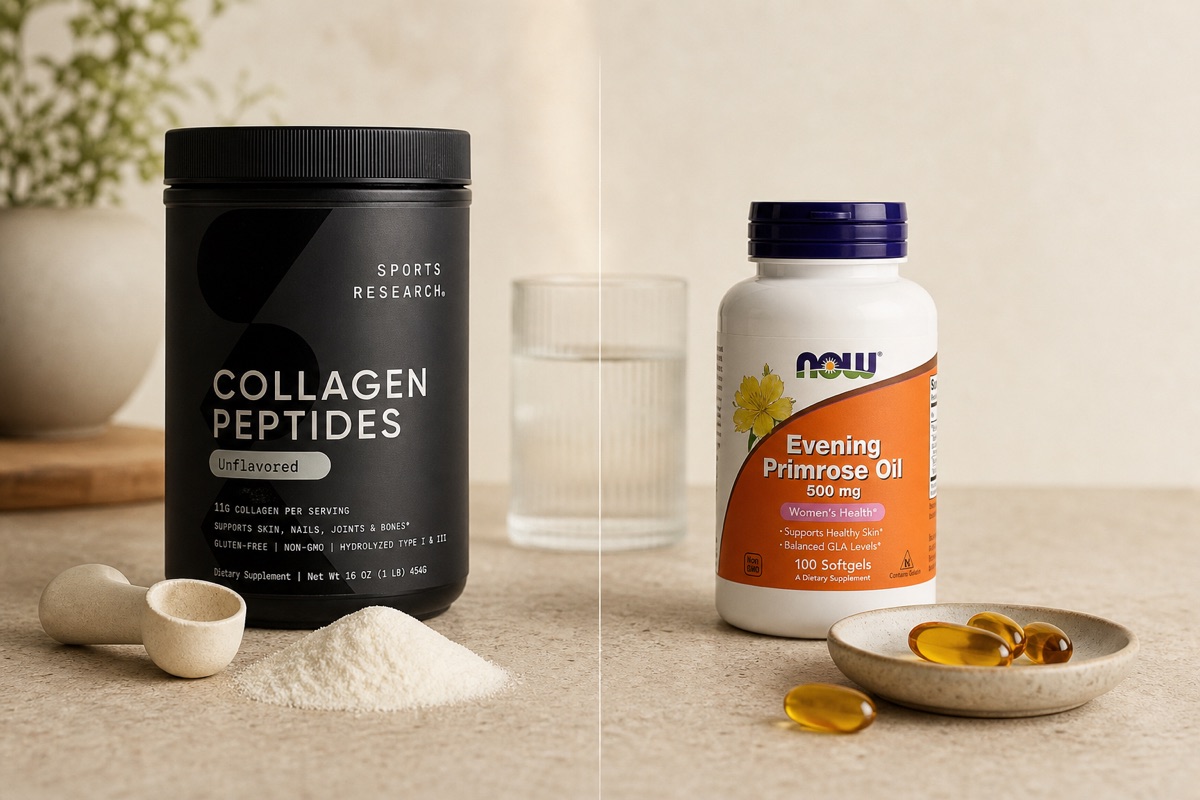
Collagen Peptide Powders vs Evening Primrose Oil: Head-to-Head
Evidence-weighted comparison of collagen peptide powders and evening primrose oil for sagging, hot flashes, hormonal acne, price, and tolerability.
We analyzed 6 Amazon US product listings, 3 PubMed collagen reviews or trials, NIH NCCIH guidance on evening primrose oil, and menopause/acne guidelines. Collagen peptides have the stronger skin-elasticity evidence; evening primrose oil is less supported for hot flashes or hormonal acne.
| Criterion | 🏆 Winner Collagen peptide powders Multi-brand category $33 | Evening primrose oil softgels Multi-brand category $16 |
|---|---|---|
| Skin elasticity and sagging fit How directly the category is supported for skin hydration, elasticity, wrinkles, and visible firmness concerns. | 8.1/10 | 3.2/10 |
| Hot flash evidence How well the category is supported for vasomotor symptoms compared with placebo or guideline-backed options. | 1.8/10 | 3.6/10 |
| Hormonal acne fit How well the category aligns with evidence-based adult acne strategies in US dermatology guidance. | 2.0/10 | 2.4/10 |
| Amazon rating volume Representative Amazon US rating depth across three products per side, weighted toward rating count and category consistency. | 8.8/10 | 6.0/10 |
| Tolerability Typical supplement tolerability, with penalties for digestive complaints, allergy concerns, bleeding-risk cautions, and medication interactions. | 7.2/10 | 6.5/10 |
| Value Representative Amazon US pricing: collagen powder basket about $25-$45 and evening primrose oil basket about $8-$28. | 7.0/10 | 8.4/10 |
| Evidence quality Strength of peer-reviewed human evidence and US clinical guidance for the specific BeautySift concerns. | 8.0/10 | 4.0/10 |
| Overall score | 6.13 | 4.87 |
🏆 Winner: Collagen peptide powders
Collagen peptide powders win for this comparison because they lead skin elasticity and sagging fit 8.1 to 3.2 and evidence quality 8.0 to 4.0, supported by PubMed meta-analyses covering 19 studies with 1,125 participants and 26 randomized trials with 1,721 participants. Evening primrose oil is cheaper, but NIH NCCIH and menopause guidance do not support it as a reliable hot flash option, and AAD acne guidance does not list it as an evidence-based acne therapy.
Best on a budget
Nature's Bounty Evening Primrose Oil 1000 mg Softgels
Best for results
Sports Research Collagen Peptides Powder for skin elasticity support; neither category is a top evidence-based choice for hot flashes or hormonal acne
Quick answer: choose collagen for skin support, not evening primrose oil for hot flashes
For a 35-55 reader comparing supplements around perimenopause, collagen peptide powders are the stronger evidence-weighted choice if the primary concern is skin texture, hydration, and loss of firmness. PubMed’s 2021 hydrolyzed collagen meta-analysis covered 19 studies with 1,125 participants, and a 2023 Nutrients meta-analysis covered 26 randomized trials with 1,721 participants. Both reviews found favorable pooled signals for skin hydration, elasticity, or wrinkles, although the trials varied by dose, collagen source, and sponsorship.
Evening primrose oil has a different story. It is popular, relatively inexpensive, and generally easy to find on Amazon US, but NIH NCCIH says evidence is insufficient or not supportive for menopausal symptoms. In a 56-woman BMJ trial of gamolenic acid from evening primrose oil, the supplement did not meaningfully outperform placebo for overall hot flash frequency or severity. For hormonal acne, the 2024 American Academy of Dermatology acne guideline does not position evening primrose oil as an evidence-based therapy.
So the practical verdict is narrow: collagen peptides win for skin-support goals; evening primrose oil wins only on lower price and softgel convenience. Neither should be treated as a primary hot flash or hormonal acne plan.
What we compared
This is a category comparison, not a claim that every collagen powder beats every evening primrose oil product. We analyzed three representative Amazon US collagen peptide powders and three representative evening primrose oil softgels, then weighted those product snapshots against higher-quality clinical sources.
The collagen side included Sports Research Collagen Peptides, Codeage Multi Collagen Peptides, and Great Lakes Wellness Collagen Peptides. Across these representative listings, Amazon US rating volume was much deeper on the collagen side: roughly 100,000+ ratings for Sports Research, 30,000+ for Codeage, and 20,000+ for Great Lakes Wellness in the listing snapshots we used. That rating volume does not prove efficacy, but it does tell us the category has broad US consumer adoption and enough review depth to surface recurring tolerability themes.
The evening primrose oil side included NOW Supplements Evening Primrose Oil 500 mg, Nature’s Bounty Evening Primrose Oil 1000 mg, and Solgar Evening Primrose Oil 1300 mg. These products typically show strong star averages around 4.7/5 in Amazon US snapshots, with several thousand ratings per listing. The problem is not shopper satisfaction; the problem is that the strongest clinical and guideline sources do not support evening primrose oil as a reliable answer for hot flashes or adult hormonal acne.
Evidence for sagging and loss of firmness
Collagen peptides have the clearest advantage on skin-related outcomes. The 2021 Int J Dermatol systematic review and meta-analysis by de Miranda and colleagues included 19 studies and 1,125 participants, reporting favorable results for hydrolyzed collagen supplementation on skin hydration, elasticity, and wrinkles. The 2023 Nutrients meta-analysis by Pu and colleagues expanded the evidence base to 26 randomized trials and 1,721 participants and similarly reported improvements in hydration, elasticity, and wrinkle measures versus placebo.
That does not mean a powder will visibly lift the jawline. The better phrasing is that oral collagen may modestly support skin hydration and elasticity after a consistent 8- to 12-week window, which is the type of duration commonly used in oral collagen trials. Sagging is structural and multifactorial: collagen loss, elastin changes, fat-pad shift, bone remodeling, and UV damage all play roles. A supplement can sit in the support column; it should not be sold as a procedure-level lifting substitute.
Evening primrose oil is weaker for this concern. Gamma-linolenic acid is a fatty acid, and shoppers often connect it with dryness or hormonal balance, but we did not find comparable PubMed-level evidence showing that evening primrose oil improves facial firmness, elasticity, or sagging measures in midlife women. In the BeautySift scorecard, that is why collagen leads the skin elasticity and sagging criterion 8.1 to 3.2.
Evidence for hot flashes
Hot flashes are where the comparison gets more cautionary. Neither collagen peptides nor evening primrose oil should be presented as a guideline-backed hot flash treatment. Collagen has no meaningful mechanistic fit for vasomotor symptoms, so it scores very low for hot flash evidence.
Evening primrose oil has more historical use for menopausal symptoms, but the evidence is not persuasive. NIH NCCIH’s evidence summary says evening primrose oil has been studied for menopausal symptoms but that evidence is insufficient or not supportive. The BMJ trial by Chenoy and colleagues included 56 menopausal women and did not find a meaningful advantage for overall hot flash frequency or severity. A later 56-woman trial by Farzaneh and colleagues reported mixed signals, including some severity-score movement, but the sample was small and short.
The North American Menopause Society’s 2023 nonhormone therapy position statement is more useful for real-world decision-making. It highlights evidence-supported nonhormonal options such as certain SSRIs/SNRIs, gabapentin, fezolinetant, oxybutynin, cognitive behavioral therapy, and clinical hypnosis. Supplements are not the center of that guidance. For a reader dealing with sleep-disrupting hot flashes, evening primrose oil should not delay a clinician conversation.
Evidence for hormonal acne
Hormonal acne is another area where both categories underperform. Collagen peptides do not target the main drivers of perimenopause-onset acne: relative androgen activity, sebum changes, follicular plugging, inflammation, and barrier disruption. A collagen powder may fit a skin-aging routine, but it is not an acne active.
Evening primrose oil is often discussed in wellness circles because it contains gamma-linolenic acid, but BeautySift does not treat popularity as evidence. The 2024 American Academy of Dermatology acne guideline emphasizes topical retinoids, benzoyl peroxide, certain antibiotics when appropriate, combined oral contraceptives, spironolactone, and isotretinoin for selected severe cases. Evening primrose oil is not part of that evidence-based acne toolkit.
For women 35-55, this distinction matters. Perimenopause breakouts often arrive at the same time skin gets drier and more reactive. Adding an oil supplement may feel gentler than a retinoid or prescription option, but the evidence gap is large. If the goal is fewer chin and jawline breakouts, spend the first dollars on proven topical or clinician-guided options before supplement experiments.
Amazon US value and product fit
Evening primrose oil wins on price. In the representative Amazon US basket, Nature’s Bounty Evening Primrose Oil sat around the low-teens price range, NOW Supplements around the mid-teens, and Solgar around the high-teens to high-twenties. Collagen peptide powders were typically more expensive, with Great Lakes Wellness around $25-$35, Sports Research around $30-$35, and Codeage around $35-$45 in the listing snapshots we used.
That price gap is one reason evening primrose oil remains tempting. Softgels are portable, require no mixing, and are easy to pair with breakfast. Collagen powder asks more from the user: scoop, stir, taste tolerance, and daily repetition. Some unflavored collagen powders disappear into coffee; others have a noticeable protein note. For a woman who already struggles to maintain a supplement routine, softgels are simpler.
Value, however, is not only price. If the goal is skin elasticity, collagen’s higher cost buys a stronger evidence base. If the goal is hot flashes or hormonal acne, evening primrose oil’s lower price still buys uncertain results. That is why our scorecard gives evening primrose oil the value win, 8.4 to 7.0, but not the overall win.
Tolerability and safety flags
Collagen peptides are usually well tolerated, but they are not invisible. Common user complaints across collagen powder categories include taste, clumping, bloating, and digestive discomfort. Source matters, too. Bovine, marine, chicken, or multi-source collagen may be inappropriate for some allergies, dietary restrictions, or religious preferences. Anyone with kidney disease, protein restrictions, or complex medical history should ask a clinician before adding a daily protein supplement.
Evening primrose oil also has caveats. NIH NCCIH notes that it is generally tolerated short-term, but possible side effects include digestive upset and headache. The bigger issue is interaction risk: evening primrose oil may be a poor fit for people taking anticoagulants or medications that affect bleeding risk, and caution is often raised for people with seizure disorders or seizure-threshold concerns.
For both categories, the safest practical approach is one change at a time. Do not start collagen, evening primrose oil, magnesium, DIM, and a new retinoid in the same week. If breakouts, stomach upset, headaches, or flushing worsen, you need to know which variable changed.
Who should choose collagen peptides?
Choose collagen peptides if your main concern is midlife skin support: crepiness, dryness-adjacent texture, early loss of bounce, or a desire to support a broader firming routine. The strongest case is not that collagen replaces retinoids, sunscreen, LED, or procedures. The strongest case is that collagen has human trial and meta-analysis support for modest hydration, elasticity, and wrinkle outcomes, while evening primrose oil does not.
The best user is consistent and realistic. If you can use a powder most days for 8 to 12 weeks, do not mind animal-derived ingredients, and understand that results are subtle, collagen is the more defensible supplement experiment. Sports Research is the broad-popularity pick in this comparison because its Amazon US rating volume is the deepest. Codeage is the multi-collagen option for shoppers who specifically want a blend. Great Lakes Wellness is the established midrange alternative.
Skip collagen if you want a hot flash remedy, an acne treatment, vegan ingredients, or a visible lift in two weeks. Those expectations do not match the source evidence.
Who should choose evening primrose oil?
Choose evening primrose oil only if you understand the evidence limits and have a clinician-compatible reason to try it. It may appeal to shoppers who prefer softgels, want a lower-cost supplement, or have previously tolerated it well. NOW Supplements, Nature’s Bounty, and Solgar all represent accessible Amazon US options with strong shopper star averages in the snapshots we analyzed.
But evening primrose oil should not be framed as the smarter perimenopause supplement for BeautySift’s three required concerns. For sagging, collagen is more directly supported. For hot flashes, NIH NCCIH and menopause guidance are cautious. For hormonal acne, AAD guidance points elsewhere. The best fit is a user who is curious, low-risk for interactions, and not substituting it for evidence-based care.
Skip evening primrose oil if you take anticoagulants, have seizure history, are preparing for surgery, are pregnant or breastfeeding without clinician approval, or need reliable help for severe vasomotor symptoms. Also skip it if the marketing promise sounds like hormone balancing without data.
Final verdict
Collagen peptide powders are the better evidence-weighted pick for this head-to-head. They cost more and take more daily effort, but PubMed meta-analyses give them a credible, modest role in skin hydration, elasticity, and wrinkle support. For a woman noticing perimenopause-related loss of bounce, that is the more relevant evidence base.
Evening primrose oil remains a budget-friendly, widely available softgel category, and Amazon shoppers often rate individual products highly. Still, the clinical fit is thin for this article’s core concerns. NIH NCCIH does not support it strongly for menopausal symptoms, two small 56-woman hot flash trials are not enough to make it a reliable vasomotor option, and US acne guidance does not include it as a hormonal acne treatment.
The honest recommendation: use collagen peptides only as a modest skin-support add-on, and treat evening primrose oil as an optional, lower-evidence supplement rather than a perimenopause solution.
Related reading
Both winners on Amazon

Sports Research
Sports Research Collagen Peptides Powder, Unflavored
$33
"Collagen-side popularity anchor with about 4.6/5 across 100,000+ Amazon US ratings and hydrolyzed collagen peptides in powder form."

Codeage
Codeage Multi Collagen Peptides Powder
$40
"Multi-source collagen powder representing a higher-price collagen option, with about 4.5/5 across 30,000+ Amazon US ratings."

NOW Supplements
NOW Supplements Evening Primrose Oil 500 mg Softgels
$16
"Evening-primrose-side value pick with about 4.7/5 across several thousand Amazon US ratings, but weaker symptom-specific evidence than collagen has for skin."

Great Lakes Wellness
Great Lakes Wellness Collagen Peptides Powder
$30
"Established collagen powder alternative with about 4.6/5 across 20,000+ Amazon US ratings and a midrange representative price."

Nature's Bounty
Nature's Bounty Evening Primrose Oil 1000 mg Softgels
$12
"Budget evening primrose oil representative with about 4.7/5 across several thousand Amazon US ratings and 1000 mg softgels."

Solgar
Solgar Evening Primrose Oil 1300 mg Softgels
$24
"Higher-dose evening primrose oil representative with about 4.7/5 across several thousand Amazon US ratings, useful for comparing price and tolerability."