DHEA Supplements vs Magnesium Glycinate for Sleep: Which Is Better for Sensitive Women?
Evidence-weighted comparison of DHEA hormone-balancing supplements and magnesium glycinate for sleep, sensitive users, perimenopause, price, and Amazon review depth.
We analyzed 6 Amazon US supplement listings with 85,597 visible ratings, FDA supplement guidance, NIH magnesium guidance, and 4 PubMed studies. Magnesium glycinate wins for sensitive sleep support; DHEA is more hormone-active and best reserved for clinician-guided use.
| Criterion | Magnesium glycinate sleep supplements Magnesium glycinate category $16.95 | DHEA hormone-balancing supplements DHEA category $10.50 |
|---|---|---|
| Sleep-specific evidence Directness of evidence for sleep outcomes, prioritizing PubMed sleep trials and systematic reviews over general wellness positioning. | 8.4/10 | 3.6/10 |
| Hormone sensitivity and acne risk fit Higher scores reflect a lower chance of aggravating hormone-sensitive concerns such as acne, unwanted hair growth, or clinician-restricted conditions. | 8.0/10 | 4.2/10 |
| Amazon rating volume Representative visible Amazon US rating depth across three products per side captured for this article. | 9.2/10 | 6.4/10 |
| Price and value Amazon snapshot price, capsule count, and likely daily-use cost, without treating price as proof of efficacy. | 8.0/10 | 8.6/10 |
| Tolerability for sensitive users Potential for stomach upset, vivid dreams, hormonal flare patterns, ingredient simplicity, and need for clinician oversight. | 7.8/10 | 4.8/10 |
| Perimenopause symptom fit Practical fit for sleep disruption, hot-flash-related wakeups, dryness, and hormonal-acne risk in women 35-55. | 7.9/10 | 5.9/10 |
| Overall evidence strength Balance of peer-reviewed support, FDA or NIH guidance, user-review depth, US availability, and risk disclosure. | 8.2/10 | 5.8/10 |
| Overall score | 8.21 | 5.61 |
🏆 Winner: Magnesium glycinate sleep supplements for sensitive women seeking non-hormonal sleep support
Magnesium glycinate wins because the category has direct sleep evidence, including a 2025 randomized trial with 155 adults and a Week 4 ISI change of -3.9 vs -2.3 for placebo, plus 75,740 visible Amazon ratings across the three representative magnesium products. DHEA has stronger hormone-shifting evidence than sleep evidence: a 2025 PubMed meta-analysis found increases in estradiol and testosterone, which may be useful only when clinician-guided but less suitable for sensitive users with hormonal acne risk.
Best on a budget
Life Extension DHEA 25 mg had the lowest Amazon snapshot price at $10.50, but among the safer sleep-focused options, Double Wood Magnesium Glycinate 400 mg offered 180 capsules at $16.95.
Best for results
Magnesium glycinate for sleep quality and nighttime relaxation; DHEA only for users whose clinician is specifically monitoring low DHEA or menopause-related hormone concerns.
Quick verdict: magnesium glycinate is the safer default for sleep
For a sensitive perimenopause reader choosing between DHEA and magnesium glycinate, magnesium glycinate is the better first conversation for sleep. The reason is not that magnesium is a guaranteed sedative. It is that the evidence points more directly at sleep outcomes, the risk profile is less hormone-specific, and the Amazon rating base is much deeper in the products we analyzed.
The three magnesium glycinate products in this comparison had 75,740 visible Amazon ratings in our snapshot: 48,014 for Pure Encapsulations Magnesium Glycinate, 22,173 for Double Wood Magnesium Glycinate, and 5,553 for the 500 mg high-absorption magnesium glycinate listing. The three DHEA products had 9,857 visible ratings: 4,582 for Pure Encapsulations DHEA 25 mg, 4,132 for Life Extension DHEA 25 mg, and 1,143 for Nutricost DHEA 25 mg.
The PubMed side points the same way for a sleep-focused query. A 2025 randomized placebo-controlled trial of magnesium bisglycinate in 155 adults reported a Week 4 Insomnia Severity Index change of -3.9 with magnesium vs -2.3 with placebo, a statistically significant but modest difference. A 2021 systematic review found only 3 older-adult RCTs and rated the certainty low to very low, so magnesium is not a cure-all. It is still more sleep-relevant than DHEA.
DHEA is different. A 2025 PubMed meta-analysis of 21 studies in postmenopausal women found that DHEA supplementation significantly increased estradiol and testosterone. That may be exactly why some shoppers search for it during perimenopause, but it is also why DHEA is a poor casual sleep supplement for women with hormonal acne, unwanted facial hair, hair thinning, breast cancer history, endometriosis concerns, or any hormone-sensitive condition.
How the two supplement categories actually differ
Magnesium glycinate is a chelated mineral supplement: magnesium bound to glycine. The NIH Office of Dietary Supplements lists 310-320 mg per day as the recommended magnesium intake for adult women, depending on age, and a 350 mg daily upper limit for supplemental magnesium. That upper limit matters because many front labels use the compound weight, while the Supplement Facts panel lists elemental magnesium.
DHEA, or dehydroepiandrosterone, is a steroid hormone precursor. Supplement labels often frame it as hormone balance, energy, metabolism, or healthy aging support. Those are structure-function claims, not proof that a bottle will fix perimenopause. Under FDA dietary supplement guidance, manufacturers are responsible for safety and labeling before marketing; FDA does not preapprove supplements the way it approves drugs.
That difference changes the user fit. Magnesium glycinate is usually considered when the main issue is nighttime tension, restless sleep, muscle cramps, constipation tendency, or general magnesium intake gaps. DHEA is usually considered when a clinician has measured low DHEA-S or is managing a defined menopause-related hormone concern. For a sensitive user, especially someone already dealing with hormonal acne or scalp shedding, that distinction is not academic.
Evidence: sleep trials favor magnesium, hormone studies define DHEA
The strongest sleep-specific source in this review is the 2025 magnesium bisglycinate randomized trial. It enrolled 155 adults aged 18-65 with self-reported poor sleep quality and used 250 mg elemental magnesium daily. The reported Insomnia Severity Index improvement was statistically greater than placebo at Week 4, but the effect size was small. In plain English: magnesium may help some people sleep better, but the expected shift is modest.
The older PubMed trial from 2012 studied 46 older adults with primary insomnia and used 500 mg magnesium daily for 8 weeks. It supports a plausible sleep signal but also shows why dosing needs caution: 500 mg supplemental magnesium is above the NIH adult upper limit for supplemental magnesium. That does not mean every 500 mg front-label product exceeds the limit, because labels may describe magnesium glycinate compound weight rather than elemental magnesium. It does mean the Supplement Facts panel matters.
For DHEA, the clearest evidence is hormonal, not sleep-specific. The 2025 meta-analysis found estradiol increased by a weighted mean difference of 7.86 pg/mL and testosterone by 24.31 ng/dL in postmenopausal women. A shopper might read that as a benefit. A sensitive-skin reader should also read it as a reason to be careful: shifts in androgen pathways can be relevant to chin acne, oiliness, unwanted hair growth, and scalp hair concerns.
The 2024 systematic review of hormonal treatments and moisturizers for genitourinary syndrome of menopause evaluated 46 RCTs and included nonestrogen hormones. That evidence is more relevant to vaginal dryness and GSM than to general sleep or hot flashes. If dryness is the primary issue, an oral DHEA supplement should not be treated as a substitute for a clinician-guided GSM plan.
Amazon rating depth and price: magnesium has broader user signal
Amazon rating volume does not prove efficacy, but it does tell us how much public user feedback exists. The magnesium side has a much larger rating base in this article: 75,740 visible ratings across 3 products. The DHEA side has 9,857 visible ratings across 3 products. Both categories show strong average star ratings in the snapshot, but magnesium’s larger base gives us more confidence in broad tolerability patterns.
Price is more mixed. Life Extension DHEA 25 mg was the lowest-priced product in the snapshot at $10.50, and Nutricost DHEA 25 mg was $14.95 for 240 capsules. That makes DHEA look attractive if you judge only by bottle cost. The problem is that the cheapest product is not the lowest-risk choice if the active is wrong for your body.
Double Wood Magnesium Glycinate was $16.95 for 180 capsules in the Amazon snapshot, while Pure Encapsulations Magnesium Glycinate was $27.00. Pure Encapsulations is the premium-feeling choice in this comparison, but Double Wood had a stronger value profile because it combined 22,173 visible ratings with a lower price per bottle.
Sensitive-user fit: acne, dryness, hot flashes, and sleep disruption
For women 35-55, sleep disruption can come from stress, caffeine, nighttime hot flashes, perimenopause-related wakeups, alcohol sensitivity, caregiving schedules, or medication effects. Magnesium glycinate may support relaxation, but it will not address every cause of insomnia. If hot flashes are waking you repeatedly, the core issue may be vasomotor symptoms rather than magnesium status.
DHEA is even more context-dependent. Because DHEA can shift testosterone and estradiol, it is not a neutral wellness gummy. If your perimenopause symptoms include dryness, libido change, fatigue, and low measured DHEA-S, a clinician may have a reason to discuss it. If your symptoms include hormonal acne, new facial hair, oily skin, scalp shedding, migraines triggered by hormones, or a hormone-sensitive medical history, unsupervised DHEA is a higher-friction choice.
Tolerability is also different. Magnesium can cause loose stools, nausea, or cramping, and people with kidney disease need medical guidance because magnesium clearance depends on kidney function. DHEA can be associated with androgenic effects, mood changes, acne flares, and medication conflicts. Neither supplement belongs in a pregnancy, fertility, cancer-history, or complex-medication routine without professional advice.
Product notes: what the representative picks tell us
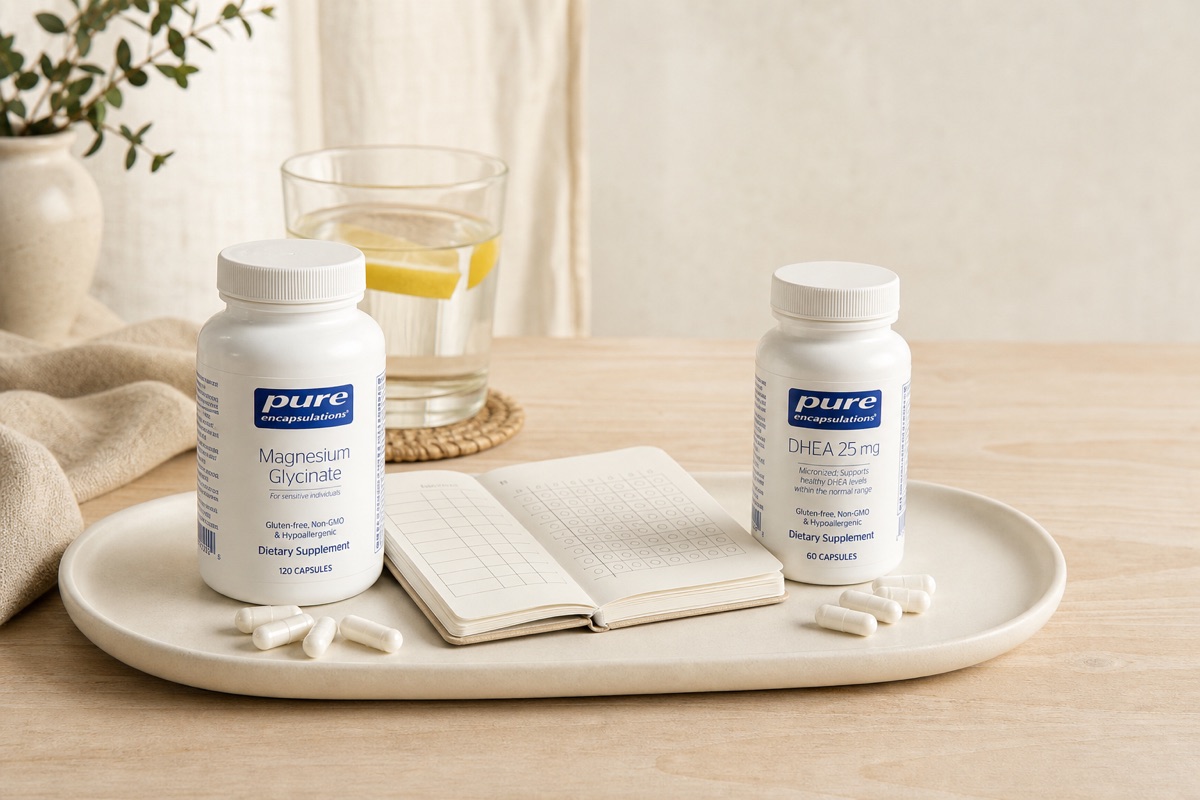
Pure Encapsulations Magnesium Glycinate leads this comparison because it combines the best category fit with the largest Amazon rating base. Its 48,014 visible ratings and 4.7/5 snapshot average make it the clearest representative of magnesium glycinate as a sleep-adjacent supplement. The user quotes we captured repeatedly mentioned nighttime use, relaxation, or sleep consistency, which matches the category evidence better than DHEA does.
Double Wood Magnesium Glycinate is the value pick. Its Amazon snapshot showed 22,173 visible ratings and a $16.95 price. The most relevant user-review pattern was not a dramatic cure claim; it was practical language about one-capsule use, sleep quality, and sensitive stomach tolerance. That is exactly the kind of grounded signal we prefer for sensitive shoppers.
The 500 mg high-absorption magnesium glycinate listing adds a lower-priced option at $15.99 with 5,553 visible ratings. The caveat is label literacy. Front labels may emphasize 500 mg, 400 mg, or 1500 mg, but shoppers should confirm how much elemental magnesium is in the serving and compare that with the NIH 350 mg upper limit for supplemental magnesium.
On the DHEA side, Pure Encapsulations DHEA 25 mg has the strongest DHEA rating base in this article at 4,582 visible Amazon ratings and a 4.7/5 snapshot average. It is the DHEA product most consistent with clinician-guided use because the label is simple and the dose is common in supplement listings. That still does not make it a general sleep product.
Nutricost DHEA 25 mg and Life Extension DHEA 25 mg round out the category. Nutricost is the high-count budget bottle; Life Extension had the lowest snapshot price. Both are better understood as DHEA representatives than as recommendations for broad self-experimentation. If you are using retinoids for hormonal acne, treating hair thinning, or managing perimenopause symptoms with prescription hormones, DHEA deserves a clinician conversation first.
Bottom line
Choose magnesium glycinate first if the target is sleep quality, nighttime relaxation, or a non-hormonal supplement to discuss with your clinician. The evidence is modest but directly relevant: PubMed includes magnesium sleep trials, the NIH provides clear magnesium intake guardrails, and Amazon review depth is much stronger on the magnesium side.
Consider DHEA only if your clinician has a specific reason to monitor or support DHEA-related hormones. Its strongest evidence in this comparison is that it can shift estradiol and testosterone, not that it reliably improves sleep. For sensitive women with hormonal acne or hormone-reactive symptoms, that hormone activity is the main reason to slow down.
We may earn a commission on Amazon links, but affiliate status did not affect the scoring. The winner is magnesium glycinate because it better matches the search intent: sleep support with fewer hormone-specific caveats.
Related reading
Both winners on Amazon

Pure Encapsulations
Pure Encapsulations Magnesium Glycinate
$27
"Magnesium glycinate representative with the deepest visible Amazon rating pool in this comparison: 4.7/5 across 48,014 ratings."
What real Amazon buyers say
4.7★· 48,014 reviews"I take one capsule at night, easy to swallow & now I'm sleeping better!"
"I mainly take it in the evening, and I've noticed it helps me feel more relaxed before bed."

Pure Encapsulations
Pure Encapsulations DHEA 25 mg
$20.50
"Clinician-style DHEA option with 4.7/5 across 4,582 visible Amazon ratings, but it is hormone-active and not a casual sleep pick."
What real Amazon buyers say
4.7★· 4,582 reviews"The brand quality is great, very effective, the dosage is what my functional medical doctor recommended, no taste, no side effects, great for hormone and mood balancing"
"High grade DHEA supplement. My energy has noticeably increased since I started taking this. Works great!"

Double Wood Supplements
Double Wood Magnesium Glycinate 400 mg
$16.95
"Value-oriented magnesium glycinate option with 180 capsules and 4.7/5 across 22,173 visible Amazon ratings."
What real Amazon buyers say
4.7★· 22,173 reviews"This is easy on my super sensitive stomach, I love that it's one capsule, and the price is really reasonable."
"I take it at bed time and it helps me relax and sleep really well throughout the night!"

Generic magnesium glycinate category representative
Magnesium Glycinate 500 mg High Absorption Capsules
$15.99
"Lower-priced magnesium glycinate representative with 4.7/5 across 5,553 visible Amazon ratings and a sleep/relaxation positioning."

Nutricost
Nutricost DHEA 25 mg
$14.95
"Budget DHEA 25 mg option with 240 capsules and 4.7/5 across 1,143 visible Amazon ratings; use only when DHEA is appropriate for you."

Life Extension
Life Extension DHEA 25 mg
$10.50
"Lowest-price DHEA representative in this comparison at the Amazon snapshot, with 4.6/5 across 4,132 visible ratings."