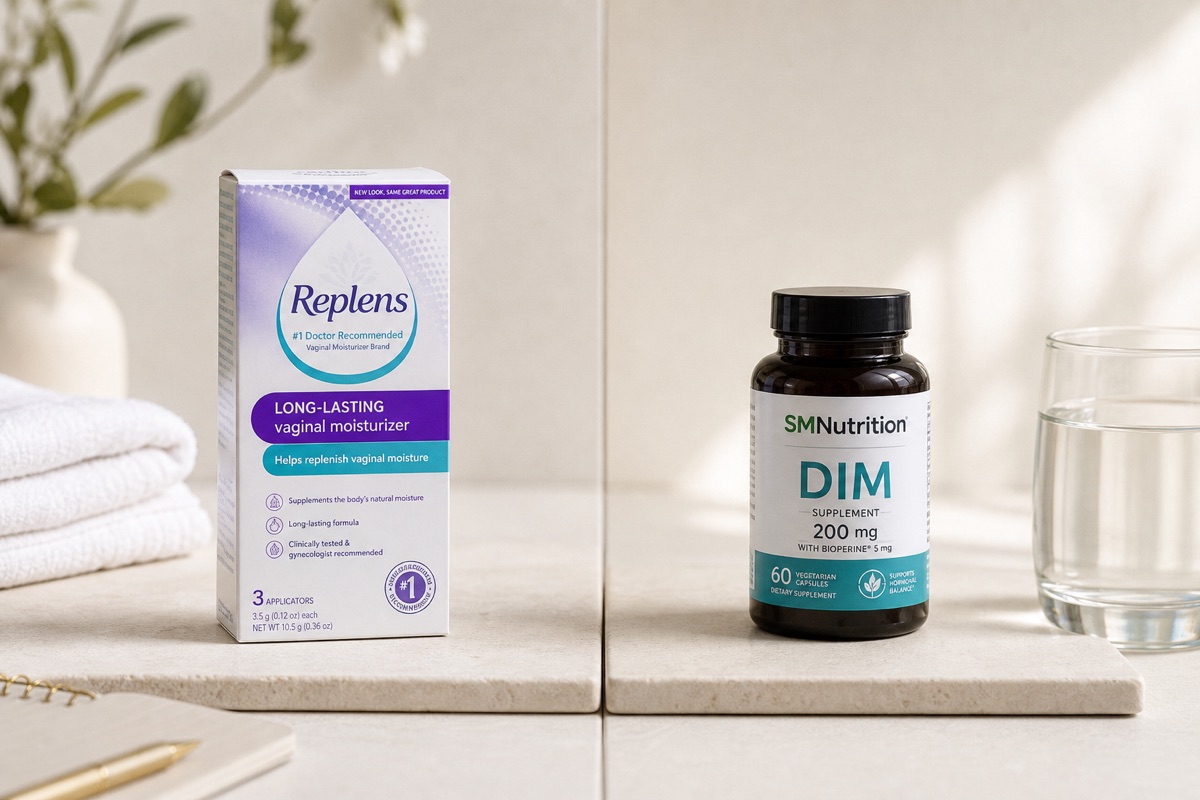
DIM Supplements vs Vaginal Moisturizers: Head-to-Head Evidence Review
Evidence-weighted comparison of DIM supplements and vaginal moisturizers for perimenopause shoppers balancing hormonal acne, dryness, tolerability, price, and review volume.
We analyzed 6 Amazon US listings with 48,746 visible ratings, FDA supplement guidance, 3 PubMed records on indole compounds and vaginal hyaluronic acid, and official brand pages. Vaginal moisturizers win for dryness relief; DIM supplements fit hormone-metabolism interest but have weaker acne-specific evidence.
| Criterion | DIM supplements Nature's Way, Smoky Mountain Nutrition, and Thorne $23.95 | 🏆 Winner Vaginal moisturizers Replens, Bonafide Revaree, and pH-D $12.98 |
|---|---|---|
| Ingredient evidence Scores direct evidence for the use case: DIM has human pharmacokinetic evidence for indole metabolism, while vaginal moisturizers have stronger menopause-dryness evidence, including a 2026 PubMed systematic review of hyaluronic acid trials. | 5.8/10 | 8.3/10 |
| Amazon US rating volume Compares the three-product Amazon snapshot: 37,043 visible ratings across the DIM products versus 11,703 across the vaginal moisturizers. | 8.4/10 | 6.8/10 |
| Price and entry cost Uses May 2026 Amazon snapshot prices. Replens and pH-D had lower entry prices than the sampled DIM formulas, while Revaree increased the moisturizer category average. | 7.2/10 | 7.8/10 |
| Tolerability Scores lower for DIM because oral supplements can create GI upset, headaches, medication conflicts, and hormone-related uncertainty; moisturizers are local products but can still sting or irritate sensitive tissue. | 6.0/10 | 7.4/10 |
| Typical user fit Scores how directly each category matches the shopper's likely problem: DIM aligns with hormone-metabolism interest and oily-skin questions, while moisturizers directly match vaginal dryness and intimacy discomfort. | 6.4/10 | 8.7/10 |
| Regulatory clarity FDA guidance says supplements are not approved to diagnose, treat, cure, or prevent disease; vaginal moisturizers are easier to frame as non-hormonal comfort products when claims stay within dryness support. | 5.7/10 | 7.8/10 |
| Overall score | 6.58 | 7.80 |
🏆 Winner: Vaginal moisturizers
Vaginal moisturizers win this head-to-head because the use case is more direct and the evidence is stronger for dryness: a 2026 PubMed systematic review covers hyaluronic acid for vaginal health, and the three Amazon moisturizer listings analyzed carried 11,703 visible ratings. DIM supplements had more rating volume at 37,043 visible Amazon ratings, led by Smoky Mountain Nutrition at 29,856, but acne-specific and perimenopause-specific clinical evidence is weaker than the dryness evidence behind moisturizers.
Best on a budget
Replens Long-Lasting Vaginal Moisturizer
Best for results
Vaginal moisturizers for dryness; DIM supplements only for shoppers specifically discussing hormone-metabolism support with a clinician
Bottom line for perimenopause shoppers
If the primary problem is vaginal dryness, vaginal moisturizers are the clearer first pick. They match the symptom directly, and the evidence base is closer to the use case. In our May 2026 Amazon US snapshot, the three moisturizer products analyzed carried 11,703 visible ratings: Replens at 6,347, Bonafide Revaree at 4,416, and pH-D at 940. PubMed also supports the category more directly: a 2026 systematic review and meta-analysis evaluated hyaluronic acid for vaginal health and quality of life in postmenopausal women.
DIM supplements are a different conversation. They are oral dietary supplements built around diindolylmethane, a compound associated with cruciferous vegetables and indole metabolism. The three DIM products in this comparison carried more visible Amazon rating volume, 37,043 ratings total, led by SMNutrition DIM at 29,856. That rating volume says the category is popular. It does not prove DIM treats perimenopause acne, oily skin, or hormone swings. FDA supplement guidance is the guardrail: dietary supplements are regulated differently from drugs and are not approved to diagnose, treat, cure, or prevent disease.
That distinction matters because the two categories solve different problems. Vaginal moisturizers are local comfort products. DIM supplements are systemic supplements with broader uncertainty. If you are comparing them because perimenopause has brought both dryness and hormonal acne, the practical answer is not either-or. Use the moisturizer lens for dryness; use the supplement lens only if you are comfortable discussing oral hormone-metabolism supplements with a clinician.
What the evidence says about DIM
DIM has a plausible biochemical story, but the finished-product evidence is not as strong as the marketing language often sounds. The PubMed record we weighted most heavily for DIM was Reed 2006, a pharmacokinetic study of indole-3-carbinol administration to women that measured DIM-related metabolism. That kind of evidence helps explain absorption and metabolism. It is not the same as a randomized acne trial in perimenopausal women.
The Amazon signal is stronger on popularity than on clinical certainty. SMNutrition DIM 200 mg showed 4.4/5 across 29,856 visible ratings at $23.95 in the May 2026 snapshot. Nature’s Way DIM-Plus showed 4.5/5 across 6,013 ratings at $28.63. Thorne Hormone Advantage showed 4.5/5 across 1,174 ratings at $51.00. Those are useful shopper signals, especially for price and tolerability patterns, but they are not controlled outcomes.
The main tolerability issue is that DIM is oral and systemic. Some shoppers report digestive upset, headaches, cycle changes, or uncertainty around hormone-related medications. The product pages do not replace medical screening. If you use hormone therapy, hormonal contraception, thyroid medication, anticoagulants, tamoxifen, fertility medications, or prescriptions affected by liver metabolism, DIM deserves a clinician conversation before checkout.
For hormonal acne specifically, DIM is best framed as a possible adjunct for shoppers already investigating hormone-metabolism support, not as a first-line acne product. Dermatology-directed options such as topical retinoids, azelaic acid, benzoyl peroxide, spironolactone, and prescription routines have clearer acne pathways. DIM may be part of a personal supplement routine, but our scoring keeps the claim narrow because the sources do not justify stronger language.
What the evidence says about vaginal moisturizers
Vaginal moisturizers are easier to score for the dryness question because the category is local, symptom-matched, and supported by menopause-focused literature. The 2026 PubMed systematic review and meta-analysis on hyaluronic acid for vaginal health and quality of life was the strongest ingredient-evidence source in this article. We also weighted the 2024 clinical practice guideline record on managing genitourinary symptoms associated with menopause.
The Amazon products cover three practical formats. Replens is the lowest-cost prefilled-applicator option in our snapshot at $12.98 with 4.4/5 across 6,347 ratings. Revaree is a hyaluronic acid insert at a higher $47.99 price point with 4.4/5 across 4,416 ratings. pH-D is a gel format with hyaluronic acid and vitamin E, priced at $14.97 with 4.4/5 across 940 ratings.
The trade-off is tolerability. Local does not automatically mean irritation-free. Vaginal tissue can sting when it encounters a new pH, gel base, applicator, fragrance-adjacent ingredient, preservative, or boric-acid-containing formula. If a product burns, causes bleeding, worsens itching, or creates discharge changes, stop and ask an OB-GYN. Dryness can be menopause-related, but infections, dermatologic conditions, pelvic floor pain, and medication effects can overlap.
The category still wins for typical user fit. If the complaint is dryness during daily life or intimacy, a moisturizer addresses the immediate surface problem. It does not balance hormones, and it does not treat acne. It simply belongs closer to the symptom than an oral DIM capsule does.
Scorecard: why vaginal moisturizers win
Our criteria array gives vaginal moisturizers an 8.3 for ingredient evidence versus 5.8 for DIM supplements. The reason is not that every moisturizer is perfect. It is that vaginal hyaluronic acid and menopause dryness have more direct PubMed support than DIM for perimenopause acne. The 2026 systematic review is much closer to the shopper question than a pharmacokinetic DIM study.
DIM wins one metric: Amazon rating volume. The DIM set reached 37,043 visible ratings, while the moisturizer set reached 11,703. That gap is mostly SMNutrition, which alone had 29,856 ratings. Rating volume helps identify mature listings and common shopper language, but it cannot overcome a weaker clinical match.
Price is close. Replens at $12.98 and pH-D at $14.97 make moisturizers accessible, while Revaree at $47.99 raises the category average. DIM products ranged from $23.95 for SMNutrition to $51.00 for Thorne. Because use patterns differ, a strict cost-per-day claim would require serving counts and use frequency; we avoided that calculation and scored entry cost instead.
Tolerability also favors moisturizers, 7.4 versus 6.0, because they act locally and can be stopped without systemic supplement concerns. That score is not a blanket safety claim. It reflects typical user fit for dryness. For someone with recurrent vaginal irritation, even a moisturizer should be introduced carefully.
Who should choose DIM first
Choose DIM first only if your main question is about oral hormone-metabolism support, not vaginal dryness. A reasonable DIM shopper is usually dealing with oily skin changes, cyclic breakouts, or supplement conversations that already came up with a clinician. She understands that Amazon ratings are user sentiment, not proof, and she is willing to stop if headaches, digestive changes, mood changes, or cycle changes appear.
Among the DIM products, SMNutrition DIM 200 mg has the strongest rating-volume signal in this article: 4.4/5 across 29,856 Amazon ratings. Nature’s Way DIM-Plus has an established mass-market profile with 4.5/5 across 6,013 ratings. Thorne Hormone Advantage is the premium option at $51.00 with fewer ratings, 1,174, but a brand position that appeals to shoppers who already prefer clinician-facing supplement companies.
Skip DIM as a self-directed experiment if you are pregnant, trying to conceive, breastfeeding, using hormone therapy, taking endocrine-related medications, or managing a hormone-sensitive medical history unless your clinician specifically clears it. Also skip DIM if your real concern is painful dryness. A capsule is not a substitute for local moisture support or OB-GYN evaluation.
Who should choose a vaginal moisturizer first
Choose a vaginal moisturizer first if dryness, friction, or intimacy discomfort is the symptom you are trying to solve. Replens is the practical budget pick in this comparison because it had the lowest entry price and the largest moisturizer rating base: 4.4/5 across 6,347 Amazon ratings. Revaree is better aligned with shoppers specifically searching for a hormone-free hyaluronic acid insert. pH-D fits shoppers who prefer a gel and want a lower price than Revaree.
The most important buying decision is format. Prefilled applicators are convenient but may feel clinical or uncomfortable. Inserts can be less messy for some users but cost more. Gels are flexible but may require more attention to dose and applicator comfort. A moisturizer that works on paper still has to fit your routine.
Do not use this category to avoid care when symptoms are persistent. Menopause-related vaginal dryness is common, but bleeding, new odor, severe pain, recurrent infections, or pain that does not improve with gentle products deserves medical evaluation. Non-hormonal moisturizers are useful tools; they are not a diagnostic plan.
How to use both categories without overcomplicating the routine
If both dryness and hormonal acne are active concerns, separate the decisions. Start with the symptom that affects comfort fastest. For most shoppers, that means a vaginal moisturizer first because dryness can affect daily comfort, sleep, and intimacy within days. Track whether the product stings, how often you need it, and whether intercourse or daily friction feels easier.
DIM, if considered at all, should be treated as a slower, more cautious supplement trial. Do not add multiple hormone-adjacent supplements at once. Do not combine DIM with new prescriptions without checking. Give your clinician the exact label, dose, and ASIN or brand page, because DIM products vary by dose and companion ingredients such as BioPerine, calcium D-glucarate, pomegranate extract, or vitamin E.
A simple tracking note can prevent confusion: date started, product name, dose or application schedule, symptom you are tracking, side effects, and stop date if needed. That is especially helpful in perimenopause because skin oil, breakouts, dryness, sleep, and cycle patterns can shift without any product being responsible.
Verdict
Vaginal moisturizers are the better evidence-weighted choice for this head-to-head because the main symptom in the comparison is dryness, and the category has more direct PubMed support. Replens is the budget pick, Revaree is the hyaluronic-acid insert pick, and pH-D is the gel-format pick.
DIM supplements are not dismissed; they simply belong in a narrower lane. Their Amazon review volume is substantial, especially SMNutrition’s 29,856-rating listing, but the clinical trail from DIM to perimenopause hormonal acne is indirect. If you pursue DIM, do it as a supplement decision with medication screening, not as a substitute for dermatology care or vaginal dryness treatment.
Related reading
Both winners on Amazon
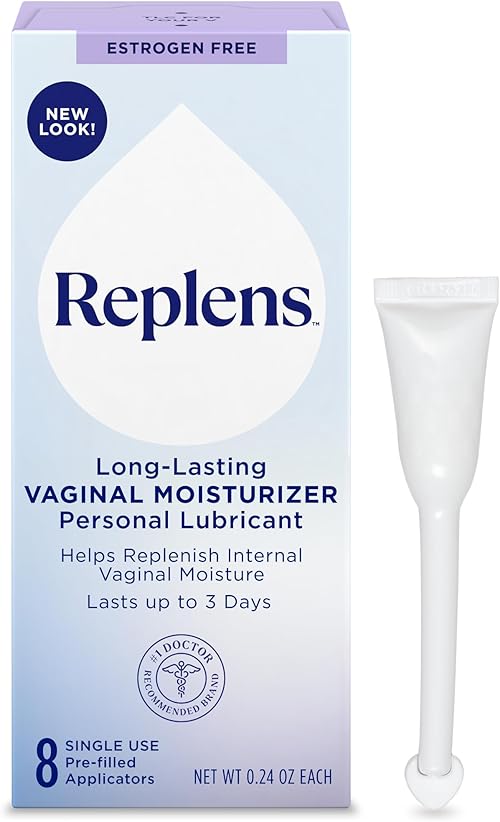
Replens
Replens Long-Lasting Vaginal Moisturizer
$12.98
"Lowest entry price in the analyzed moisturizer set; Amazon snapshot showed 4.4/5 across 6,347 ratings."
What real Amazon buyers say
4.4★· 6,347 reviews"I've had a hysterectomy. I'm in menopause and experience vaginal dryness."
"I rarely write reviews but this was a life saver."

SMNutrition
SMNutrition DIM Supplement 200 mg with BioPerine
$23.95
"Highest visible Amazon rating volume in this comparison; snapshot showed 4.4/5 across 29,856 ratings."
What real Amazon buyers say
4.4★· 29,856 reviews"So glad I gave this a chance."
"Menopause and DIM It's 3am I woke up shirt drenched!"

Bonafide
Bonafide Revaree Hyaluronic Acid Vaginal Moisturizer
$47.99
"Hyaluronic-acid insert from a menopause-focused brand; Amazon snapshot showed 4.4/5 across 4,416 ratings."
What real Amazon buyers say
4.4★· 4,416 reviews"ok, am really excited to share how i feel about this product.."
"I was very hesitant because of the price."

Nature's Way
Nature's Way DIM-Plus
$28.63
"Broccoli-family indole supplement with broad US availability; Amazon snapshot showed 4.5/5 across 6,013 ratings."

pH-D Feminine Health
pH-D Boric Acid Moisturizing Vaginal Gel with Hyaluronic Acid
$14.97
"Lower-cost hyaluronic acid gel format; Amazon snapshot showed 4.4/5 across 940 ratings."

Thorne
Thorne Hormone Advantage
$51
"Premium DIM-containing formula from a clinician-favored supplement brand; Amazon snapshot showed 4.5/5 across 1,174 ratings."