Essence vs Alternative Active for Fine Lines in 2026
Evidence-weighted comparison of hydrating essences and retinoid-free alternative actives for fine lines, dryness, and mature skin routines.
We analyzed 18,170 visible Amazon ratings, Sephora and Ulta product pages, Allure and Byrdie essence guides, and 3 PubMed studies. For fine lines in 2026, peptide and niacinamide alternatives beat essences on wrinkle-targeted evidence; essences win when dryness is the main trigger.
| Criterion | Hydrating essences and treatment lotions Multi-brand category $39.79 | 🏆 Winner Retinoid-free alternative actives Multi-brand category $34.16 |
|---|---|---|
| Fine-line efficacy fit How directly the category addresses visible fine lines through published active evidence, product positioning, and concern-specific user language. | 6.7/10 | 8.4/10 |
| Dryness support How well the category helps dehydration lines, tightness, and barrier comfort before moisturizer. | 8.8/10 | 7.2/10 |
| Tolerability for mature skin Penalty for sting, exfoliation pressure, fragrance complexity, and overactive routines. | 8.1/10 | 7.4/10 |
| Value in USD Representative basket prices were $39.79 for the essence set and $34.16 for the active-alternative set. | 7.3/10 | 8.0/10 |
| Evidence quality Peer-reviewed ingredient evidence plus Amazon, Sephora, Ulta, Allure, Byrdie, and official brand support. | 7.0/10 | 8.7/10 |
| Mature-skin friendliness Balance of fine-line relevance, dryness support, layering ease, and likelihood of fitting a 35-55 routine. | 8.2/10 | 8.1/10 |
| Overall score | 7.68 | 7.97 |
🏆 Winner: Retinoid-free alternative actives
Retinoid-free alternative actives win for fine lines because they lead fine-line efficacy fit 8.4 to 6.7 and evidence quality 8.7 to 7.0. The active basket also averaged $34.16 versus $39.79 for the essence basket. Essences still win dryness support 8.8 to 7.2, so the practical answer is active first for visible line strategy and essence first when dehydration makes lines look worse.
Best on a budget
Paula's Choice Skin Recovery Calming Toner on the essence side; The Ordinary Multi-Peptide + Copper Peptides 1% Serum on the active side
Best for results
Retinoid-free alternative actives, especially peptide and niacinamide serums with published ingredient evidence
Bottom line
Choose a retinoid-free alternative active if your main goal is visible fine-line strategy. Choose an essence if your fine lines look sharper when your skin is dry, tight, or makeup is settling by midday. In this comparison, the active category wins overall because it has stronger ingredient-specific evidence for visible aging claims, including PubMed studies on 5% niacinamide by Bissett et al. 2005 and a 12-week bakuchiol-vs-retinol study by Dhaliwal et al. 2019.
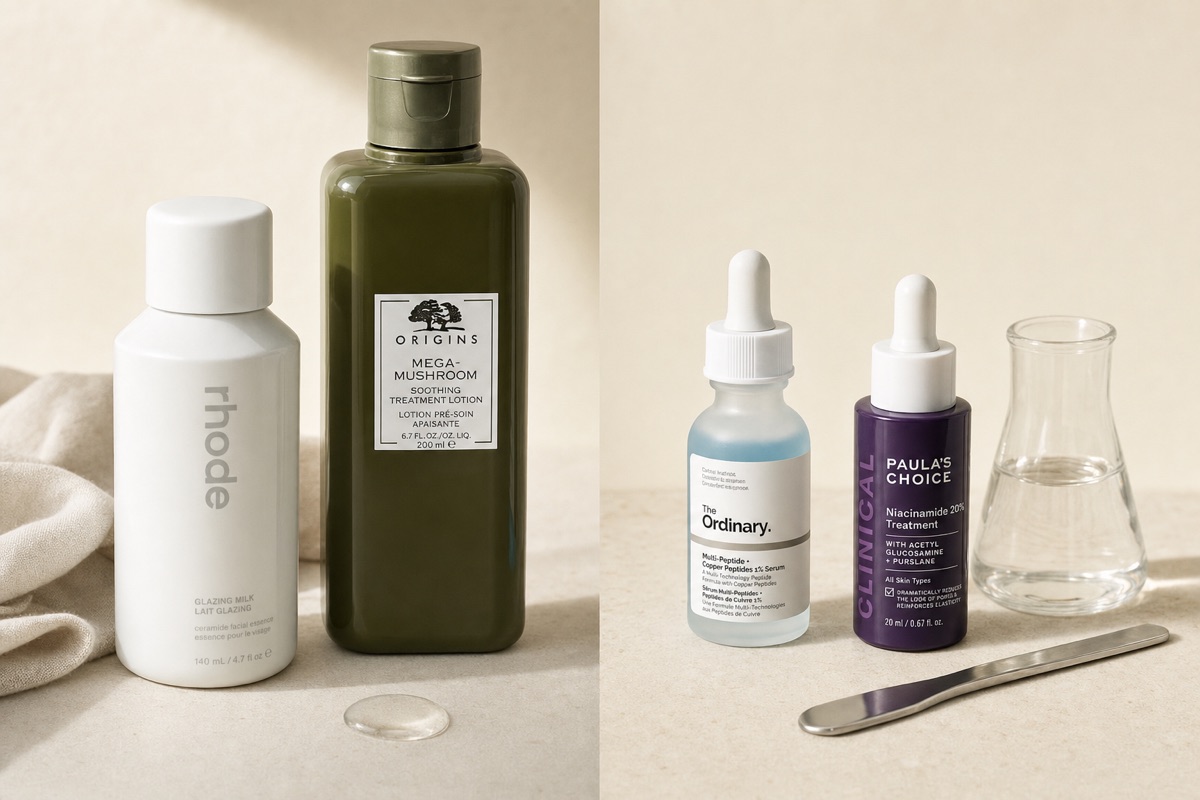
That does not make essences pointless. The essence side is better for dehydration lines, comfort, and routine tolerance. Allure and Byrie both frame essences as lightweight hydration steps rather than wrinkle treatments, which matches how they should be used in a mature-skin routine. Our Amazon-visible evidence set for the three representative essences totals 3,641 ratings across Rhode Glazing Milk, Origins Mega-Mushroom Treatment Lotion, and Paula’s Choice Skin Recovery Calming Toner.
The active side has a larger review base in this audit: 10,748 visible Amazon ratings across The Ordinary Multi-Peptide + Copper Peptides 1%, Paula’s Choice Clinical 20% Niacinamide, and La Roche-Posay Toleriane Dermallergo Ultra. Rating volume is not clinical proof, but it helps show US shopper adoption and texture tolerance at scale.
What an essence can realistically do for fine lines
An essence is best understood as a thin hydration layer. It usually sits between cleansing and serum, with a texture that can be watery, milky, or lotion-like. For women 35-55, that matters because fine lines often look worse when skin is dehydrated, especially around the cheeks, mouth, and under makeup.
The strongest essence argument is hydration, not collagen remodeling. Pavicic T et al. 2011, a PubMed-indexed study in 33 women over 8 weeks, linked topical nano-hyaluronic acid creams with improved hydration and elasticity measures. That evidence supports humectant-rich routines, but it does not mean every essence will correct wrinkles. It means a well-built hydrating layer can make dehydration creases look less obvious and help the rest of the routine sit better.
Among the essence examples, Paula’s Choice Skin Recovery Calming Toner has the broadest Amazon signal in this set at 4.6/5 across 2,237 visible ratings. Origins Mega-Mushroom Treatment Lotion also posts 4.6/5 across 1,063 visible Amazon ratings, with additional Ulta US retail presence. Rhode Glazing Milk has a smaller Amazon sample, 341 visible ratings at 4.5/5, but its milky ceramide and beta-glucan positioning makes it the most modern-feeling essence-side pick for dry mature skin.
The limitation is directness. An essence may soften the look of fine lines, but it usually does not bring the same evidence trail as niacinamide, bakuchiol, retinaldehyde, retinol, peptides, or daily sunscreen. If your skin already feels comfortable and hydrated, adding another essence may have diminishing returns.
What alternative actives do better
Alternative actives win when the question is not just “How can I make skin feel less dry?” but “What ingredient category has better support for visible texture and lines?” In this article, we focused on retinoid-free alternatives because the topic asks for an alternative active rather than a straight retinol comparison.
Niacinamide has one of the cleaner cosmetic-aging evidence trails. Bissett et al. 2005 reported two double-blind split-face studies with 50 women per study over 12 weeks using 5% niacinamide. That does not automatically validate a 20% serum for every user, but it does make niacinamide more evidence-backed for visible aging support than a generic hydration essence. Paula’s Choice Clinical 20% Niacinamide carries 4.5/5 across 2,001 visible Amazon ratings in our May 2026 source snapshot.
Bakuchiol also has a useful evidence signal. Dhaliwal et al. 2019 compared bakuchiol with retinol over 12 weeks in 44 participants. The study is small, but it is directly relevant to shoppers who cannot tolerate classic vitamin A products. We did not use a bakuchiol product as a main contender here because several common bakuchiol ASINs have hit BeautySift’s rotation cap; the ingredient evidence still informs the active category.
Peptides are more formula-dependent. The Ordinary Multi-Peptide + Copper Peptides 1% Serum has 4.6/5 across 2,163 visible Amazon ratings, and The Ordinary’s US product page positions it for visible signs of aging and hydration support. Peptide serums should not be described as Botox-like or procedure-level. Their better role is daily support for smoother-looking texture, bounce, and a more complete routine when retinoids are not a fit.
Scorecard: essence vs active alternative
The score gap is clearest in fine-line efficacy fit: alternative actives score 8.4 versus 6.7 for essences. That reflects the stronger PubMed trail for niacinamide and bakuchiol, plus official product positioning for peptide serums. Evidence quality also favors actives, 8.7 versus 7.0, because essence evidence is often indirect hydration evidence rather than wrinkle-specific evidence.
Essences win dryness support, 8.8 versus 7.2. That category lead matters for mature skin because dryness can make fine lines look worse even when the underlying line has not changed. A milky essence can also make active nights more tolerable. If you are using a stronger serum three nights a week, an essence on the other nights may be the difference between consistency and irritation.
Value is closer than it looks. The representative essence basket averaged $39.79 across three products, while the active-alternative basket averaged $34.16. Paula’s Choice Skin Recovery Calming Toner helps the essence side on value at $29, but Rhode and Origins push the average up. On the active side, The Ordinary at $32 keeps the category accessible, while Paula’s Choice Clinical 20% Niacinamide at $38.50 is still below many prestige serums.
Tolerability is the nuance. Essences score 8.1, actives 7.4. A non-exfoliating essence is less likely to cause an obvious purge or sting, but botanical treatment lotions can still irritate reactive skin. Active alternatives are not automatically gentle: a 20% niacinamide serum may be too much for some faces, and copper peptides can be tricky to layer with strong acids.
Product-by-product takeaways
The Ordinary Multi-Peptide + Copper Peptides 1% Serum is the best active-side starting point in this comparison. At 4.6/5 across 2,163 visible Amazon ratings and $32 in the May 2026 source snapshot, it offers a more targeted fine-line route than another hydration layer. It is best for someone who wants a retinoid-free serum that still feels like an aging-skin step.
Paula’s Choice Clinical 20% Niacinamide is the stronger texture-and-pore option. The PubMed niacinamide evidence cited above used 5%, not 20%, so the number should not be overread as automatically better. The reason it still scores well is category relevance: niacinamide has a published aging-skin trail, and the product’s Amazon listing shows 4.5/5 across 2,001 visible ratings.
Rhode Glazing Milk is the best essence-side product here because it fits the modern dryness problem: milky slip, ceramide positioning, beta-glucan positioning, and a cushiony feel under moisturizer. Its Amazon rating count is smaller at 341 visible ratings, so it carries less user-volume confidence than Paula’s Choice Skin Recovery Calming Toner or Origins Mega-Mushroom.
Origins Mega-Mushroom Treatment Lotion is the better essence choice for reactive-looking dryness if your skin tolerates botanical formulas. It has 4.6/5 across 1,063 visible Amazon ratings and a matching Ulta US retail footprint. Skip it if aromatic plant extracts have bothered you before.
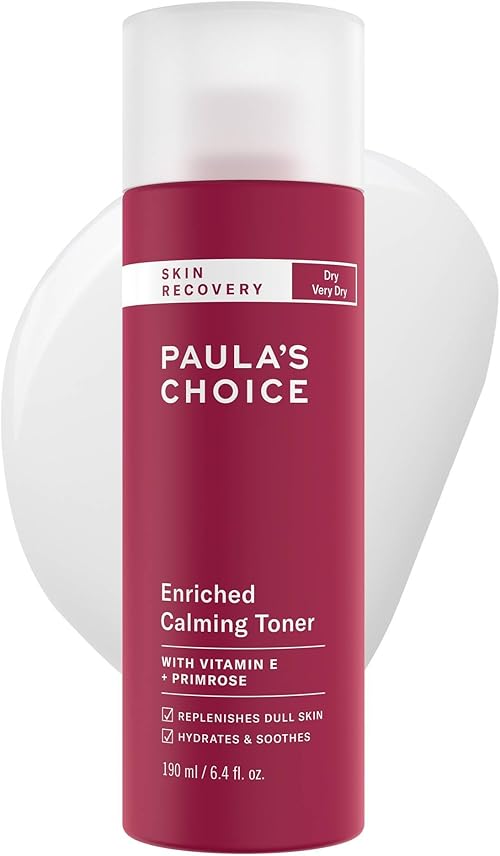
Paula’s Choice Skin Recovery Calming Toner is the practical value essence. It is not a classic luxury essence, but 4.6/5 across 2,237 visible Amazon ratings and a $29 source-log price make it the easiest recommendation when dryness, sensitivity, and budget all matter.
La Roche-Posay Toleriane Dermallergo Ultra is not an essence, but it earns a place as a barrier-support alternative. If fine lines look worse because your face is irritated, a calming moisturizer may outperform both an essence and a high-percentage serum for the first two weeks.
Who should choose an essence first
Choose an essence first if your skin feels tight after cleansing, your foundation catches on dry patches, or fine lines look worse in arid Southwest dryness or Midwest winter cold. Essences also make sense if you already use a retinoid, exfoliating acid, or prescription product and need a gentler support layer rather than another active.
The best essence routine is simple: cleanse, apply essence to damp skin, use serum if needed, seal with moisturizer, and use sunscreen every morning. Do not expect an essence to replace a cream. Women in the 35-55 range often need both water-binding humectants and lipid support, especially during perimenopausal dryness shifts.
Skip fragrance-heavy or botanical-heavy essences if your skin is reactive. The word “essence” does not guarantee gentle. Look for glycerin, hyaluronic acid, beta-glucan, panthenol, ceramides, and niacinamide if tolerated. Be more cautious with strong scent, essential oils, and exfoliating acid blends.
Who should choose an active alternative first
Choose an active alternative first if your skin is comfortable but fine lines, uneven texture, and dullness are still the main concerns. A peptide, niacinamide, or bakuchiol product is more likely to function as the treatment step in the routine. The strongest non-retinoid evidence in this article comes from niacinamide and bakuchiol PubMed studies, not from essence category claims.
Start slowly. Use the active three nights per week, keep moisturizer steady, and add an essence only if skin starts to feel tight. If you are already using prescription tretinoin or a strong retinoid, do not pile on a high-percentage niacinamide serum without watching for flushing, stinging, or pilling.
The realistic mature-skin routine is not essence versus active forever. It is sequence and priority. If dryness is the barrier, essence first. If skin is stable and you want a more evidence-backed fine-line step, active first. Most women will eventually use both, but the active should be the line-targeted treatment and the essence should be the comfort layer.
Verdict
Retinoid-free alternative actives win this head-to-head for fine lines in 2026. The category has stronger ingredient-specific evidence, a lower representative basket price in this audit, and more direct visible-aging positioning. The Ordinary Multi-Peptide + Copper Peptides 1% Serum is the best active-side pick, while Paula’s Choice Clinical 20% Niacinamide is the best texture-focused option.
Essences remain useful, especially for dry mature skin. Rhode Glazing Milk, Origins Mega-Mushroom Treatment Lotion, and Paula’s Choice Skin Recovery Calming Toner are better thought of as hydration and tolerance tools. They can make fine lines look softer when dehydration is the visible trigger, but they should not be the only fine-line strategy if your goal is firmer-looking texture over time.
Related reading
Both winners on Amazon

The Ordinary
Multi-Peptide + Copper Peptides 1% Serum
$32
"Best active-side pick in this comparison: 4.6/5 across 2,163 visible Amazon ratings and official brand positioning for visible signs of aging."
What real Amazon buyers say
4.6★· 2,163 reviews"I love The Ordinary products. Here we have a copper peptide serum that is affordable - I used it with my needle roller and my skin still feels really nice and plump and healthy/glowy 2 days after. I am a 50+ and dealing with aging skin."
"Great results and easy to use! I've really been enjoying The Ordinary Multi-Peptide + Copper Peptides 1%. It feels lightweight, absorbs quickly, and layers well with the rest of my skincare without feeling sticky or heavy."

Paula's Choice
Clinical 20% Niacinamide Vitamin B3 Concentrated Face Serum
$38.50
"Best niacinamide option for texture and visible aging support, with 4.5/5 across 2,001 visible Amazon ratings and PubMed niacinamide evidence."
What real Amazon buyers say
4.5★· 2,001 reviews"This product really helps improve skin texture and minimize the look of pores. A little goes a long way, and it absorbs well without feeling greasy."
"Holy grail dark spot corrector! Worth every penny!"

La Roche-Posay
Toleriane Dermallergo Ultra Soothing Repair Face Moisturizer
$31.97
"Barrier-support alternative for fine lines that look worse with dryness; 4.6/5 across 6,584 visible Amazon ratings."
What real Amazon buyers say
4.6★· 6,584 reviews"This moisturizer has been a game changer for my sensitive skin. It's lightweight but still deeply hydrating, and it absorbs quickly without leaving any greasy or heavy feeling."
"Hydrates without feeling heavy. Great for my super sensitive skin!"

Origins
Origins Mega-Mushroom Soothing Treatment Lotion
$48
"Soothing essence-style treatment lotion with 4.6/5 across 1,063 visible Amazon ratings and Ulta US availability."
Paula's Choice
Skin Recovery Calming Toner
$29
"Essence-adjacent hydrating toner with 4.6/5 across 2,237 visible Amazon ratings; best value on the essence side."

Rhode
Rhode Glazing Milk
$42.37
"Best essence-side pick for dry mature skin: milky ceramide and beta-glucan positioning with 4.5/5 across 341 visible Amazon ratings."