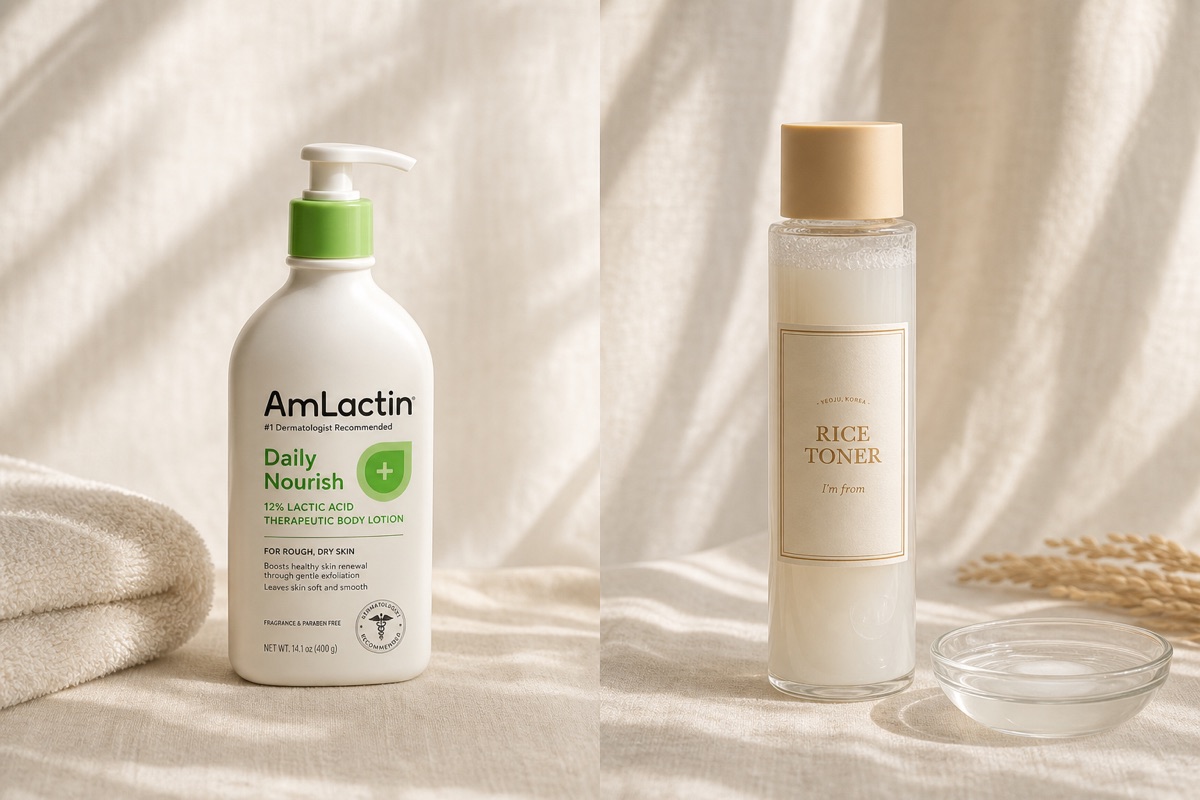
Essences vs Body Lotions: Urea and Lactic Acid Head-to-Head
Evidence-weighted comparison of facial essences and urea or lactic acid body lotions for dry, dull mature skin, ratings, price, tolerability, and fit.
We analyzed 9 PubMed/FDA sources and Amazon US snapshots across 6 products: urea/lactic body lotions averaged 4.42/5 across 39,129 ratings, while hydrating essences averaged 4.61/5 across 18,450 ratings. Choose lotions for rough body dryness; choose essences for facial hydration before moisturizer.
| Criterion | Hydrating facial essences Essence and toner category $17 | Urea and lactic acid body lotions Keratolytic body lotion category $19.99 |
|---|---|---|
| Ingredient evidence for dryness Strength of published ingredient evidence for improving visible dryness, roughness, and hydration. | 7.2/10 | 9.0/10 |
| Dullness and texture payoff How directly the category addresses dullness caused by dehydration, flakes, and uneven surface texture. | 7.8/10 | 8.8/10 |
| Amazon rating volume Representative Amazon US rating depth across three products per side, using visible rating counts captured for this article. | 7.5/10 | 9.2/10 |
| Price and value Visible Amazon US price relative to category size, application area, and expected use frequency. | 7.0/10 | 8.6/10 |
| Tolerability Lower likelihood of stinging, over-exfoliation, stickiness, fragrance issues, or barrier disruption scores higher. | 8.1/10 | 6.7/10 |
| Typical user fit How cleanly the category answers the shopper's main use case: facial hydration versus rough body dryness. | 8.3/10 | 8.9/10 |
| Overall evidence strength Balance of peer-reviewed evidence, FDA context, Amazon rating depth, and US product availability. | 7.5/10 | 8.8/10 |
| Overall score | 7.63 | 8.57 |
🏆 Winner: Urea and lactic acid body lotions for rough body dryness; hydrating essences for facial dehydration
Body lotions win the evidence-weighted score because PubMed sources include randomized or controlled studies of urea, lactic acid, or ammonium lactate for xerosis, and the three representative Amazon lotion listings total 39,129 ratings. Essences score higher for facial tolerability and elegance, but their ingredient evidence is more indirect: hyaluronic acid and humectants support hydration, not exfoliation of rough body texture.
Best on a budget
COSRX Full Fit Propolis Synergy Toner among essences at the $17.00 Amazon snapshot; AmLactin Daily Nourish 12% Lactic Acid Lotion among body lotions at the $19.99 Amazon snapshot.
Best for results
Urea and lactic acid body lotions for rough arms, legs, heels, and visibly flaky body skin; hydrating facial essences for tight, dehydrated facial skin that needs a watery layer before cream.
Quick verdict
Essences and body lotions solve different dry-skin problems. A facial essence is a thin, watery layer built around humectants: glycerin, hyaluronic acid, rice extract, propolis, panthenol, or similar water-binding ingredients. It can make facial skin feel less tight and look more hydrated, especially when menopausal or perimenopausal dryness makes a normal cream feel like it disappears too quickly.
Urea and lactic acid body lotions are more corrective for rough texture. The PubMed evidence we reviewed is stronger for this side: the 2002 randomized lactic acid versus ammonium lactate foot-xerosis study, the 2018 topical urea review, and the 2020 14-day lactic acid plus ceramide study all point in the same direction. These ingredients can improve the appearance and feel of dry, flaky, rough skin when used consistently.
Our evidence-weighted winner is body lotion for rough body dryness and essence for facial dehydration. If the problem is crepey-looking shins, rough upper arms, flaky elbows, or heels, pick the urea/lactic category. If the problem is a tight face after cleansing, makeup catching on dry patches, or a dull surface that improves when skin is hydrated, an essence belongs before moisturizer.
What each category is actually designed to do
A facial essence is not a lightweight body lotion. It usually has very little oil, wax, petrolatum, or dimethicone compared with a body moisturizer. That is why many essence users like the slip under sunscreen and makeup, but it is also why an essence rarely lasts all day on very dry skin unless a cream seals it in.
The three essence representatives in this analysis were I’m From Rice Toner, COSRX Full Fit Propolis Synergy Toner, and Paula’s Choice Resist Advanced Replenishing Face Toner. Their Amazon US snapshots totaled 18,450 ratings, with a weighted average of 4.61/5. That rating depth is useful user evidence, but it does not replace ingredient-specific clinical evidence. For essences, the strongest published support is indirect: hyaluronic acid serum studies show improved surface hydration and appearance, while glycerin is well established as a humectant in dry-skin moisturizers.
Urea and lactic acid lotions are built for thicker body skin. Urea is both a humectant and, at higher cosmetic-use levels, a texture-softening ingredient. Lactic acid is an alpha hydroxy acid that can help loosen dull, flaky surface buildup while also functioning as part of the skin’s natural moisturizing factor. The lotion representatives in this analysis were AmLactin Daily Nourish 12% Lactic Acid Lotion, La Roche-Posay Lipikar Urea 10%, and Dermal Therapy Alpha Hydroxy Lotion. Their Amazon US snapshots totaled 39,129 ratings, with a weighted average of 4.42/5.
Ingredient evidence: urea and lactic acid have the sharper clinical trail
The body-lotion side wins ingredient evidence because the clinical literature maps more directly to rough body dryness. Ademola et al. compared 10% lactic acid and 12% ammonium lactate lotion in a double-blind randomized foot-xerosis study, and the trial design fits the exact use case: dry, rough, thickened skin on the body. Draelos et al. published a 14-day controlled study of 15% lactic acid plus ceramides for shin dryness, moisturization, and desquamation. Pan et al.’s 2018 urea review supports urea’s role in skincare as a moisturizing and keratolytic ingredient.
That does not mean every lactic acid body lotion is automatically gentle. Lactic acid can sting on nicked, freshly shaved, or barrier-impaired skin. Urea can also tingle at higher percentages. For women 35-55 dealing with drier skin, lower frequency is often smarter than daily enthusiasm: try two or three nights weekly, then increase only if the skin feels comfortable.
Essences have a different evidence profile. A 2021 PubMed-indexed topical hyaluronic acid serum evaluation reported increased hydration and visible appearance improvements, but HA evidence supports water-binding and plumping more than rough-body exfoliation. Glycerin has stronger barrier-hydration evidence, including randomized work in dry or eczema-prone skin, but most essences do not publish the same active percentages that lactic acid and urea lotions do.
Amazon rating volume and price: body lotions are the value category
Amazon rating volume favors body lotions. The three body-lotion representatives in this article totaled 39,129 Amazon ratings: 35,444 for AmLactin Daily Nourish, 2,940 for La Roche-Posay Lipikar Urea 10%, and 745 for Dermal Therapy Alpha Hydroxy Lotion. The three essence representatives totaled 18,450 ratings: 14,149 for I’m From Rice Toner, 3,021 for COSRX Full Fit Propolis Synergy Toner, and 1,280 for Paula’s Choice Resist Advanced Replenishing Toner.
Price needs context. COSRX was the lowest essence snapshot at $17.00, and AmLactin was the strongest body-lotion value snapshot at $19.99. On pure dollars, those are close. On cost per routine, body lotion often wins because the bottle is meant for larger areas and the result target is specific: softening rough body skin. An essence can be a good value if it prevents you from layering multiple hydrating serums, but it still usually needs moisturizer on top.
The rating averages tell a different story. Essences scored a higher weighted Amazon average in our six-product snapshot, 4.61/5 versus 4.42/5 for body lotions. That is plausible because essences are pleasant to use and less likely to smell medicinal. Body lotions with lactic acid or urea often earn more mixed texture comments: effective softening, but possible stickiness, scent complaints, or stinging.
Tolerability: essences are easier on the face, lotions are stronger on the body
For sensitive facial skin, essences are the safer default. They usually avoid high acid percentages and heavy exfoliation. Paula’s Choice Resist Advanced Replenishing Toner, for example, is positioned for dry, aging skin, and the Amazon snapshot showed 4.7/5 across 1,280 ratings. COSRX Full Fit Propolis Synergy Toner adds a lower-priced hydrating option, though propolis or bee-derived ingredients may not suit everyone.
For body skin, the tolerability question changes. A little tingle on rough elbows or shins may be acceptable if the skin is intact. The same tingle on the face, neck, or chest can become irritation quickly. The FDA’s cosmetic-versus-drug guidance is also a useful guardrail: for ordinary cosmetic coverage, we should talk about improving the appearance of dryness, roughness, and dullness, not treating eczema or healing cracked skin.
Avoid urea or lactic acid lotion on open cracks, active rashes, or freshly shaved legs. If your skin burns for more than a few minutes, rinse it off and switch to a bland moisturizer. For menopausal dryness, hot flashes, or skin that flushes easily, fragrance-free formulas and slower frequency matter more than chasing the highest acid percentage.
Best user fit by concern
Choose a hydrating essence if your main complaint is facial tightness after cleansing, makeup settling into dry patches, or dullness that looks better after misting or moisturizing. The best routine fit is after cleansing and before serum or cream. In a dry climate or during Midwest winter cold, seal it with a moisturizer; otherwise, the water-binding layer can feel short-lived.
Choose a urea or lactic acid body lotion if your main complaint is rough body skin: flaky shins, dry elbows, bumpy-looking upper arms, or heels that look chalky. AmLactin’s 12% lactic acid positioning gives the most Amazon rating depth in this article, while La Roche-Posay Lipikar Urea 10% is the cleaner urea-forward choice for people who want less AHA framing.
Choose the hybrid route if you want both softening and exfoliation on body skin. Dermal Therapy Alpha Hydroxy Lotion combines 10% urea and 10% lactic acid, which is why it scored well for results but lower for conservative tolerability. That is a body product, not a face shortcut.
How to use them together without overdoing it
You can use both categories in the same routine because they usually live on different areas. Use an essence on the face after cleansing, then apply serum, moisturizer, and sunscreen in the morning. Use a urea or lactic acid lotion on body skin at night or after showering, focusing on rough areas rather than applying it everywhere immediately.
Do not use body AHA lotion as a facial exfoliant. The face, neck, and chest are more reactive than shins and elbows, and a product designed for body roughness can be too much under retinoids, vitamin C, or exfoliating toners. If you already use retinoids, benzoyl peroxide, or prescription actives, keep lactic acid body lotion away from areas that are peeling or inflamed.
A practical schedule is simple: essence daily if it feels comfortable, body urea/lactic lotion two to four nights weekly at first. If the body skin becomes smoother without stinging, increase frequency. If the face still feels dry after essence and cream, look at cleanser harshness, indoor humidity, and whether your moisturizer contains enough emollient or occlusive support.
Final recommendation
For the target query, body lotions with urea or lactic acid are the stronger evidence-backed answer for dry, dull, rough body skin. They have more directly relevant PubMed support, deeper representative Amazon rating volume, and clearer use cases. Essences win for facial comfort, layering elegance, and dehydrated-skin glow, but they are not a substitute for a body lotion when the problem is roughness or flaking.
If you are building a routine for mature dry skin, think in zones. Face: hydrating essence plus moisturizer. Body: urea or lactic acid lotion, introduced slowly. That split gives each category the job it is actually designed to do.
Related reading
Both winners on Amazon

AmLactin
AmLactin Daily Nourish Therapeutic Body Lotion 12% Lactic Acid
$19.99
"Lactic-acid-side value representative with 12% lactic acid, a $19.99 Amazon snapshot, and 4.4/5 across 35,444 visible Amazon ratings."
What real Amazon buyers say
4.4★· 35,444 reviews"I love the softening results, but between the greasing and smell I won't be buying it again."

I'm From
I'm From Rice Toner
$28
"Essence-side high-volume representative with rice extract and niacinamide positioning; Amazon snapshot shows 4.6/5 across 14,149 ratings."
What real Amazon buyers say
4.6★· 14,149 reviews"I love this toner! I've finished the whole bottle. It's light and moisturizing."

La Roche-Posay
La Roche-Posay Lipikar Urea 10% Roughness Smoothing Lotion
$22.96
"Urea-side representative with 10% urea plus shea butter and allantoin; Amazon snapshot shows 4.6/5 across 2,940 ratings."
What real Amazon buyers say
4.6★· 2,940 reviews"I love going to bed with it on and super love how soft and moisturized my skin looks and feels by morning."

COSRX
COSRX Full Fit Propolis Synergy Toner
$17
"Lower-priced essence representative with propolis, honey extract, and panthenol positioning; Amazon snapshot shows 4.6/5 across 3,021 ratings."

Paula's Choice
Paula's Choice Resist Advanced Replenishing Face Toner
$20.28
"US-brand toner representative for dry, aging skin; Amazon snapshot shows 4.7/5 across 1,280 ratings."

Dermal Therapy
Dermal Therapy Alpha Hydroxy Lotion 10% Urea + 10% Lactic Acid
$28
"Hybrid body-lotion representative combining 10% urea and 10% lactic acid; Amazon snapshot shows 4.5/5 across 745 ratings."