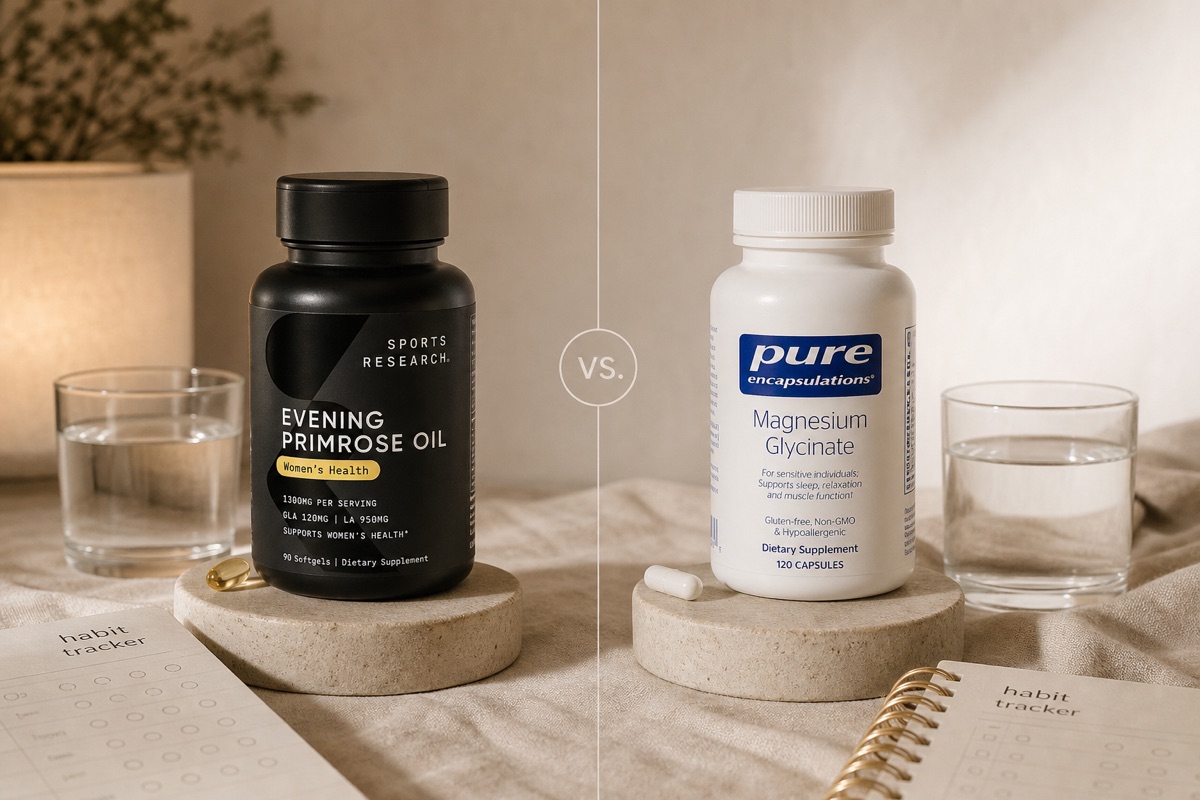
Evening Primrose Oil vs Magnesium Glycinate for Sleep and Fine Lines
Evidence-weighted comparison of evening primrose oil and magnesium glycinate for perimenopause sleep disruption, fine-line appearance, hot flashes, and hormonal acne fit.
We analyzed 112,271 Amazon US ratings across 6 supplement listings plus PubMed trials on evening primrose oil (2013, 2021, 2024, 2025) and magnesium for insomnia (2012, 2025). Magnesium glycinate is the stronger sleep-first pick; evening primrose oil is more relevant when hot flashes or hormonal skin complaints drive the search.
| Criterion | Evening primrose oil supplements Multi-brand category $19.37 | 🏆 Winner Magnesium glycinate supplements Multi-brand category $24.90 |
|---|---|---|
| Sleep relevance How directly the ingredient category maps to sleep quality, nighttime relaxation, and user demand for sleep support. | 5.8/10 | 8.4/10 |
| Fine-line plausibility How plausibly the category supports fine-line appearance through sleep quality, skin comfort, barrier feel, or indirect lifestyle fit. | 6.4/10 | 6.9/10 |
| Perimenopause symptom fit Fit for women 35-55 searching around hot flashes, night sweats, mood-related sleep interruption, and hormonal skin changes. | 7.8/10 | 7.5/10 |
| Skin-specific evidence Weight given to PubMed skin or acne-adjacent evidence and ingredient-mechanism relevance, not anecdote alone. | 6.7/10 | 4.8/10 |
| Amazon US confidence Representative Amazon rating volume and average rating across three products per side. | 7.5/10 | 8.8/10 |
| Tolerability Penalizes likely GI upset, pill burden, oiliness, drug-supplement interactions, and formula confounders. | 6.9/10 | 7.8/10 |
| Value Representative Amazon basket average: evening primrose oil $19.37 and magnesium glycinate $24.90. | 8.1/10 | 7.4/10 |
| Evidence quality Peer-reviewed support for the stated use case, capped where evidence is indirect or formulation-specific. | 6.6/10 | 8.1/10 |
| Overall score | 6.98 | 7.46 |
🏆 Winner: Magnesium glycinate supplements
Magnesium glycinate wins for the sleep-first fine-lines query because it leads sleep relevance 8.4 to 5.8, Amazon US confidence 8.8 to 7.5, tolerability 7.8 to 6.9, and evidence quality 8.1 to 6.6. The magnesium side also has 72,904 Amazon ratings across three representative listings, versus 39,367 for evening primrose oil. Evening primrose oil remains the more skin- and hot-flash-adjacent category, but its fine-line case is less direct.
Best on a budget
Solgar Evening Primrose Oil 1300 mg if the priority is a lower upfront supplement price; Double Wood Magnesium Glycinate 400 mg if the priority is lower cost per capsule on the sleep side
Best for results
Pure Encapsulations Magnesium Glycinate for sleep-first shoppers; Sports Research Evening Primrose Oil if skin comfort and perimenopause symptom fit matter more than sleep evidence
Bottom line
Choose magnesium glycinate if the core question is sleep. Choose evening primrose oil if the search is really about perimenopause symptoms, skin comfort, or hormonal acne adjacency and sleep is only part of the picture. Neither supplement is a direct fine-line treatment, and neither should replace sunscreen, moisturizer, retinoids, or medical care for persistent sleep disruption.
BeautySift analyzed 112,271 Amazon US ratings across six representative supplement listings: 39,367 ratings on the evening-primrose side and 72,904 ratings on the magnesium-glycinate side. We also weighted PubMed evidence, including Abbasi B et al. 2012 on magnesium supplementation in primary insomnia, a 2025 PubMed-indexed randomized trial of magnesium bisglycinate for poor sleep, and a 2025 systematic review of evening primrose oil for menopause hot flashes.
The practical verdict is narrow but useful. Magnesium glycinate has the cleaner sleep evidence and a larger Amazon rating base in this set. Evening primrose oil has more relevance to hot flashes, night sweats, fatty-acid skin support, and hormonal skin concerns, but the evidence does not make it a wrinkle supplement.
Why sleep enters a fine-lines conversation
For women 35-55, fine lines often become more visible when sleep quality drops. That does not mean a sleep supplement rebuilds collagen. It means fatigue, dehydration, under-eye puffiness, and poorer recovery can make existing lines look sharper in the mirror. A sleep-first supplement can therefore be relevant to fine-line appearance without being a cosmetic active.
That distinction protects against overclaiming. Magnesium glycinate scored 8.4 for sleep relevance because the PubMed record includes sleep-focused magnesium trials, and the three magnesium listings we analyzed total 72,904 Amazon ratings. Pure Encapsulations Magnesium Glycinate alone holds 4.7/5 across 47,944 ratings in our Amazon snapshot. Double Wood Magnesium Glycinate adds 22,108 ratings at the same 4.7/5 average.
Evening primrose oil scored lower for sleep relevance at 5.8. It can appear in perimenopause searches because hot flashes and night sweats can disrupt sleep, but the ingredient evidence is more symptom-adjacent than sleep-specific. The 2025 PubMed systematic review on evening primrose oil for menopause hot flashes is more relevant to temperature disruption than to sleep architecture.
What evening primrose oil is best at
Evening primrose oil is a fatty-acid supplement, commonly discussed for gamma-linolenic acid and women’s-health positioning. In this comparison, it performed best on perimenopause symptom fit and skin-specific evidence. The PubMed set includes a 2025 systematic review and meta-analysis on menopause hot flashes, a 2021 randomized controlled trial on hot flashes and night sweats, and 2022 PubMed-indexed isotretinoin-adjacent studies looking at skin-condition parameters and biochemical measures.
That makes evening primrose oil more relevant when the question sounds like this: “My sleep is worse because hot flashes wake me up, and my skin feels drier and more reactive.” Sports Research Evening Primrose Oil is the strongest Amazon signal here, at 4.6/5 across 34,421 ratings and $21.95 in our snapshot. Solgar Evening Primrose Oil 1300 mg has fewer ratings, 3,251, but a slightly higher 4.7/5 average and lower $12.20 price.
The caution is confounding. HerbaMe Evening Primrose Oil with Black Cohosh has 4.6/5 across 1,695 Amazon ratings and perimenopause-oriented reviews, but black cohosh means it is not a clean read on evening primrose oil alone. That is why it ranks as a hot-flash-adjacent blend, not as the purest ingredient comparison pick.
What magnesium glycinate is best at
Magnesium glycinate is the cleaner sleep-first contender. The 2012 PubMed-indexed double-blind placebo-controlled trial by Abbasi B et al. evaluated magnesium supplementation in elderly people with primary insomnia. A 2025 PubMed-indexed randomized placebo-controlled trial looked specifically at magnesium bisglycinate in healthy adults reporting poor sleep. Those studies do not prove that every Amazon magnesium glycinate product will work for every perimenopausal shopper, but they are more directly aligned with the sleep query than evening primrose oil evidence is.
Pure Encapsulations Magnesium Glycinate leads the magnesium side because it combines rating volume and formulation clarity: 4.7/5 across 47,944 Amazon ratings at $27.00. Double Wood Magnesium Glycinate is the value play at $13.95 with 22,108 ratings and the same 4.7/5 average. Metagenics Magnesium Glycinate is more expensive at $33.75 and has 2,852 ratings, but some shoppers prefer practitioner-channel brands.
Magnesium is not automatically gentle for everyone. Dose, timing, kidney health, and medication interactions matter. Some magnesium forms can cause loose stools, and even glycinate can feel too sedating or cause vivid dreams for some people. The FDA’s dietary supplement guidance is relevant here: supplements are regulated differently from drugs and are not preapproved to diagnose, treat, cure, or prevent disease.
Fine lines: the evidence split
Evening primrose oil wins skin-specific evidence in our scoring, 6.7 to 4.8, because PubMed includes skin-condition and acne-adjacent studies. That matters for hormonal-acne readers who are asking whether a fatty-acid supplement belongs in a broader skin routine. Still, the evidence is not the same as proving fewer fine lines. It is better described as skin comfort, barrier-adjacent support, and perimenopause fit.
Magnesium glycinate wins fine-line plausibility by a smaller margin, 6.9 to 6.4, because the pathway is indirect: sleep quality can influence how tired, puffy, or dehydrated the face looks. That is not the same as stimulating collagen. If your fine lines are from sun exposure, collagen loss, or expression movement, a sleep supplement will not compete with daily broad-spectrum sunscreen, a retinoid, or a peptide-rich moisturizer.
For a US shopper trying to prioritize one purchase, the decision is simple. If the mirror concern shows up mainly after poor sleep, start with sleep hygiene and consider magnesium glycinate if it is appropriate for you. If the concern is cyclic breakouts, breast tenderness, hot flashes, or dryness tied to hormonal shifts, evening primrose oil is the more thematically relevant category, with the caveat that evidence is mixed and individual response varies.
Tolerability and who should skip each
Skip or pause evening primrose oil if you are pregnant, trying to conceive, managing a seizure disorder, taking blood thinners, preparing for surgery, or using medications where supplement interactions matter. Capsule size is also a practical issue: several Amazon user reviews mention large softgels. Oil-based supplements can also cause GI upset or reflux in some users.
Skip or pause magnesium glycinate if you have kidney disease unless a clinician clears it, or if you already take magnesium-containing medications or laxatives. It can interact with some antibiotics, thyroid medication timing, and other minerals if taken together. Some users love nighttime magnesium; others report grogginess, vivid dreams, or no sleep benefit.
Tolerability scores reflect that nuance. Magnesium glycinate scored 7.8 because glycinate is usually chosen when shoppers want a gentler magnesium form. Evening primrose oil scored 6.9 because the use case often overlaps with medication-sensitive perimenopause concerns, and some high-interest formulas add black cohosh or other herbs that complicate attribution.
How to choose in a 35-55 routine
Choose magnesium glycinate if your first sentence is, “I wake up at 3 a.m. and look exhausted by morning.” In this article’s scoring, magnesium leads sleep relevance by 2.6 points and evidence quality by 1.5 points. The strongest Amazon-backed option here is Pure Encapsulations Magnesium Glycinate, while Double Wood is the budget-minded magnesium pick.
Choose evening primrose oil if your first sentence is, “My hot flashes, night sweats, or hormonal skin swings are making me feel out of sync.” Sports Research Evening Primrose Oil has the largest EPO rating set in this comparison. Solgar is the lower-priced pure EPO option. HerbaMe may appeal to shoppers specifically searching menopause blends, but black cohosh changes the risk and evidence profile.
Do not stack both on day one. If a clinician says both are reasonable for you, add one product at a time and keep a simple two-week symptom note: bedtime, wake time, hot-flash frequency, GI symptoms, morning grogginess, skin dryness, and breakout pattern. That kind of tracking is more useful than guessing which supplement did what.
Related reading
Both winners on Amazon

Sports Research
Sports Research Evening Primrose Oil
$21.95
"Largest evening-primrose listing in this evidence set: 4.6/5 across 34,421 Amazon ratings, cold-pressed oil format, and perimenopause-relevant user demand."
What real Amazon buyers say
4.6★· 34,421 reviews"My doctor recommended taking Evening Primrose supplements for various reasons. I tried several brands but finally I found in this product quality and consistency. I have been a customer for years. The supplements do what they are expected to do. Satisfied customer here. I will keep buying this product."
"Bought this product after searching to get relief from hot flashes and sleeplessness due to harmone changes. It's been about 10 days now and I see a significant improvement in my sleep quality and decrease in hot flashes as well."

Pure Encapsulations
Pure Encapsulations Magnesium Glycinate
$27
"Highest magnesium-side rating volume here: 4.7/5 across 47,944 Amazon ratings, with a glycinate form positioned for sleep, stress, nerves, and muscles."
What real Amazon buyers say
4.7★· 47,944 reviews"The Pure Encapsulations Magnesium (Glycinate) is a very clean and well-tolerated supplement. It's easy on the stomach compared to other forms of magnesium and is great for supporting relaxation, muscle recovery, and better sleep."
"Seems to be a good choice, I researched the company & the form of magnesium. I take one capsule at night, easy to swallow & now I'm sleeping better!"

Solgar
Solgar Evening Primrose Oil 1300 mg
$12.20
"Lower upfront evening-primrose option with 4.7/5 across 3,251 Amazon ratings; useful for shoppers comparing fatty-acid support before sleep supplements."
What real Amazon buyers say
4.7★· 3,251 reviews"I've been using Solgar Evening Primrose Oil for a few weeks now, and it has made a noticeable difference in both hormonal symptoms and overall skin health. The 1300 mg dose is ideal - it's potent enough to deliver real results without needing to take multiple capsules."
"Good supplement from a,great brand. Not easy to swallow though as they are very big!"

Double Wood
Double Wood Magnesium Glycinate 400 mg
$13.95
"Value-oriented magnesium glycinate listing with 4.7/5 across 22,108 Amazon ratings and a lower upfront price than Pure Encapsulations."

Metagenics
Metagenics Magnesium Glycinate 100 mg
$33.75
"Professional-channel magnesium glycinate option with 4.7/5 across 2,852 Amazon ratings; pricier but relevant for shoppers who prefer practitioner brands."

HerbaMe
HerbaMe Evening Primrose Oil with Black Cohosh
$23.95
"Perimenopause-oriented formula with 4.6/5 across 1,695 Amazon ratings; black cohosh makes it less clean for isolating evening primrose oil evidence."