Face Oils vs Azelaic Acid: Rosehip and Argan Compared With Azelaic Products
Evidence-weighted comparison of rosehip and argan face oils versus azelaic acid products for dryness, hormonal acne, redness-prone skin, and mature routines.
Azelaic acid wins for blemish- and redness-prone skin because DailyMed cites 1,362 subjects in two 12-week Finacea Foam trials; rosehip and argan oils win for dryness support, with Sephora review volume for Josie Maran argan oil exceeding 6,000 reviews.
| Criterion | Rosehip and argan face oils Multi-brand category $16 | 🏆 Winner Azelaic acid products Multi-brand category $29 |
|---|---|---|
| Ingredient evidence Score reflects PubMed, DailyMed, FDA, and ingredient-role evidence rather than BeautySift testing. | 6.4/10 | 9.1/10 |
| Dryness support Face oils score higher for emollience and comfort; azelaic acid can help some routines but may sting or dry at first. | 8.8/10 | 6.3/10 |
| Hormonal-acne fit Azelaic acid has stronger dermatology evidence for acne-adjacent concerns, while oils may not suit breakout-prone users. | 5.5/10 | 8.5/10 |
| Redness and hot-flash-prone comfort Azelaic acid has rosacea-label evidence, but face oils may feel more immediately comforting during dryness or flushing episodes. | 7.2/10 | 8.0/10 |
| Tolerability Oils can clog or feel heavy for some users; azelaic acid can sting, tingle, or dry, especially when introduced too quickly. | 7.4/10 | 7.1/10 |
| Amazon and U.S. retail accessibility Both categories have multiple Amazon-accessible ASINs; azelaic products also have strong Sephora and Ulta visibility. | 8.0/10 | 8.6/10 |
| Routine versatility Face oils layer best over moisturizer at night; azelaic acid fits better as a targeted treatment step for uneven tone and bumps. | 7.6/10 | 8.4/10 |
| Overall score | 7.27 | 8.00 |
🏆 Winner: Azelaic acid products
Azelaic acid products win 8.0 to 7.3 in our weighted scoring because DailyMed documents 1,362 subjects for Finacea Foam and 664 for Finacea Gel, while rosehip and argan oils rely more on emollient, barrier-support, and retailer-review evidence than controlled treatment data.
Best on a budget
Rosehip and argan face oils
Best for results
Azelaic acid products
Bottom line
Azelaic acid products are the better evidence-weighted choice when the main goal is hormonal-acne support, bumpy texture, post-blemish marks, or rosacea-adjacent redness. Face oils, especially rosehip and argan, are the better comfort choice when the main problem is dryness, tightness, or a compromised-feeling barrier.
The difference is not subtle in the source quality. DailyMed documents 1,362 subjects in two 12-week Finacea Foam trials and 664 subjects in two Finacea Gel trials. By comparison, the best public evidence for rosehip and argan oils is mostly ingredient-role evidence: fatty-acid composition, emollience, barrier support, and large U.S. retailer review footprints such as the 6,000+ Sephora review snapshot for Josie Maran 100% Pure Argan Oil.
For women 35-55, the practical answer is often not “oil or azelaic forever.” It is timing and goal-setting. Use azelaic acid when your routine needs a more active blemish/redness/uneven-tone step. Use rosehip or argan oil when your skin is dry, wind-chapped, or feeling stripped after retinoids, acids, winter weather, or hot-flash-related flushing.
Why azelaic acid wins on clinical evidence
Azelaic acid has a drug-label and dermatology-literature trail that face oils do not. DailyMed’s Finacea Foam label cites 1,362 subjects in two 12-week multicenter, randomized, double-blind, vehicle-controlled trials. DailyMed’s Finacea Gel label cites 664 subjects in two 12-week vehicle-controlled trials. Those are not BeautySift tests; they are public U.S. prescribing-information sources.
That matters because consumers often compare a 10% cosmetic azelaic product on Amazon with a bottle of rosehip oil and ask which one is “better for skin.” Better depends on the concern. For inflammatory papules, pustules, rosacea-prone redness, and blemish-related uneven tone, azelaic acid has a more specific evidence base. The 2024 American Academy of Dermatology acne guideline also keeps azelaic acid in the conversation as a recognized topical option, while face oils are not guideline acne treatments.
There is one important caveat: prescription 15% or 20% azelaic acid evidence should not be lazily transferred to every cosmetic 10% product. Paula’s Choice, Naturium, The Ordinary, and COS DE BAHA formulas are consumer skincare products, not the same products as Finacea or Azelex. Still, ingredient-level relevance and user demand are strong enough that azelaic acid wins the evidence category in this comparison.
Why face oils still matter for mature dry skin
Rosehip and argan oils are not weak products; they are just different products. PubMed’s 2018 plant-oil review by Lin, Zhong, and Santiago describes topical plant oils through the lens of fatty acids, barrier repair, and inflammation pathways. Cosmetic Ingredient Review materials also frame plant-derived fatty oils as skin-conditioning or emollient ingredients when used appropriately.
That is exactly where rosehip and argan oils fit best. They can reduce the feeling of tightness, add slip over moisturizer, and make a retinoid-heavy routine feel less punishing. In midlife skin, that comfort role can be meaningful. Estrogen shifts, indoor heating, aggressive cleansing, and retinoid use can all make skin feel less resilient. A few drops of oil over a bland moisturizer may be more useful than adding another active.
But oils are not neutral for everyone. A rich oil step can feel suffocating in Florida summer humidity, on naturally oily T-zones, or during a hormonal breakout week. Reddit skincare discussions repeatedly surface the same friction points: “Is this purging?” after azelaic acid, “Is oil breaking me out?” after rosehip, and “Can I layer both?” The best answer is to assign each product a job instead of expecting one category to solve everything.
Scoring summary
Our weighted score favors azelaic acid products overall: 8.0 versus 7.3 for rosehip and argan face oils. Azelaic acid scores higher for ingredient evidence, hormonal-acne fit, U.S. retail visibility, and targeted routine function. Face oils score higher for dryness support, immediate comfort, and budget accessibility.
The closest category is tolerability. Face oils can be soothing, but they can also feel heavy or clog-prone depending on skin type and formulation. Azelaic acid can be elegant and effective, but stinging, tingling, dryness, and pilling are common early complaints in consumer discussions. That is why the winner is not “azelaic acid for everyone.” It is azelaic acid for users who want an active step and are willing to introduce it slowly.
Amazon accessibility is strong on both sides. We verified non-capped ASINs for three azelaic products and three rosehip oils for this article. Amazon rating counts were not used as clinical evidence because public Amazon pages can merge variants, shift sellers, and hide review details behind dynamic rendering. We used Amazon mainly for availability and affiliate-link verification, and used DailyMed, PubMed, Sephora, Ulta, FDA, and ingredient sources for the claim hierarchy.
Best fit by skin goal
Choose rosehip or argan oil if your main complaint is dry, papery, or tight skin. Oils are best as the final step over moisturizer, especially at night. They are also useful when your routine already includes retinoids, vitamin C, exfoliating acids, or benzoyl peroxide and you do not want to add another potentially stingy active.
Choose azelaic acid if your main complaint is hormonal chin breakouts, post-blemish discoloration, visible redness, or rough uneven texture. Azelaic acid products work best when used consistently, not as a one-night rescue. Start two or three nights per week, especially if your skin is reactive or you are already using retinol.
Choose both only if each has a clear job. A practical order is cleanser, hydrating serum if used, azelaic acid, moisturizer, then one to three drops of oil. If the routine pills, separate them: azelaic acid in the morning under sunscreen if tolerated, oil at night over moisturizer.
Tolerability and safety notes
Neither category is automatically better for sensitive skin. Face oils avoid the acid-sting problem, but they may trigger congestion or leave a film. Azelaic acid avoids the heaviness problem, but it can sting or dry the skin, particularly around the nose folds, mouth, and cheeks.
If you have diagnosed rosacea, persistent inflammatory acne, melasma, or painful cysts, this comparison should not replace medical care. FDA and DailyMed sources are useful because they show what has been studied and labeled, but over-the-counter cosmetic products do not become prescription-equivalent just because they share an ingredient name. The FDA also makes clear that cosmetics are not FDA-approved before sale in the same way drugs are.
Pregnancy and nursing questions deserve clinician input. Azelaic acid is often discussed as a pregnancy-compatible topical in dermatology settings, but product choice, concentration, and personal history matter. Face oils are simpler cosmetically, yet fragrance, essential oils, and allergies can still complicate them. For the lowest-risk oil route, choose fragrance-free, single-oil formulas and patch test.
Product notes from the comparison set
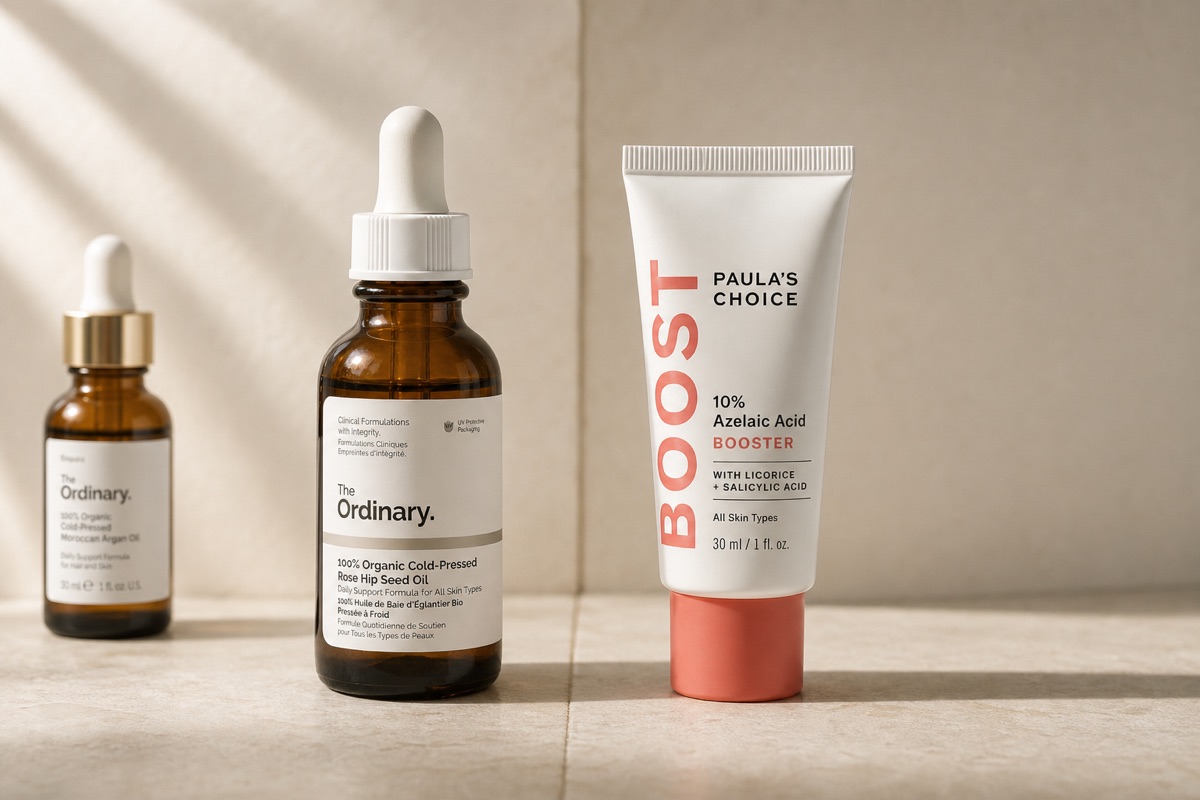
Paula’s Choice BOOST 10% Azelaic Acid Booster is our strongest OTC azelaic pick because it has broad U.S. retailer presence and a formula built around a clear 10% azelaic-acid positioning. Naturium Azelaic Topical Acid 10% is the accessible mainstream alternative for shoppers who want a contemporary cosmetic formula. COS DE BAHA Azelaic Acid 10 Serum is the budget Amazon option, but budget serums can be more variable in texture expectations.
The Ordinary 100% Organic Cold-Pressed Rose Hip Seed Oil is the most recognizable rosehip oil in this set, supported by Sephora and Ulta visibility. NOW Solutions Rose Hip Seed Oil and Leven Rose Rosehip Seed Oil give the category lower-cost Amazon-accessible alternatives. We would use these as comfort products, not as acne treatments.
Argan oil remains relevant even though the verified Amazon set here leans rosehip. Sephora’s Josie Maran 100% Pure Argan Oil snapshot, with more than 6,000 reviews, shows how much U.S. consumer demand still exists for a simple oil step. In practice, argan often feels richer and more cushiony; rosehip often feels lighter and more treatment-adjacent in consumer perception. Neither has the same claim strength as azelaic acid for blemish-prone skin.
Verdict
Azelaic acid products are the better first choice if your search intent is “rosehip oil vs azelaic acid for acne,” “argan oil vs azelaic acid for redness,” or “what helps hormonal breakouts after 40?” The evidence is more targeted, the dermatology trail is stronger, and the product category is designed around visible skin concerns beyond dryness.
Rosehip and argan oils are the better first choice if your search intent is “what helps dry mature skin feel comfortable?” or “what can I put over moisturizer when my retinoid is drying me out?” They are support players, not primary active treatments.
The most balanced mature-skin routine may use both, but not with equal expectations: azelaic acid for the active concern, face oil for comfort and barrier feel.
If your skin is currently irritated, simplify before choosing sides. A bland cleanser, moisturizer, and sunscreen give you a cleaner read on whether azelaic acid is helping or whether an oil is simply masking dryness for a few hours.
Affiliate disclosure
BeautySift may earn a commission from Amazon links. Affiliate availability does not change our scoring; the comparison above weights public clinical evidence, retailer review signals, ingredient analysis, and routine fit.
Related reading
Best Face Oils for Mature Dry Skin in 2026
Best Niacinamide Serums for Women Over 40 in 2026
The Ordinary Niacinamide Review 2026: Reddit Sentiment and Formula Analysis
Both winners on Amazon

Paula's Choice
Paula's Choice BOOST 10% Azelaic Acid Booster
"Most practical OTC azelaic pick in this comparison because it pairs 10% azelaic acid with a mainstream U.S. review footprint at Sephora and Ulta."

Naturium
Naturium Azelaic Topical Acid 10%
"A widely stocked U.S. 10% azelaic-acid option for shoppers who want a cosmetic product rather than a prescription rosacea drug."

The Ordinary
The Ordinary 100% Organic Cold-Pressed Rose Hip Seed Oil
"The rosehip oil benchmark for dryness and barrier-comfort routines, with broad U.S. retailer recognition at Sephora and Ulta."

COS DE BAHA
COS DE BAHA Azelaic Acid 10 Serum
"Budget-friendly 10% azelaic serum for shoppers comparing Amazon-accessible azelaic options."

NOW Solutions
NOW Solutions Rose Hip Seed Oil
"Simple rosehip seed oil positioning for dryness-focused shoppers who want a minimal face-oil step."

Leven Rose
Leven Rose Rosehip Seed Oil
"Another Amazon-accessible rosehip oil for users prioritizing slip, comfort, and barrier-friendly emollience over active treatment claims."