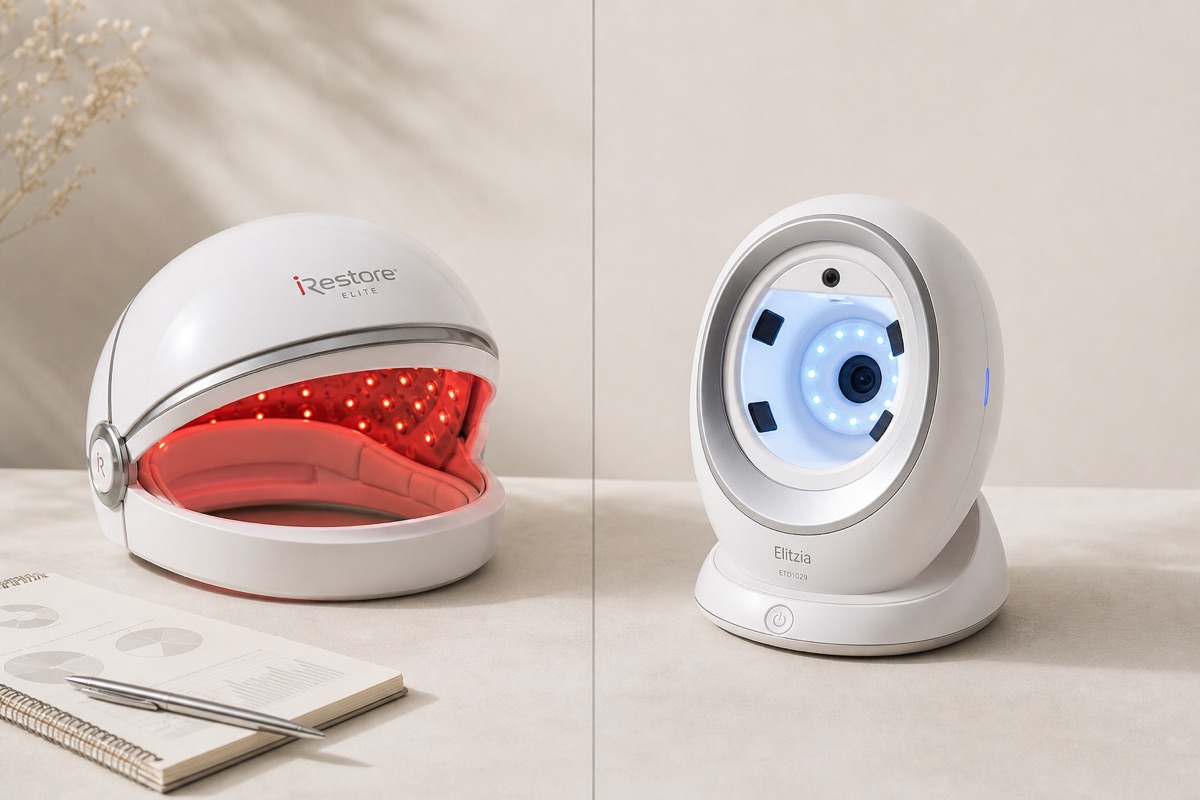
Hair-Growth Laser Caps vs Smart Skin Scanners for Sensitive Skin
Evidence-weighted comparison of hair-growth laser caps and smart skin scanners for sensitive skin, thinning hair, pigmentation tracking, and fine-line routines.
We analyzed 7,235 Amazon ratings across 6 devices, 3 PubMed studies, and FDA 510(k) context. Hair-growth laser caps have stronger outcome evidence for thinning hair; smart skin scanners are gentler for sensitive facial skin because they measure wrinkles, spots, or hydration rather than treating skin.
| Criterion | 🏆 Winner Hair-growth laser caps Multi-brand category $1,799 | Smart skin scanners Multi-brand category $339.79 |
|---|---|---|
| Outcome evidence Strength of peer-reviewed evidence for a visible result, not just monitoring. | 8.8/10 | 5.8/10 |
| Sensitive-skin tolerability Penalizes heat, scalp discomfort, treatment exposure, contact pressure, and irritation complaints; rewards non-treatment imaging. | 7.2/10 | 9.0/10 |
| Amazon rating volume Representative Amazon US rating volume in this evidence set: 226 laser-cap ratings versus 6,990 scanner/analyzer ratings. | 4.8/10 | 8.4/10 |
| Price accessibility Representative basket price favors scanners because a consumer hydration analyzer is under $30 while caps run about $1,449 to $2,199. | 3.6/10 | 7.8/10 |
| Concern fit Hair caps directly fit hair thinning; scanners better fit tracking hyperpigmentation, wrinkles, and dryness without adding actives. | 8.5/10 | 7.6/10 |
| At-home decision usefulness How well the category helps a shopper decide what to do next without a salon, clinic, or prescription. | 7.6/10 | 7.9/10 |
| Overall score | 6.75 | 7.75 |
🏆 Winner: Hair-growth laser caps
Hair-growth laser caps win on results evidence because PubMed trials of 655 nm LLLT in 44 men and 47 women reported statistically significant hair-count gains after 16 weeks, including a 37% advantage over sham in women. Smart skin scanners score higher for sensitive-skin tolerability, 9.0 versus 7.2, because they primarily measure or image skin rather than deliver a treatment dose.
Best on a budget
Smart skin scanners, especially a simple hydration analyzer, because representative Amazon prices range from $24.98 to $339.79 before salon-grade systems.
Best for results
Hair-growth laser caps for androgenetic-pattern thinning; scanners for tracking fine lines, spots, and dryness rather than changing them.
The short verdict for sensitive skin
If the question is “which works,” hair-growth laser caps have the stronger treatment evidence. The best public support comes from low-level light therapy studies indexed in PubMed: Lanzafame et al. reported statistically significant hair-count gains after 16 weeks in both a 44-man study and a 47-woman study using 655 nm light. In the female study, the active group showed a 37% greater hair-growth increase than sham.
If the question is “which is safer for reactive facial skin,” smart skin scanners are the calmer category. They do not exfoliate, peel, heat the face, or add an active ingredient. The tradeoff is that scanners measure; they do not treat. A scanner may help a 45-year-old track whether brown spots, fine lines, or dryness are changing, but the improvement still comes from sunscreen, retinoids, pigment-targeting ingredients, procedures, or prescription care.
That distinction matters for women 35-55 because these categories solve different problems. Laser caps are for scalp hair thinning, especially androgenetic-pattern thinning. Smart skin scanners are for decision support: tracking hydration, wrinkles, visible spots, pores, and sometimes scalp close-ups. Comparing them as if both are treatments creates false expectations.
Evidence: treatment data favors laser caps
Hair-growth laser caps are built around low-level laser or light therapy, often abbreviated LLLT. The most relevant public evidence is not from the Amazon listings themselves; it comes from controlled studies of 655 nm light. In the 2014 female trial on PubMed, 47 women ages 18-60 used a helmet-like device or sham for 16 weeks, and the active group had a 37% greater hair-growth increase versus placebo. In the 2013 male trial, 44 men used a similar protocol for 16 weeks, and the active group showed a 35% to 39% hair-count increase depending on analysis.
Those numbers do not mean every cap on Amazon will produce the same result. Device design, diode count, contact, session adherence, baseline diagnosis, medications, iron status, thyroid status, menopause timing, and shedding triggers all matter. They do mean the category has outcome evidence for hair counts, which smart skin scanners do not.
Smart scanners have a different evidence base. A 2023 PubMed-indexed Visia study of 19 participants found wrinkle absolute-score repeat deviation around 3% and Truskin Age correlations of r=0.827 to 0.896 versus chronological age. That supports imaging reproducibility for certain measurements. It does not prove that a scanner improves wrinkles, pigment, or sensitivity.
Amazon US signal: scanners have more rating volume
Amazon rating volume favors the scanner side in this snapshot. Across the three scanner/analyzer products included here, we found 6,990 Amazon ratings, driven mostly by the Handy Nano Mist Sprayer with Skin Analyzer Moisture Tester at 6,465 ratings and 4.2/5. The Elitzia ETD1029 has a smaller but still meaningful 510-rating base at 4.5/5. The salon-grade 3D Smart Skin Detector is newer or more niche, with 15 ratings at 3.8/5.
The laser-cap side has a much smaller Amazon sample: 226 ratings across iRestore Elite, Hairmax PowerFlex 272, and Capillus SPECTRUM in this evidence set. That does not make the devices ineffective. It does mean the public Amazon sentiment pool is thinner and more polarized, especially when the item costs $1,449 to $2,199.
For expensive beauty tech, low rating volume is a practical risk. A $24.98 moisture analyzer can have thousands of casual buyers. A $1,799 laser cap naturally attracts fewer purchasers, longer timelines, and more frustration when durability or warranty expectations are not met.
Sensitive-skin fit: face versus scalp matters
For sensitive facial skin, smart scanners win tolerability because they are observational. A hydration meter or imaging device can still be annoying if it presses on skin, uses bright light, or leads to over-monitoring, but it is less likely to trigger a flare than a new peel, retinoid, or heat-based treatment.
Laser caps are not facial skincare devices. They sit on the scalp, so “sensitive skin” means sensitive scalp: tenderness, itching, seborrheic dermatitis, psoriasis, migraine sensitivity, tight hairstyles, or post-color irritation. Amazon review excerpts for iRestore and Capillus include ease-of-use praise, while Hairmax reviews also surface durability complaints. That is why our laser-cap tolerability score is solid, 7.2, but not as high as the scanner score of 9.0.
A useful rule: if your skin sensitivity is mainly on the face, a scanner is the lower-risk purchase. If your primary concern is progressive hair thinning, a scanner will not solve the problem; it may only help document scalp density or product progress photos.
Price and value: scanners are easier to justify
Laser caps are expensive. The three caps in this article range from $1,449 for Hairmax PowerFlex 272 to $2,199 for Capillus SPECTRUM, with iRestore Elite at $1,799 in the Amazon snapshot. That price only makes sense if the buyer has a hair-thinning pattern that matches the evidence base and is willing to use the device consistently for months.
Scanners range widely. A professional 3D skin detector can cost more than a laser cap, but the practical at-home scanner category includes lower-cost tools: the Elitzia ETD1029 was $339.79 in the Amazon snapshot, while the Handy hydration analyzer was $24.98. The lower price makes scanners easier to use as a routine-support tool, not a high-stakes treatment bet.
Value depends on what you need to change. A scanner is good value if it stops you from buying random serums and helps you track dryness, fine lines, or dark spots with more consistency. A laser cap is better value only if hair regrowth is the priority and you are already ruling out common shedding causes with a clinician.
Which side fits hair thinning, hyperpigmentation, and fine lines?
For hair thinning, laser caps are the clear fit. They target the scalp and have controlled-trial support for androgenetic-pattern hair loss. They are not a substitute for minoxidil, spironolactone, oral medications, platelet-rich plasma, or diagnosis, but they belong in the hair-growth conversation.
For hyperpigmentation, smart skin scanners are the more relevant category because they can track visible spots or UV-pattern change, depending on the device. They do not fade pigment. The actual fading work usually comes from daily broad-spectrum sunscreen, pigment-safe actives, retinoids, dermatology procedures, or prescription treatment.
For fine lines, scanners again fit tracking more than treating. The 2023 Visia study supports repeatability for wrinkle scoring under standardized capture conditions, but at-home and salon devices vary. If the goal is to smooth fine lines, compare LED masks, retinoids, sunscreen, peptides, or in-office options instead.
Our evidence-weighted pick
Hair-growth laser caps win the overall comparison because the topic asks “which works,” and the laser-cap category has stronger outcome evidence. The 16-week PubMed trials give the category a measurable hair-count basis that scanners lack.
Smart skin scanners win for sensitive facial skin, budget flexibility, and tracking hyperpigmentation or fine lines. They are also less likely to create irritation because they are not adding an active treatment. The best shopper fit is someone who wants measurement discipline: before-and-after documentation, hydration checks, or a reason to stop changing products every week.
The wrong purchase is the one that answers the wrong problem. Do not buy a laser cap to monitor melasma. Do not buy a scanner expecting it to regrow hair. If both concerns are real, prioritize the active problem first: scalp thinning with a laser cap or skin reactivity and pigment tracking with a scanner.
Practical buying guidance
Choose a hair-growth laser cap if your thinning is gradual, patterned, and already discussed with a clinician or dermatologist. Look for FDA-cleared language, a realistic session schedule, return terms, warranty clarity, and reviews that mention long-term use rather than first-week excitement.
Choose a smart skin scanner if your main frustration is not knowing whether your routine is helping. It is most useful when you repeat measurements under the same lighting, time of day, and skin condition. Do not let scanner scores push you into harsh routines; sensitive skin usually improves with fewer changes, not more.
For either category, set a 16-week expectation window. The PubMed laser studies used 16 weeks. Skin tracking also needs time because pigment, barrier recovery, and fine-line hydration changes fluctuate with sun exposure, hormones, sleep, and climate.
Also check the return window before opening the box. Laser caps are high-ticket devices, and several Amazon reviews we reviewed focus less on hair results than on charging, warranty, or device-failure frustration. For scanners, check whether the device stores images locally, requires an app, or creates salon-style reports you will actually use. Sensitive-skin shoppers often do best with fewer variables: same lighting, same day of week, same routine, and one product change at a time. That slower approach also makes it easier to tell whether redness, shedding, or dryness came from the device, a seasonal shift, or a separate product change.
Related reading
Both winners on Amazon

iRestore
iRestore Elite Laser Red Light Therapy for Hair Growth System
$1,799
"Highest-rated laser cap in this evidence set at 4.2/5 across 148 Amazon ratings, with FDA-cleared positioning and 12-minute daily use copy on the listing."
What real Amazon buyers say
4.2★· 148 reviews"I'm a 59 year old woman whose long curly hair was beginning to thin and seem less lively post-menopause."
"I have been using it for 6 months. Hair loss has stopped and my hair is definitely thicker. It is so easy to use."
Hairmax
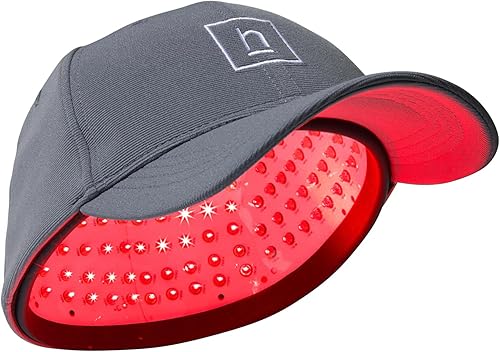
Hairmax PowerFlex 272 Laser Cap
$1,449
"FDA-cleared laser-cap listing with the lowest laser-cap price in this set, though Amazon sentiment is mixed at 3.4/5 across 60 ratings."
What real Amazon buyers say
3.4★· 60 reviews"I purchased the Hairmax Laser Hair Growth Cap in October 2022 following my hair transplant, in hopes to expedite the regrowth process and strengthen my new grafts."
"It worked great but stopped working only 14 months after using it and the warranty is only for a year."

Capillus
Capillus SPECTRUM Laser Red Light Therapy Cap
$2,199
"Premium laser-cap option with 312-laser positioning, Bluetooth app copy, and 4.0/5 across 18 Amazon ratings in the snapshot."
What real Amazon buyers say
4.0★· 18 reviews"It's a really good (expensive) cap. A bit big on my head but that is to fit all the separate light nodes. Only 6 minutes and done!"
"It's very comfortable, feels just like wearing a regular hat, and only takes a few minutes a day, which makes it easy to stay consistent."

Generic professional device
Skin Analysis System 3D Smart Skin Detector
$2,370.77
"Salon-grade smart scanner listing with 13.3-inch screen, 8 spectral analysis, and 3.8/5 across 15 Amazon ratings; best considered a professional tool, not a treatment."

Elitzia
Elitzia ETD1029 UV Beauty Cold Light Skin Analyzer
$339.79
"Mid-price scanner/analyzer with the strongest scanner rating balance in this set: 4.5/5 across 510 Amazon ratings."

Handy
Handy Nano Mist Sprayer with Skin Analyzer Moisture Tester
$24.98
"Budget hydration-check option with the largest Amazon rating volume in this article: 4.2/5 across 6,465 ratings. It measures moisture rather than wrinkles or pigment."