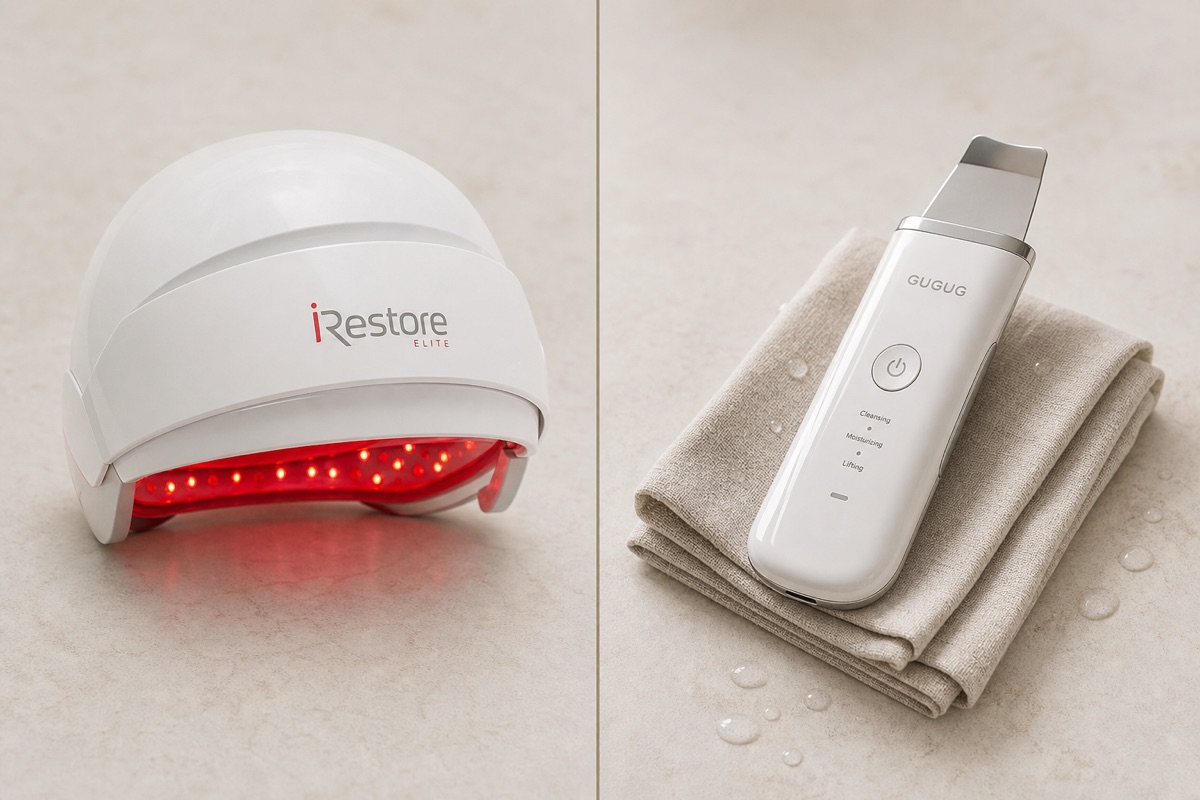
Hair-Growth Laser Caps vs Ultrasonic Skin Scrubbers for Fine Lines
Evidence-weighted comparison of hair-growth laser caps and ultrasonic skin scrubbers for women 35-55 weighing thinning hair, dullness, pores, and fine-line routines.
We analyzed 33,158 Amazon ratings across 6 devices, 3 PubMed hair-growth trials/reviews, FDA 510(k) context, and DERMAFLASH brand claims. Hair-growth laser caps have stronger clinical evidence for thinning hair; ultrasonic skin scrubbers are cheaper exfoliation tools, not well-proven fine-line treatments.
| Criterion | 🏆 Winner Hair-growth laser caps Multi-brand category $1,799 | Ultrasonic skin scrubbers Multi-brand category $16.99 |
|---|---|---|
| Clinical evidence for the claimed result Scores peer-reviewed evidence for the core visible outcome: hair-density support for caps and fine-line improvement for scrubbers. | 8.8/10 | 3.8/10 |
| Amazon rating volume Representative Amazon US rating volume in this evidence set: 226 laser-cap ratings versus 32,432 ultrasonic scrubber ratings. | 4.8/10 | 9.0/10 |
| Price accessibility Representative Amazon prices favor scrubbers at $16.99 to $165.75, while laser caps in this set run $1,449 to $2,199. | 3.2/10 | 9.3/10 |
| Tolerability and misuse risk Penalizes scalp fit, heat perception, overuse, aggressive scraping, barrier disruption, and use on active acne or inflamed skin. | 7.2/10 | 6.8/10 |
| Fit for women 35-55 Weights common concerns: perimenopausal hair thinning, dullness, pores, fine lines, and routines that must be realistic at home. | 8.5/10 | 6.9/10 |
| Ingredient or product-pairing evidence Laser caps are device-only; scrubbers depend heavily on cleanser, slip, sunscreen, and post-exfoliation barrier care rather than an active ingredient built into the tool. | 7.8/10 | 5.4/10 |
| Overall score | 6.72 | 6.87 |
🏆 Winner: Hair-growth laser caps
Hair-growth laser caps win for evidence-backed results because PubMed sources include a 2021 meta-analysis of 7 double-blind randomized trials and a 2014 female trial where 42 completers using 655 nm red light gained +100.3 hairs versus +23.9 with sham after 16 weeks. Ultrasonic scrubbers win on Amazon volume and price, including 32,179 GUGUG ratings at $16.99, but direct fine-line evidence for consumer spatulas is much weaker.
Best on a budget
Ultrasonic skin scrubbers, because representative Amazon prices in this article range from $16.99 to $165.75 versus $1,449 to $2,199 for laser caps.
Best for results
Hair-growth laser caps for pattern hair thinning; ultrasonic scrubbers for short-term smoothness and decongested-looking pores, not proven wrinkle correction.
Quick verdict
Hair-growth laser caps and ultrasonic skin scrubbers solve very different problems, even though both sit in the at-home beauty-device aisle. Based on the sources above, laser caps are the stronger evidence play for women noticing gradual pattern thinning. Ultrasonic scrubbers are the easier budget purchase for surface dullness, congested-looking pores, and that tight, not-quite-clean feeling after sunscreen or makeup removal.
The mismatch matters for fine lines. A laser cap does not treat facial lines at all; it is a scalp device. A skin scrubber touches the face, but consumer ultrasonic spatulas are not well-supported wrinkle devices. The stronger wrinkle-related ultrasound literature generally involves professional energy-based treatments or sonophoresis with topicals, not a $16.99 spatula used over wet skin for a few minutes.
So the practical answer is split. If the concern is perimenopausal thinning at the part line or crown, start by comparing laser caps, minoxidil, iron/ferritin status, thyroid history, and a dermatologist visit. If the concern is dullness from buildup, an ultrasonic scrubber can make sense as an occasional cleansing aid, as long as it does not replace sunscreen, retinoids, vitamin C, or barrier care.
Evidence snapshot: what the numbers actually support
The hair-growth side has the better clinical record. A 2021 Journal of Clinical and Aesthetic Dermatology systematic review and meta-analysis identified 7 double-blind randomized controlled trials of FDA-cleared home-use low-level light or laser therapy devices and reported improved hair density versus sham, with a standardized mean difference of 1.27. That is not a guarantee for every user, but it is stronger than the evidence base behind most at-home cosmetic gadgets.
Female-relevant data are especially important for BeautySift’s audience. In the 2014 Lasers in Surgery and Medicine trial cited in PubMed, 42 women completed 16 weeks of 655 nm red-light treatment. The active group gained +100.3 hairs, while the sham group gained +23.9 hairs. A separate 2014 American Journal of Clinical Dermatology HairMax trial included 122 women in the efficacy analysis and reported terminal hair-count gains around +20 hairs/cm2 for active laser-comb groups versus about +3 hairs/cm2 for sham.
Ultrasonic skin scrubbers have a different evidence profile. Amazon demand is much larger in our product set: the GUGUG skin scrubber listing alone shows 32,179 Amazon ratings, far more than the 226 laser-cap ratings across the three cap listings we analyzed. But high rating volume is not the same as proof of fine-line change. The FDA cosmetics guidance also matters here: cosmetic products generally do not need FDA premarket approval, except color additives, so cleansing or exfoliation language should not be read as FDA-reviewed wrinkle efficacy.
Head-to-head scoring
BeautySift weighted the categories on six dimensions: clinical evidence, Amazon rating volume, price, tolerability, fit for women 35-55, and product-pairing evidence. The result is not a single universal winner; it is a winner by job.
Hair-growth laser caps score 8.8 for clinical evidence because the PubMed record includes controlled trials and meta-analysis data for density change. They score only 3.2 for price accessibility because the three Amazon cap listings in this article run from $1,449 to $2,199. Ultrasonic scrubbers score 9.3 on price because the two budget listings are $16.99 and the pro-leaning Bio-Therapeutic tool is $165.75.
For Amazon rating volume, scrubbers win decisively: 32,432 scrubber ratings versus 226 cap ratings in this evidence set. That tells us the scrubber category is broader and more impulse-friendly. It does not tell us that scrubbers are better for fine lines. For outcome evidence, caps remain ahead because their main claim, hair-density support in pattern thinning, has stronger trial support than the scrubber category’s fine-line-adjacent claims.
Where laser caps fit best
A laser cap is most relevant when hair thinning is gradual, patterned, and persistent: widening part, reduced ponytail density, crown show-through, or post-menopausal thinning that does not look like a sudden shed. The PubMed studies above focus on pattern hair loss, not every cause of shedding. Sudden hair fall after illness, rapid weight loss, medication change, heavy bleeding, or severe stress deserves medical evaluation before a device purchase.
The upside is that a cap is passive once it is on your head. The downside is that consistency is nonnegotiable. The 2014 female trial used every-other-day treatment for 16 weeks, while the HairMax trial ran 3 times weekly for 26 weeks. That time horizon is longer than most shoppers expect. If you stop after 3 weeks because the Amazon box did not deliver visible density, you have not matched the usage window of the clinical evidence.
Tolerability is usually manageable, but not irrelevant. Some shoppers dislike the fit, warmth, weight, or high upfront cost. Caps also do not address scalp inflammation, low ferritin, thyroid changes, traction styling, or medication-related shedding. For women 35-55, the best fit is often a combined plan: clinician-guided diagnosis, minoxidil if appropriate, gentle styling changes, and a cap only if the budget and routine are realistic.
Where ultrasonic scrubbers fit best
An ultrasonic scrubber is better understood as a cleansing and exfoliation accessory. The spatula edge is typically used on wet skin, often after cleansing, to loosen visible debris and oil from the surface. DERMAFLASH describes its DERMAPORE category as a 35K Hz ultrasonic pore extractor and skincare infuser, which is useful for understanding the category language. It is not the same as independent proof that a consumer scrubber reduces wrinkles.
For dullness, a scrubber can be a reasonable occasional tool if your skin tolerates it. It may be especially appealing in Florida summer humidity, after mineral sunscreen, or when long-wear makeup leaves residue around the nose and chin. For fine lines, though, expectations should stay modest. Smoother surface texture can make lines look a bit less obvious for a day, but that is different from collagen remodeling or long-term wrinkle reduction.
Hormonal acne is the caution zone. Scraping over inflamed chin or jawline breakouts can worsen irritation, spread bacteria across already-angry skin, or push a compromised barrier further. If you use prescription retinoids, benzoyl peroxide, exfoliating acids, or recently had a peel, skip the scrubber until the barrier is calm. A device that is safe on resilient, oily skin can be too much on retinoid-dry midlife skin.
Product notes: three options per side
Among laser caps, iRestore Elite is the strongest category representative in this article because its Amazon snapshot combines a 4.2/5 rating across 148 ratings with the most favorable rating balance among the three cap listings. Hairmax PowerFlex 272 is the lower-price cap at $1,449, but its 3.4/5 Amazon rating across 60 ratings means the value case is not clean. Capillus SPECTRUM is the premium option at $2,199, with 4.0/5 across 18 ratings and a more limited public Amazon sample.
Among ultrasonic scrubbers, the GUGUG Skin Scrubber is the volume pick: 4.0/5 across 32,179 Amazon ratings at $16.99. That is useful sentiment scale, but it also reflects a low-cost gadget category where expectations vary widely. UNIWA is another $16.99 scrubber with 4.0/5 across 72 ratings, better treated as a budget alternative than a proven anti-aging device. Bio-Therapeutic bt-Micro Fusion is the higher-price scrubber at $165.75 and 4.1/5 across 181 ratings; it makes the most sense for shoppers who want a pro-leaning brand rather than the cheapest Amazon spatula.
None of the six products should be treated as a substitute for basics. For hair thinning, that means diagnosis, scalp-friendly styling, and evidence-backed topicals when appropriate. For fine lines and dullness, that means daily broad-spectrum sunscreen, retinoid tolerance, hydration, and pigment-conscious routines. Devices can support the routine; they should not become the whole routine.
Who should choose which?
Choose a hair-growth laser cap if your primary concern is thinning hair and you can afford a device that may require 4 to 6 months of consistent use before you can judge it fairly. The strongest sources in this article are the 2021 meta-analysis and the 2014 female LLLT trial, not Amazon star ratings alone. If your budget is tight, it may be smarter to talk with a clinician about minoxidil and lab work first.
Choose an ultrasonic skin scrubber if your primary concern is dullness, residue, or congested-looking pores and you want a low-cost, occasional add-on. Use it gently, keep skin wet, avoid inflamed acne, and stop if you see stinging, redness, or new flaking. Do not buy it expecting a fine-line result comparable to retinoids, sunscreen, professional lasers, or dermatologist-directed procedures.
Skip both devices if you are trying to solve the wrong problem. A laser cap will not brighten dull facial skin. A scrubber will not regrow hair. And neither one should be used to self-treat sudden shedding, painful scalp symptoms, cystic hormonal acne, suspicious lesions, or rapidly changing skin texture.
Related reading
Both winners on Amazon

iRestore
iRestore Elite Laser Red Light Therapy for Hair Growth System
$1,799
"Highest-rated laser cap in this evidence set at 4.2/5 across 148 Amazon ratings, with FDA-cleared positioning and 12-minute daily use copy on the listing."
What real Amazon buyers say
4.2★· 148 reviews"I'm a 59 year old woman whose long curly hair was beginning to thin and seem less lively post-menopause."
"I have been using it for 6 months. Hair loss has stopped and my hair is definitely thicker. It is so easy to use."
Hairmax
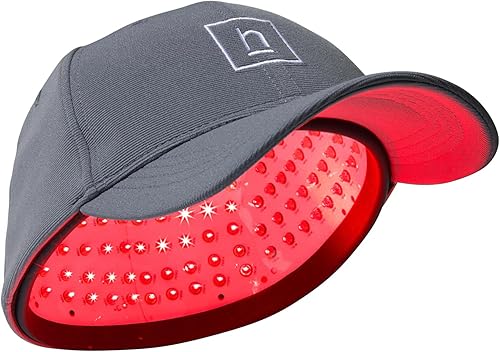
Hairmax PowerFlex 272 Laser Cap
$1,449
"FDA-cleared laser-cap listing with the lowest laser-cap price in this set, though Amazon sentiment is mixed at 3.4/5 across 60 ratings."
What real Amazon buyers say
3.4★· 60 reviews"I purchased the Hairmax Laser Hair Growth Cap in October 2022 following my hair transplant, in hopes to expedite the regrowth process and strengthen my new grafts."
"It worked great but stopped working only 14 months after using it and the warranty is only for a year."

Capillus
Capillus SPECTRUM Laser Red Light Therapy Cap
$2,199
"Premium laser-cap option with 312-laser positioning, Bluetooth app copy, and 4.0/5 across 18 Amazon ratings in the snapshot."
What real Amazon buyers say
4.0★· 18 reviews"It's a really good (expensive) cap. A bit big on my head but that is to fit all the separate light nodes. Only 6 minutes and done!"
"It's very comfortable, feels just like wearing a regular hat, and only takes a few minutes a day, which makes it easy to stay consistent."

GUGUG
GUGUG Skin Scrubber Face Spatula
$16.99
"Largest Amazon rating pool in this article at 4.0/5 across 32,179 ratings; best framed as a low-cost cleansing and exfoliation tool rather than a fine-line device."

UNIWA
UNIWA Skin Scrubber Face Spatula
$16.99
"Low-cost ultrasonic spatula listing with 4.0/5 across 72 Amazon ratings, LCD display, and IPX6 waterproof positioning."

Bio-Therapeutic
Bio-Therapeutic bt-Micro Fusion Ultrasonic Skin Exfoliation Tool
$165.75
"Higher-priced scrubber from a professional-device brand with 4.1/5 across 181 Amazon ratings; still better supported for exfoliation than wrinkle reversal."