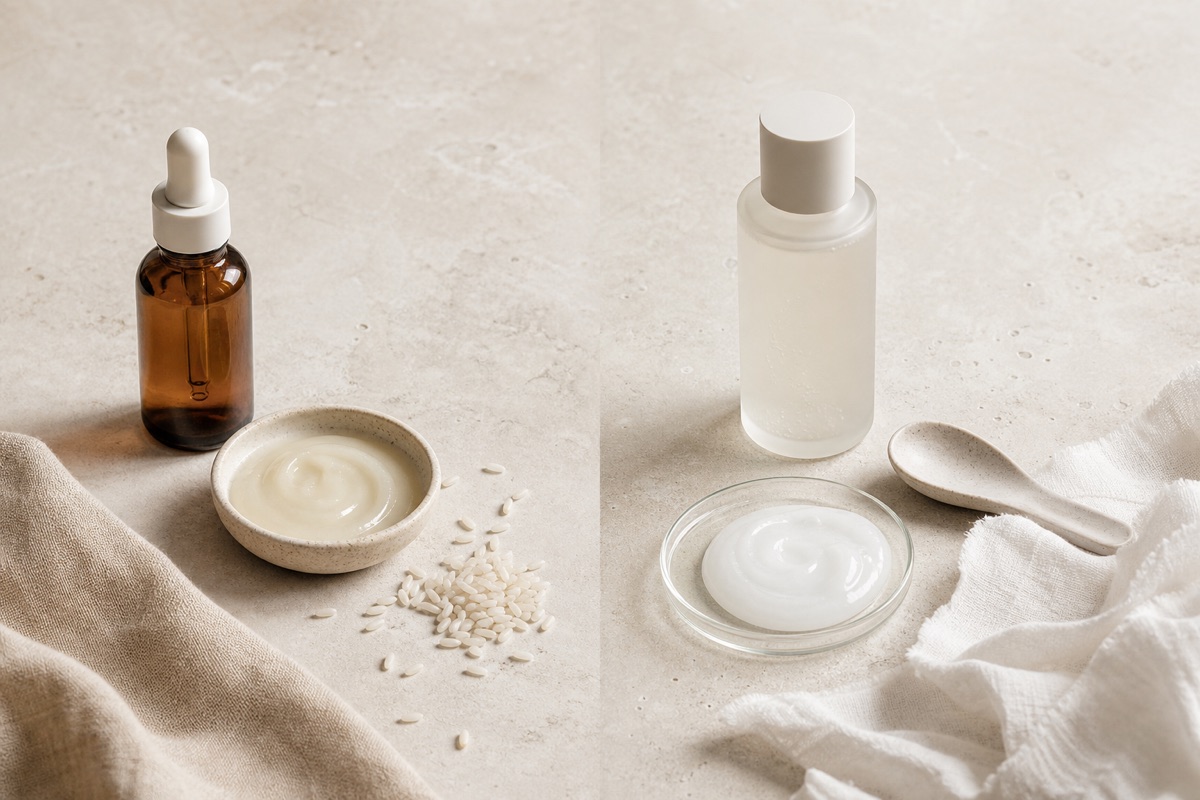
Kojic Acid Products vs Lactic Acid Products for Fine Lines
Evidence-weighted comparison of kojic acid products and lactic acid products for fine lines, dark spots, dullness, Amazon ratings, value, and sensitive skin.
We analyzed 10 sources, including the 74-subject JAAD alpha hydroxy acid photoaging study, FDA AHA safety guidance, 5 PubMed kojic-acid and hyperpigmentation reviews, and Amazon US snapshots across 6 products. Lactic acid is better supported for fine lines; kojic acid is the more targeted dark-spot choice.
| Criterion | Kojic acid products Brightening product category $8 | Lactic acid products AHA exfoliant category $9.20 |
|---|---|---|
| Fine-line evidence How directly the published evidence addresses photoaging, surface smoothing, wrinkles, or fine-line appearance. | 5.9/10 | 8.5/10 |
| Hyperpigmentation evidence How directly the cited literature and ingredient reviews address melasma, dark spots, post-blemish marks, and uneven tone. | 8.4/10 | 6.4/10 |
| Amazon rating volume Representative Amazon US rating depth across three products per side, using visible rating counts captured for this article. | 7.5/10 | 8.9/10 |
| Price and value Visible Amazon US pricing relative to format, routine frequency, size, and strength of evidence for the shopper's goal. | 8.2/10 | 8.4/10 |
| Sensitive-skin tolerability Lower likelihood of stinging, over-exfoliation, barrier disruption, or sun-sensitivity problems scores higher. | 7.3/10 | 6.4/10 |
| Typical user fit How clearly each category fits common concerns for women 35-55: fine lines, dullness, discoloration, texture, and sensitivity. | 7.5/10 | 8.1/10 |
| Overall evidence strength Balance of clinical relevance, safety guidance, Amazon rating depth, ingredient logic, and US availability. | 7.4/10 | 8.2/10 |
| Overall score | 7.46 | 7.84 |
🏆 Winner: Lactic acid products for fine lines; kojic acid products for dark spots
Lactic acid wins the fine-line question because PubMed-indexed AHA literature includes a 74-subject photoaging study and FDA AHA guidance directly covers lactic acid as an exfoliating alpha hydroxy acid. Kojic acid scores higher for hyperpigmentation because PubMed reviews from 2020 and 2022 discuss kojic acid as a pigment-focused ingredient rather than a wrinkle active.
Best on a budget
The Ordinary Lactic Acid 10% + HA 2% for fine-line and dullness value; Good Molecules Brightening and Dark Spots Bar for a low-cost kojic-acid dark-spot routine.
Best for results
Lactic acid products for fine lines, dullness, and rough texture; kojic acid products for dark spots, post-blemish marks, and uneven tone.
Quick answer
For fine lines, lactic acid has the stronger evidence trail. The 74-subject JAAD alpha hydroxy acid study cited in our sources looked at photoaged skin, and FDA alpha hydroxy acid guidance explicitly includes lactic acid. Kojic acid is better treated as a dark-spot and uneven-tone ingredient; the cited 2020 and 2022 PubMed reviews place it in the hyperpigmentation conversation, not the wrinkle-treatment lane.
The practical answer for a US shopper 35-55: choose lactic acid if your main concern is fine lines that look worse with dullness, rough texture, or makeup settling. Choose kojic acid if your main concern is brown spots, post-blemish marks, or uneven tone and you already tolerate exfoliation poorly. If you have both concerns, do not start both at once; build a routine that gives each active enough space to work without upsetting the barrier.
What each category is trying to do
Kojic acid and lactic acid are often grouped together because both appear in brightening routines, but they do different jobs. Kojic acid is usually used for the look of discoloration. In the PubMed sources cited here, kojic acid appears in the context of melasma, facial hyperpigmentation, and pigment pathways. That makes it a logical match for sun spots, old blemish marks, and mottled tone that can become more visible in the 40s and 50s.
Lactic acid is an alpha hydroxy acid. Its strongest cosmetic fit is surface renewal: smoothing the look of rough texture, loosening dull surface cells, and making fine lines appear less etched because the surface reflects light more evenly. The FDA’s alpha hydroxy acid page names lactic acid and warns that AHAs can increase sun sensitivity. That warning matters for every shopper, but it matters more if your routine already includes retinoids, vitamin C, peel pads, or a prescription active.
Neither category is a substitute for sunscreen, retinoids, or an in-office dermatology plan when discoloration or wrinkles are significant. But for over-the-counter skincare, the evidence split is clear: lactic acid has the better fine-line rationale, while kojic acid has the better discoloration rationale.
Evidence comparison: fine lines
Fine lines are where lactic acid pulls ahead. The JAAD alpha hydroxy acid study by Ditre and colleagues included 74 subjects with photoaged skin, and the cited 1997 JAAD report also discusses AHA effects on photoaged skin. That does not mean every lactic acid product on Amazon will transform lines. It does mean the category has direct relevance to the surface changes shoppers usually call fine lines: dullness, roughness, and uneven texture.
Kojic acid does not have the same wrinkle-specific evidence base in the sources we reviewed. The cited PubMed reviews discuss kojic acid as a cosmeceutical for hyperpigmentation and melasma. That is still valuable for mature skin because dark spots and uneven tone can make skin look older even when lines are mild. But if the search query is specifically fine lines, kojic acid is an indirect player.
Our scoring reflects that split. Lactic acid scored 8.5/10 for fine-line evidence because the literature and FDA category guidance are aligned with photoaging and exfoliation. Kojic acid scored 5.9/10 for fine-line evidence because it can improve the look of overall tone, but the ingredient’s published role is not primarily wrinkle smoothing.
Evidence comparison: dark spots and dullness
Kojic acid is more persuasive for dark spots. The 2020 Dermatol Ther review by Searle and colleagues covers top cosmeceuticals for facial hyperpigmentation, and the 2020 Skinmed article by Zachary and colleagues focuses specifically on kojic acid for melasma. Those sources support kojic acid as a pigment-focused ingredient, especially when a product is designed for uneven tone rather than simply added as marketing dust.
Lactic acid can still help dullness. Exfoliation removes surface buildup, which can make tone look brighter and makeup sit more smoothly. But it is not as targeted for pigment pathways. For a woman in her 40s or 50s with both dullness and brown spots, lactic acid can improve the look of the surface while kojic acid addresses the tone concern more directly.
This is why the winner depends on the main complaint. If the problem is “my foundation catches on texture and my smile lines look dry,” lactic acid is the better first move. If the problem is “my cheeks have lingering dark marks and sun spots,” kojic acid deserves the first slot, usually with a barrier-supporting moisturizer and daily sunscreen.
Amazon US signal and product availability
Amazon rating volume is not clinical evidence, but it is useful for spotting whether a product has enough real-world user signal to be worth analyzing. On the lactic acid side, the three representative products in our sources show especially deep rating volume: The Ordinary Lactic Acid 10% + HA 2% has 7,693 visible Amazon ratings, Sunday Riley Good Genes has 3,233, and AmLactin Daily Nourish 12% Lactic Acid Lotion has 35,429.
The kojic acid side is more mixed but still useful. Dr. Melaxin Peel Shot Kojic Acid Turmeric Serum shows 12,023 visible Amazon ratings, Medicube Kojic Acid Turmeric Capsule Serum shows 1,624, and Good Molecules Brightening and Dark Spots Bar shows 2,858. That gives kojic acid enough user signal for a serious comparison, though the category includes more soaps, bars, and multi-active blends than simple single-active serums.
Format matters. Lactic acid products are often leave-on liquids, treatments, or lotions. Kojic acid products are often bars, brightening serums, or formulas combined with niacinamide, turmeric, tranexamic acid, azelaic derivatives, or exfoliating acids. That makes kojic acid harder to judge as a standalone ingredient because the final result may come from the blend, not kojic acid alone.
Tolerability for women 35-55
The tolerability question is not as simple as “kojic acid is gentle” and “lactic acid is harsh.” A low-strength lactic acid used once weekly may be easier to tolerate than a heavily fragranced kojic soap used twice a day. A hydrating kojic serum may be easier than an AHA/BHA kojic peel serum. Formula and frequency matter more than the ingredient name on the front label.
Still, lactic acid carries a predictable exfoliation risk. The FDA notes that alpha hydroxy acids can increase sun sensitivity, and overuse can bring stinging, peeling, tightness, or a shiny compromised-barrier look. For mature skin, that matters because dryness and barrier fragility often increase during perimenopause and after menopause.
Kojic acid can irritate, too, especially in leave-on multi-active products. Bars can be drying if they are used like regular body soap on the face. Serums can sting if paired with too many brightening actives. But kojic acid is not inherently an exfoliant in the same way lactic acid is, so it can be easier to place in a routine when the goal is discoloration and the barrier is already reactive.
Price and value
Both categories have accessible Amazon options. The Ordinary Lactic Acid 10% + HA 2% is the lowest-price leave-on fine-line option in this comparison at a $9.20 snapshot, while Good Molecules Brightening and Dark Spots Bar is the lowest-price kojic option at an $8.00 snapshot. Price alone does not decide the winner; the better value is the product that fits the right job.
For fine lines, a low-cost lactic acid serum can be a better buy than a kojic product with a larger rating count because the ingredient category matches the concern more directly. For dark spots, a kojic serum or bar can be a better buy than a prestige lactic treatment because the claim is better aligned with pigment.
The prestige outlier is Sunday Riley Good Genes at a $68.00 snapshot. It has a strong Amazon rating average in our source set, but its value score is lower because the category has cheaper lactic acid alternatives. The body-care outlier is AmLactin Daily Nourish: its 35,429 visible Amazon ratings make it the deepest user-signal product here, but it is mainly a body lotion, not a face fine-line serum.
How to choose between them
Pick lactic acid if your fine lines look worse when skin is dull, rough, flaky, or makeup settles unevenly. Start with one night weekly, then move to two nights only if skin stays comfortable. Follow with a plain moisturizer. Do not stack it the same night as a strong retinoid, peel pad, or scrub when your barrier is already tight.
Pick kojic acid if dark spots, post-acne marks, or uneven tone are the bigger issue. A leave-on serum usually gives a more targeted routine than a rinse-off bar, but bars can make sense for body discoloration or shoppers who dislike serums. Avoid using a kojic bar as an aggressive facial cleanser twice daily if your skin is dry or easily flushed.
Use both only if you can tolerate a slow schedule. A reasonable split is kojic acid most nights and lactic acid 1 night weekly, or lactic acid once weekly and kojic acid on non-exfoliation nights. If redness, stinging, new flaking, or a tight shiny look appears, pause the acid step first.
Side-by-side verdict
Lactic acid wins for fine lines because the evidence is more direct. The cited 74-subject JAAD AHA study, the 1997 JAAD AHA report, and FDA AHA guidance all support lactic acid as part of the exfoliating acid category relevant to photoaged texture. It is not a facelift in a bottle, but it is the more logical over-the-counter choice for surface lines and dullness.
Kojic acid wins for dark spots because the cited PubMed reviews place it in the hyperpigmentation category. It is the better choice when the shopper is not mainly worried about lines but about uneven tone that makes the face look tired or blotchy.
For many women 35-55, the best answer is not either-or. It is sequence and restraint: sunscreen every morning, one tone-focused product if spots are the problem, one exfoliating night if texture is the problem, and a moisturizer that keeps the barrier calm enough for either active to work.
FAQs
Is kojic acid or lactic acid better for fine lines?
Lactic acid is better supported for fine lines. Our sources include a 74-subject JAAD alpha hydroxy acid study and FDA AHA guidance that directly covers lactic acid. Kojic acid is better supported for hyperpigmentation, not wrinkle smoothing.
Can kojic acid fade dark spots faster than lactic acid?
Kojic acid is the more targeted dark-spot choice based on the cited PubMed hyperpigmentation reviews. Lactic acid can make skin look brighter by exfoliating dull surface cells, but that is not the same as targeting pigment pathways.
Can I use kojic acid and lactic acid in the same routine?
Yes, but not all at once. Start one product for 2 to 3 weeks before adding the other. Most sensitive or mature skin does better with lactic acid 1 night weekly and kojic acid on separate nights, rather than layering both in the same routine.
Which is safer for sensitive skin?
Neither is automatically safer. A gentle kojic serum may be easier than a strong lactic acid peel, but a drying kojic bar can be harsher than a low-frequency lactic acid serum. If your skin stings easily, choose the simpler formula and introduce it slowly.
Do I need sunscreen with kojic acid or lactic acid?
Yes. Sunscreen is essential for discoloration routines, and FDA AHA guidance specifically warns that alpha hydroxy acids can increase sun sensitivity. Without daily sunscreen, both dark spots and fine-line texture can look more persistent.
Related reading
Both winners on Amazon

The Ordinary
The Ordinary Lactic Acid 10% + HA 2%
$9.20
"Lactic-acid value representative with 4.6/5 across 7,693 visible Amazon ratings and the strongest fine-line evidence match among the six products."
What real Amazon buyers say
4.6★· 7,693 reviews"As a 40-something year old mom juggling kids, work, and everything in between, I don't have time (or budget!) for complicated skincare routines."
"I alternate this and 0.25% tretinoin every other day and it has been the perfect combo for my acne prone, very fair, very sensitive skin."

Medicube
Medicube Kojic Acid Turmeric Clarifying and Balancing Capsule Serum
$18.90
"Leave-on kojic-acid serum representative with 4.5/5 across 1,624 visible Amazon ratings and a serum format that suits tone-focused routines."
What real Amazon buyers say
4.5★· 1,624 reviews"For anyone with dry, mature, or sensitive skin who wants to improve brightness without irritation, this is a very strong option."

Good Molecules
Good Molecules Brightening and Dark Spots Bar
$8
"Low-cost kojic-acid bar with tranexamic acid, niacinamide, and an Amazon snapshot of 4.3/5 across 2,858 ratings."
What real Amazon buyers say
4.3★· 2,858 reviews"After about two weeks of consistent use, I began to notice gradual but visible improvements."
"It has no discernible smell (I don't tolerate fragrance), does not strip moisture (I'm quite dry at the moment, winter here still), lathers nicely."

Sunday Riley
Sunday Riley Good Genes All-in-One Lactic Acid Treatment
$68
"Prestige lactic-acid treatment representative with 4.6/5 across 3,233 visible Amazon ratings and a texture-smoothing product position."

Dr. Melaxin
Dr. Melaxin Peel Shot Kojic Acid Turmeric Serum
$19
"Exfoliating kojic-acid serum with AHA/BHA, niacinamide, and 4.3/5 across 12,023 visible Amazon ratings in the snapshot."

AmLactin
AmLactin Daily Nourish 12% Lactic Acid Lotion
$11.97
"Body-focused lactic-acid lotion with the deepest rating volume in this comparison: 4.4/5 across 35,429 visible Amazon ratings."