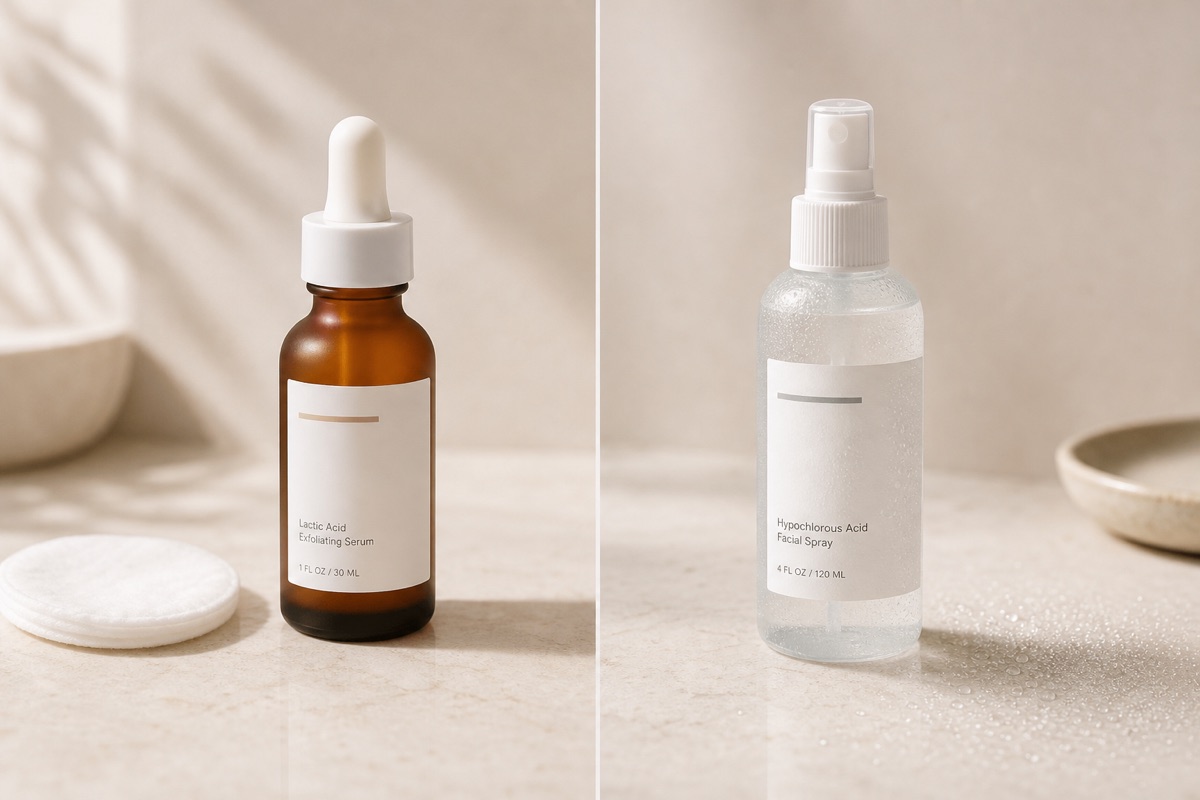
Lactic Acid Products vs Hypochlorous Acid Sprays for Fine Lines
Evidence-weighted comparison of lactic acid products and hypochlorous acid sprays for fine lines, dullness, hot-flash flushing, hormonal acne, value, and tolerability.
We analyzed 2 PubMed AHA sources, FDA alpha hydroxy acid guidance, 3 PubMed hypochlorous acid reviews, and Amazon US snapshots across 6 products. Lactic acid is better supported for fine lines and dullness; hypochlorous acid sprays better fit hot-flash flushing, sweat, and hormonal-acne routines.
| Criterion | Lactic acid products AHA exfoliant category $9.20 | Hypochlorous acid sprays Redness and breakout-support spray category $17.99 |
|---|---|---|
| Fine-line evidence How directly published evidence addresses photoaging, surface smoothing, wrinkles, or fine-line appearance. | 8.4/10 | 3.6/10 |
| Dullness and texture payoff How strongly the category supports exfoliation, glow, smoother texture, or a fresher surface appearance. | 8.7/10 | 4.4/10 |
| Hot-flash and redness fit How well the format fits flushing, sweat, post-workout use, and reactive skin moments without adding heavy layers. | 5.2/10 | 8.8/10 |
| Hormonal-acne routine fit Usefulness when breakouts are linked to sweat, oil, occlusion, shaving, mask friction, or cycle-related flare patterns. | 6.6/10 | 8.5/10 |
| Amazon rating volume Representative Amazon US rating depth across three products per side, using visible rating counts captured for this article. | 7.9/10 | 8.6/10 |
| Price and value Visible Amazon US price relative to size, likely frequency, and evidence strength for the shopper's primary concern. | 8.5/10 | 8.1/10 |
| Sensitive-skin tolerability Lower likelihood of stinging, peeling, over-exfoliation, sun-sensitivity problems, or barrier disruption scores higher. | 6.2/10 | 8.9/10 |
| Overall evidence strength Balance of clinical relevance, safety guidance, Amazon review depth, ingredient logic, and practical US availability. | 8.2/10 | 7.5/10 |
| Overall score | 7.46 | 7.30 |
🏆 Winner: Lactic acid products for fine lines; hypochlorous acid sprays for hot-flash flushing and hormonal-acne support
Lactic acid wins the fine-line question because the cited PubMed AHA literature includes a 74-subject photoaging study and FDA guidance directly identifies lactic acid as an alpha hydroxy acid. Hypochlorous acid sprays win tolerability and routine-fit categories: SkinSmart, Tower 28, and Prequel total 18,862 Amazon ratings in the May 2026 snapshot and fit sweat, flushing, and breakout-prone routines better than wrinkle care.
Best on a budget
The Ordinary Lactic Acid 10% + HA 2% for fine-line and dullness value; Prequel Universal Skin Solution for a lower-priced hypochlorous-acid face spray.
Best for results
Lactic acid products for fine lines, rough texture, and dullness; hypochlorous acid sprays for redness-prone, sweaty, hormonal-acne, or hot-flash flushing routines.
Quick verdict
For fine lines, lactic acid products are the better-supported category. The strongest source is the 74-subject Journal of the American Academy of Dermatology alpha hydroxy acid study by Ditre et al., which looked at photoaged skin using clinical, histologic, and ultrastructural assessment. FDA alpha hydroxy acid guidance also names lactic acid and warns that AHA products can increase sun sensitivity.
Hypochlorous acid sprays answer a different problem. The PubMed sources in this article discuss topical hypochlorous acid in dermatology, wound-care, and antiseptic contexts, not as a wrinkle or collagen active. In BeautySift’s May 2026 Amazon US snapshot, the three hypochlorous products here total 18,862 ratings: SkinSmart at 12,872, Tower 28 at 4,834, and Prequel at 1,156. That is meaningful user adoption, but the routine fit is calming, post-sweat cleansing, and redness management rather than fine-line remodeling.
The practical answer: choose lactic acid if your main concern is fine lines, dullness, rough texture, or makeup sitting in dry patches. Choose hypochlorous acid if hot flashes, sweat, hormonal-acne flare patterns, or reactive redness are making your skin feel hard to manage during the day.
What lactic acid does differently
Lactic acid is an alpha hydroxy acid. In cosmetic products, its role is exfoliation: it helps loosen dead surface cells so skin looks smoother and less dull. That mechanism is why lactic acid earns an 8.4 score for fine-line evidence and an 8.7 score for dullness and texture in this comparison. It is not a retinoid, injectable, or prescription treatment, but it has more direct relevance to photoaged surface texture than hypochlorous acid.
The Amazon US product mix reflects that fine-line and texture positioning. The Ordinary Lactic Acid 10% + HA 2% shows 4.6/5 across 7,693 ratings at $9.20 in our snapshot. The Ordinary Lactic Acid 5% + HA 2% shows 4.6/5 across 7,878 ratings at $8.10. Sunday Riley Good Genes shows 4.6/5 across 3,233 ratings at $68.00. Those three products total 18,804 visible Amazon ratings, almost the same order of magnitude as the hypochlorous-acid side.
The trade-off is irritation. Lactic acid is usually considered gentler than glycolic acid because its molecule is larger, but it is still an exfoliating acid. The FDA AHA guidance specifically warns about increased sun sensitivity. For women 35-55, that matters because fine lines, discoloration, dryness, and barrier reactivity often overlap. A product that makes skin peel can make makeup sit worse and can make dark spots look more persistent if sunscreen is inconsistent.
What hypochlorous acid sprays do differently
Hypochlorous acid sprays are non-exfoliating water-based sprays. They are typically used after cleansing, after sweating, after workouts, after mask wear, or during irritated-skin moments when a cream layer feels like too much. The cited PubMed hypochlorous-acid sources support dermatology-adjacent relevance, but they do not prove that a facial mist reduces fine lines. That is why hypochlorous acid scores 3.6 for fine-line evidence and 4.4 for dullness and texture.
Where sprays win is tolerability and timing. SkinSmart’s Amazon snapshot shows 4.7/5 across 12,872 ratings at $17.99. Tower 28 SOS shows 4.6/5 across 4,834 ratings at $28.00, and the brand’s US page positions it as a hypochlorous-acid facial spray. Prequel Universal Skin Solution shows 4.4/5 across 1,156 ratings at $16.99, and the brand’s US page gives routine guidance for a hypochlorous-acid skin solution.
That makes hypochlorous acid especially relevant for hot flashes and hormonal acne. A hot flash can leave skin damp, red, and prickly at exactly the moment you do not want to touch your face. A spray can be used at a desk, in a gym bag, or after a humid commute without adding another serum. For hormonal-acne patterns, hypochlorous acid is not a replacement for benzoyl peroxide, salicylic acid, adapalene, or a dermatologist’s plan, but it can fit the low-residue support slot when sweat and friction are part of the flare pattern.
Scorecard: fine lines, dullness, acne, and tolerability
Lactic acid wins the primary query by a wide margin: 8.4 to 3.6 on fine-line evidence. The reason is source relevance. The PubMed AHA study includes 74 subjects with photoaged skin, while the hypochlorous-acid PubMed sources focus on topical antimicrobial and dermatology uses, not cosmetic wrinkle outcomes. Lactic acid also wins dullness and texture, 8.7 to 4.4, because exfoliation directly targets the surface buildup that can make mature skin look flat.
Hypochlorous acid wins hot-flash and redness fit, 8.8 to 5.2. It also wins hormonal-acne routine fit, 8.5 to 6.6, because a non-sticky spray is easier to use after sweating, mask friction, or midday flushing. This is a routine-fit score, not a claim that hypochlorous acid treats acne. The difference is important: BeautySift is aggregating public evidence and user signals, not making drug claims.
Amazon rating volume is close. The three lactic acid products total 18,804 ratings, while the three hypochlorous-acid sprays total 18,862 ratings in the article snapshot. Rating volume does not prove efficacy, but it helps surface real-world adoption, complaint patterns, and pricing context. Lactic acid wins value for fine lines because The Ordinary’s 5% and 10% options sit under $10 in the snapshot. Hypochlorous acid wins tolerability, 8.9 to 6.2, because it is non-exfoliating and less likely to trigger peeling or sun-sensitivity problems.
Which category fits women 35-55 best?
For women in their late 30s, 40s, and 50s, the right answer depends on the day-to-day pattern. If fine lines show most when skin looks dull, makeup clings to dry patches, or texture feels rough around the cheeks and mouth, lactic acid is the more logical first purchase. Start lower if your skin is reactive: The Ordinary’s 5% lactic acid option is a more cautious entry point than a 10% serum or a prestige treatment.
If fine lines are not the only issue, the answer changes. Perimenopause can bring hot flashes, warmer skin, surprise sweat, and breakouts that feel more inflammatory than they did in your 20s. In that pattern, hypochlorous acid may be the more useful daily tool even though it is not the better fine-line ingredient. It gives you a low-residue way to refresh skin after sweat without adding an exfoliant at the wrong time.
For sensitive skin, think of lactic acid as the scheduled active and hypochlorous acid as the flexible support step. Lactic acid belongs in a planned evening routine, usually 1 or 2 nights weekly at first, followed by moisturizer. Hypochlorous acid can sit near cleansing, workouts, or hot-flash moments. If you use both, let the spray dry before applying leave-on treatments.
Product-side read: three picks per category
On the lactic acid side, The Ordinary Lactic Acid 10% + HA 2% is the strongest value representative because it pairs a low snapshot price, 4.6/5 Amazon rating, and 7,693-rating volume. The 5% version has similar Amazon rating depth at 7,878 ratings and makes more sense if you have dryness, rosiness, or a history of over-exfoliation. Sunday Riley Good Genes is the prestige option at $68.00, which may appeal if you prefer a treatment texture and do not mind paying more for the experience.
On the hypochlorous-acid side, SkinSmart is the rating-volume leader with 12,872 Amazon ratings and the lowest price among the three spray contenders used in the scorecard. Tower 28 is the more beauty-coded facial mist, with official US brand positioning and 4,834 Amazon ratings. Prequel is the derm-founded value-luxury crossover at $16.99 with 1,156 ratings. All three are better framed as redness, sweat, and breakout-support tools than as fine-line products.
The clean shopping decision is not “which acid is stronger.” It is “which problem am I trying to solve first?” Lactic acid has the better claim for fine lines and dullness because exfoliation and photoaging evidence line up. Hypochlorous acid has the better claim for tolerability, hot-flash practicality, and hormonal-acne support because it is quick, non-exfoliating, and easy to use when skin feels reactive.
How to use them without overdoing it
If you choose lactic acid, begin with one night per week for two weeks, then move to two nights only if skin stays comfortable. Use moisturizer after it, and do not stack it on the same night as a strong retinoid, peel pad, or another exfoliating acid unless a clinician has given you a specific plan. The FDA AHA guidance is the reason sunscreen is not optional here: morning broad-spectrum SPF matters when exfoliating acids are in the routine.
If you choose hypochlorous acid, use it after cleansing, after sweating, or when skin feels flushed. Spray, let it dry, then follow with moisturizer or sunscreen depending on time of day. Do not use the spray as an excuse to skip cleansing at night after makeup or sunscreen. It is a support step, not a full routine.
If you use both, separate their jobs. Hypochlorous acid can live in the daytime or post-sweat slot. Lactic acid should live in a controlled evening slot. That separation gives a 35-55 shopper the best chance of getting the visible smoothness benefit of lactic acid without turning every hot-flash or breakout moment into another irritation trigger.
Bottom line
For the primary query, lactic acid products beat hypochlorous acid sprays for fine lines. The scorecard favors lactic acid because the cited PubMed AHA literature and FDA AHA guidance are more directly connected to photoaged texture, dullness, and surface renewal. Hypochlorous acid sprays remain useful, but their evidence-weighted role is different: they are better for flushing, sweat, redness-prone skin, and hormonal-acne support.
If your skin is dry, dull, and textured, buy a lactic acid product first and use it slowly. If your skin is reactive, sweaty, breakout-prone, or easily flushed, buy a hypochlorous acid spray first and treat fine lines with sunscreen, moisturizer, and a separate active you can tolerate. Many routines can include both, but they should not be treated as interchangeable acids.
Related reading
Both winners on Amazon

The Ordinary
The Ordinary Lactic Acid 10% + HA 2%
$9.20
"Lactic-acid face-serum representative with 4.6/5 across 7,693 visible Amazon ratings and the lowest facial-product price in this comparison."
What real Amazon buyers say
4.6★· 7,693 reviews"As a 40-something year old mom juggling kids, work, and everything in between, I don't have time (or budget!) for complicated skincare routines."
"I alternate this and 0.25% tretinoin every other day and it has been the perfect combo for my acne prone, very fair, very sensitive skin."

SkinSmart
SkinSmart Antimicrobial Facial Cleanser
$17.99
"Hypochlorous-acid high-volume representative with 4.7/5 across 12,872 visible Amazon ratings in the snapshot."
What real Amazon buyers say
4.7★· 12,872 reviews"The spray is super easy to use and feels refreshing on the skin."
"No irritation or drying and it seems to have limited ingredients."

Tower 28
SOS Daily Rescue Facial Spray
$28
"Beauty-focused hypochlorous-acid mist with 4.6/5 across 4,834 visible Amazon ratings and strong US brand recognition."
What real Amazon buyers say
4.6★· 4,834 reviews"This facial spray has been a game changer for my sensitive skin. It feels extremely gentle and soothing, especially during flare ups, redness, or irritation."
"My teenager loves it! It helps her skin a lot, so we have have it on subscription."

The Ordinary
The Ordinary Lactic Acid 5% + HA 2%
$8.10
"Lower-strength lactic-acid option with 4.6/5 across 7,878 visible Amazon ratings; a more cautious entry point than 10% AHA."

Prequel
Universal Skin Solution Hypochlorous Acid Spray
$16.99
"Derm-founded hypochlorous-acid spray with 4.4/5 across 1,156 visible Amazon ratings and a lower price than many beauty mists."

Sunday Riley
Sunday Riley Good Genes All-in-One Lactic Acid Treatment
$68
"Prestige lactic-acid treatment representative with 4.6/5 across 3,233 visible Amazon ratings; strongest fit for shoppers who prefer a treatment-step feel."