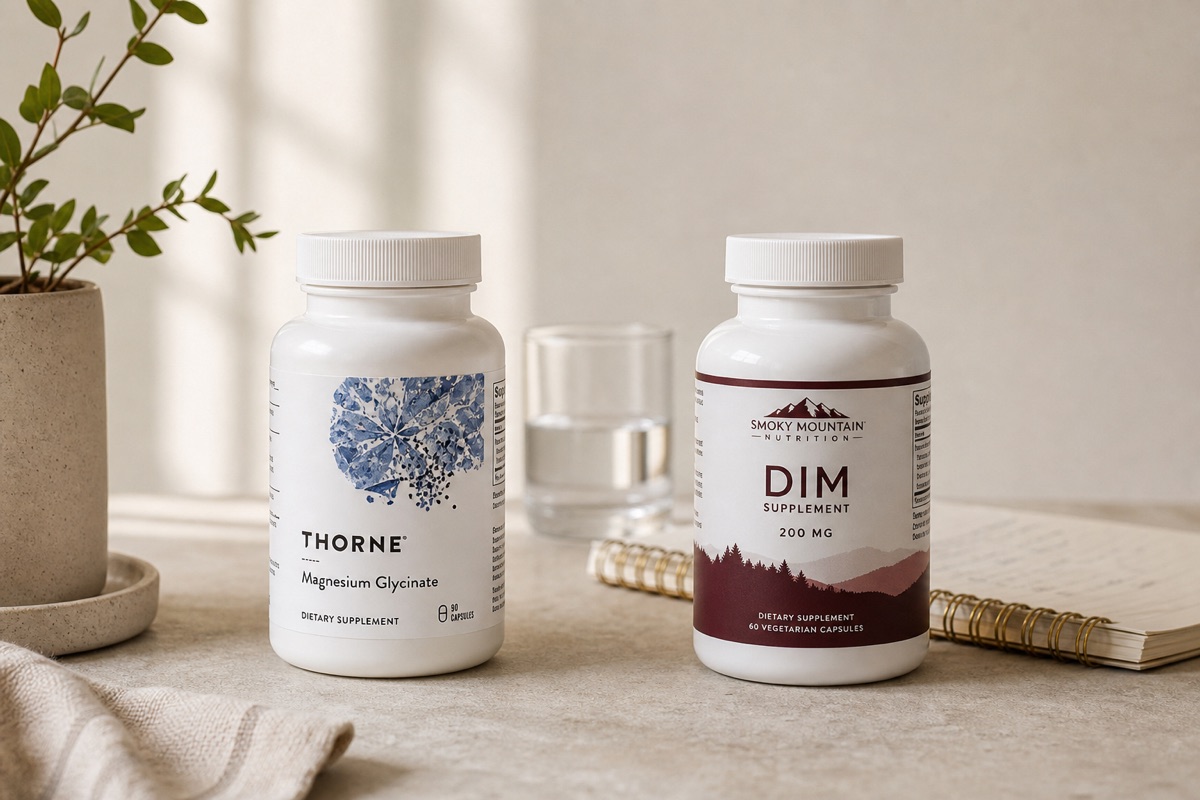
Magnesium Glycinate Sleep vs DIM Supplements: Head-to-Head
Evidence-weighted comparison of magnesium glycinate for sleep and DIM supplements for perimenopause, hormonal acne, hot flashes, price, and tolerability.
We analyzed 68,132 Amazon US ratings across 6 representative supplements, 4 PubMed clinical reviews or trials, and FDA supplement guidance. Magnesium glycinate is the stronger sleep-first pick; DIM is more targeted to estrogen-metabolism and hormonal-acne shoppers.
| Criterion | 🏆 Winner Magnesium glycinate sleep supplements Multi-brand category $19.32 | DIM supplements Multi-brand category $20.45 |
|---|---|---|
| Ingredient evidence Peer-reviewed fit between the active category and the shopper's stated goal: sleep quality for magnesium glycinate, estrogen-metabolism support for DIM. | 8.0/10 | 7.2/10 |
| Amazon rating volume Representative Amazon US rating volume across three products per side: 12,811 magnesium ratings and 36,956 DIM ratings. | 7.4/10 | 8.6/10 |
| Price value Representative Amazon basket averages: $19.32 for magnesium glycinate and $20.45 for DIM. Lower cost per bottle earns a modest advantage. | 8.1/10 | 7.8/10 |
| Tolerability Ingredient-format tolerance based on common supplement considerations, review language, and need for clinician oversight around hormone-sensitive histories. | 8.0/10 | 6.6/10 |
| Sleep-first fit How directly the category matches the query of sleep disruption without relying on hormone-metabolism claims. | 8.4/10 | 5.2/10 |
| Hormonal-acne fit How directly the category is positioned for oiliness, hormonal acne, and estrogen-metabolism concerns. | 4.4/10 | 7.9/10 |
| Hot-flash fit How plausible the category is for perimenopause comfort without overstating evidence for vasomotor symptoms. | 5.8/10 | 6.4/10 |
| Overall score | 7.16 | 7.10 |
🏆 Winner: Magnesium glycinate sleep supplements
Magnesium glycinate wins for the primary sleep query because it leads sleep-first fit 8.4 to 5.2 and tolerability 8.0 to 6.6, supported by 2023 and 2021 PubMed systematic reviews on magnesium and sleep. DIM has the larger Amazon signal in this set, 36,956 ratings versus 12,811 for magnesium, and wins hormonal-acne fit 7.9 to 4.4, but its best use case is estrogen-metabolism support, not a direct sleep aid.
Best on a budget
Double Wood DIM Supplement for the lowest listed DIM price; Magnesium Glycinate 500mg for the lowest magnesium-side price in this evidence set
Best for results
Magnesium glycinate for sleep-first routines; DIM for shoppers specifically researching estrogen metabolism, cyclical oiliness, or hormonal-acne patterns
Bottom line
Choose magnesium glycinate if the problem you want to solve first is sleep quality. Choose DIM if your main concern is a hormone-pattern skin or perimenopause question, especially cyclical oiliness, jawline breakouts, or estrogen-metabolism language you have already discussed with a clinician. The two categories are often marketed to the same 35-55 shopper, but they are not interchangeable.
BeautySift analyzed 68,132 Amazon US ratings across six representative supplements: three magnesium glycinate products and three DIM products. We also weighted PubMed evidence differently for each category. Arab A et al. 2023 reviewed magnesium and sleep health, while Mah J and Pitre T 2021 reviewed oral magnesium supplementation for insomnia in older adults. For DIM, Godinez-Martinez E et al. 2023 studied diindolylmethane supplementation in 60 premenopausal women, and Thomson CA et al. 2017 evaluated DIM in a randomized placebo-controlled biomarker trial.
The short version: magnesium has the more direct sleep evidence. DIM has the more direct estrogen-metabolism rationale. Neither should be treated like a prescription therapy for hot flashes, acne, insomnia, or hormone imbalance.
What magnesium glycinate is best at
Magnesium glycinate is the calmer, sleep-first category in this comparison. The form matters because glycinate is generally marketed as a better-tolerated magnesium form than oxide or citrate, which are more often associated with laxative effects. The Amazon evidence set supports that positioning without proving a clinical outcome: Magnesium Glycinate 500mg holds 4.7/5 across 5,539 Amazon ratings, Thorne Magnesium Glycinate holds 4.7/5 across 2,172 ratings, and Nature’s Bounty High Absorption Magnesium Glycinate holds 4.7/5 across about 5,100 ratings.
The PubMed evidence is not a blank check. The 2023 systematic review by Arab A et al. concluded that magnesium is relevant to sleep health, but the literature varies by population, dosage, baseline magnesium status, and study quality. The 2021 systematic review and meta-analysis by Mah J and Pitre T focused on older adults with insomnia and described limited evidence, not a guarantee that every bottle improves sleep.
For a perimenopause shopper, that nuance matters. If your nights are broken by stress, muscle tension, late caffeine, or the common “tired but wired” feeling, magnesium glycinate has a cleaner fit than DIM. If your awakenings are dominated by drenching night sweats or new heavy bleeding, the supplement aisle is not the right first stop.
What DIM supplements are best at
DIM, short for 3,3’-diindolylmethane, is a compound associated with cruciferous vegetables and estrogen-metabolism pathways. That is why DIM labels often mention estrogen balance, PMS, menopause support, or hormonal acne. In the Amazon evidence set, DIM has the bigger rating footprint: Smoky Mountain Nutrition DIM has 4.4/5 across 29,856 ratings, Double Wood DIM has 4.5/5 across about 1,100 ratings, and Nature’s Way DIM-Plus has 4.5/5 across about 6,000 ratings.
The PubMed evidence is more hormone-specific than sleep-specific. Godinez-Martinez E et al. 2023 evaluated DIM supplementation in 60 premenopausal women with estrogen-metabolite outcomes. Thomson CA et al. 2017 studied diindolylmethane in a randomized placebo-controlled setting for biomarker modulation. Those studies make DIM more relevant to estrogen-metabolism questions than magnesium, but they do not make DIM an acne medication or hot-flash treatment.
DIM also has more caveats. Amazon review language around DIM more often includes adjustment periods, headaches, cycle changes, or strong hormone-related expectations. That does not mean DIM is unsafe for every adult, but it does mean the category deserves more caution if you use hormonal contraception, menopausal hormone therapy, tamoxifen or other hormone-related medication, have a hormone-sensitive cancer history, are pregnant, or are trying to conceive.
Head-to-head scoring
Magnesium glycinate wins the sleep-first comparison. In our criteria table, magnesium leads sleep-first fit 8.4 to 5.2 and tolerability 8.0 to 6.6. That edge comes from the PubMed sleep literature and from the gentler supplement-positioning pattern we saw across Amazon reviews and labels.
DIM wins hormonal-acne fit, 7.9 to 4.4, because the category is explicitly tied to estrogen metabolism and hormonal-acne language in Amazon product positioning. It also wins Amazon rating volume, 8.6 to 7.4, because the three DIM products in this set account for 36,956 ratings versus 12,811 ratings for the magnesium set. Rating volume is useful for detecting broad shopper adoption, but it is not the same as proof that a supplement treats acne, hot flashes, or insomnia.
Price is close. The representative magnesium basket averages $19.32 across the three Amazon products cited in sources. The representative DIM basket averages $20.45. That is too small a difference to make price the deciding factor for most shoppers. The bigger decision is goal fit: sleep and relaxation versus estrogen-metabolism support.
Tolerability and safety considerations
The gentler default is magnesium glycinate, especially compared with higher-risk hormone-adjacent supplement claims. That said, magnesium is not automatically appropriate for everyone. People with kidney disease, those taking certain antibiotics or thyroid medication, and anyone already using multiple mineral supplements should ask a clinician or pharmacist about timing and dose.
DIM requires a more individualized screen. Because DIM is marketed around estrogen metabolism, it is not a casual add-on for every perimenopause routine. If your hot flashes, acne, or cycle changes are new, severe, or disruptive, the safer path is to get evaluated rather than using a supplement to guess at hormones. The FDA’s dietary-supplement guidance also matters here: supplements are regulated differently from drugs, and structure-function language on a label is not the same as FDA approval for a medical condition.
A practical tolerance read: start with the category that matches the least complicated goal. For sleep support, magnesium glycinate is usually the cleaner experiment. For hormonal acne or estrogen-metabolism support, DIM may be more relevant, but it has a narrower user fit and a higher need for medication and history checks.
Who should choose magnesium glycinate
Magnesium glycinate fits the shopper who says, “I need help winding down, and I want the simplest supplement option first.” It is also the better choice if you are sensitive to hormone-related claims, do not know whether your acne is hormone-driven, or want to avoid experimenting with estrogen-metabolism supplements.
Among the products we analyzed, the strongest value signal is the Magnesium Glycinate 500mg listing at $15.99 with 4.7/5 across 5,539 Amazon ratings. Thorne is the quality-positioned upgrade at $26.00 with 4.7/5 across 2,172 Amazon ratings. Nature’s Bounty is the mainstream brand option at $15.97 with about 5,100 ratings.
Skip magnesium as a self-directed fix if your sleep disruption is mainly from severe hot flashes, untreated anxiety, restless legs that needs evaluation, sleep apnea symptoms, or medication side effects. In those cases, magnesium may be a side note rather than the core answer.
Who should choose DIM
DIM fits the shopper who says, “My breakouts and body changes feel cyclical or hormone-patterned, and I am specifically researching estrogen metabolism.” It is more relevant to hormonal-acne language than magnesium, and it has the larger Amazon rating base in this comparison. Smoky Mountain Nutrition DIM is the rating-volume leader here at 4.4/5 across 29,856 ratings, while Double Wood is the lowest listed DIM price at $11.95.
The tradeoff is that DIM is less straightforward. It is not a sedative, not a sleep supplement, and not a guaranteed hot-flash solution. A user review on the Smoky Mountain Nutrition listing mentions reduced night sweats, while another long review mentions headaches during the adjustment period. That mixed pattern is exactly why DIM scores lower on tolerability than magnesium in this head-to-head.
Skip DIM unless your medication and hormone history are compatible. This is especially important if you use hormone therapy, have a history of hormone-sensitive conditions, take tamoxifen or similar medication, are pregnant, or are trying to conceive.
How to decide in one minute
If your top complaint is sleep, start with magnesium glycinate. If your top complaint is hormonal acne, cyclical oiliness, or estrogen-metabolism questions, research DIM more carefully and consider clinician input first. If your top complaint is hot flashes, neither category should be treated as the main evidence-based answer; look at cooling tools, lifestyle triggers, and medical options with stronger vasomotor-symptom data.
Also avoid stacking too quickly. Adding magnesium, DIM, ashwagandha, melatonin, and a menopause blend at the same time makes it hard to know what helped or what caused side effects. A cleaner approach is one change at a time, with a written note of sleep quality, hot flashes, breakouts, digestion, headaches, and cycle changes.
For many women in the 35-55 range, the more useful purchase is not the supplement with the loudest label. It is the product with the clearest reason to exist in your routine. Magnesium glycinate has that clarity when the goal is winding down at night. DIM has that clarity only when the question is specifically hormone-pattern skin or estrogen-metabolism support. If the label promises everything at once, treat that as a reason to slow down, not a reason to buy faster.
Related reading
Both winners on Amazon

Generic Amazon-listed magnesium glycinate
Magnesium Glycinate 500mg High Absorption
$15.99
"Budget magnesium-side pick with 4.7/5 across 5,539 Amazon ratings and a sleep, relaxation, muscle, bone, and heart-health positioning."
What real Amazon buyers say
4.7★· 5,539 reviews"This product has helped with sleep. Relaxation. I'm very happy with this magnesium glycinate. Have purchased it 3 times."
"I have bought and used other brands of Magnesium Clycinate for help with sleep with various results but this one is absolutely effective and wonderful!!!!"

Thorne
THORNE Magnesium Glycinate
$26
"Quality-focused magnesium glycinate with 4.7/5 across 2,172 Amazon ratings and third-party-certified positioning."
What real Amazon buyers say
4.7★· 2,172 reviews"This magnesium glycinate is easy to take and very gentle on the stomach compared to other forms. It absorbs well and is a great option for supporting relaxation, muscle comfort, and overall well-being."
"I bought the Thorne Magnesium Glycinate Capsules (90 servings) for $25 because I wanted a magnesium supplement that could support relaxation and better sleep as part of my nightly routine."

Smoky Mountain Nutrition
Smoky Mountain Nutrition DIM Supplement 200 mg
$23.95
"DIM-side rating leader in this evidence set: 4.4/5 across 29,856 Amazon ratings, with estrogen-balance, menopause, and hormonal-acne positioning."
What real Amazon buyers say
4.4★· 29,856 reviews"The headaches are gone and the night sweats are almost gone. If I sweat it's very minimal. My moods are wayyy better."
"I read the reviews and ordered it. I DID HAVE A HEADACHE FOR TWO WEEKS... even WITH eating enough and drinking more water than I normally do, but wanted so desperately for it to work."

Nature's Bounty
Nature's Bounty High Absorption Magnesium Glycinate 240 mg
$15.97
"Mainstream magnesium glycinate option with 4.7/5 across about 5,100 Amazon ratings and muscle, bone, heart, and nerve-health positioning."

Double Wood Supplements
Double Wood DIM Supplement
$11.95
"Lower-price DIM option with 4.5/5 across about 1,100 Amazon ratings and 200 mg per capsule positioning."

Nature's Way
Nature's Way DIM-Plus
$25.45
"Legacy DIM-plus formula with 4.5/5 across about 6,000 Amazon ratings and balanced-estrogen-metabolism positioning."