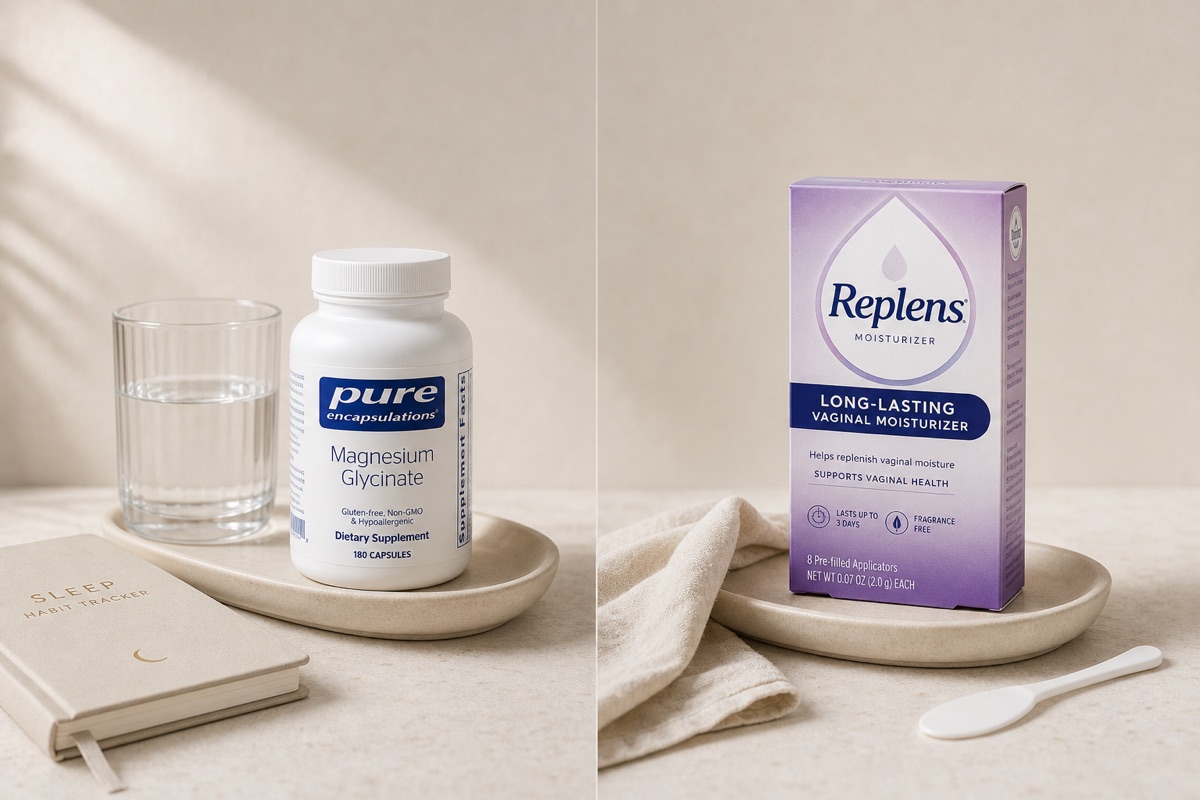
Magnesium Glycinate Sleep vs Vaginal Moisturizers for Sensitive Skin
Evidence-weighted comparison of magnesium glycinate sleep supplements and vaginal moisturizers for perimenopause dryness, sleep, and sensitive-skin fit.
We analyzed 84,036 Amazon ratings across 6 products, 3 PubMed sleep and GSM papers, NIH magnesium safety guidance, FDA supplement rules, and NAMS guidance. Vaginal moisturizers win for sensitive dryness; magnesium glycinate is an indirect sleep-support option, not a dryness fix.
| Criterion | Magnesium glycinate sleep supplements Multi-brand category $20.31 | 🏆 Winner Vaginal moisturizers Multi-brand category $25.14 |
|---|---|---|
| Direct fit for sensitive dryness How directly the category addresses vaginal dryness, friction discomfort, and sensitive-tissue comfort in perimenopause. | 2.8/10 | 8.8/10 |
| Sleep-support evidence How well the category matches sleep onset or overnight comfort, using PubMed evidence and product positioning. | 6.9/10 | 4.2/10 |
| Ingredient evidence Strength of evidence for the relevant active category: magnesium supplementation for sleep versus polycarbophil, hyaluronic acid, and pH-balanced moisturizers for vaginal dryness. | 5.9/10 | 8.2/10 |
| Sensitive-skin tolerability Penalizes GI side effects, fragrance, burning/stinging complaints, and need for dose or formula trial-and-error. | 7.1/10 | 7.8/10 |
| Amazon rating volume Representative Amazon US rating counts in this article: 66,754 magnesium ratings and 14,170 vaginal moisturizer ratings. | 9.0/10 | 7.6/10 |
| Value Representative basket average: $20.31 for magnesium glycinate and $25.14 for vaginal moisturizers, with vaginal products varying more by format. | 8.0/10 | 7.2/10 |
| User-fit clarity How easy it is for a shopper to know when the category is the right choice and when to skip it. | 6.4/10 | 8.5/10 |
| Overall score | 6.59 | 7.47 |
🏆 Winner: Vaginal moisturizers
Vaginal moisturizers win for sensitive-skin dryness because they are the direct category for the primary problem. NAMS 2020 supports nonprescription moisturizers and lubricants for mild GSM symptoms, and a 2022 trial in women age 45-55 found both polycarbophil and hyaluronic acid gels improved Vaginal Health Index scores over 30 days with no adverse events reported. Magnesium glycinate has larger Amazon rating volume in this basket, but PubMed sleep evidence is limited, indirect, and not specific to vaginal dryness.
Best on a budget
Replens Long-Lasting Vaginal Moisturizer for targeted dryness; Natrol Magnesium Glycinate if the purchase goal is sleep support under $15
Best for results
Vaginal moisturizers for dryness and comfort; magnesium glycinate only when sleep onset is the separate concern
Bottom line
For sensitive vaginal dryness, vaginal moisturizers are the more evidence-aligned choice. Magnesium glycinate can belong in a sleep routine, but it does not directly address vaginal tissue dryness, friction, or the burning-stinging cycle that can show up during perimenopause.
BeautySift analyzed 84,036 Amazon ratings across six representative Amazon US products, plus PubMed, NIH, FDA, NAMS, and ACOG sources. The score gap is clearest on direct fit: vaginal moisturizers score 8.8 for sensitive dryness, while magnesium glycinate scores 2.8. Magnesium leads on Amazon rating volume because supplements sell in broader categories, but rating volume is not the same as relevance to vaginal dryness.
The practical answer: choose a vaginal moisturizer when the problem is local dryness, discomfort with intimacy, or sensitive tissue that feels irritated by ordinary lubricants. Consider magnesium glycinate only when the separate problem is sleep onset or nighttime restlessness, and keep dose, drug interactions, and GI side effects in view.
What magnesium glycinate can and cannot do
Magnesium glycinate is an oral dietary supplement, not a vaginal dryness product. Its strongest consumer appeal is evening relaxation: the three magnesium products in this article represent 66,754 Amazon ratings, led by Pure Encapsulations Magnesium Glycinate at 4.7/5 across 47,900 ratings. That is a large user signal, but it does not prove a specific sleep result, and it says nothing direct about vaginal comfort.
The clinical sleep evidence is more modest than the supplement aisle suggests. Mah and Pitre’s 2021 PubMed meta-analysis included 3 randomized controlled trials and 151 older adults. It found sleep onset latency was 17.36 minutes shorter with oral magnesium versus placebo, but the authors rated the evidence low to very low. Abbasi et al. 2012 studied 46 older adults using 500 mg magnesium daily for 8 weeks and reported improvements in insomnia severity, sleep time, and sleep efficiency, but that trial was small and not magnesium glycinate-specific.
The safety framing matters for women 35-55. The NIH Office of Dietary Supplements lists the adult female magnesium RDA as 320 mg/day for age 31 and older and sets the adult tolerable upper intake level for supplemental magnesium at 350 mg/day. Some sleep studies used higher research doses, which is why this article does not treat 500 mg as a casual default. NIH also notes that supplemental magnesium can cause diarrhea, nausea, and abdominal cramping and can interact with antibiotics, bisphosphonates, diuretics, and proton pump inhibitors.
What vaginal moisturizers are built to do
Vaginal moisturizers are designed for the local dryness side of the question. They are not the same as arousal lubricants: moisturizers are typically used on a schedule to improve day-to-day comfort, while lubricants mainly reduce friction during sex. Many shoppers need both, but they are not interchangeable.
The guideline support is stronger here. The 2020 NAMS position statement says genitourinary syndrome of menopause can affect approximately 27% to 84% of postmenopausal women and lists nonprescription vaginal lubricants and moisturizers as options. NAMS also says nonhormone therapies available without prescription provide sufficient relief for most women with mild symptoms, while prescription options may be needed for moderate-to-severe symptoms.
Product-level ingredient evidence also points toward moisturizers for sensitive dryness. A 2022 PubMed trial in women age 45 to 55 in late menopausal transition compared polycarbophil vaginal moisturizing gel with hyaluronic acid gel. In 53 analyzed participants, both groups improved Vaginal Health Index scores over 30 days: polycarbophil improved from 12.54 to 16.36, and hyaluronic acid improved from 12.00 to 16.60, with p<0.001 in both groups and no adverse events reported. That does not mean every product will feel good to every sensitive user, but it is more directly relevant than sleep-supplement evidence.
Ingredient evidence: indirect sleep support vs local hydration
The ingredient comparison is not close if the query is sensitive skin plus dryness. Magnesium is a mineral involved in normal neuromuscular function, and oral supplementation may be relevant when diet is low or sleep onset is the goal. But vaginal dryness in perimenopause is usually local tissue change, not a magnesium-deficiency problem.
Vaginal moisturizers bring ingredients to the site of discomfort. Replens is a polycarbophil-style category fit, Revaree uses hyaluronic acid, and Good Clean Love Restore is positioned as a pH-balanced gel with aloe vera and lactic acid. The 2022 polycarbophil-versus-hyaluronic-acid trial is especially relevant because the mean participant age was 49.45 years, close to BeautySift’s perimenopause audience.
There is also a useful counterweight: Mitchell et al. 2018 in JAMA Internal Medicine randomized 302 postmenopausal women and found symptom severity improved in the moisturizer group, but moisturizer was not significantly better than placebo gel for the most bothersome symptom. That keeps the claim honest. Vaginal moisturizers are reasonable first-line OTC options for mild dryness; they are not guaranteed fixes for all GSM symptoms.
Tolerability for sensitive users
Sensitive-skin fit depends on the kind of sensitivity. Magnesium glycinate is often marketed as gentler than some other magnesium salts, but the article’s evidence set does not prove glycinate is irritation-free. The main tolerability issue is internal: loose stools, nausea, cramps, and medication interactions. If you have kidney disease, heart rhythm concerns, or take medications that interact with magnesium, this is a clinician question before it is a shopping question.
Vaginal moisturizers create a different tolerability challenge. The benefit is direct application to dry tissue; the downside is that sensitive tissue may react to preservatives, fragrance, osmolality, pH mismatch, or simply too much product. ACOG’s 2021 Clinical Consensus, written for people with a history of estrogen-dependent breast cancer, says nonhormonal methods should be considered first-line and lists silicone-, polycarbophil-, and water-based lubricants, hyaluronic acid, polyacrylic acid, and vitamin E and D vaginal suppositories as reported options. ACOG also notes insufficient data to say one nonhormonal approach is superior to others.
That is why the winner is category-level, not a promise that one tube will suit everyone. For reactive users, start with the smallest package, avoid fragranced products, patch-test externally when appropriate, and stop if burning, unusual discharge, odor, bleeding, or pain appears.
Price and Amazon rating volume
The magnesium basket is less expensive on average in this article, at $20.31 across Pure Encapsulations, Natrol, and Naturebell. The vaginal moisturizer basket averages $25.14 across Replens, Revaree, and Good Clean Love, and the range is wider: Replens was $12.98 in the Amazon snapshot, while Revaree was $47.99.
Amazon rating volume favors magnesium: 66,754 ratings across the three magnesium products versus 14,170 ratings across the three vaginal moisturizers. That is not surprising. Magnesium glycinate is sold for many reasons, including relaxation, muscle support, and general supplementation. Vaginal moisturizers serve a more specific and more private need, so lower rating volume should not be read as weaker relevance.
For price-sensitive shoppers, Replens is the strongest targeted value in the article: 4.4/5 across 6,346 ratings at $12.98. For sleep-support shoppers who want to stay under $15, Natrol Magnesium Glycinate was $13.98 with 4.6/5 across 754 ratings. Those are different purchases for different problems.
Who should choose each category
Choose a vaginal moisturizer if your main issue is day-to-day dryness, friction discomfort, dryness after sex, or sensitive tissue during perimenopause. This is the direct-fit category and the one supported by NAMS as an OTC option for mild GSM symptoms. Replens is the budget-friendly targeted pick; Revaree is the hyaluronic-acid pick; Good Clean Love Restore is the pH-balanced gel pick.
Choose magnesium glycinate if the issue is sleep onset, evening tension, or wanting a melatonin-free supplement conversation. Pure Encapsulations has the largest Amazon signal in this set, Naturebell is the value-size capsule option, and Natrol is the lower-cost sleep-positioned capsule. None should be framed as a vaginal dryness treatment.
Skip self-treatment and ask a clinician if dryness is moderate to severe, if sex is painful despite moisturizers, if you have bleeding, recurrent UTIs, new pelvic pain, odor, discharge, or symptoms after cancer treatment. NAMS notes prescription vaginal estrogen, vaginal DHEA, systemic estrogen therapy, and ospemifene are effective options for moderate-to-severe GSM; those choices require individualized medical guidance.
Evidence-weighted verdict
Vaginal moisturizers win this comparison because they address the primary query directly. They have category-level guideline support, ingredient evidence in perimenopause-age women, and a clearer user fit for sensitive dryness. Magnesium glycinate remains a reasonable sleep-support category for some shoppers, but its PubMed evidence is limited, older-adult focused, and not specific to glycinate or vaginal symptoms.
The best routine may be both, but not for the same reason: a vaginal moisturizer on a consistent schedule for dryness, and magnesium glycinate only if it fits your sleep routine and medication profile. That split keeps the evidence honest and prevents a common mistake: using a supplement to solve a local tissue problem.
Affiliate disclosure
BeautySift may earn a commission from Amazon links in this article. Affiliate relationships do not affect the scoring rubric; the comparison is based on public Amazon rating snapshots, PubMed-indexed literature, NIH and FDA guidance, NAMS and ACOG recommendations, and official product positioning.
Related reading
Both winners on Amazon
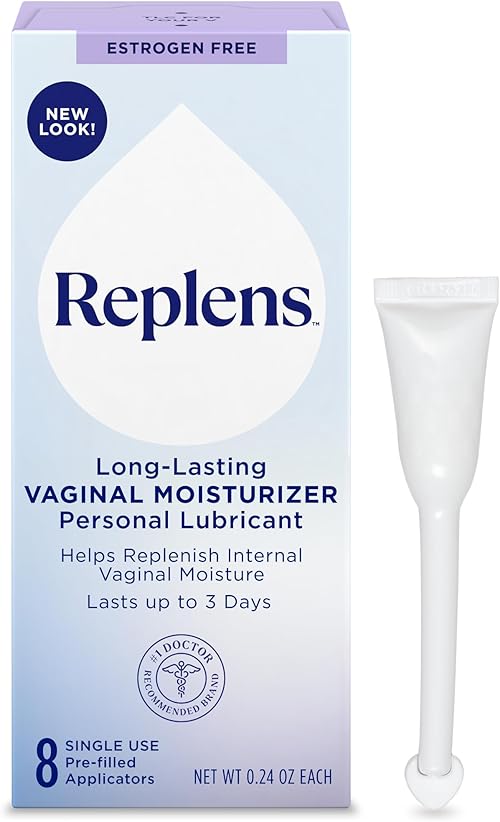
Replens
Replens Long-Lasting Vaginal Moisturizer
$12.98
"Targeted fragrance-free vaginal moisturizer with 4.4/5 across 6,346 Amazon ratings and a lower observed price than most applicator or suppository formats."
What real Amazon buyers say
4.4★· 6,346 reviews"Instant relief from the dryness."
"It's also not messy at all and very easy to use."

Pure Encapsulations
Pure Encapsulations Magnesium Glycinate
$27
"Highest magnesium-side Amazon signal in this set: 4.7/5 across 47,900 ratings for a glycinate capsule often chosen for evening routines."
What real Amazon buyers say
4.7★· 47,900 reviews"I've noticed a more relaxed feeling in the evening and improved sleep consistency when taken regularly."
"I take one capsule at night, easy to swallow & now I'm sleeping better!"

Bonafide
Bonafide Revaree Vaginal Moisturizer
$47.99
"Hyaluronic-acid vaginal moisturizer with 4.4/5 across 4,419 Amazon ratings and hormone-free positioning for dryness relief."
What real Amazon buyers say
4.4★· 4,419 reviews"This product worked very well for me and helped provide long-lasting moisture and comfort."
"Work well, but I wish they weren't so expensive."

Good Clean Love
Good Clean Love Restore Moisturizing Vaginal Gel
$14.44
"pH-balanced moisturizing vaginal gel with aloe vera and lactic acid positioning; 4.3/5 across 3,405 Amazon ratings."

Natrol
Natrol Magnesium Glycinate 240 mg
$13.98
"Budget sleep-positioned magnesium glycinate capsule with 4.6/5 across 754 Amazon ratings and melatonin-free user appeal."

Naturebell
Naturebell Pure Magnesium Glycinate 500 mg
$19.95
"Large-count magnesium glycinate option with 4.7/5 across 18,100 Amazon ratings; better for value seekers than product minimalists."