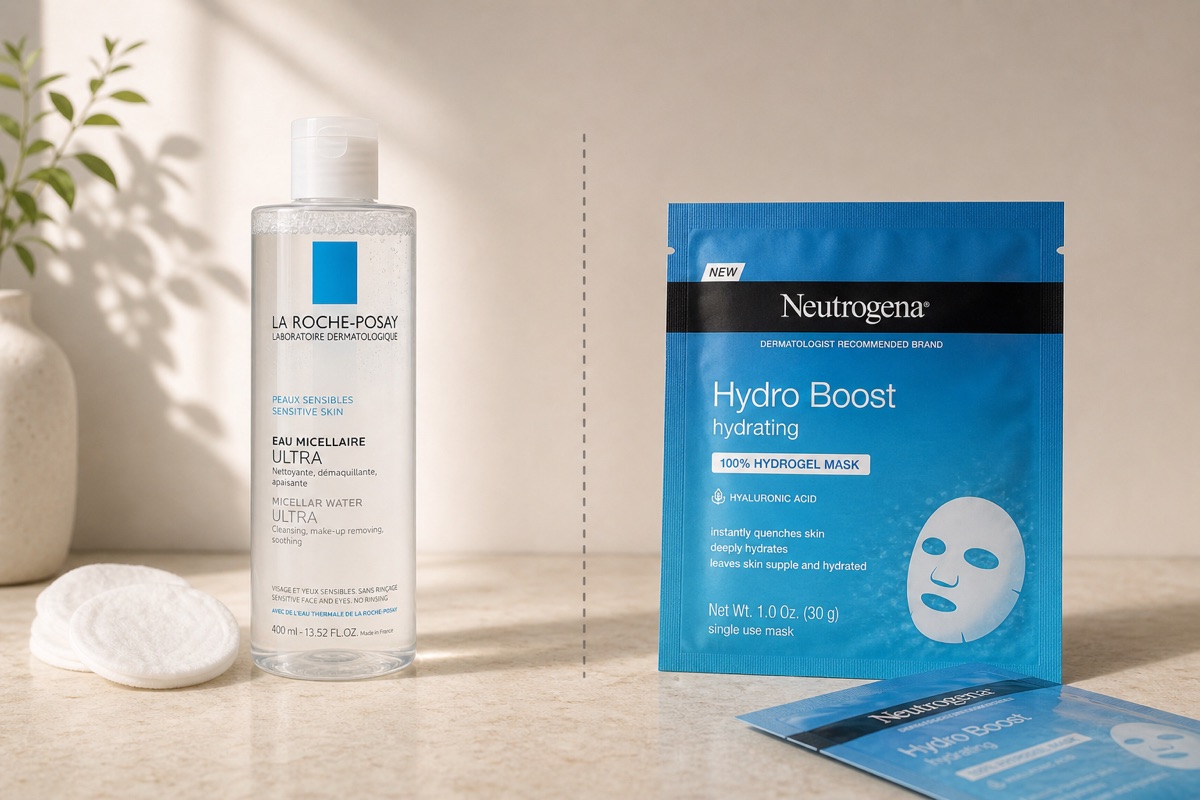
Micellar Waters vs Sheet Masks: Which Works for Sensitive Skin?
Evidence-weighted comparison of micellar waters and sheet masks for sensitive, dry, and dull skin using Amazon US ratings, ingredient evidence, and user fit.
We analyzed 78,492 Amazon US ratings across 6 representative products plus PubMed sensitive-skin literature. Micellar waters are the safer daily sensitive-skin choice because they cleanse with less rubbing; sheet masks are better as occasional hydration boosters, not daily barrier care.
| Criterion | 🏆 Winner Micellar waters Multi-brand category $15.60 | Sheet masks Multi-brand category $21.15 |
|---|---|---|
| Sensitive-skin tolerability Penalizes fragrance exposure, rubbing, residue, and long contact time; rewards sensitive-skin positioning and mild-cleansing evidence. | 8.4/10 | 6.7/10 |
| Daily usefulness How well the category fits a repeatable morning or evening routine for US shoppers with reactive skin. | 8.8/10 | 5.9/10 |
| Hydration support Short-term water-binding and cushion effect, weighted toward dry or tight skin rather than cleansing. | 6.8/10 | 8.1/10 |
| Ingredient evidence Strength of category-level evidence from mild-cleansing literature, sensitive-skin reviews, humectant logic, and official positioning. | 7.8/10 | 6.4/10 |
| Value Representative Amazon US basket average: $15.60 for micellar waters and $21.15 for sheet masks. | 8.6/10 | 6.2/10 |
| Rating-volume confidence Amazon US rating volume in this evidence set: 75,591 micellar-water ratings versus 2,901 sheet-mask ratings. | 9.0/10 | 5.8/10 |
| Dullness fit How directly the category helps skin look fresher without relying on strong exfoliating acids or retinoids. | 6.9/10 | 7.3/10 |
| Overall score | 8.04 | 6.63 |
🏆 Winner: Micellar waters
Micellar waters win for sensitive skin because they lead tolerability 8.4 to 6.7, daily usefulness 8.8 to 5.9, value 8.6 to 6.2, and rating-volume confidence 9.0 to 5.8. The source set includes 75,591 Amazon ratings across three micellar waters versus 2,901 ratings across three sheet masks, plus PubMed mild-cleansing evidence from Ananthapadmanabhan 2004. Sheet masks win hydration support 8.1 to 6.8, so they are better as occasional moisture boosts.
Best on a budget
Garnier Micellar Water
Best for results
La Roche-Posay Micellar Cleansing Water for daily sensitive-skin cleansing; Neutrogena Hydro Boost Hydrogel Sheet Mask when the goal is occasional hydration
Bottom line
Choose micellar water if your sensitive skin needs a repeatable daily step: makeup removal, sunscreen breakdown, or a low-friction cleanse before moisturizer. Choose a sheet mask if your skin feels temporarily tight, flat, or dehydrated and you want a short hydration boost once in a while.
The evidence set is uneven in a way that matters. The three micellar waters we analyzed have 75,591 Amazon US ratings in the May 2026 snapshot. The three sheet masks have 2,901 Amazon US ratings. Rating volume is not clinical proof, but it gives more confidence about broad tolerability patterns, especially when the products are positioned for sensitive skin and supported by mild-cleansing literature.
Sheet masks still have a place. They scored higher for hydration support because a saturated sheet can hold humectants against the skin for a short contact period. But for women 35-55 dealing with dryness, dullness, perimenopause-related reactivity, or a routine that already includes retinoids or acids, daily contact time is not automatically better. Sensitive skin usually rewards boring consistency more than novelty.
What micellar water does better
Micellar water is a cleansing category. Its job is to help lift sunscreen, light makeup, oil, and daily debris with less rubbing than a foaming cleanser alone. That matters for sensitive skin because friction is a common real-world trigger: more cotton-pad pressure, more washcloth scrubbing, and more repeated passes can make cheeks look redder or feel hotter.
In the representative Amazon set, La Roche-Posay Micellar Cleansing Water has 4.7/5 across 57,855 ratings, Garnier Micellar Water has 4.7/5 across 10,052 ratings, and Bioderma Sensibio H2O has 4.7/5 across 7,684 ratings. Those three products also keep the average category price moderate at $15.60 in this comparison. The value advantage is practical: if you use a product most nights, price per bottle matters more than it does for a once-weekly mask.
Ingredient evidence also favors micellar water for the specific question of sensitive-skin routine design. Ananthapadmanabhan et al. 2004 in Dermatologic Therapy reviewed how cleanser technology can affect the skin barrier, and the paper’s core point is directly relevant: cleansing can be done in ways that reduce barrier compromise. Micellar water is not automatically irritation-proof, but the category is built around mild cleansing rather than exfoliation, peeling, or long-wear treatment claims.
Where sheet masks make more sense
Sheet masks are not cleansers; they are short-contact hydration vehicles. Their strongest use case is not removing the day. It is helping dry, dull, or tight skin look more hydrated before an event, after a travel day, or during a cold Midwest winter week when indoor heat makes skin feel papery.
That is why sheet masks scored 8.1 for hydration support versus 6.8 for micellar waters. Neutrogena Hydro Boost Hydrogel Sheet Mask is positioned around hyaluronic acid and holds 4.3/5 across 100 Amazon ratings in the 12-pack listing. Rael Collagen Bamboo Facial Sheet Mask has the strongest sheet-mask rating volume in this set, at 4.5/5 across 2,453 Amazon ratings. By Nature 2% Hyaluronic Acid Sheet Face Mask is explicitly positioned for dry, dehydrated, and sensitive skin and has 4.5/5 across 348 Amazon ratings.
The trade-off is contact time. A sheet mask keeps a formula pressed against skin for longer than a cleanser does. If the formula includes fragrance, essential oils, a high load of botanical extracts, or a preservative system your skin dislikes, that extended contact can turn a soothing ritual into stinging. Misery et al. 2017 described sensitive skin as a pattern of unpleasant sensations such as stinging, burning, pain, pruritus, and tingling; for that user, more exposure is not always better.
Ingredient evidence: mild cleansing beats novelty
For sensitive skin, the most evidence-aligned routine is usually low-friction cleansing, barrier support, sunscreen, and careful use of actives. Micellar water fits that framework because it can reduce the need for aggressive rubbing at the cleansing stage. It is also easy to control: use a saturated cotton pad, pause briefly over eye makeup, wipe lightly, then rinse and moisturize.
Sheet masks are more variable. Some are simple humectant masks built around glycerin, hyaluronic acid, aloe, or panthenol-like soothing logic. Others lean heavily on fragrance, extracts, acids, or brightening complexes. The category can help dullness visually because hydrated stratum corneum reflects light more evenly, but that is a temporary cosmetic effect. It is different from long-term brightening evidence for ingredients such as vitamin C, retinoids, azelaic acid, or sunscreen.
That distinction matters for mature sensitive skin. Dullness after 40 is often a mix of dryness, slower surface turnover, sun exposure history, and inconsistent sunscreen. A sheet mask may make skin look fresher for a day. A gentle cleansing step can make the whole routine easier to tolerate, especially if it helps you remove sunscreen without over-washing.
Price and rating volume
The micellar-water basket is less expensive in this comparison: $15.60 average across Garnier, La Roche-Posay, and Bioderma. The sheet-mask basket averages $21.15 across Neutrogena, Rael, and By Nature. That does not mean every micellar water is cheap or every sheet mask is costly, but it reflects the products we could verify on Amazon US without using capped ASINs.
Rating volume is the bigger difference. The micellar side has 75,591 Amazon ratings; the sheet-mask side has 2,901. La Roche-Posay alone has 57,855 ratings in the snapshot, which gives that category more signal for broad US shopper experience. The strongest sheet-mask volume in the set is Rael at 2,453 ratings.
A fair interpretation is not “micellar water is clinically proven to be better.” It is: micellar water has stronger public user-volume support, clearer daily routine fit, and better category-level alignment with mild-cleansing evidence. Sheet masks have a narrower but valid job: occasional hydration.
Who should choose micellar water
Choose micellar water if your skin flushes easily, if cleanser makes your cheeks feel tight, or if you wear sunscreen but hate a heavy double cleanse. It is also the better fit if your routine already includes retinol, exfoliating acids, benzoyl peroxide, or prescription topicals. In that setting, the cleansing step should be quiet and predictable.
The best technique is deliberately gentle. Saturate the pad so you are not dragging dry cotton across the skin. Hold it over mascara or sunscreen-heavy areas for a few seconds before wiping. Use fewer passes, not more. Then rinse with lukewarm water and apply a fragrance-free moisturizer while skin is still slightly damp.
Skip micellar water as a leave-on if you are very reactive. Many people leave it on without issue, but sensitive skin is less forgiving. Rinsing gives you the cleansing benefit while reducing residue risk.
Who should choose a sheet mask
Choose a sheet mask if your skin feels dehydrated but not actively inflamed. Good moments include the night before a social event, after a flight, during dry indoor-heating season, or after a week when your routine has been minimal and skin looks flat.
Do not use a sheet mask as a way to push through irritation. If your face is burning from over-exfoliation, a long-contact mask can backfire. In that case, stop actives, use a bland moisturizer, and keep cleansing simple. If stinging, swelling, or rash persists, a board-certified dermatologist is the right next step.
For best odds, patch test the serum from the packet on the side of the jaw before the first full-face use. Keep the first wear short, around 10 minutes. Do not let the sheet dry on your face; as it dries, it can feel tight and defeat the hydration purpose.
Verdict
Micellar waters are the better sensitive-skin category for daily use. They won five of seven criteria: sensitive-skin tolerability, daily usefulness, ingredient evidence, value, and rating-volume confidence. Sheet masks won hydration support and narrowly led dullness fit, which is exactly how they should be used: as occasional moisture and glow support, not as a replacement for cleansing or moisturizer.
For most US shoppers with sensitive skin, start with a micellar water and a bland moisturizer. Add a sheet mask only when your skin is calm enough to tolerate longer contact and dry enough to benefit from the temporary hydration.
The practical sequence is simple: remove sunscreen gently, rinse, moisturize, and give your barrier a few quiet nights before judging whether dullness is improving. If you add a mask, treat it as an optional layer after cleansing, not a corrective treatment. That framing keeps expectations realistic and helps sensitive skin avoid the cycle of over-correcting every flare.
Related reading
Both winners on Amazon

La Roche-Posay
La Roche-Posay Micellar Cleansing Water for Sensitive Skin
$17.99
"Highest rating volume in this evidence set: 4.7/5 across 57,855 Amazon ratings, with explicit sensitive-skin positioning."
What real Amazon buyers say
4.7★· 57,855 reviews"Works great without drying your skin out. Used to use witch hazel and like this way better. Non greasy, and good for sensitive skin."

Garnier
Garnier Micellar Water, Hydrating Facial Cleanser and Makeup Remover
$8.82
"Lowest price among the micellar picks here and 4.7/5 across 10,052 Amazon ratings for gentle cleansing and makeup removal."
What real Amazon buyers say
4.7★· 10,052 reviews"This micellar water works well as a gentle cleanser and makeup remover. It removes light makeup and daily buildup without requiring harsh rubbing, and it leaves the skin feeling clean."

Bioderma
Bioderma Sensibio H2O Micellar Water
$19.99
"Sensitive-skin micellar staple with 4.7/5 across 7,684 Amazon ratings; a higher-cost but strongly reviewed option."
What real Amazon buyers say
4.7★· 7,684 reviews"I love this micellar water. It removes my makeup on the first pass with no harsh rubbing or irritation. Even around the eyes, it feels soothing rather than stinging."

Neutrogena
Neutrogena Hydro Boost Hydrating Hydrogel Sheet Mask
$33.48
"Hydration-focused hydrogel option with hyaluronic acid positioning; 4.3/5 across 100 Amazon ratings in the 12-pack listing."

Rael
Rael Collagen Bamboo Facial Sheet Mask
$14.99
"Mid-price sheet mask with the largest sheet-mask rating volume in this set: 4.5/5 across 2,453 Amazon ratings."

By Nature
By Nature 2% Hyaluronic Acid Sheet Face Mask
$14.99
"Hydration-first sheet mask positioned for dry, dehydrated, and sensitive skin; 4.5/5 across 348 Amazon ratings."