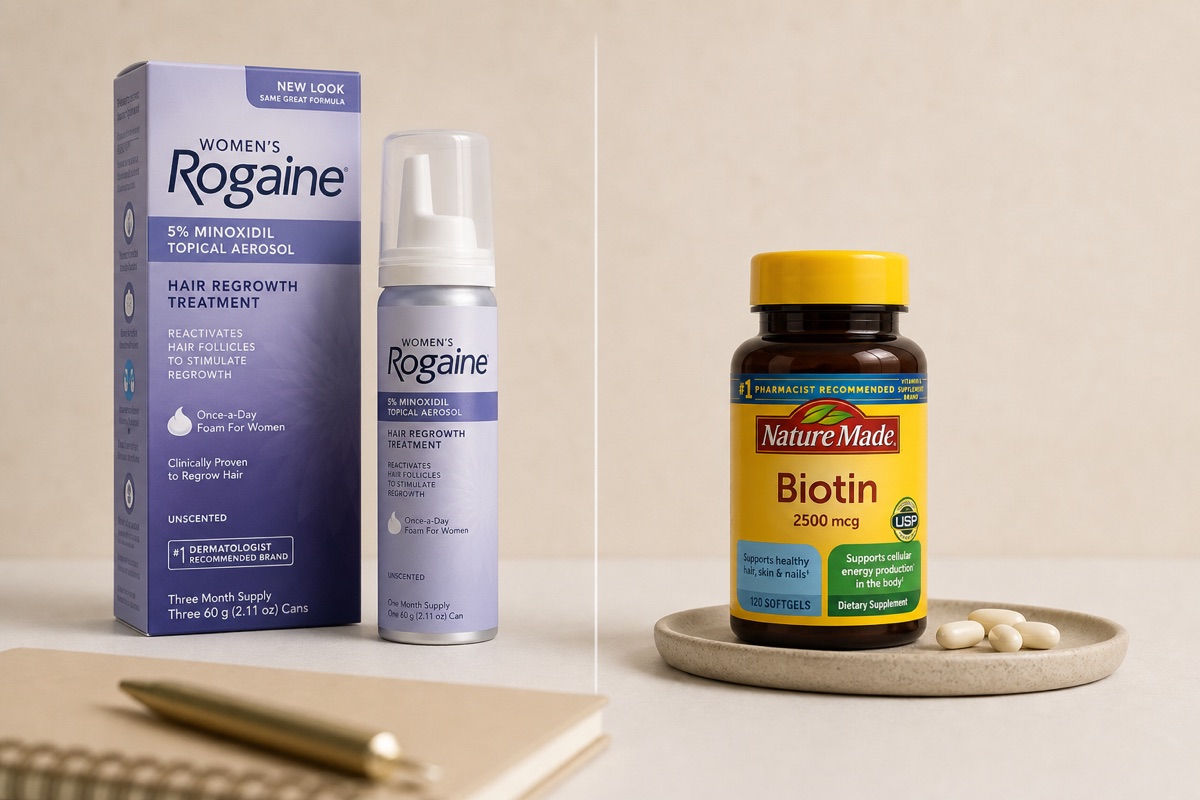
Minoxidil Foam Alternatives vs Biotin Supplements: Head-to-Head
Evidence-weighted comparison of minoxidil-foam alternatives and biotin supplements for women 35-55, including hair-growth evidence, Amazon ratings, price, and fit.
Based on Olsen 2002 (J Am Acad Dermatol, n=381), a 2017 PubMed biotin review, and Amazon US snapshots across 6 products totaling 258,253 ratings, minoxidil-foam alternatives win on regrowth evidence; biotin supplements fit best when low biotin intake, brittle nails, or supplement preference is the main issue.
| Criterion | Minoxidil-foam alternatives Topicals and devices category $8.90 | Biotin supplements Oral supplement category $19.95 |
|---|---|---|
| Direct regrowth evidence How directly peer-reviewed evidence supports visible hair regrowth or density improvement for the category. | 8.7/10 | 4.8/10 |
| Ingredient or mechanism specificity How clearly the active mechanism targets follicle cycling, scalp stimulation, or a known nutritional gap. | 8.2/10 | 5.2/10 |
| Amazon rating volume Representative Amazon US rating depth across three products per side captured for this article. | 7.9/10 | 8.8/10 |
| Price and value Visible Amazon US price, likely replacement cadence, and cost relative to evidence strength. | 7.1/10 | 7.4/10 |
| Tolerability Lower likelihood of scalp irritation, unwanted texture, pill burden, or supplement interaction scores higher. | 7.0/10 | 7.8/10 |
| Typical user fit How easily a woman 35-55 can match the category to her main hair-thinning scenario. | 8.1/10 | 6.3/10 |
| Overall evidence strength Balance of clinical literature, regulatory context, Amazon review depth, and US availability. | 8.3/10 | 6.2/10 |
| Overall score | 7.90 | 6.64 |
🏆 Winner: Minoxidil-foam alternatives for evidence-backed regrowth; biotin supplements only for deficiency-leaning or supplement-preferred routines
Minoxidil-foam alternatives win because Olsen 2002 studied topical minoxidil in 381 women and FDA materials treat minoxidil as an OTC drug active, while the 2017 PubMed biotin review found hair-growth evidence mostly in people with deficiency or underlying pathology. Biotin products have broader Amazon rating volume in this snapshot, but rating volume does not equal stronger regrowth evidence.
Best on a budget
Mielle Organics Rosemary Mint Scalp & Hair Strengthening Oil is the lowest visible Amazon price in the comparison at $8.90; Sports Research Biotin is the lower-cost oral option at $19.95.
Best for results
For visible density goals, the strongest evidence remains minoxidil-derived or device-based approaches rather than biotin-only supplements unless a clinician has identified low biotin status or a related nutritional gap.
Quick verdict
For women 35-55 comparing minoxidil foam alternatives with biotin supplements, the evidence is uneven in a useful way. The minoxidil-adjacent side has the better regrowth case because topical minoxidil has randomized trial evidence in women: Olsen 2002 in J Am Acad Dermatol followed 381 women with female pattern hair loss. The biotin side has enormous Amazon volume, led in our snapshot by Sports Research Biotin at 99,776 visible Amazon ratings, but the 2017 PubMed review by Patel, Swink, and Castelo-Soccio found that published biotin hair-growth evidence mostly involves deficiency or underlying pathology.
That means the right choice depends less on which category has the bigger promise and more on why your hair is thinning. If you see widening part lines, temple recession, or a family-pattern change around perimenopause, a regrowth-focused topical or device category is the more evidence-aligned lane. If your main concern is brittle nails, low dietary intake, or wanting a supplement while you ask a clinician about ferritin, thyroid, vitamin D, or hormone shifts, biotin can be reasonable as support, not as a stand-alone substitute for proven hair-loss treatment.
What counts as a minoxidil foam alternative here?
We did not treat every “hair growth” product as equal. A true minoxidil foam alternative has to solve a real reason people avoid foam: residue, scalp feel, daily adherence, irritation, or reluctance to use a drug active indefinitely. The three representative products we used are different by design: a rosemary-mint scalp oil, a red-light laser device, and a peptide scalp serum.
Mielle Organics Rosemary Mint Scalp & Hair Strengthening Oil is not minoxidil, and it should not be described as equivalent. Its evidence relevance comes from the rosemary oil literature: Panahi 2015 compared rosemary oil with 2% minoxidil over 6 months in 100 people with androgenetic alopecia. That is a narrower evidence base than topical minoxidil, but it is more directly hair-focused than a generic beauty oil. Its Amazon footprint is much larger than many niche scalp serums: our Amazon US snapshot showed 4.5/5 across 122,274 ratings at $8.90.
iRestore Professional Laser Red Light Therapy Hair Growth System is the opposite value case. At $799.00 in our Amazon snapshot, it asks for a large upfront spend. Its category has peer-reviewed support from low-level laser device studies, including Lanzafame 2013 with 44 participants, but device adherence matters. If you will not use a helmet-style device consistently, the evidence never gets a fair chance to translate into your routine.
The Scalp Delivery AM/PM GHK-CU Peptide Hair Growth Serum is the least proven of the three representatives by public rating depth, with 109 visible Amazon ratings in our snapshot. It makes sense as a texture alternative for people who dislike foam and want a leave-on scalp serum, but the evidence score is lower because peptide blend claims are less directly supported by large female-pattern hair-loss trials than minoxidil.
What biotin supplements can and cannot do
Biotin is vitamin B7, and it is involved in normal metabolism. That does not mean high-dose biotin reliably regrows hair in people who are not deficient. The most important source in this comparison is the 2017 Skin Appendage Disorders review by Patel, Swink, and Castelo-Soccio. Its practical message is conservative: reported hair and nail improvement is most convincing when there is deficiency, inherited enzyme disorder, brittle nail syndrome, or another underlying issue, not as a universal hair-loss fix.
That distinction matters for perimenopause. Hair changes from 35 to 55 can come from androgen sensitivity, postpartum history, thyroid shifts, iron status, stress, weight changes, medications, or traction. A high-Amazon-rating biotin capsule cannot diagnose which bucket you are in. Sports Research Biotin had the largest biotin-only snapshot in this article at 4.6/5 across 99,776 visible Amazon ratings. Natrol Biotin had 4.5/5 across 14,178 ratings. Those numbers show shopper adoption and satisfaction, not clinical superiority over minoxidil.
Viviscal sits slightly outside the pure-biotin lane because it is a multi-ingredient hair supplement with marine protein complex positioning. We included it because shoppers comparing biotin often cross-shop broader hair supplements. Its Amazon snapshot showed 4.3/5 across 30,008 visible ratings, and a 2012 J Clin Aesthet Dermatol study by Ablon evaluated an oral marine protein supplement over 180 days. Still, supplement evidence should be read as supportive, not a replacement for medical workup when shedding is sudden or patterned.
Evidence scorecard
| Criterion | Minoxidil-foam alternatives | Biotin supplements | Why it matters |
|---|---|---|---|
| Direct regrowth evidence | 8.7 | 4.8 | Topical minoxidil has female-pattern hair-loss trial evidence; biotin evidence is strongest when deficiency or pathology is present. |
| Mechanism specificity | 8.2 | 5.2 | Minoxidil-style topicals and red-light devices target scalp or follicle pathways more directly than a general vitamin. |
| Amazon rating volume | 7.9 | 8.8 | Biotin products have very large visible rating counts, led by Sports Research at 99,776 ratings. |
| Price and value | 7.1 | 7.4 | Oils and biotin are inexpensive; devices raise the average cost of the alternative category. |
| Tolerability | 7.0 | 7.8 | Supplements avoid scalp residue, but high-dose biotin can complicate lab tests and cause pill-burden issues. |
| Typical user fit | 8.1 | 6.3 | Patterned thinning fits topical/device strategies better; deficiency-leaning concerns fit supplements better. |
The category winner is minoxidil-foam alternatives, with caveats. The best-supported hair-regrowth active remains minoxidil itself, so “alternative” should not be read as “stronger than minoxidil.” It means a shopper is looking for another route because foam texture, irritation, or long-term daily drug use is a barrier. In that situation, rosemary oil, low-level laser devices, and peptide serums are different levels of evidence rather than interchangeable choices.
Biotin wins only in a narrower user profile: someone who has reason to suspect low biotin intake, brittle nails, or a clinician-identified nutritional gap, or someone who wants a low-friction supplement while pursuing a proper workup. It loses as a direct head-to-head substitute for minoxidil-style regrowth.
Tolerability and safety trade-offs
Topical alternatives can be locally annoying. Oils may feel heavy on fine hair, transfer to pillowcases, or irritate seborrheic-prone scalps. Peptide serums can leave residue or create styling conflict. Red-light devices avoid product texture, but they require time, storage, and consistent use. For women in the humid Southeast or during hot flashes, any leave-on scalp product can feel more noticeable than it does in a dry climate.
Biotin supplements feel simpler because they do not change your hairstyle or scalp feel. The trade-off is internal. High-dose biotin is widely sold in 10,000 mcg strengths, including Sports Research and Natrol in our Amazon snapshot, but biotin can interfere with some lab assays. That matters in midlife because thyroid testing is a common part of a hair-shedding workup. If you take high-dose biotin, tell your clinician before bloodwork and follow their advice on pausing it.
Neither side should be used to postpone care for sudden shedding, patchy hair loss, scalp pain, scaling, or eyebrow loss. Those patterns can point to telogen effluvium, alopecia areata, thyroid disease, iron deficiency, inflammatory scalp conditions, medication effects, or other causes that need diagnosis.
Price and Amazon rating context
Our six-product Amazon snapshot covered 258,253 visible ratings. The three minoxidil-foam alternative representatives totaled 123,992 visible ratings: 122,274 for Mielle, 1,609 for iRestore, and 109 for Scalp Delivery. The three supplement representatives totaled 143,962 visible ratings: 99,776 for Sports Research, 14,178 for Natrol, and 30,008 for Viviscal.
That volume is useful, but it should not be overread. Amazon ratings capture satisfaction, shipping experience, taste, texture, price, and expectations. They do not replace blinded clinical endpoints such as hair count or investigator assessment. This is why the product-comparison score gives biotin a high Amazon-volume mark but a lower direct-evidence mark.
Price also cuts both ways. Mielle at $8.90 is the lowest visible price in the set and therefore easy to try. Sports Research at $19.95 and Natrol at $19.44 are also low-friction. Viviscal at $100.98 for a 90-day supply is more expensive but still below the one-time $799.00 iRestore device price. The device only makes value sense if you will use it long enough to amortize the upfront cost.
Who should pick which side?
Pick a minoxidil-foam alternative if your biggest barrier is topical foam itself, not the idea of scalp treatment. A scalp oil may fit dry, coarse, textured, or protective-style routines where pre-wash oiling already makes sense. A peptide serum may fit someone who wants a lighter leave-on step and accepts weaker public evidence. A red-light device may fit a disciplined user who wants a product-free approach and has the budget for it.
Pick a biotin supplement if your concern is broader hair quality, brittle nails, or nutritional support, and especially if a clinician has pointed to a relevant gap. Biotin is not the first-choice answer for clear androgen-pattern thinning, but it can be part of a broader plan that includes adequate protein, iron evaluation, thyroid review, gentle styling, and a realistic timeline.
If you are deciding for perimenopause-related thinning, start with the pattern. A widening part and miniaturized hair suggest a different path than diffuse shedding after a major stressor. Supplements are easiest to buy; they are not always the most targeted.
Bottom line
Minoxidil-foam alternatives beat biotin supplements for evidence-weighted regrowth goals. The strongest reason is not hype; it is the structure of the evidence. Topical minoxidil has female-pattern hair-loss trial data, rosemary oil has a smaller 6-month comparative study, and low-level laser devices have randomized device literature. Biotin has very large consumer adoption but weaker direct evidence unless deficiency or a related condition is present.
For a US woman 35-55, the practical sequence is straightforward: identify the shedding pattern, ask for basic medical context if the change is sudden or persistent, choose a topical/device route if visible density is the goal, and reserve biotin for nutritional support rather than expecting it to replace a regrowth treatment.
Related reading
Both winners on Amazon

Mielle Organics
Mielle Organics Rosemary Mint Scalp & Hair Strengthening Oil
$8.90
"Low-cost scalp-oil alternative with rosemary-oil relevance from Panahi 2015 and 4.5/5 across 122,274 visible Amazon ratings."
What real Amazon buyers say
4.5★· 122,274 reviews"I got this because I had some thinning along my hair line and wanted my many baby hairs to stop sticking up all over the place and needed something to help them grow."

iRestore
iRestore Professional Laser Red Light Therapy Hair Growth System
$799
"Device-side alternative for shoppers avoiding leave-on minoxidil texture; 4.4/5 across 1,609 visible Amazon ratings and supported by low-level laser literature."
What real Amazon buyers say
4.4★· 1,609 reviews"Received next day from ordering. Easy to use. Excited to see results. Customer service has been very responsive with warranty and free gift for ordering."

Scalp Delivery
Scalp Delivery AM/PM GHK-CU Peptide Hair Growth Serum
$45.99
"Peptide-serum alternative for users who dislike foam residue; lower Amazon evidence depth at 4.3/5 across 109 visible ratings."
What real Amazon buyers say
4.3★· 109 reviews"After a few weeks, I noticed less shedding and new baby hairs starting to come in, especially around my hairline."

Sports Research
Sports Research Biotin 10,000 mcg with Organic Coconut Oil
$19.95
"High-volume biotin-only supplement snapshot: 4.6/5 across 99,776 visible Amazon ratings, but PubMed evidence is strongest for deficiency contexts."

Natrol
Natrol Biotin 10,000 mcg Tablets
$19.44
"Biotin-only tablet option with 4.5/5 across 14,178 visible Amazon ratings; best framed as nutritional support rather than proven regrowth therapy."

Viviscal
Viviscal Hair Growth Supplements for Women 90-Day Supply
$100.98
"Broader hair-supplement formula that includes biotin and marine ingredients; 4.3/5 across 30,008 visible Amazon ratings."