Minoxidil Foam Alternatives vs Biotin Supplements for Sensitive Skin
Evidence-weighted comparison of minoxidil foam alternatives and biotin supplements for women with sensitive scalps, shedding, and perimenopause-related hair thinning.
We analyzed 359,388 Amazon US ratings across 6 representative products, FDA biotin safety guidance, and PubMed hair-loss literature. For sensitive skin, topical minoxidil-foam alternatives have stronger scalp-specific evidence; biotin supplements fit confirmed deficiency better than routine thinning.
| Criterion | 🏆 Winner Minoxidil foam alternatives Multi-brand category $16.85 | Biotin supplements Multi-brand category $12.27 |
|---|---|---|
| Ingredient evidence for thinning How directly the category has evidence for hair-density or shedding concerns, prioritizing PubMed and scalp-specific mechanisms. | 7.2/10 | 5.1/10 |
| Sensitive-skin fit Penalizes fragrance, essential-oil sting, acne risk, GI complaints, and lab-test interference; rewards patch-test control and non-irritating formats. | 6.8/10 | 7.0/10 |
| Amazon rating volume Representative Amazon US rating set: 128,105 ratings for topical alternatives and 231,283 ratings for biotin supplements. | 7.7/10 | 8.8/10 |
| Value in USD Representative basket averages from Amazon US snapshots: $16.85 for topical alternatives and $12.27 for biotin supplements. | 7.5/10 | 8.6/10 |
| User fit for women 35-55 How well the category matches perimenopause-era shedding, sensitive scalps, medication hesitancy, and the need for realistic timelines. | 8.0/10 | 6.2/10 |
| Evidence quality Peer-reviewed support is stronger for scalp-directed approaches than for high-dose biotin in non-deficient adults. | 7.4/10 | 5.5/10 |
| Overall score | 7.43 | 6.87 |
🏆 Winner: Minoxidil foam alternatives
Minoxidil foam alternatives win narrowly for sensitive-skin shoppers because they are scalp-directed and can be patch-tested, while biotin is most evidence-supported when a deficiency exists. In our scoring, topical alternatives lead ingredient evidence 7.2 to 5.1 and user fit 8.0 to 6.2, supported by PubMed rosemary-oil data and 128,105 Amazon ratings across three topical products. Biotin wins price and rating volume, but FDA guidance on lab-test interference keeps it from being the default hair-thinning pick.
Best on a budget
Bronson Biotin 10,000 mcg if a clinician has confirmed low biotin or a diet-related gap; Mielle Rosemary & Mint Hair Oil if you want a low-cost topical option.
Best for results
The Ordinary Multi-Peptide Serum for Hair Density is the stronger non-minoxidil cosmetic pick; see a dermatologist for persistent shedding or visible part widening.
Bottom line
If your scalp reacts easily, start with the gentlest scalp-directed alternative before defaulting to high-dose biotin. The reason is simple: hair thinning is happening at the follicle and scalp, while biotin only helps when the body is short on biotin or when a clinician identifies a nutrition-related gap. Patel DP et al. 2017 in Skin Appendage Disorders reviewed biotin for hair loss and found the strongest case in people with deficiency or an underlying condition, not in every adult with shedding.
That does not make topical alternatives a guaranteed substitute for minoxidil. Minoxidil remains the better-studied drug active for pattern hair loss, and this article is about non-minoxidil options for shoppers who are avoiding foam because of sensitivity, preference, or medication hesitancy. In the non-minoxidil set, rosemary and peptide scalp products have more relevant placement than biotin because they go on the scalp, can be patch-tested, and are easier to stop if irritation appears.
Our evidence set includes 359,388 Amazon US ratings across six representative products. Topical alternatives account for 128,105 ratings, led by Mielle Organics Rosemary & Mint Hair Oil at 122,200 ratings. Biotin supplements account for 231,283 ratings, led by Nature’s Bounty Biotin 10,000 mcg at 120,883 ratings and Sports Research Biotin 10,000 mcg at 99,700 ratings. Rating volume shows usage breadth, not medical efficacy, so we weighted it below PubMed and FDA evidence.
How we scored the two approaches
BeautySift scored the categories on ingredient evidence, sensitive-skin fit, Amazon rating volume, value, user fit for women 35-55, and evidence quality. Topical alternatives scored higher on ingredient evidence, 7.2 versus 5.1, because PubMed has at least some direct scalp-relevant evidence for rosemary oil. Panahi Y et al. 2015 compared rosemary oil with 2% minoxidil in androgenetic alopecia and found hair-count improvement at the 6-month mark in both groups; scalp itching was reported more often in the minoxidil group.
That study does not prove that every rosemary product on Amazon performs like the study material. It does show why rosemary is a more rational hair-thinning comparison point than a general beauty supplement when the shopper is specifically avoiding minoxidil foam. The Ordinary Multi-Peptide Serum adds another non-drug route: the brand positions it for thicker, fuller, denser-looking hair, and Amazon reviewers frequently discuss texture, scalp feel, and consistency of use.
Biotin supplements scored higher on rating volume and price. The representative biotin basket averaged $12.27, compared with $16.85 for topical alternatives. But efficacy scoring stayed lower because high-dose biotin is not a universal hair-growth active. It is a nutrient. If your biotin status is already adequate, more biotin is not the same thing as a targeted follicle treatment.
Sensitive scalp: where topical alternatives help and where they can backfire
For sensitive skin, the main advantage of topical alternatives is control. You can patch-test behind the ear or on a small scalp section, wait 24 to 48 hours, and stop quickly if burning, flaking, itching, or bumps appear. That matters for women in perimenopause because the scalp can become drier and more reactive while hair density is changing.
The Ordinary Multi-Peptide Serum is the cleanest fit for a sensitivity-first routine because it is a lightweight serum rather than a heavy essential-oil blend. Its Amazon listing shows 4.0/5 across 1,448 ratings at $24.00, and one verified reviewer wrote that the formula is “lightweight, non-greasy, and absorbs quickly into the scalp” and “hasn’t caused any irritation.” That is user evidence, not a clinical guarantee, but it matches the format we would prioritize for easily oily or itchy scalps.
AROMATICA Root Enhancer Rosemary Water is another lighter option. Its Amazon listing shows 4.5/5 across 4,457 ratings at $17.64, and verified reviews repeatedly mention a non-greasy, cooling scalp feel. Cooling can be pleasant, but it can also signal mentholated or aromatic ingredients that some sensitive users dislike. If you react to minty shampoos, essential oils, or fragrance, patch-test this category carefully.
Mielle Organics Rosemary & Mint Hair Oil is the value standout at $8.90 and 4.5/5 across 122,200 Amazon ratings. It is also the richest format here. That can be helpful for dry scalp and protective styling, but it may be too heavy for fine hair, seborrheic dermatitis-prone scalps, or anyone who breaks out along the hairline from oils.
Biotin: why the Amazon numbers look strong but the evidence is narrower
Biotin supplements dominate on Amazon volume. Nature’s Bounty Biotin 10,000 mcg has 4.7/5 across 120,883 ratings, Sports Research Biotin 10,000 mcg has 4.6/5 across 99,700 ratings, and Bronson Biotin 10,000 mcg has 4.7/5 across 10,700 ratings. Those are large consumer signals, and they help explain why biotin is often the first supplement shoppers try when shedding starts.
The scientific caution is that biotin is most persuasive when deficiency is documented or likely. The Patel DP et al. 2017 PubMed review is the key evidence check: biotin use for hair loss is not broadly proven for people without deficiency. In a US shopper’s routine, that means biotin should not crowd out evaluation for thyroid changes, low ferritin, vitamin D status, androgen sensitivity, medication changes, stress shedding, or rapid weight-loss related shedding.
There is also a safety-administration issue. The FDA’s 2019 safety communication warns that biotin can interfere with certain lab tests, including some hormone and cardiac assays. That matters for women 35-55 because perimenopause often brings more thyroid panels, hormone conversations, and preventive labs. If you take high-dose biotin, tell your clinician before blood work. Do not assume a hair supplement is invisible to medical testing.
For sensitive skin specifically, biotin has one real advantage: it does not sit on the scalp. If every topical burns, flakes, or triggers dermatitis, a supplement may feel easier. But “easier to tolerate” is not the same as “more likely to improve thinning.” In our scoring, biotin led sensitive-skin fit by a slim 7.0 to 6.8, while topical alternatives led ingredient evidence by 7.2 to 5.1.
Best user fit by scenario
Choose a topical minoxidil-foam alternative if your main issue is part-line widening, temple thinning, or a scalp that can tolerate leave-on products when introduced slowly. The Ordinary is the best starting point if you want a cosmetic serum texture. AROMATICA is the better fit if you want a refreshing spray and your scalp tolerates rosemary or minty notes. Mielle is the budget oil pick if your scalp is dry and your hair type can handle richer oils.
Choose biotin if a clinician has identified low biotin, your diet is highly restricted, or you want nail support alongside hair support and understand the lab-test caveat. Nature’s Bounty is the lowest-friction budget pick by rating volume and price. Sports Research is the better fit if vegan softgels matter. Bronson is the lowest-cost bottle in this set at $7.99.
Skip both as your only plan if shedding is sudden, patchy, painful, accompanied by scalp sores, or visible enough that your ponytail circumference changes quickly. Those patterns deserve dermatology input. Over-the-counter products can support a routine, but they should not delay diagnosis of telogen effluvium, androgenetic alopecia, alopecia areata, thyroid-related shedding, iron deficiency, or medication-triggered hair loss.
Routine guidance for sensitive skin
Introduce one change at a time. If you start a topical serum and a high-dose supplement in the same week, you will not know which one caused itching, breakouts, stomach upset, or improvement. For sensitive scalps, a practical sequence is a small-area topical patch test, then 3 nights a week for 2 weeks, then daily only if the scalp remains calm.
Avoid stacking multiple rosemary, peppermint, caffeine, and essential-oil products at once. A rosemary shampoo, rosemary oil, scalp spray, and exfoliating scalp treatment can be too much even when each product looks gentle alone. If your scalp already feels hot, tight, or flaky, prioritize bland cleansing and dermatology advice over more actives.
For supplements, keep your clinician in the loop. The FDA warning on biotin and lab tests is the reason we do not treat high-dose biotin as a casual beauty gummy. If you have upcoming thyroid, hormone, fertility, or cardiac-related labs, ask whether and when to pause biotin before testing.
Verdict
For the primary question, minoxidil foam alternatives are the better evidence-weighted choice for sensitive-skin shoppers who still want a hair-specific routine. They are not as proven as minoxidil, but rosemary and peptide scalp products are more directly relevant to the follicle environment than routine high-dose biotin.
Biotin supplements are better for a narrower user: someone with suspected or confirmed deficiency, restricted diet, nail brittleness as a co-concern, or zero tolerance for leave-on scalp products. They are affordable and widely reviewed, but the FDA lab-test warning and limited non-deficiency evidence keep them from winning the overall comparison.
Related reading
Both winners on Amazon

The Ordinary
The Ordinary Multi-Peptide Serum for Hair Density
$24
"Best scalp-specific cosmetic alternative in this set: 4.0/5 across 1,448 Amazon ratings and official positioning for thicker, fuller, denser-looking hair."
What real Amazon buyers say
4.0★· 1,448 reviews"The formula is lightweight, non-greasy, and absorbs quickly into the scalp. Feels gentle and hasn’t caused any irritation."
"I have been using this serum for almost 5 months, 3-4 times a week in conjunction with red light therapy. I started taking tirzepatide in October and was experiencing hair thinning and increased shedding."

AROMATICA
AROMATICA Root Enhancer Rosemary Water
$17.64
"Lightweight rosemary-water format with 4.5/5 across 4,457 Amazon ratings; better for oily or easily weighed-down scalps than heavy oils."
What real Amazon buyers say
4.5★· 4,457 reviews"I’ve been using this rosemary root enhancer for a few weeks and really like how light and refreshing it feels on my scalp. The spray absorbs quickly, doesn’t feel greasy, and leaves my hair feeling clean and hydrated."
"Lightweight with a refreshing rosemary scent, and it doesn’t feel greasy on the scalp. It gives a nice cooling sensation and helps my scalp feel cleaner and less itchy, with roots looking more refreshed between washes."
Nature's Bounty
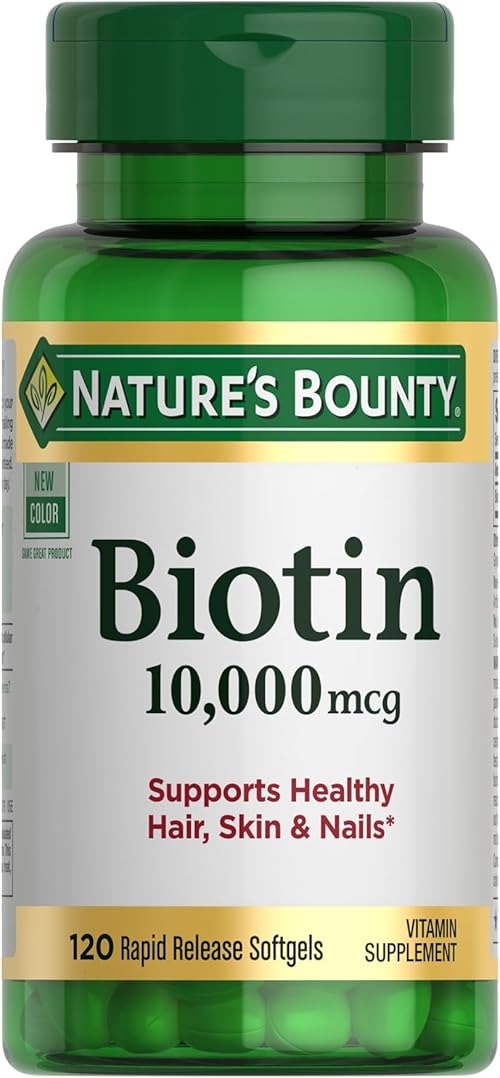
Nature's Bounty Biotin 10,000 mcg
$8.88
"Highest biotin-side rating volume in this comparison: 4.7/5 across 120,883 Amazon ratings at a low per-bottle price."
What real Amazon buyers say
4.7★· 120,883 reviews"I have been using Nature's Bounty Biotin 10,000 mcg for a few months now, and the results are fantastic. My hair feels thicker and healthier, my skin has a noticeable glow, and my nails are stronger than ever."
"Seems to help my hair quite a bit. I do feel like it feels thicker."

Mielle Organics
Mielle Organics Rosemary & Mint Hair Oil
$8.90
"Low-cost rosemary-and-biotin oil with the largest topical-side Amazon signal: 4.5/5 across 122,200 ratings."

Sports Research
Sports Research Biotin 10,000 mcg
$19.95
"Vegan softgel biotin option with 4.6/5 across 99,700 Amazon ratings; better for supplement shoppers avoiding gelatin."

Bronson
Bronson Biotin 10,000 mcg
$7.99
"Lowest priced biotin bottle in this set, with 4.7/5 across 10,700 Amazon ratings and a vegetarian tablet format."