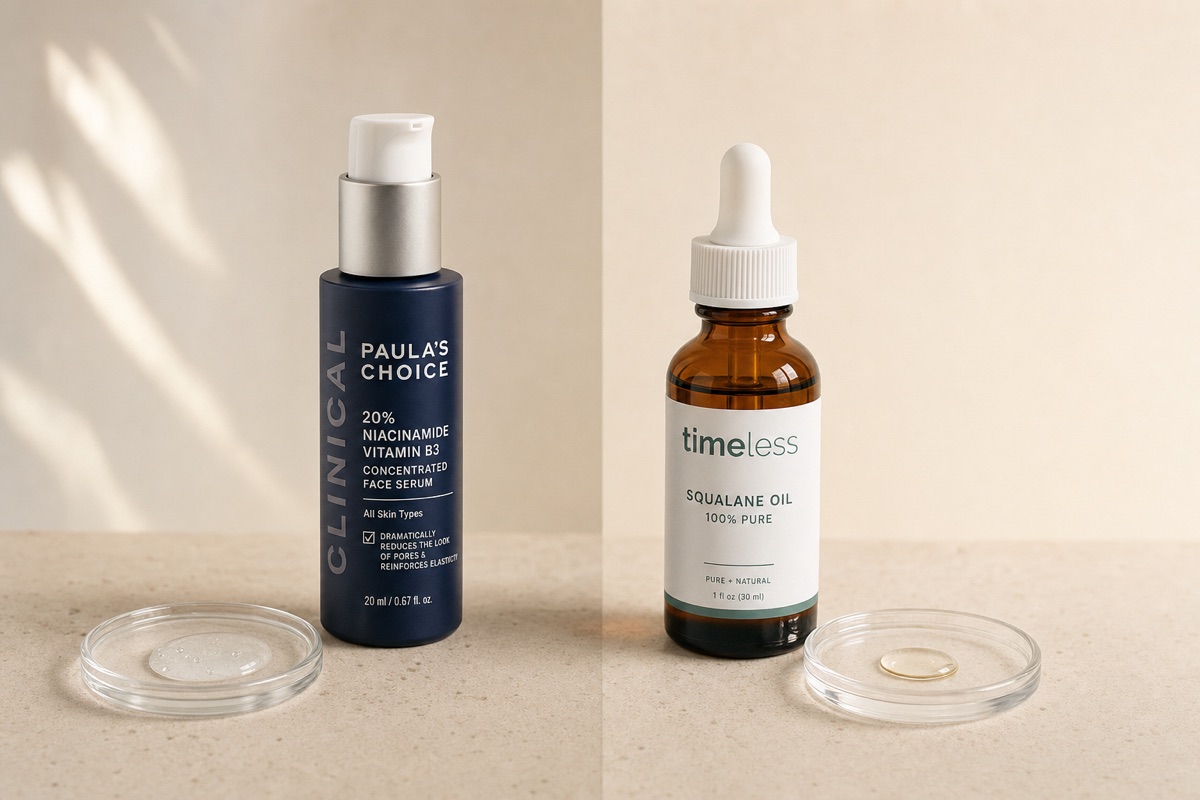
Niacinamide Serums vs Squalane Oils for Fine Lines
Evidence-weighted comparison of niacinamide serums and squalane oils for fine lines, dryness, dullness, hormonal-breakout marks, and mature skin.
We analyzed 39,299 Amazon ratings across 6 representative products, PubMed niacinamide papers from 2004-2006, and official US brand pages. Niacinamide serums win for fine lines tied to uneven tone, pores, dullness, and hormonal-breakout marks; squalane oils win as a simple dry-skin sealing step.
| Criterion | 🏆 Winner Niacinamide serums Multi-brand category $16.99 | Squalane oils Multi-brand category $8 |
|---|---|---|
| Fine-line relevance How directly the category addresses fine lines through published aging-skin evidence, hydration support, and surface-smoothing fit. | 8.2/10 | 6.8/10 |
| Dryness support How well the category helps dry, tight, mature skin look less crepey or papery. | 7.0/10 | 8.4/10 |
| Dullness and uneven-tone fit Weighted toward yellowing, hyperpigmented spots, post-blemish marks, and visible dullness. | 8.8/10 | 5.2/10 |
| Hormonal-acne routine fit How well the category fits adult breakout-prone skin without relying on harsh acne-drug positioning. | 8.1/10 | 5.8/10 |
| Tolerability Penalizes high-strength active tingling, heavy-oil congestion risk, fragrance dependence, and routine-stacking difficulty. | 7.4/10 | 8.3/10 |
| Value Representative Amazon US prices: Naturium niacinamide at $16.99 and Good Molecules squalane oil at $8.00. | 8.2/10 | 8.8/10 |
| Evidence quality Strength of PubMed active evidence, official ingredient positioning, Amazon rating volume, and concern-specific use cases. | 8.9/10 | 6.4/10 |
| Overall score | 8.09 | 7.10 |
🏆 Winner: Niacinamide serums
Niacinamide serums win for fine lines because the category has stronger aging-skin evidence and broader mature-skin utility. In our scoring, niacinamide leads fine-line relevance 8.2 to 6.8, dullness and uneven-tone fit 8.8 to 5.2, hormonal-acne routine fit 8.1 to 5.8, and evidence quality 8.9 to 6.4, supported by PubMed papers from 2004, 2005, and 2006 plus 30,736 Amazon ratings across three representative niacinamide products. Squalane oils win dryness support 8.4 to 7.0 and value 8.8 to 8.2.
Best on a budget
Good Molecules Squalane Oil if you only need a low-cost sealing step; Good Molecules Niacinamide Serum if pores, dullness, or post-breakout marks are part of the fine-line concern
Best for results
Niacinamide serums, especially Paula's Choice Clinical 20% Niacinamide for experienced users and Naturium Niacinamide 12% Plus Zinc 2% for a balanced pore-and-tone routine
Bottom line
Choose niacinamide serum if your fine lines show up with dullness, visible pores, uneven tone, or post-breakout marks. Choose squalane oil if your routine already has a serum and moisturizer, but your skin still looks dry, papery, or tight by afternoon. For most women 35-55 comparing these two categories for fine lines, niacinamide is the more complete first step; squalane is the better finishing layer.
BeautySift analyzed 39,299 Amazon ratings across six representative products: 30,736 ratings on the niacinamide-serum side and 9,658 ratings on the squalane-oil side. That review volume does not prove wrinkle reversal. It does help show how broadly each category is used by US shoppers, especially when read beside PubMed-indexed niacinamide studies and official brand ingredient positioning.
The evidence gap is clear. Bissett DL et al. 2004, indexed on PubMed, specifically links topical niacinamide with aging-skin appearance markers including yellowing, wrinkling, red blotchiness, and hyperpigmented spots. Bissett DL et al. 2005 also frames niacinamide as a vitamin B active for aging facial skin appearance. Squalane has a useful cosmetic role, but the strongest evidence in this comparison is simpler: it is an emollient oil that softens and seals rather than a water-soluble active with aging-skin trial language.
What niacinamide serums do better
Niacinamide serums are the better match when “fine lines” is not the only problem on the face. Many women in the BeautySift audience are comparing products because the lines sit next to other changes: dullness around the cheeks, larger-looking pores around the nose, post-hormonal-breakout marks on the chin, or texture that makes makeup catch. Niacinamide is better positioned for that mixed picture.
The category’s strongest published evidence is active-specific. Bissett DL et al. 2004 named wrinkling, yellowing, red blotchiness, and hyperpigmented spots in aging facial skin. Draelos ZD et al. 2006 evaluated 2% niacinamide and facial sebum, which matters for adult skin that can be dry on the cheeks but still breakout-prone around the jawline. Those studies do not mean every niacinamide serum will smooth every line. They do mean niacinamide has a more direct evidence trail for the concerns that often travel with fine lines.
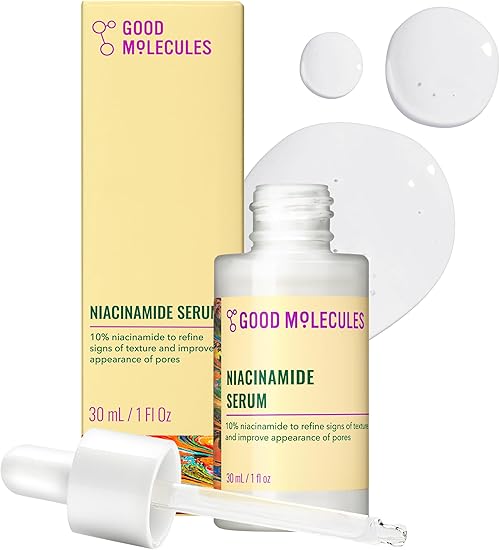
The Amazon signal also favors niacinamide on volume. Naturium Niacinamide Face Serum 12% Plus Zinc 2% shows 4.5/5 across 16,158 Amazon ratings at $16.99, and the Naturium US page identifies 12% niacinamide plus 2% zinc. Good Molecules Niacinamide Serum shows 4.7/5 across 12,577 Amazon ratings at $5.97, while its official US page positions the product as a 10% niacinamide serum for uneven tone, texture, and visible pores. Paula’s Choice Clinical 20% Niacinamide is the strongest high-percentage option, with 4.5/5 across 2,001 Amazon ratings and official US positioning around pores, uneven tone, and texture.
Where niacinamide can disappoint
Niacinamide is not a face oil, and it does not replace a moisturizer. If your fine lines are mainly dehydration creases from dry indoor heat, retinoid flaking, or Midwest winter cold, a watery niacinamide serum can feel insufficient on its own. That is why niacinamide scored 7.0 for dryness support while squalane scored 8.4.
Strength also matters. Paula’s Choice discloses 20% niacinamide; Naturium discloses 12% niacinamide plus 2% zinc; Good Molecules positions its serum around 10% niacinamide. Those percentages can be useful, but more is not automatically better for reactive mature skin. If your barrier is already irritated from retinoids, exfoliating acids, benzoyl peroxide, or frequent cleansing, a high-strength serum can sting, feel tight, or make the area around the mouth look worse before it looks better.
The practical starting point is modest: once daily under moisturizer, not layered with every active you own. Women using prescription tretinoin or a strong retinol can place niacinamide in the morning and keep the evening routine simpler. If the formula includes zinc, acids, or other actives, treat it as part of the active load rather than a neutral hydration step.
What squalane oils do better
Squalane oils are better when the immediate problem is dry skin that needs a soft, flexible finish. A 100% squalane oil is not trying to be a pore serum or dark-spot serum. It acts like a lightweight emollient layer that can reduce the look of dry, papery surface texture by smoothing the top of the skin and slowing the feeling of moisture loss.
The squalane products in this comparison are straightforward. Timeless Skin Care 100% Pure Squalane Oil has the largest squalane-side Amazon signal, with 4.6/5 across 5,673 ratings at $15.26. Good Molecules Squalane Oil is the value pick at $8.00 with 4.6/5 across 2,596 ratings. Biossance 100% Squalane Oil is the prestige option at $34.00 with 4.6/5 across 1,389 ratings, and the Biossance official US page identifies its oil as sugarcane-derived and positioned for face, body, and hair.
That simplicity is the appeal. If a vitamin C serum, retinoid, or niacinamide product is already doing the active work, squalane can make the routine feel less harsh. It is especially useful at night over moisturizer, over dry cheek areas, or during arid Southwest weather when skin loses comfort quickly. For makeup wearers, one drop pressed into dry zones can help reduce flaky-looking foundation, but too much can break down base makeup.
Where squalane is limited
Squalane is not the better answer for dullness, visible pores, or post-hormonal-breakout marks. It does not provide niacinamide, humectants, ceramides, exfoliating acids, retinoids, or pigment-focused actives unless the formula includes more than squalane. That is why squalane scored 5.2 for dullness and uneven-tone fit, compared with 8.8 for niacinamide.
It also should not be framed as a wrinkle treatment. A face oil can soften the look of dehydration lines, but it does not have the same PubMed aging-skin appearance trail that niacinamide has in this comparison. If etched expression lines are the main concern, neither category is the strongest single answer; sunscreen, retinoids, peptides, procedures, or dermatologist-guided options may matter more.
Acne-prone fit is mixed. Many shoppers tolerate squalane well because it is lightweight compared with heavier oils, but an oil is still an oil in the routine. If hormonal breakouts cluster around the chin or jaw, start with one drop on dry cheek areas instead of applying it over the entire lower face. If closed comedones or milia increase, stop the oil and keep niacinamide plus a non-comedogenic moisturizer as the base routine.
How the scoring breaks down
Niacinamide won the overall comparison because it leads the categories that matter most for this query. It scored 8.2 for fine-line relevance versus 6.8 for squalane, 8.8 for dullness and uneven-tone fit versus 5.2, 8.1 for hormonal-acne routine fit versus 5.8, and 8.9 for evidence quality versus 6.4. Those advantages are tied to PubMed papers from 2004, 2005, and 2006 plus official US brand pages that position niacinamide around pores, texture, tone, and sebum-related concerns.
Squalane still won two categories. It scored 8.4 for dryness support versus 7.0 for niacinamide because an oil is more immediately cushioning when skin looks dry and tight. It also scored 8.8 for value versus 8.2 because Good Molecules Squalane Oil is $8.00 in the Amazon snapshot, while the representative niacinamide value pick, Naturium, is $16.99. Good Molecules Niacinamide Serum is cheaper at $5.97, but the category average rises when Paula’s Choice and Naturium are included.
Tolerability is close but not identical. Squalane scored 8.3 because simple 100% oil formulas avoid many active-related stinging issues. Niacinamide scored 7.4 because high-strength formulas can tingle or feel drying, especially when used with retinoids or exfoliating acids. Still, niacinamide’s tolerability is usually manageable when the percentage, frequency, and moisturizer pairing are chosen carefully.
Which should you buy first?
Buy niacinamide first if your mirror complaint sounds like this: fine lines plus dull tone, larger-looking pores, uneven texture, post-breakout marks, or shine in the T-zone with dry cheeks. In that situation, squalane may make the skin feel better, but niacinamide addresses more of the visible pattern. Naturium is the balanced value pick, Good Molecules is the lowest-cost serum pick, and Paula’s Choice is the higher-strength option for experienced users.
Buy squalane first if your routine already has enough actives and your skin mainly needs comfort. That is common for women using retinoids, vitamin C, exfoliating toners, or prescription acne products. Timeless is the review-volume pick, Good Molecules is the budget oil, and Biossance is the prestige sugarcane-derived option. Use it as the last step, not as a replacement for every hydrating layer.
If you are unsure, the most practical mature-skin routine is not either-or. Use niacinamide serum where you want tone, pores, and post-blemish support; use squalane sparingly over dry areas when moisturizer is not enough. That pairing respects what each category does best instead of expecting one ingredient to solve every fine-line concern.
Routine examples for women 35-55
For combination skin with hormonal breakouts: cleanse, apply a niacinamide serum, use a light moisturizer, and finish with broad-spectrum sunscreen in the morning. At night, use retinoid or acne treatment on its own schedule, then moisturizer. Skip squalane on the chin if that area clogs easily; use one drop only on dry cheek zones if needed.
For dry, dull skin: use niacinamide in the morning under moisturizer and sunscreen, then add squalane at night over moisturizer when skin feels tight. This works well when fine lines look worse from dryness but tone and texture still matter. If you also use vitamin C, keep vitamin C in the morning and niacinamide at night, or alternate based on tolerance.
For reactive skin in a cold climate: start lower and slower. Choose a simple niacinamide formula two to four mornings per week, then add moisturizer. Use squalane only after moisturizer and only on areas that feel dry. If stinging develops, pause the niacinamide before blaming the oil; if congestion develops, pause the oil before abandoning the serum.
Related reading
Both winners on Amazon

Paula's Choice
Paula's Choice Clinical 20% Niacinamide Vitamin B3 Concentrated Face Serum
$38.50
"Strongest high-percentage niacinamide pick in this comparison; Amazon lists 4.5/5 across 2,001 ratings and the official US page positions it for pores, tone, and texture."
What real Amazon buyers say
4.5★· 2,001 reviews"This product really helps improve skin texture and minimize the look of pores. A little goes a long way, and it absorbs well without feeling greasy."
"Holy grail dark spot corrector! Worth every penny!"

Naturium
Naturium Niacinamide Face Serum 12% Plus Zinc 2%
$16.99
"Best review-volume and value balance on the niacinamide side; Amazon lists 4.5/5 across 16,158 ratings."
What real Amazon buyers say
4.5★· 16,158 reviews"Excellent alternative to some of the more expensive niacinimide products. I bought this primarily to reduce pore size and improve overall texture/complexion and I feel like it delivers on those particular benefits."
"I'm in my 40's and after using it consistently, my skin feels a lot smoother and clearer."
Good Molecules
Good Molecules Niacinamide Serum
$5.97
"Lowest-cost niacinamide pick in this set; Amazon lists 4.7/5 across 12,577 ratings."
What real Amazon buyers say
4.7★· 12,577 reviews"This is a great Niacinamide Serum, especially at this price point."
"I have been using the Good Molecules facial serum on my face for 2 years.I love the way it decreases the pores."

Timeless Skin Care
Timeless Skin Care Squalane Oil 100% Pure
$15.26
"Highest squalane-side rating volume in this set: 4.6/5 across 5,673 Amazon ratings for a simple 2 oz oil."

Good Molecules
Good Molecules Squalane Oil
$8
"Lowest-cost squalane option in this comparison, with 4.6/5 across 2,596 Amazon ratings."

Biossance
Biossance 100% Squalane Oil
$34
"Prestige squalane option with official sugarcane-derived positioning and 4.6/5 across 1,389 Amazon ratings."