Nutrafol vs Vegamour vs 5% Minoxidil for Hair Thinning in 2026
Evidence-weighted comparison of Nutrafol Women's Balance, VEGAMOUR GRO Hair Serum, and Women's Rogaine 5% Minoxidil Foam for perimenopause-related hair thinning.
We analyzed FDA minoxidil labeling, 3 PubMed hair-growth papers from 2004-2019, 3 Amazon US listings with 29.1K visible ratings, and brand clinical claims. For pattern thinning, 5% minoxidil has the strongest evidence; Nutrafol is the best supplement option; Vegamour is a cosmetic scalp-serum choice.
| Criterion | 🏆 Winner Women's Rogaine 5% Minoxidil Foam Rogaine $39.99 | Women's Balance Hair Growth Supplements Nutrafol $88 | GRO Hair Serum VEGAMOUR $64 |
|---|---|---|---|
| Evidence for female pattern hair loss Scores peer-reviewed and regulatory support highest, brand-sponsored supplement data next, and cosmetic serum claims lower. | 9.5/10 | 7.2/10 | 5.8/10 |
| Perimenopause fit How well the product maps to common 40+ concerns: widening part, hormone-adjacent shedding, stress load, scalp tolerance, and routine practicality. | 8.8/10 | 8.6/10 | 7.1/10 |
| Time to credible evaluation Hair-growth products require months; scores favor sources with clear 16- to 48-week study or labeling windows. | 8.7/10 | 7.6/10 | 6.8/10 |
| Tolerability and cautions Balances scalp irritation, unwanted facial hair, shedding transition, supplement interactions, and cosmetic-serum sensitivity risk. | 7.0/10 | 7.3/10 | 8.0/10 |
| User-review signal Amazon visible ratings and review counts are treated as broad user sentiment, not clinical proof. | 8.3/10 | 8.0/10 | 7.1/10 |
| Value USD price weighed against evidence strength and likely ongoing monthly cost. | 8.9/10 | 6.2/10 | 6.8/10 |
| Accessibility US availability through a verified Amazon listing and broader OTC or prestige-retail context. | 9.0/10 | 7.7/10 | 7.8/10 |
| Overall score | 8.60 | 7.51 | 7.06 |
🏆 Winner: Women's Rogaine 5% Minoxidil Foam
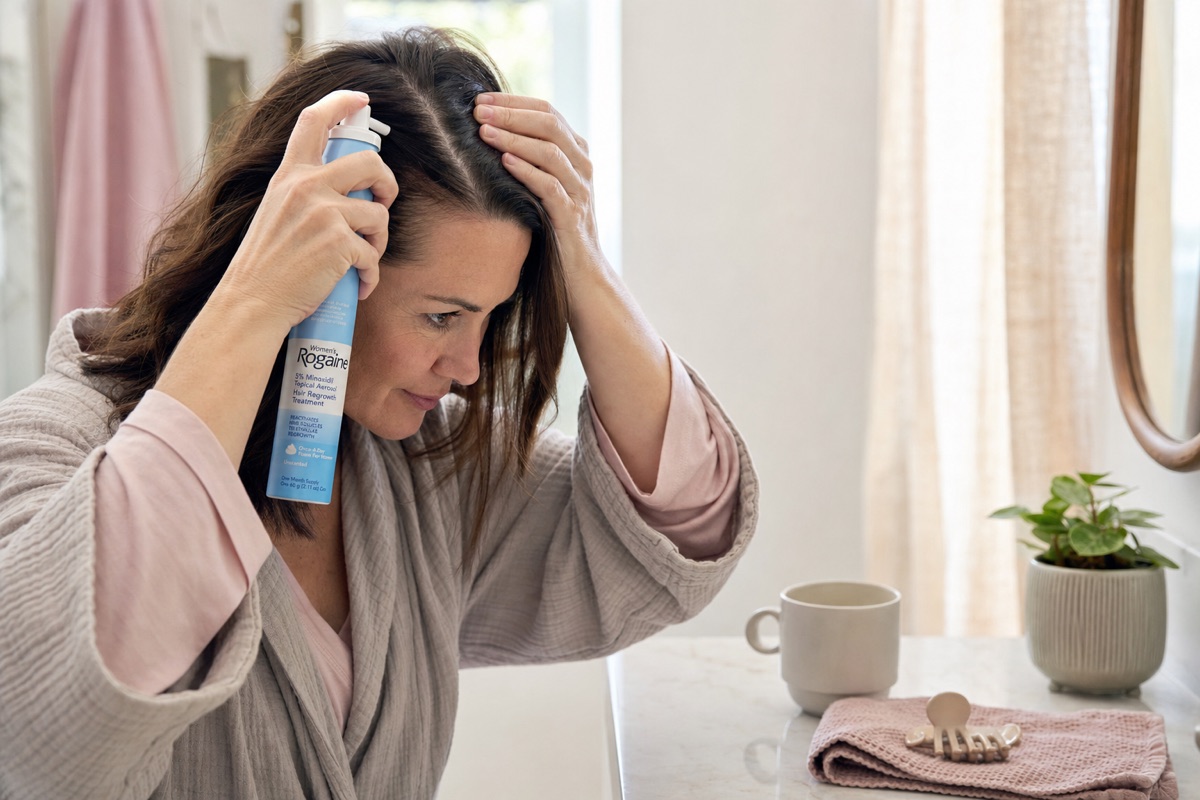
Women's Rogaine 5% Minoxidil Foam wins because minoxidil is the only contender here with FDA OTC labeling and multiple peer-reviewed female-pattern-hair-loss studies, including Lucky 2004 and Blume-Peytavi 2011. It also had the strongest value signal in the Amazon snapshot at $39.99 with 18.6K ratings. Nutrafol is stronger than Vegamour for supplement users because it has a published 6-month oral-supplement trial, but it is not FDA-approved for hair-loss treatment.
Best on a budget
Women's Rogaine 5% Minoxidil Foam
Best for results
Women's Rogaine 5% Minoxidil Foam for pattern thinning; Nutrafol Women's Balance when a clinician-guided supplement strategy is preferred
Bottom line
Choose Women’s Rogaine 5% Minoxidil Foam if your main concern is gradual widening at the part, crown thinning, or dermatologist-suspected female pattern hair loss. In this comparison, minoxidil is the only option with FDA OTC labeling plus multiple peer-reviewed studies in women. That is why it wins the evidence-weighted score, even though it requires patience and can cause irritation or an early shedding phase.
Choose Nutrafol Women’s Balance if you want a supplement strategy for the 45+ life stage and have already considered medical causes of shedding such as iron deficiency, thyroid changes, medication shifts, major stress, and androgen-related hair loss. Nutrafol has a stronger published-study trail than most beauty supplements, including Ablon 2018, but it is still a dietary supplement rather than an FDA-approved hair-loss drug.
Choose VEGAMOUR GRO Hair Serum if you want a daily cosmetic scalp serum and are not ready for minoxidil or oral supplements. Its brand positioning and Amazon review base are meaningful for shopper sentiment, but the finished product does not have the same peer-reviewed and regulatory support as 5% minoxidil.
How we scored Nutrafol, Vegamour, and minoxidil
BeautySift did not test these products. We compared publicly verifiable sources: DailyMed/FDA-style OTC minoxidil labeling, PubMed studies, official US brand pages, and Amazon US listing snapshots captured for the 2026 hair-growth content set.
The scoring favors evidence quality first. Minoxidil scores highest because Lucky 2004 evaluated 5% and 2% topical minoxidil solutions against placebo over 48 weeks, and Blume-Peytavi 2011 compared once-daily 5% minoxidil foam with twice-daily 2% solution in women. Those studies do not guarantee results for every shopper, but they put minoxidil in a higher evidence category than a supplement or cosmetic serum.
Nutrafol scores second because it has a published 6-month randomized, double-blind, placebo-controlled supplement study in women with self-perceived thinning hair. We still down-weight it versus minoxidil because supplement studies are not the same as FDA-reviewed OTC drug labeling, and a multi-ingredient supplement is not automatically appropriate for every user.
Vegamour scores third because its strongest support is brand-published clinical positioning, official product claims, and user sentiment. That can be useful for cosmetic fullness goals, but it should not be framed as equivalent to minoxidil for female pattern hair loss.
Where 5% minoxidil wins
5% minoxidil wins on evidence, cost, and direct relevance to pattern thinning. The Women’s Rogaine Amazon snapshot used here showed a $39.99 price and 18.6K visible ratings, while DailyMed labeling and peer-reviewed literature give shoppers a clearer framework for use, warnings, and expected timelines.
The tradeoff is commitment. Minoxidil is not a short trial product. Results are usually judged over months, and stopping can allow gained hair to shed again. It can also cause scalp irritation, unwanted facial hair, and early shedding. Anyone who is pregnant, trying to conceive, breastfeeding, dealing with sudden shedding, or managing heart or scalp conditions should ask a clinician before use.
Where Nutrafol wins
Nutrafol wins if you specifically want a supplement positioned for women 45+ and prefer an inside-out routine over a leave-on scalp treatment. The Amazon snapshot for Nutrafol Women’s Balance showed $88 and 15.7K visible ratings, and Ablon 2018 gives the brand more published support than many hair supplements.
The caution is cause-matching. If thinning is driven by female pattern hair loss, minoxidil has stronger evidence. If shedding is driven by low ferritin, thyroid imbalance, medication change, rapid weight loss, or postpartum hormone shifts, a generic supplement approach may miss the real trigger. Nutrafol should be reviewed like any multi-ingredient supplement, especially around medications, surgery, liver concerns, pregnancy plans, and autoimmune conditions.
Where Vegamour wins
Vegamour wins for shoppers who want a lightweight, drug-free scalp serum with prestige-beauty positioning. The Amazon snapshot for VEGAMOUR GRO Hair Serum showed $64 and 5.4K visible ratings, which is a substantial user-sentiment signal for a cosmetic serum.
Its limitation is evidence strength. Brand clinical claims can be helpful, but they are not the same as a peer-reviewed randomized trial indexed in PubMed or FDA OTC drug labeling. Vegamour is best framed as a cosmetic density-support step, not the strongest option when the goal is evidence-backed regrowth for pattern thinning.
Practical routine notes
Do not start three hair-growth products at once if you are trying to understand what helps or what irritates your scalp. A more evidence-led sequence is to identify the likely cause of thinning first, choose the highest-evidence option that fits that cause, then add supportive products only if they do not interfere with adherence.
For women in perimenopause, hair thinning can overlap with stress load, ferritin status, thyroid changes, androgen sensitivity, scalp inflammation, styling breakage, and medication changes. A widening part or crown thinning pattern deserves a different strategy than breakage at the ends or sudden diffuse shedding.
If you see abrupt shedding, patchy loss, scalp pain, scaling, redness, or eyebrow/body-hair changes, treat this article as shopping context only and seek medical evaluation. OTC products are not a substitute for diagnosing alopecia areata, telogen effluvium, scarring alopecia, thyroid disease, or iron deficiency.
Affiliate disclosure
BeautySift may earn a commission from Amazon links in this article. Affiliate relationships do not affect the scoring rubric; the comparison above is based on public labeling, PubMed literature, official brand information, and Amazon US listing data.
Related reading
- Guide: Perimenopause hair thinning protocol -> /guides/hair-thinning-protocol-perimenopause-2026/
- List: Best hair growth products for women over 40 -> /listicles/best-hair-growth-products-women-40plus-2026/
- List: Best scalp serums for thinning hair -> /listicles/best-scalp-serums-thinning-hair-women-40plus-2026/
Both winners on Amazon

Rogaine
Women's 5% Minoxidil Foam
$39.99
"Best evidence-weighted choice for female pattern hair loss; Amazon snapshot showed 4.1/5 across 18.6K ratings."

Nutrafol
Women's Balance Hair Growth Supplements
$88
"Best supplement fit for women 45+; Amazon snapshot showed 4.2/5 across 15.7K ratings."

VEGAMOUR
GRO Hair Serum
$64
"Best cosmetic scalp-serum option; Amazon snapshot showed 4.0/5 across 5.4K ratings."