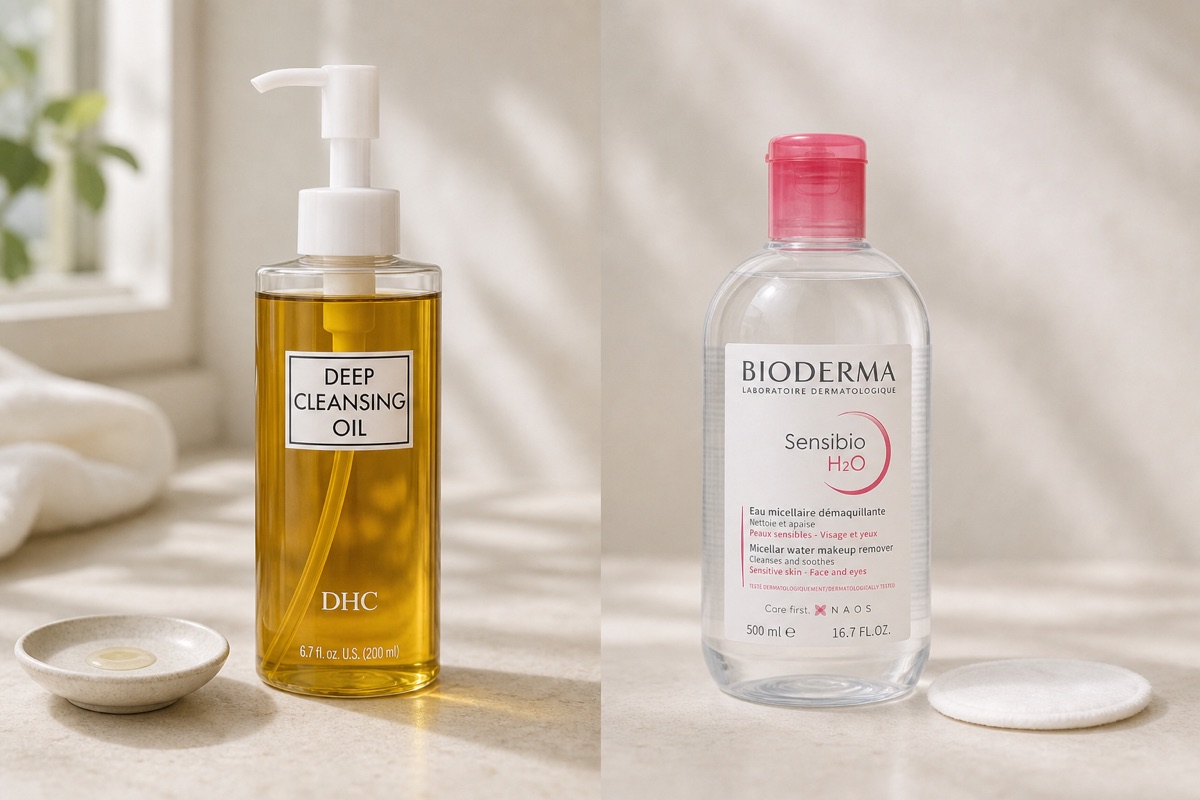
Oil Cleansers vs Micellar Waters for Fine Lines
Evidence-weighted comparison of oil cleansers and micellar waters for fine lines, dryness, sensitive skin, makeup removal, and mature skin routines.
We analyzed 214,023 Amazon US ratings across 6 representative cleansers plus PubMed cleanser-barrier reviews. Micellar waters lead on value and sensitive-skin convenience; oil cleansers lead on sunscreen and long-wear makeup removal, which can reduce tugging around fine lines.
| Criterion | 🏆 Winner Oil cleansers Multi-brand category $25.15 | Micellar waters Multi-brand category $15.60 |
|---|---|---|
| Fine-line fit How well the cleanser format helps remove makeup or sunscreen with less rubbing around expression lines and the orbital area. | 8.4/10 | 7.6/10 |
| Dryness support Weighted toward cushion, after-cleansing comfort, and low-stripping use for dry or mature skin. | 8.7/10 | 7.2/10 |
| Sensitive-skin tolerability Penalizes fragrance concerns, eye stinging reports, cotton-pad friction, and formulas that may leave a residue if not rinsed. | 7.4/10 | 8.5/10 |
| Makeup and sunscreen removal Assesses fit for water-resistant sunscreen, long-wear foundation, mascara, and end-of-day grime. | 9.0/10 | 7.3/10 |
| Value Representative Amazon US basket average: oil cleansers $25.15 across three products and micellar waters $15.60 across three products. | 7.2/10 | 9.0/10 |
| Evidence quality Combines Amazon rating volume, official product positioning, cleanser-barrier literature, and category-specific user sentiment. | 8.0/10 | 8.5/10 |
| Routine simplicity How easy the format is for travel, late-night cleansing, and users who avoid sink-based double cleansing. | 7.0/10 | 9.1/10 |
| Overall score | 7.96 | 8.17 |
🏆 Winner: Oil cleansers
Oil cleansers win narrowly for fine-line-focused cleansing because they scored higher on fine-line fit, 8.4 to 7.6, and makeup and sunscreen removal, 9.0 to 7.3. The reason is mechanical rather than anti-aging: a well-emulsifying oil can dissolve long-wear makeup and water-resistant sunscreen with less cotton-pad friction. Micellar waters win value, 9.0 to 7.2, and sensitive-skin convenience, 8.5 to 7.4, supported by 137,307 Amazon ratings across three representative micellar products.
Best on a budget
Garnier Micellar Cleansing Water
Best for results
DHC Deep Cleansing Oil for makeup and sunscreen removal with less rubbing; Bioderma Sensibio H2O for no-rinse sensitive-skin convenience
Bottom line
Choose an oil cleanser if fine lines look worse because you are tugging at sunscreen, mascara, or long-wear foundation every night. Choose micellar water if your routine is light, your skin is reactive, or you want a low-effort cleanser that does not require a full sink routine. Neither format treats wrinkles in the way a retinoid, sunscreen, or in-office procedure can. The fine-line connection is gentler removal: less rubbing, less tightness, and fewer rough passes over already delicate skin.
BeautySift compared six representative Amazon US products: three oil cleansers and three micellar waters. The data set totals 214,023 Amazon ratings. Oil cleansers accounted for 76,716 ratings with a weighted 4.54/5 average across DHC Deep Cleansing Oil, KOSE SOFTYMO Speedy Cleansing Oil, and Bioderma Atoderm Shower Oil. Micellar waters accounted for 137,307 ratings with a weighted 4.7/5 average across Bioderma Sensibio H2O, Garnier Micellar Cleansing Water, and La Roche-Posay Micellar Cleansing Water.
The numeric winner depends on the job. Oil cleansers win this comparison for fine-line-focused removal because they scored 8.4 versus 7.6 on fine-line fit and 9.0 versus 7.3 on makeup and sunscreen removal. Micellar waters win value, 9.0 versus 7.2, and sensitive-skin convenience, 8.5 versus 7.4. That split matters for women 35-55 because mature skin often has two competing needs: remove more durable sunscreen and makeup, but avoid leaving the face tight, red, or overworked.
Why cleansing matters for fine lines
Fine lines are not caused by cleanser choice alone. UV exposure, collagen loss, estrogen-related dryness, facial movement, smoking history, and genetics matter more. Still, cleansing can change how visible lines look day to day. Dry, stripped skin tends to make creases look sharper. Rubbing around the eyes can also make delicate skin look temporarily irritated or crepey, especially when you are removing mascara or mineral sunscreen.
The PubMed-indexed 2009 review by Kuehl BL et al. discusses gentle cleansing and moisturizing for atopic dermatitis and sensitive skin, which is relevant here because barrier comfort is a major tolerability issue even for shoppers without eczema. A 2013 PubMed review on stratum corneum fatty acids also emphasizes the importance of barrier lipids during cleansing. Those papers do not say that an oil cleanser or micellar water erases wrinkles. They support the more modest claim: mild cleansing and barrier-aware routines are better fits for dry or sensitive skin than harsh, stripping wash steps.
For a 35-55 routine, the practical question is not “Which cleanser is anti-aging?” It is “Which cleanser removes the day with the least friction and least dryness so my retinoid, moisturizer, and sunscreen routine stays consistent?” That is where oil cleansers and micellar waters separate.
Oil cleansers: best when removal is the problem
Oil cleansers are built around the idea that oil-based soils dissolve more easily in oil. Long-wear foundation, water-resistant sunscreen, sebum, and some mascara formulas can break down faster when massaged with a cleansing oil than when repeatedly wiped with a damp cotton pad. A good cleansing oil then emulsifies with water so it rinses away rather than sitting like a leave-on facial oil.
DHC Deep Cleansing Oil is the strongest representative in this comparison. Its Amazon US listing shows 4.6/5 across 24,123 ratings at a $21.49 snapshot, and the DHC US product page positions it as a fragrance-free makeup remover and cleanser. KOSE SOFTYMO Speedy Cleansing Oil is another popular fast-rinse option, with 4.6/5 across 9,734 Amazon ratings at $19.98. Bioderma Atoderm Shower Oil is different: it is a face-and-body cleansing oil positioned for dry to atopic sensitive skin, with 4.5/5 across 42,859 Amazon ratings at $33.99.
For fine lines, oil cleansing is most persuasive at night. If you wear mineral SPF, tinted sunscreen, long-wear base makeup, waterproof eye makeup, or a full face that takes effort to remove, an oil cleanser can reduce the number of passes needed. That is why oil cleansers scored 9.0 for makeup and sunscreen removal. The benefit is not a collagen claim. It is a lower-friction cleansing step that may leave dry mature skin less tight afterward.
The tradeoff is residue risk. Some oil cleansers feel rich, and some users dislike the sensation even after rinsing. If you are breakout-prone, use a small amount, emulsify thoroughly, and consider following with a gentle water-based cleanser. If your eyes sting easily, avoid pushing the oil into the waterline.
Micellar waters: best when convenience and sensitivity matter
Micellar waters use surfactant structures suspended in water to lift light makeup, sunscreen, and grime onto a cotton pad. The category is popular because it is fast, portable, and low mess. For sensitive skin, micellar water can feel less intimidating than a full cleanse, especially on late nights or during travel.
The Amazon rating volume is stronger on the micellar side in this analysis. Bioderma Sensibio H2O Micellar Water has 4.7/5 across 57,862 Amazon ratings at a $19.99 snapshot, and Bioderma’s US page positions Sensibio H2O for sensitive skin and no-rinse makeup removal. Garnier Micellar Cleansing Water has 4.7/5 across 72,810 Amazon ratings at $8.82, making it the best value product in the set. La Roche-Posay Micellar Cleansing Water has 4.7/5 across 6,635 Amazon ratings at $17.99 and fits shoppers who prefer pharmacy-style sensitive-skin brands.
Micellar water scored 9.1 for routine simplicity because it works when you do not want a sink-based routine. It also scored 8.5 for sensitive-skin tolerability, ahead of oil cleansers at 7.4. That does not mean every micellar water is irritation-free. Cotton-pad friction can be a problem around the eyes and mouth, and some users feel better rinsing afterward even when a product is marketed as no-rinse.
For fine lines, micellar water is best when your makeup is light and your main goal is avoiding over-cleansing. It is less ideal if you need multiple soaked pads to remove mascara or sunscreen. Once you are wiping repeatedly, the friction advantage disappears.
Scorecard: oil cleanser vs micellar water
Oil cleansers won the fine-line-specific score because they are better at dissolving durable makeup and sunscreen with less rubbing. The score was 8.4 for oil cleansers versus 7.6 for micellar waters. That edge is most relevant around crow’s feet, the under-eye area, and smile lines where repeated tugging is easy to notice.
Micellar waters won on value. The representative micellar basket averaged $15.60 across Garnier, Bioderma, and La Roche-Posay. The representative oil-cleanser basket averaged $25.15 across DHC, KOSE, and Bioderma Atoderm. Garnier alone was $8.82 in the Amazon snapshot and carried the largest single product rating count in this article, 72,810 ratings.
Oil cleansers won on dryness support, 8.7 to 7.2, because the format is often more cushioning and less stripping when rinsed well. Micellar waters won on routine simplicity, 9.1 to 7.0, because they are easier for travel, low-energy nights, and quick morning cleanup. Evidence quality was close: 8.0 for oil cleansers and 8.5 for micellar waters, reflecting stronger rating volume on the micellar side but more convincing removal logic on the oil side.
Who should choose an oil cleanser
Choose an oil cleanser if your evening routine includes water-resistant sunscreen, long-wear foundation, waterproof mascara, or tinted SPF that clings around the nose and eyes. The oil format is also a strong fit if your skin feels tight after gel or foaming cleansers. In this comparison, DHC Deep Cleansing Oil is the cleanest fine-line fit because it combines broad Amazon rating volume, a fragrance-free positioning on the DHC US page, and a makeup-removal use case.
Oil cleansers also make sense for dry mature skin in Midwest winter cold or Southwest dryness, when a harsh cleanse can make cheeks look papery. The right technique matters: apply to dry hands and dry face, massage gently for under a minute, add water to emulsify, then rinse thoroughly. Do not scrub. If you still feel a film, follow with a bland cleanser rather than rubbing with a towel.
Skip oil cleansers if you hate any residue, have a history of oil-triggered breakouts, or need a cleanser you can use without water. They are also not the best one-step answer for someone who wears only moisturizer and a light daily sunscreen.
Who should choose micellar water
Choose micellar water if your routine is light, your skin reacts easily, or you want a cleanser you can use at the vanity without splashing water. Bioderma Sensibio H2O is the sensitive-skin benchmark in this data set, while Garnier Micellar Cleansing Water is the value pick with 72,810 Amazon ratings at the $8.82 snapshot. La Roche-Posay Micellar Cleansing Water is the pharmacy-style alternative for shoppers who like dermocosmetic branding.
Micellar water is especially useful for mornings, quick makeup corrections, and nights when the alternative is sleeping in makeup. For women dealing with perimenopause-related dryness, that convenience can support consistency: a gentle cleanse followed by moisturizer is better than skipping skincare because the routine feels too involved.
Skip micellar water as your only cleanse if you wear water-resistant sunscreen daily, heavy base makeup, or waterproof mascara. If you need three or four cotton pads, switch to cleansing oil or use micellar water only as a first pass. Rinse if your skin feels sticky, itchy, or tight afterward.
Practical routine recommendations
For a fine-line-conscious evening routine, use oil cleanser first when you wear durable sunscreen or makeup. Massage gently, emulsify with water, and rinse. If your skin is dry and comfortable, you may not need a second cleanse. If you are acne-prone or the oil leaves a film, follow with a gentle non-stripping cleanser.
Use micellar water when your day is lighter. Saturate the cotton pad enough that it glides rather than drags. Press briefly over eye makeup before wiping. Around crow’s feet and under-eyes, avoid back-and-forth rubbing. If the pad is still picking up color after multiple passes, micellar water is not the most efficient cleanser for that makeup load.
For very sensitive skin, patch test either format along the jawline for several nights. The ingredient list matters more than the category name: fragrance, essential oils, strong surfactants, and poor rinsing can all create problems. If you use prescription retinoids or over-the-counter retinol, be more conservative on cleansing nights because the skin barrier may already be more reactive.
Final verdict
Oil cleansers are the better choice for fine-line-focused cleansing when the issue is friction from sunscreen and makeup removal. They are not wrinkle treatments, but they can make the cleansing step less rough and less drying. Micellar waters are the better choice for value, convenience, and quick sensitive-skin cleansing, especially when your makeup is light.
If you want one default for a mature, dry, SPF-heavy routine, start with an oil cleanser at night and keep micellar water for mornings, travel, or low-makeup days. If your skin is reactive and you rarely wear long-wear products, start with micellar water and rinse when needed. The best cleanser is the one that removes the day without leaving your face tight, red, or over-handled.
Related reading
Both winners on Amazon

DHC
DHC Deep Cleansing Oil
$21.49
"Oil-cleanser anchor with 4.6/5 across 24,123 Amazon ratings; best fit here for removing sunscreen and makeup with less rubbing around fine lines."
What real Amazon buyers say
4.6★· 24,123 reviews"This has to be the best face cleanser/makeup removers I have ever used in my 42 years of existence."

Bioderma
Bioderma Sensibio H2O Micellar Water
$19.99
"Sensitive-skin micellar benchmark with 4.7/5 across 57,862 Amazon ratings; strongest no-rinse option for light makeup and quick cleansing."
What real Amazon buyers say
4.7★· 57,862 reviews"Wow, this product is not only perfect for that, it actually makes my skin soft and clean"

Garnier
Garnier Micellar Cleansing Water
$8.82
"Best value signal in the set: 4.7/5 across 72,810 Amazon ratings at $8.82, with broad sensitive-skin positioning."
What real Amazon buyers say
4.7★· 72,810 reviews"No rubbing or scrubbing and my skin feels absolutely clean after using. Non-irritating in my experience."

KOSE
KOSE SOFTYMO Speedy Cleansing Oil
$19.98
"Fast-rinsing oil cleanser with 4.6/5 across 9,734 Amazon ratings; useful for users who want oil cleansing without a heavy feel."

Bioderma
Bioderma Atoderm Shower Oil
$33.99
"Dry-skin-oriented cleansing oil for face and body with 4.5/5 across 42,859 Amazon ratings; better for tight skin than heavy eye makeup."

La Roche-Posay
La Roche-Posay Micellar Cleansing Water
$17.99
"Dermocosmetic micellar option with 4.7/5 across 6,635 Amazon ratings; useful for shoppers who prefer pharmacy-style sensitive-skin formulas."