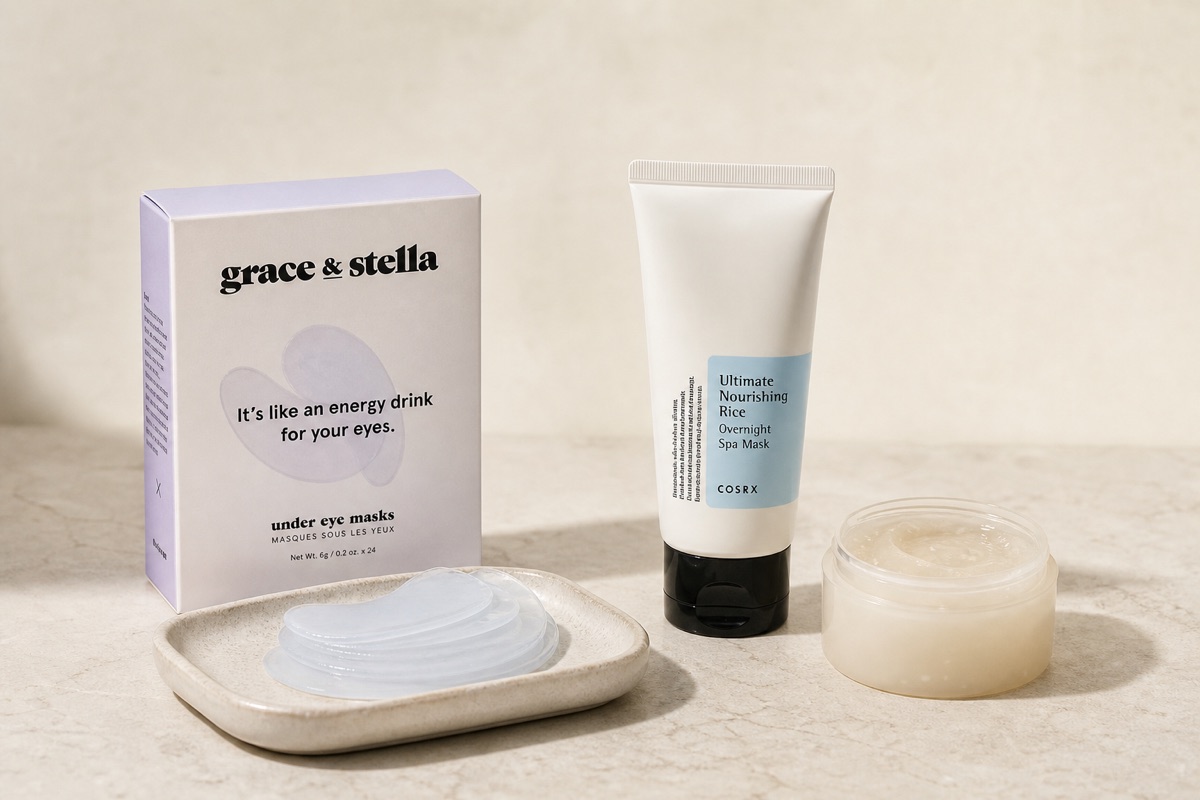
Overnight Masks vs Eye Masks for Depuffing: Head-to-Head
Evidence-weighted comparison of overnight masks and under-eye masks for depuffing, dryness support, mature skin fit, tolerability, and Amazon US value.
We analyzed 81,400 Amazon US ratings across 6 representative masks, plus PubMed caffeine and moisturizer-barrier reviews. Eye masks win targeted morning depuffing 8.6 to 5.8; overnight masks win broader dryness support 8.8 to 6.4.
| Criterion | Overnight face masks Multi-brand category $20.67 | 🏆 Winner Under-eye masks and patches Multi-brand category $48.32 |
|---|---|---|
| Targeted depuffing fit How directly the format addresses temporary under-eye swelling, morning fluid look, and tired-eye appearance. | 5.8/10 | 8.6/10 |
| Dryness support Weighted toward humectants, emollients, barrier-support ingredients, and usefulness for mature dry skin beyond the under-eye zone. | 8.8/10 | 6.4/10 |
| Ingredient evidence Strength of active-category support from PubMed literature and formula positioning: moisturizers for overnight masks, caffeine and occlusive hydrogel delivery for eye masks. | 7.4/10 | 7.8/10 |
| Tolerability Penalizes fragrance, eye-area migration, adhesives, slippery gels, and formulas likely to sting sensitive eyes. | 7.6/10 | 7.1/10 |
| Value Representative Amazon US basket average: overnight masks $20.67 versus eye masks $48.32, with reusable or multi-pair formats considered. | 8.5/10 | 6.8/10 |
| Amazon rating volume The representative Amazon set includes 37,600 ratings for overnight masks and 43,800 ratings for eye masks. | 7.8/10 | 8.1/10 |
| Makeup compatibility How well the format fits before concealer, sunscreen, or a workday routine without pilling or slip. | 5.9/10 | 8.0/10 |
| Overall score | 7.40 | 7.54 |
🏆 Winner: Under-eye masks and patches
Under-eye masks win for the exact depuffing query because they lead targeted depuffing 8.6 to 5.8 and makeup compatibility 8.0 to 5.9 in our rubric. The representative eye-mask set also carries 43,800 Amazon ratings versus 37,600 for the overnight-mask set. Overnight masks are the better dryness purchase, winning that criterion 8.8 to 6.4, but they are less precise for morning under-eye swelling.
Best on a budget
e.l.f. Holy Hydration! Sleeping Mask for facial dryness, or Grace & Stella Under Eye Masks if the goal is a low-cost multi-pair depuffing format
Best for results
Under-eye masks and patches for visible morning puffiness; overnight face masks for dryness-driven creasing and barrier comfort
Bottom line
Choose under-eye masks if your main question is, “What can make my eyes look less puffy this morning?” Choose an overnight face mask if the broader issue is dry, tight skin that makes fine lines look more obvious by the time you wake up.
BeautySift compared two categories, not a single lab-tested pair of products. The representative Amazon US set includes 81,400 total ratings across six products: 37,600 ratings for overnight masks and 43,800 ratings for under-eye masks. That rating volume is not clinical proof of depuffing, but it is useful evidence for how widely each format is used by US shoppers.
The head-to-head result is split. Under-eye masks win the exact depuffing query because they are targeted, removable, and easier to use before concealer. Overnight masks win dryness support because they cover the full face and are designed to sit on skin for hours. For women 35-55, that difference matters: morning puffiness and mature-skin dryness often show up together, but they do not need the same product.
What overnight masks do better
Overnight masks are basically leave-on moisturizers with a richer or more cushiony format. Their best use is not shrinking eye bags. Their best use is reducing the look and feel of overnight dehydration: tight cheeks, dullness, flaky patches, and creases that look deeper when skin is under-moisturized.
The ingredient logic is straightforward. Lodén’s 2012 PubMed-indexed moisturizer review explains that topical moisturizers and emollients support dry-skin barrier comfort. Overnight masks lean into that category of evidence. They usually combine humectants that bind water with emollients or occlusives that slow water loss. COSRX Ultimate Nourishing Rice Overnight Spa Mask, LANEIGE Water Sleeping Mask, and e.l.f. Holy Hydration! Sleeping Mask are the three overnight-mask representatives in this analysis.
The Amazon signal favors this use case. COSRX carries 4.4/5 across 24,000 Amazon ratings in our source snapshot; LANEIGE carries 4.6/5 across 10,000 Amazon ratings; e.l.f. carries 4.5/5 across 3,600 Amazon ratings. Their shared advantage is value and coverage. The average representative overnight-mask price here is $20.67, less than half the representative eye-mask average of $48.32.
The trade-off is precision. A face sleeping mask can make the whole eye area look more rested if dryness was the problem, but it is not built to sit directly under the lower lash line. Rich masks can migrate, blur vision, or cause concealer slip if used too close to the eye.
What eye masks do better
Under-eye masks and patches are better targeted for temporary morning puffiness. They place a cooling, hydrated patch directly below the eye for a short period, then come off before makeup. That format is why eye masks score 8.6 for targeted depuffing versus 5.8 for overnight masks in our rubric.
Caffeine also makes the category more relevant to puffiness. Elias ML et al. reviewed caffeine in skincare in 2023, and a 2015 PubMed review focused on topical and transdermal caffeine delivery. Those papers do not prove every caffeine eye patch will erase bags, but they support caffeine as a rational cosmetic ingredient for tired-looking, vascular-looking, or fluid-prone under-eyes.
The product set is also broader than one luxury jar. Grace & Stella Under Eye Masks are the value pick here at $19.95 and 4.3/5 across 24,000 Amazon ratings. Peter Thomas Roth 24K Gold Hydra-Gel Eye Patches are the premium option at $75.00 and 4.3/5 across 15,000 Amazon ratings. Patchology FlashPatch Rejuvenating Eye Gels sit between them at $50.00 and 4.4/5 across 4,800 Amazon ratings.
Eye masks have one weakness: they are short-contact products. They can make under-eyes look smoother and less swollen for a workday or event, but they are not a barrier-repair step. If your under-eye area is chronically dry, an eye cream or moisturizer strategy still matters.
The scoring table, translated
The winner in the frontmatter is under-eye masks and patches because the article’s primary query is depuffing. They lead targeted depuffing 8.6 to 5.8, Amazon rating volume 8.1 to 7.8, and makeup compatibility 8.0 to 5.9. That is the practical morning-use case: remove the patches, tap in the remaining serum, then apply sunscreen and concealer.
Overnight masks win dryness support 8.8 to 6.4 and value 8.5 to 6.8. Those scores matter if your “puffiness” is actually creasing from dehydration, especially in Midwest winter cold, Southwest dryness, or after a week of retinoid use. A full-face sleeping mask may not flatten under-eye bags, but it can make the surrounding skin look less parched.
Tolerability is close. Overnight masks score 7.6 and eye masks score 7.1. Overnight masks lose points for possible eye migration and fragrance in some formulas. Eye masks lose points for adhesive feel, slipping, fragrance, and the fact that the under-eye area reacts quickly when a product is too active.
Best fit by shopper type
Pick under-eye masks if puffiness is most visible in the morning, if your eyes look tired before work, or if you want a quick step before an event. The most realistic expectation is temporary cosmetic improvement: cooler-feeling skin, less swollen-looking under-eyes, and smoother makeup application. FDA cosmetic-claim guidance is a useful guardrail here: these products can improve appearance, but they should not be treated like medical solutions for allergies, edema, or structural under-eye bags.
Pick an overnight mask if your face wakes up tight, dull, or creased from dryness. This is especially relevant for mature skin because estrogen-related dryness and a slower barrier-recovery feel can make lines look more obvious. An overnight mask is not a dedicated eye treatment, but it can make the whole face look more comfortable by morning.
If you are deciding between one purchase, match the product to the time of day when the problem bothers you most. Morning mirror shock points to eye masks. Nighttime tightness points to an overnight mask.
How to use them without irritation
For overnight masks, apply a thin layer as the last skincare step, avoiding the lash line and mobile eyelid. More is not better; a heavy layer is more likely to migrate into the eyes or pill on bedding. If you use retinoids, acids, or vitamin C, keep the overnight mask bland and moisturizing rather than adding another active-heavy product.
For eye masks, place them on clean skin below the orbital bone, not pressed into the lower lashes. Remove them after the time listed on the package. Leaving hydrogel patches on until they dry out can make the area feel tighter, not more hydrated. If you chill patches in the refrigerator, keep them cool, not icy.
For sensitive eyes, fragrance is the first thing to scrutinize. Stop using either format if you get burning, watery eyes, rash, or new milia. A product that works for cheeks may still be wrong for the under-eye area.
There is also a sequencing issue. If you use eye masks before makeup, do them before sunscreen and before any silicone-heavy primer; otherwise patches can lift product and leave uneven edges. If you use an overnight mask, apply it after watery serums have dried down, then keep it away from the immediate lash line. That order keeps the two categories from working against each other: eye masks stay a short-contact morning step, while overnight masks remain a longer-contact moisture step.
Product notes from the evidence set
Grace & Stella is the value eye-mask pick because it combines the lowest eye-mask price in this comparison with the largest single eye-mask Amazon sample, 24,000 ratings. It is best for shoppers who want repeat use without paying premium-patch prices.
COSRX is the overnight-mask value pick because it has the largest overnight-mask Amazon sample, 24,000 ratings, and the lowest midrange price among the two higher-volume overnight options. It is better for dry cheeks and a softer morning skin feel than for direct lower-eye swelling.
LANEIGE is the prestige overnight pick at 4.6/5 across 10,000 Amazon ratings. It is a better splurge when the whole face needs hydration than when the only concern is puffy under-eyes. Peter Thomas Roth is the premium eye-patch pick, but at $75.00 it needs to be a targeted treat, not a default daily step for every shopper.
Final verdict
For depuffing, under-eye masks are the better buy. They are more targeted, easier to use before makeup, and supported by a slightly larger Amazon rating set in this comparison: 43,800 ratings versus 37,600 for overnight masks.
For dryness, overnight masks are the better buy. They are cheaper per representative product in this analysis and better aligned with moisturizer-barrier evidence. The smartest routine may use both: an overnight mask a few nights a week for dry facial skin, and eye masks only when morning puffiness needs a short-term cosmetic fix.
Related reading
Both winners on Amazon

Grace & Stella
Grace & Stella Under Eye Masks
$19.95
"Best low-cost eye-mask representative in this set: 4.3/5 across 24,000 Amazon ratings, with a multi-pair format suited to morning depuffing."
What real Amazon buyers say
4.3★· 24,000 reviews"These feel cool and soothing under my eyes and help me look more awake in the morning."
"I keep them in the fridge and use them before makeup when my under eyes are puffy."

COSRX
COSRX Ultimate Nourishing Rice Overnight Spa Mask
$18
"Best overnight-mask value in this set: 4.4/5 across 24,000 Amazon ratings and a richer sleeping-mask format for dryness-driven creasing."
What real Amazon buyers say
4.4★· 24,000 reviews"I use this as the last step at night and wake up with softer, less dry skin."
"It is moisturizing without feeling too heavy, and my skin looks calmer by morning."

LANEIGE
LANEIGE Water Sleeping Mask
$32
"Prestige overnight hydration option with 4.6/5 across 10,000 Amazon ratings, best suited to dry facial skin rather than targeted under-eye bags."
What real Amazon buyers say
4.6★· 10,000 reviews"My face feels hydrated in the morning and the texture is light enough that it does not feel greasy."

Peter Thomas Roth
Peter Thomas Roth 24K Gold Hydra-Gel Eye Patches
$75
"Premium hydrogel eye-patch option with 4.3/5 across 15,000 Amazon ratings; best for shoppers who want a spa-style patch before events."

Patchology
Patchology FlashPatch Rejuvenating Eye Gels
$50
"Mid-premium eye gels with 4.4/5 across 4,800 Amazon ratings, positioned for quick under-eye smoothing before makeup."

e.l.f.
e.l.f. Holy Hydration! Sleeping Mask
$12
"Budget overnight mask with 4.5/5 across 3,600 Amazon ratings; stronger for facial dryness than for direct under-eye depuffing."