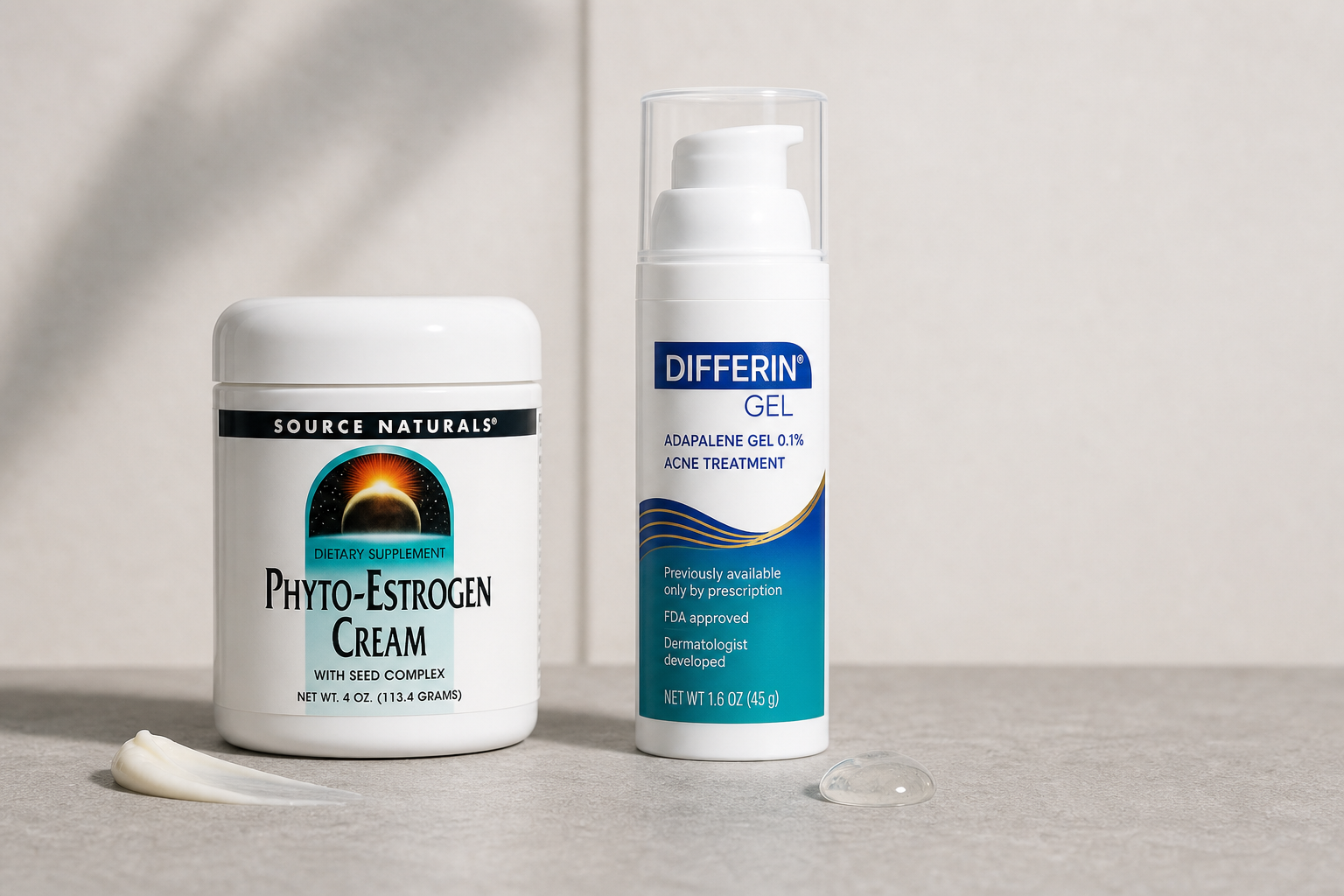
Phytoestrogen Creams vs Hormonal Acne Treatments for Fine Lines
Evidence-weighted comparison of phytoestrogen creams and hormonal acne treatments for fine lines, adult breakouts, price, tolerability, and US Amazon fit.
We analyzed 29,351 Amazon ratings across 6 US products, FDA adapalene records, the 2024 AAD acne guideline, and PubMed topical-estrogen literature. For fine lines plus adult acne, OTC acne treatments led by adapalene have the stronger evidence fit; phytoestrogen creams are more of a body-dryness experiment.
| Criterion | Phytoestrogen creams Source Naturals, Joellyne Naturals, and Emerita $24.12 | 🏆 Winner Hormonal-pattern acne treatments Differin, La Roche-Posay, and CeraVe $23.97 |
|---|---|---|
| Fine-line relevance Scores weigh whether the category has a defensible path to visible fine-line improvement through hydration, retinoid biology, exfoliation, or cosmetic texture support. | 5.9/10 | 7.8/10 |
| Hormonal-acne relevance Scores reflect usefulness for recurring jawline, chin, clogged-pore, and inflamed adult breakouts, using guideline and FDA evidence where available. | 2.4/10 | 8.9/10 |
| Amazon rating volume Representative US Amazon rating totals are 1,847 ratings for the three phytoestrogen creams versus 27,514 ratings for the three acne-treatment products. | 5.8/10 | 8.8/10 |
| Value Representative product prices are close at the entry point, but acne treatments have stronger evidence per dollar: $23.97 Differin versus $24.12 Source Naturals. | 6.4/10 | 8.1/10 |
| Tolerability for mature skin Scores balance likely dryness, fragrance or stickiness, hormone-adjacent caution, retinoid purge risk, and how easily each category can be introduced slowly. | 6.3/10 | 6.9/10 |
| Evidence quality Scores reward FDA records, dermatology guidelines, and active-specific evidence over cosmetic hormone-like positioning and anecdotal Amazon support. | 5.4/10 | 8.7/10 |
| Claim clarity Scores reward clear cosmetic or OTC acne-drug roles and penalize broad hormone-balance language that may confuse skincare, supplements, and medical treatment. | 5.5/10 | 8.4/10 |
| Overall score | 5.39 | 8.23 |
🏆 Winner: Hormonal-pattern acne treatments
Hormonal-pattern acne treatments win for the combined fine-lines-plus-breakouts use case because they scored 8.9 vs 2.4 on acne relevance, 8.8 vs 5.8 on Amazon rating volume, and 8.7 vs 5.4 on evidence quality. The FDA record for OTC adapalene and the 2024 AAD acne guideline give adapalene, benzoyl peroxide, and salicylic acid a clearer role than phytoestrogen creams. Phytoestrogen creams may still fit body dryness or neck/chest softness, but the cited 2014 topical-oestrogen facial trial keeps wrinkle claims modest.
Best on a budget
CeraVe Acne Control Gel if you want a lower-priced acne active with barrier-conscious brand positioning; Source Naturals if you specifically want the lowest-entry phytoestrogen cream.
Best for results
Differin Acne Treatment Gel 0.1% adapalene for recurring clogged pores and adult breakouts; phytoestrogen creams only for cosmetic softness expectations.
Quick verdict
If you are choosing between phytoestrogen creams and hormonal-pattern acne treatments for fine lines, the more practical answer depends on whether acne is active. For women 35-55 with recurring chin, jawline, or clogged-pore breakouts, hormonal-pattern acne treatments win. We analyzed 27,514 Amazon ratings across Differin, La Roche-Posay, and CeraVe acne products, plus the 2024 American Academy of Dermatology acne guideline and FDA adapalene records. That evidence is clearer than the wrinkle case for plant-estrogen creams.
Phytoestrogen creams still have a role, but it is narrower. Source Naturals Phyto-Estrogen Cream had the largest Amazon signal on that side, with 4.3/5 across 1,536 ratings in the snapshot we cited. Joellyne Naturals and Emerita added 311 more ratings combined. That is meaningful user volume for a niche category, but it does not turn these creams into wrinkle treatments or acne treatments.
For fine lines alone, hydration, sunscreen, retinoids when tolerated, and barrier repair usually make more sense than hormone-like cosmetic language. For fine lines plus breakouts, adapalene is the standout because it sits in the topical retinoid category and has FDA-recognized OTC acne use. It may also support smoother-looking texture over time, but the acne evidence is the stronger claim.
What each category is trying to do
Phytoestrogen creams are usually marketed around plant-derived estrogen-like ingredients: soy isoflavones, red clover, wild yam, pueraria mirifica, or related botanical positioning. The promise is often softness, moisture, menopause support, or a more supple look. These products are not the same as prescription estriol or estrogen therapy, and they should not be treated that way.
Hormonal-pattern acne treatments are not actually hormone treatments in the OTC aisle. They are products used for acne patterns that many adult women recognize: chin bumps, jawline congestion, cyclical flare-ups, clogged pores, and occasional inflammation. The representative products here use adapalene or salicylic acid. Differin and La Roche-Posay are adapalene gels; CeraVe Acne Control Gel uses 2% salicylic acid with ceramide-led brand positioning.
That distinction matters for fine lines. Phytoestrogen creams aim at dryness and softness. Acne treatments aim at pore behavior, inflammation, and cell turnover. If your fine lines look worse because your skin is dehydrated but you do not break out, a bland moisturizer may be more useful than either side. If your fine lines sit next to breakouts and uneven texture, an acne-active routine has the stronger reason to exist.
Ingredient evidence: adapalene has the clearer lane
The 2024 American Academy of Dermatology acne guideline, indexed on PubMed, supports topical retinoids, benzoyl peroxide, and salicylic acid as part of acne care. FDA records also document Differin Gel 0.1% adapalene moving to OTC acne-treatment status. Those two sources give the acne-treatment side a clearer evidence base than a cosmetic cream whose main story is plant-estrogen positioning.
That does not mean adapalene is automatically gentle. Mature skin is often drier in perimenopause, especially around the mouth and cheeks. Retinoids can cause peeling, tightness, and a purge period. The correct comparison is not “gentle cream versus harsh drug.” It is “claim-heavy cosmetic softness versus active acne treatment with better evidence and higher irritation management needs.”
For the phytoestrogen side, PubMed is more cautionary than promotional. Yoon, Lee, and Chung’s 2014 Acta Dermato-Venereologica study looked at long-term topical oestrogen treatment of sun-exposed facial skin in postmenopausal women and did not find improvement in facial wrinkles or elasticity. That study does not test every phytoestrogen cream on Amazon, but it is enough to keep the fine-line claim restrained.
The Lephart and Naftolin 2022 review in Clinical, Cosmetic and Investigational Dermatology discusses estrogens, SERMs, and skin aging more broadly. It helps explain why estrogen-language skincare attracts interest during menopause. It does not prove that an over-the-counter phytoestrogen body cream will soften facial wrinkles.
Amazon signal and price: acne treatments have the bigger user base
The rating-volume gap is large. The three hormonal-pattern acne treatments in this comparison total 27,514 Amazon ratings: Differin at 10,209, La Roche-Posay Effaclar Adapalene at 7,842, and CeraVe Acne Control Gel at 9,463. The three phytoestrogen creams total 1,847 ratings: Source Naturals at 1,536, Joellyne Naturals at 132, and Emerita at 179.
Amazon ratings do not prove efficacy, and BeautySift does not treat reviews as clinical data. They do matter for practical shopping. A product with thousands of ratings usually gives a broader picture of texture complaints, dryness, breakouts, packaging issues, and repeat-purchase behavior than a product with a few hundred ratings.
Price is closer than the evidence. Differin was $23.97 in the cited Amazon snapshot, while Source Naturals was $24.12. CeraVe was lower at $17.82, and La Roche-Posay was higher at $39.99. On the phytoestrogen side, Joellyne Naturals was $28.49 and Emerita was $26.95. If the cart total is similar, the better value is the product category with the clearer job.
For acne plus fine lines, that is the acne-treatment side. For body softness without active acne, a phytoestrogen cream may still be a reasonable experiment if you are comfortable with the ingredient positioning and have no clinician-advised reason to avoid hormone-adjacent products.
Tolerability: both sides need caution after 35
Phytoestrogen creams can look gentle because the word “cream” sounds comforting. The actual user fit is more complicated. Some Amazon reviewers like the smoothness and neutral fragrance of Source Naturals. Others in this category mention heaviness, scent, stickiness, or slow absorption. Thick body-style creams can be fine for arms and chest but too occlusive for the face, especially near acne-prone jawlines.
Acne treatments have a different risk profile. Adapalene can dry, peel, and irritate if you apply too much too often. Salicylic acid can over-exfoliate when stacked with retinoids, vitamin C, scrubs, or peels. Perimenopausal skin often needs slower introduction than the routines popular with younger acne shoppers.
A realistic routine would start with one acne active two or three nights per week, a plain moisturizer, and daily sunscreen. If you also want to try a phytoestrogen cream, keep it on the body or neck at first and avoid applying it over the same facial zones where you are using adapalene or salicylic acid. That gives you a better chance of identifying what caused dryness, congestion, or redness.
Best fit by shopper type
Choose hormonal-pattern acne treatments if your main issue is recurring breakouts with fine lines in the same routine. Differin is the most evidence-forward option in this set because FDA records support OTC adapalene for acne and the Amazon snapshot shows 4.6/5 across 10,209 ratings. La Roche-Posay is similar in active category but higher-priced. CeraVe is the lower-cost salicylic acid option when clogged pores and texture are the main concern.
Choose phytoestrogen creams if your acne is not active and your real concern is dry-looking body skin, neck softness, or menopause-positioned body care. Source Naturals has the strongest review base in this side of the comparison, with 1,536 Amazon ratings. Joellyne Naturals and Emerita are lower-volume alternatives, so we treated them as supporting products rather than proof of a category-wide effect.
Skip phytoestrogen creams or ask a clinician first if you have a hormone-sensitive cancer history, unexplained bleeding, are using hormone therapy, are pregnant or breastfeeding, or have been told to avoid estrogen-like products. Skip aggressive acne-active routines if your barrier is cracked, stinging, or eczema-prone; stabilize the skin first.
How to use the winner without overdoing it
For adapalene, use a pea-size amount for the whole face at night, not a dab on every bump. Start two or three nights per week, then increase only if your skin is calm. Moisturizer can go before or after, depending on sensitivity. Sunscreen is non-negotiable because retinoid routines and exfoliating acids do not make sense without UV protection.
For salicylic acid gels, avoid layering with adapalene on the same night until you know your tolerance. If you are already using a retinoid, a salicylic acid product may belong only on the T-zone or on alternate nights. If your skin feels tight by noon, you are probably treating too hard, not too little.
For phytoestrogen creams, treat the first two weeks as a patch-test period. Apply to a small body area, then the neck or chest only if there is no itching, redness, rash, or new congestion. Avoid using these products as eye creams or as acne treatments. The evidence supports modest expectations: softness, comfort, and possibly a less dry look, not wrinkle reversal.
Final take
Hormonal-pattern acne treatments are the better evidence-weighted choice when fine lines and breakouts are both part of the question. They have the larger Amazon user base, clearer FDA and dermatology-guideline support, and a more specific active-ingredient role. Phytoestrogen creams are not useless, but they belong in a narrower lane: body dryness, softness, and menopause-positioned cosmetic care for shoppers who are comfortable with hormone-adjacent language.
If your face is breaking out and drying out at the same time, do not solve both by adding more actives. Pick one evidence-led acne active, pair it with a bland moisturizer and sunscreen, and reassess after several weeks. If the acne is painful, cystic, scarring, or new after 40, a dermatologist visit is a better next step than stacking Amazon creams.
Related reading
Both winners on Amazon

Differin
Differin Acne Treatment Gel 0.1% Adapalene Pump
$23.97
"Strongest evidence fit for recurring adult breakouts: FDA-approved OTC adapalene with 4.6/5 across 10,209 Amazon ratings."
What real Amazon buyers say
4.6★· 10,209 reviews"I've been using Differin Gel for years, and it's a staple in my routine."
"Overall, this is a solid option for anyone looking for a long-term acne treatment rather than a quick fix."

Source Naturals
Phyto-Estrogen Cream
$24.12
"Most-reviewed phytoestrogen cream in this set, with 4.3/5 across 1,536 Amazon ratings; better framed as cosmetic softness than wrinkle treatment."
What real Amazon buyers say
4.3★· 1,536 reviews"This phytoestrogen cream is smooth, easy to apply, and absorbs quickly. It has a light, pleasant scent and doesn't feel greasy on the skin."
"I have only been using this a few days and to date I have had no allergic reactions. What I like about this product is that it has neutral fragrance."

La Roche-Posay
La Roche-Posay Effaclar Adapalene Gel 0.1% Acne Treatment
$39.99
"Prestige-pharmacy adapalene option with 4.6/5 across 7,842 Amazon ratings and official US acne-treatment positioning."
What real Amazon buyers say
4.6★· 7,842 reviews"First of all, people who rated this product low--- this product was doing exactly what it was supposed to do."
"Yes, your skin might purge and will get worse before it gets better."

CeraVe
CeraVe Acne Control Gel
$17.82
"2% salicylic acid gel with 4.6/5 across 9,463 Amazon ratings and barrier-conscious CeraVe positioning."

Joellyne Naturals
Phytoestrogen Cream with Soy Isoflavones
$28.49
"Soy-isoflavone phytoestrogen cream with 4.5/5 across 132 Amazon ratings; lower-volume but relevant to the plant-estrogen query."

Emerita
Phytoestrogen Body Cream
$26.95
"Body-focused phytoestrogen cream with 4.6/5 across 179 Amazon ratings; best considered for body dryness rather than acne."