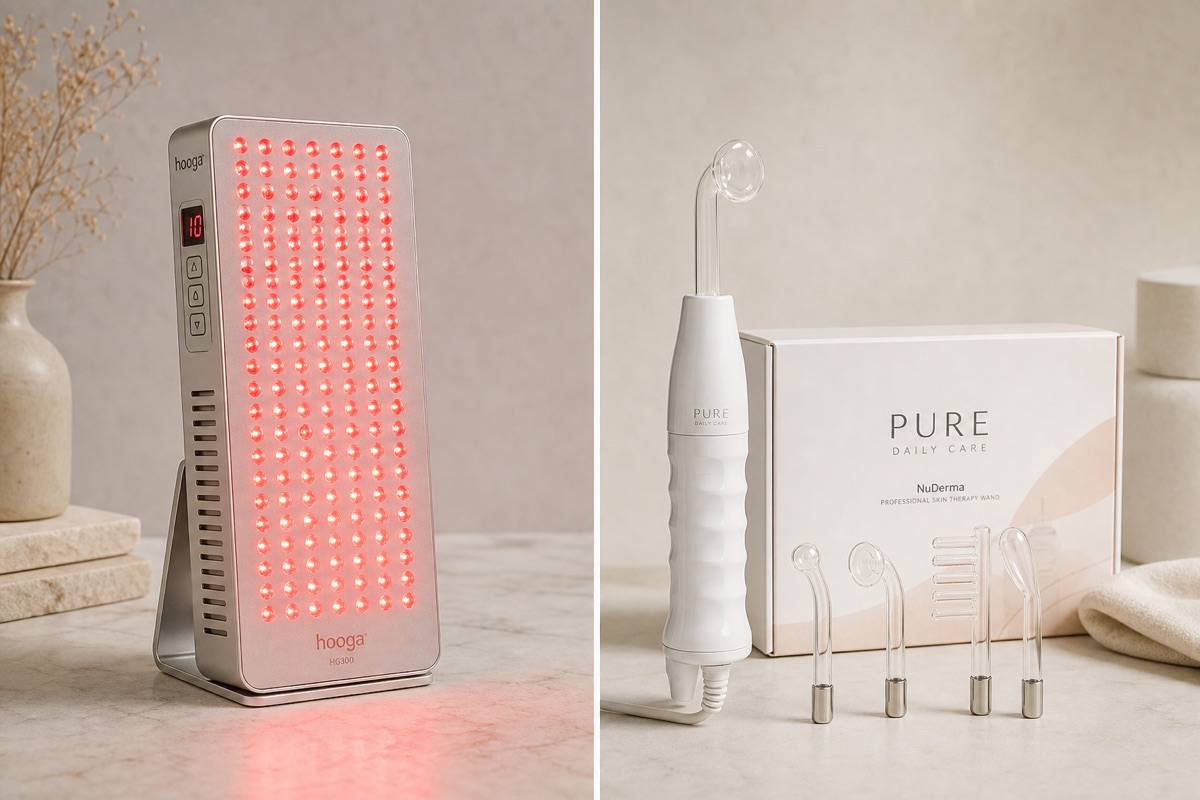
Red Light Therapy Panels vs High-Frequency Wands for Fine Lines
Evidence-weighted comparison of red light therapy panels and high-frequency facial wands for fine lines, acne-prone skin, sagging, price, and tolerance.
Based on 8 Amazon US product pages totaling 38,653 displayed ratings, 2 PubMed photobiomodulation reviews, FDA device guidance, and Reddit beauty-tech discussions, red light panels have stronger fine-line evidence; high-frequency wands fit oily, breakout-prone users better.
| Criterion | 🏆 Winner Red light therapy panels Category $56.98 | High-frequency facial wands Category $69.95 |
|---|---|---|
| Fine-line evidence Strength of published support for collagen, photobiomodulation, and visible aging claims. | 8.6/10 | 5.1/10 |
| Amazon rating volume Displayed Amazon US rating count across the 3 representative products per side. | 6.4/10 | 9.0/10 |
| Price accessibility Entry price and midrange price for US shoppers, using May 2026 Amazon snapshots. | 7.8/10 | 8.4/10 |
| Tolerability for mature skin Likelihood of fitting dryness, sensitivity, rosacea tendency, and skin barrier concerns common after 35. | 8.0/10 | 5.9/10 |
| Acne-prone skin fit Usefulness for oilier or breakout-prone users, especially jawline congestion and occasional hormonal acne. | 5.8/10 | 7.6/10 |
| Ease of consistent use How easy the device is to use repeatedly without complex technique. | 7.3/10 | 6.5/10 |
| Overall score | 7.32 | 7.08 |
🏆 Winner: Red light therapy panels
Red light therapy panels win for fine lines because PubMed-indexed photobiomodulation literature supports red and near-infrared light mechanisms for skin rejuvenation, while high-frequency wands rely more on acne-focused user sentiment and device tradition. High-frequency wands lead Amazon rating volume in this snapshot, but their fine-line evidence score is lower.
Best on a budget
Viconor Red Light Therapy Lamp with Stand for red light, or Pure Daily Care NuDerma Handheld Neon Wand if breakouts matter more than wrinkles
Best for results
Red light therapy panels
Bottom line: choose red light for lines, high frequency for breakout-prone areas
Red light therapy panels are the better fine-line choice for most US shoppers over 35. In our evidence weighting, panels scored 8.6/10 for fine-line evidence because red and near-infrared photobiomodulation has PubMed-indexed support, including Avci et al. 2013 in Seminars in Cutaneous Medicine and Surgery. High-frequency wands scored 5.1/10 for fine-line evidence because their strongest practical use case is not wrinkles; it is short-contact, targeted use on oily or breakout-prone areas.
That does not make high-frequency wands useless. Amazon US rating volume is much larger for the three wand products we analyzed: 34,239 displayed ratings across NuDerma Professional, NuDerma Clinical, and NuDerma handheld neon wand, versus 2,207 displayed ratings across Hooga HG300, BestQool 170W, and Viconor in the same May 2026 snapshot. Rating volume is not clinical proof, but it does show that high-frequency wands are widely bought and reviewed.
For fine lines, sagging, and a drier midlife skin barrier, red light panels are the cleaner first buy. For occasional hormonal acne along the chin or jawline, a high-frequency wand can be a cheaper second device if you tolerate the sensation.
How the technologies differ
Red light panels use visible red light, commonly around 660nm, and near-infrared light, commonly around 850nm. The three Amazon products in this comparison disclose those wavelengths in their product titles or descriptions: Hooga HG300 lists 660nm and 850nm, Viconor lists 660nm and 850nm, and BestQool lists multiple red and near-infrared wavelengths. The skin-care argument is photobiomodulation: light energy is used to support cellular signaling, inflammation modulation, and collagen-related pathways. PubMed literature is not a blank check for every home device, but the mechanism is better documented than the wrinkle claims around high-frequency wands.
High-frequency wands use glass electrodes filled with gas, commonly neon or argon, to create a mild electrical current at the skin surface. The familiar spa-use pitch is that the device creates a warming, tingling, oxygenating feel and may help oily or blemish-prone areas. In this comparison, NuDerma Professional and NuDerma Clinical include neon and argon attachments, while the lower-cost NuDerma handheld model is neon-only. The evidence problem is simple: user demand is high, but fine-line outcomes are not as well supported by peer-reviewed cosmetic-aging literature.
Evidence score: panels have the stronger anti-aging case
Panels win the evidence category because their active technology maps to published photobiomodulation literature. Avci et al. 2013 reviewed low-level laser and light therapy in skin, and PubMed-indexed review literature continues to discuss red and near-infrared light for skin rejuvenation. BeautySift does not treat those papers as proof that every Amazon panel will reproduce a clinic device result. We do treat them as stronger backing than a brand page or user review alone.
High-frequency wands are harder to credit for fine lines. They may temporarily make skin look more awake because of stimulation, warmth, or reduced surface oil, but that is different from evidence of collagen remodeling. If your primary concern is etched crow’s feet, forehead lines, or crepey cheek texture, the red light category deserves the first look.
The wrinkle caveat is dose. A panel used once a month will not compete with consistent sunscreen and retinoid use. Most consumer red light routines require repeated sessions over weeks, eye protection, and a realistic expectation: softening and support, not a facelift.
Amazon rating volume: wands are the mass-market winner
Amazon rating volume favors high-frequency wands in this snapshot. Pure Daily Care’s NuDerma handheld neon wand showed 4.4/5 across 21,196 displayed ratings, the NuDerma Professional showed 4.4/5 across 7,339 displayed ratings, and NuDerma Clinical showed 4.3/5 across 5,704 displayed ratings. That is a combined 34,239 displayed ratings for the wand side.
The red light panel side was smaller but still useful. Hooga HG300 showed 4.6/5 across 1,082 displayed ratings, BestQool 170W showed 4.8/5 across 452 displayed ratings, and Viconor showed 4.4/5 across 673 displayed ratings. That totals 2,207 displayed ratings.
Rating volume matters because it catches practical friction: confusing instructions, bulbs that fail, awkward stands, fragile attachments, and whether people keep using the device. It does not outrank clinical plausibility. A 20,000-review wand can still be less convincing for fine lines than a lower-review red light panel if the underlying anti-aging mechanism is weaker.
Price and value: the cheapest device depends on your goal
The cheapest red light option in our Amazon snapshot was the Viconor stand lamp at $56.98. The Hooga HG300 sat at $199, and BestQool 170W sat at $319. That gives red light a wide range: inexpensive entry lamps, compact panels, and larger modular panels.
High-frequency wands also span a usable budget range. The NuDerma handheld neon wand was $69.95, NuDerma Professional was $99.95, and NuDerma Clinical was $169.95 in our captured pages. If your concern is an occasional hormonal breakout, high frequency can be less expensive than a stronger panel. If your concern is fine lines across the full face, neck, chest, or hands, the panel cost is easier to justify because it treats a larger area without tracing each spot with a glass electrode.
For value, we scored red light panels 7.8/10 and high-frequency wands 8.4/10. Wands cost less at the entry level and have huge Amazon volume. Panels cost more when you buy a credible multi-LED unit, but the fine-line evidence makes the spend more rational for anti-aging shoppers.
Tolerability: red light is gentler for dry, reactive, or mature skin
Red light panels scored 8.0/10 for tolerability versus 5.9/10 for high-frequency wands. The main reason is contact. With a panel, there is usually no glass electrode dragging across the skin and no zap-like sensation. You still need eye protection and time limits, and warmth can bother some users, but the category is generally easier to fit around dryness.
High-frequency wands can be a poor match for compromised barriers. The sensation can feel prickly, the glass attachments can tug if used without slip, and overuse can make the skin feel dry. For women in the 35-55 range dealing with perimenopausal dryness, cheek sensitivity, or retinoid adjustment, that matters. A device that makes the skin feel tight may push people to abandon the routine before any benefit appears.
Avoid high-frequency devices over broken skin, irritated dermatitis, or areas where you cannot control pressure. If you have a pacemaker, implanted electrical device, seizure history, pregnancy concerns, or active medical skin condition, ask a clinician before using electrical home devices. That is not legal filler; it follows the FDA’s broader low-risk device principle that wellness devices should not drift into medical treatment claims.
Acne and hormonal breakouts: wands have a real user-fit advantage
High-frequency wands are not the fine-line winner, but they are more compelling for breakout-prone areas. We scored wands 7.6/10 for acne-prone skin fit versus 5.8/10 for red light panels. The reason is practical, not magical: a wand is easy to apply to one chin bump or jawline cluster for a short session, and user reviews often frame these devices around blemishes, oiliness, and post-breakout texture.
Red light can still be useful for calmer-looking skin, especially when a full-face panel is already in the routine. But if the shopper’s real problem is monthly hormonal acne rather than etched lines, the first purchase may be a wand or a dermatologist-guided acne plan, not a $319 panel.
For combination concerns, split the decision by priority. Choose red light if fine lines, laxity, neck texture, and dullness are the main issues. Choose high frequency if you mostly want a targeted tool for oily spots and occasional breakouts and you are not highly sensitive.
Best product fits from this comparison
Best red light value: Hooga HG300. The Hooga panel combines disclosed 660nm and 850nm wavelengths, a compact format, and a 4.6/5 Amazon snapshot across 1,082 displayed ratings. It is the cleanest category representative if you want a panel without jumping to a full-body system.
Best larger red light option: BestQool 170W. BestQool had the highest star average in this set at 4.8/5 across 452 displayed ratings and a larger format than the smallest budget lamps. The tradeoff is price: $319 in our snapshot.
Best budget red light experiment: Viconor. At $56.98 and 4.4/5 across 673 displayed ratings, Viconor is the lower-risk entry point. It is not the same category of build as a premium panel, but it lets cautious shoppers try a stand-style red and near-infrared lamp before spending more.
Best high-frequency wand: NuDerma Professional. The NuDerma Professional kit scored best among wands because it combines neon and argon attachments with 7,339 displayed Amazon ratings at 4.4/5. It is the best fit if you want the high-frequency category for blemish-prone zones.
Best attachment range: NuDerma Clinical. It costs more at $169.95 but includes six fusion neon and argon wands. The Amazon snapshot showed 4.3/5 across 5,704 displayed ratings.
Best budget high-frequency pick: NuDerma handheld neon wand. At $69.95 with 21,196 displayed ratings at 4.4/5, it is the mass-market pick. The limitation is that it is neon-only, so it is less flexible than a kit with both neon and argon.
Who should buy which device?
Buy a red light panel if you are mostly concerned with fine lines, early sagging, crepey texture, dullness, or maintaining firmness after 35. It is also the better category if your skin is dry, retinoid-adjusting, or easily overworked by friction. The best routine is boring and repeatable: cleanse, use the panel as directed, moisturize, and keep sunscreen nonnegotiable in the morning.
Buy a high-frequency wand if you are oily, breakout-prone, or dealing with occasional hormonal acne along the chin and jawline. Use it as a targeted device, not a full-face anti-aging substitute. More passes are not better. If skin feels tight, hot, or unusually dry afterward, reduce frequency.
Skip both if you expect in-office results, have an electrical-device contraindication, or would rather invest in dermatologist-guided retinoids, pigment treatment, or procedures. At-home devices can support a routine, but they do not replace daily SPF, prescription care, or realistic timelines.
Verdict
Red light therapy panels win this comparison for fine lines because the evidence is better aligned with skin-aging concerns. The category has stronger PubMed support, better tolerability for dry mature skin, and broader treatment-area practicality. High-frequency wands win rating volume and targeted breakout fit, but their wrinkle claims are less persuasive.
If you can buy only one device for fine lines, choose a red light panel. If your fine lines are mild but monthly jawline breakouts are the frustration, choose a high-frequency wand or add it later as a targeted tool.
Related reading
Both winners on Amazon

Hooga
Hooga HG300 Red Light Therapy Panel
$199
"Compact 660nm red and 850nm near-infrared panel; Amazon snapshot showed 4.6/5 across 1,082 displayed ratings."

Pure Daily Care
NuDerma Professional Skin Therapy Wand
$99.95
"Neon and argon wand kit with the strongest high-frequency rating volume in this comparison: 4.4/5 across 7,339 displayed ratings."

BestQool
BestQool 170W Red Light Therapy Panel
$319
"Higher-output panel with four disclosed wavelengths and a 4.8/5 Amazon snapshot across 452 displayed ratings."

Viconor
Viconor Red Light Therapy Lamp with Stand
$56.98
"Budget stand-style 660nm and 850nm lamp; Amazon snapshot showed 4.4/5 across 673 displayed ratings."

Pure Daily Care
Pure Daily Care NuDerma Clinical Skin Therapy Wand
$169.95
"Six fusion neon and argon attachments; Amazon snapshot showed 4.3/5 across 5,704 displayed ratings."

Pure Daily Care
Pure Daily Care NuDerma Handheld Neon Wand
$69.95
"Lower-cost neon-only wand with broad Amazon volume: 4.4/5 across 21,196 displayed ratings in the May 2026 snapshot."