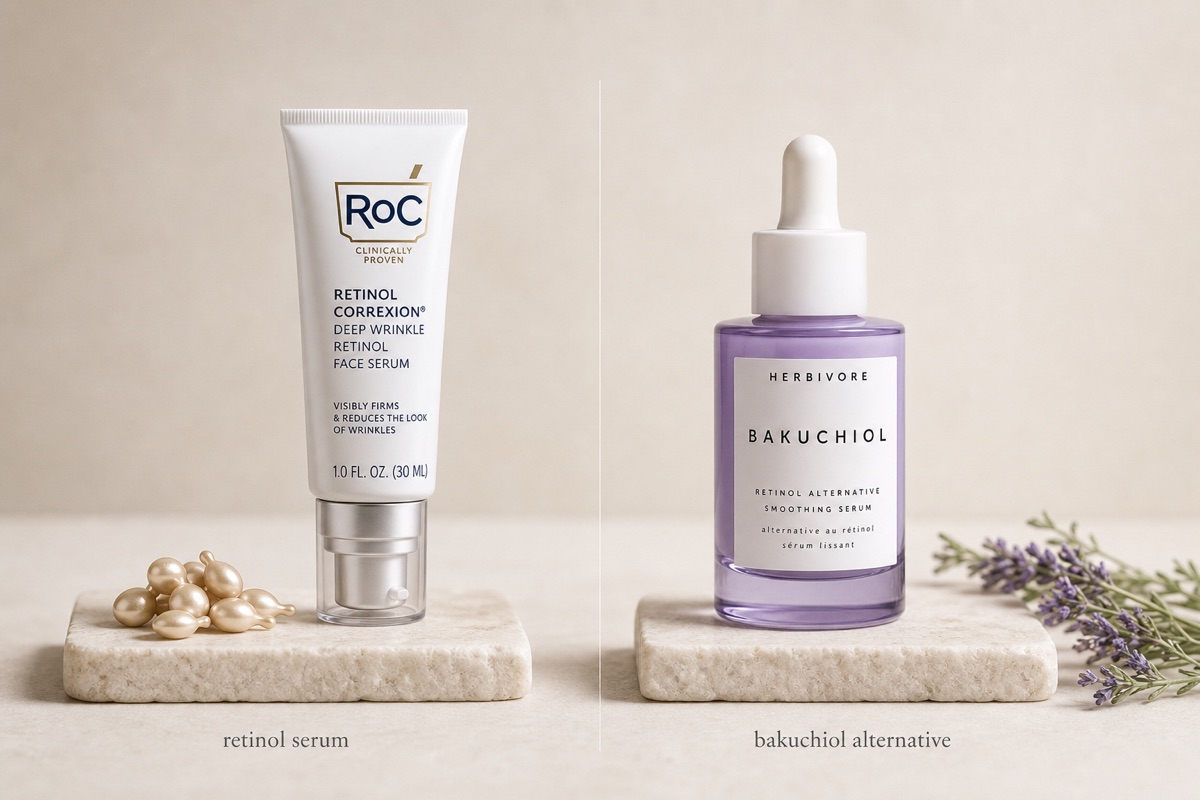
Retinol Serums vs Bakuchiol Products for Fine Lines
Evidence-weighted comparison of retinol serums and bakuchiol products for fine lines, sensitive skin, Amazon US rating volume, price, tolerability, and user fit.
We analyzed 2 PubMed clinical papers and 6 Amazon US product snapshots: the retinol serum set averaged 4.40/5 across 23,606 ratings, while the bakuchiol set averaged 4.50/5 across 1,213 ratings. Retinol has stronger wrinkle evidence; bakuchiol has the better tolerability signal.
| Criterion | Retinol serums Vitamin A derivative category $21.97 | Bakuchiol products Plant-derived retinol alternative category $9.99 |
|---|---|---|
| Fine-line evidence Strength of published ingredient evidence for visible wrinkles and photoaging, weighted toward randomized controlled studies. | 9.1/10 | 7.8/10 |
| Amazon rating volume Representative Amazon US rating depth across three products per side, using visible rating counts captured for this article. | 9.2/10 | 4.8/10 |
| Average Amazon star rating Weighted visible Amazon star average across three representative products per side. | 8.4/10 | 8.8/10 |
| Price and value Visible Amazon US price spread, with budget access and cost of long-term nightly use considered. | 7.9/10 | 8.6/10 |
| Sensitive-skin tolerability Likelihood of scaling, stinging, dryness, or barrier disruption, based on clinical side-effect reporting and review language. | 6.2/10 | 8.7/10 |
| Routine compatibility How easily the category fits with moisturizers, sunscreen, exfoliating acids, and perimenopause-related dryness. | 7.1/10 | 8.4/10 |
| Overall evidence strength Balance of clinical data, FDA or dermatology guidance, Amazon review depth, and ingredient transparency. | 8.7/10 | 7.6/10 |
| Overall score | 8.09 | 7.81 |
🏆 Winner: Retinol serums for strongest wrinkle evidence; bakuchiol products for sensitive-skin tolerance
Retinol wins the evidence score because Kafi et al. reported a statistically significant fine-wrinkling improvement after 24 weeks in a randomized 0.4% retinol study, and the three retinol products captured 23,606 Amazon ratings. Bakuchiol wins tolerability because Dhaliwal et al. found no statistical difference in wrinkle improvement versus retinol over 12 weeks, while retinol users reported more scaling and stinging.
Best on a budget
Good Molecules Bakuchiol Oil for Dry Skin at a $9.99 Amazon snapshot for the gentlest low-entry option; RoC Retinol Correxion Deep Wrinkle Serum at $21.97 for the lower-cost retinol representative.
Best for results
Retinol serums when the primary goal is the strongest evidence-backed fine-line routine; bakuchiol products when visible aging concerns overlap with sensitive, dry, or retinol-reactive skin.
Bottom line: retinol has the evidence edge; bakuchiol has the comfort edge
Retinol serums and bakuchiol products are both sold to women who want softer-looking fine lines, smoother texture, and a routine that still feels realistic after 40. They are not equal swaps, though. Retinol is a vitamin A derivative with a longer dermatology history and more clinical familiarity. Bakuchiol is a plant-derived ingredient often marketed as a retinol alternative, with a smaller but relevant clinical evidence base and a stronger tolerability story.
The most useful head-to-head evidence is Dhaliwal et al.’s 2019 British Journal of Dermatology study. In that randomized, double-blind 12-week comparison, 44 participants used either 0.5% bakuchiol twice daily or 0.5% retinol daily. The authors reported that both groups significantly decreased wrinkle surface area and hyperpigmentation, with no statistical difference between the two compounds; retinol users reported more facial scaling and stinging.
That does not make bakuchiol a proven replacement for every retinol user. Retinol still wins on depth of evidence. Kafi et al.’s 2007 Archives of Dermatology study followed 36 elderly subjects for 24 weeks and found a statistically significant fine-wrinkling score change with 0.4% retinol versus vehicle: -1.64 versus -0.08, with P<.001. For a shopper whose skin tolerates retinoids, that kind of evidence keeps retinol in front.
How the Amazon data changes the conversation
Amazon ratings are not clinical proof, but they do show which products have enough real-world use to surface patterns: texture complaints, peeling reports, scent issues, and whether shoppers keep buying. In the six-product snapshot captured for this article, the retinol side had far more rating depth: 23,606 visible ratings across RoC Retinol Correxion Deep Wrinkle Serum, Paula’s Choice Clinical 1% Retinol Face Treatment, and SkinMedica Retinol Complex 1.0. The weighted retinol average was 4.40/5.
The bakuchiol side had a higher but much smaller visible rating base: 4.50/5 across 1,213 ratings for Herbivore Bakuchiol Retinol Alternative Face Serum, Good Molecules Bakuchiol Oil for Dry Skin, and Beekman 1802 Dream Booster Bakuchiol Face Serum. That 4.50/5 looks appealing, but the sample is about one-twentieth the size of the retinol set. We weight it as a useful comfort and satisfaction signal, not a category-changing result claim.
Price also splits in a practical way. Good Molecules’ bakuchiol oil had the lowest Amazon snapshot price at $9.99, while RoC’s retinol serum was $21.97. Paula’s Choice sat at $45.50 and SkinMedica at $76.80, showing how quickly retinol can move from drugstore to prestige. Bakuchiol does not automatically mean cheap: Herbivore’s visible Amazon price was $47.60, higher than the RoC and Paula’s Choice retinol picks.
Ingredient evidence: what retinol does better
Retinol’s advantage is not that every retinol serum is strong. The advantage is that the ingredient family has clearer support for photoaging when used consistently and carefully. Kafi et al.’s 24-week study is especially relevant because it looked at naturally aged skin and measured fine wrinkling on a semiquantitative scale. The study used 0.4% retinol lotion up to three times weekly, not a random cosmetic blend with unknown active strength.
That distinction matters because many retail retinol products do not disclose their exact retinol percentage. Paula’s Choice Clinical 1% Retinol Face Treatment does, and SkinMedica Retinol Complex 1.0 signals a stronger-user formula. RoC does not make the same kind of percentage-forward promise on the Amazon listing we captured, but it has substantial user volume at 15,362 ratings.
The downside is also well known: retinol can cause dryness, peeling, stinging, and barrier stress, especially when someone starts nightly, layers acids, or uses it during a dry Midwest winter without enough moisturizer. The American Academy of Dermatology’s retinoid education emphasizes gradual use and sun protection. For women in perimenopause, when dryness and reactivity can become more noticeable, that slow-start advice is not optional.
Ingredient evidence: what bakuchiol does better
Bakuchiol’s strongest argument is not that it is stronger than retinol. It is that one randomized 12-week study found comparable improvement in wrinkle surface area and hyperpigmentation versus 0.5% retinol while the retinol group reported more scaling and stinging. For a shopper who has already tried retinol and quit because of irritation, that is a meaningful signal.
The tradeoff is evidence depth. Retinol has decades of derivative research and routine dermatology use behind it. Bakuchiol has fewer high-quality human studies, and product formulas vary widely: water-light serums, oils, fragrance-free boosters, and botanical blends. Herbivore, Good Molecules, and Beekman 1802 are not interchangeable textures. An oil can feel comforting on dry cheeks but heavy on an oily T-zone. A booster serum may layer better under moisturizer but deliver a subtler sensory result.
Bakuchiol is also not automatically irritation-free. Plant-derived does not mean risk-free, and fragrance, essential oils, or a heavy oil base can bother some sensitive users. The better way to frame bakuchiol is as lower-risk for retinol-type peeling, not as a guarantee that every formula suits every face.
Tolerability: the decisive factor for sensitive skin
For sensitive skin, bakuchiol wins this comparison. Dhaliwal et al. specifically reported more scaling and stinging in the retinol group. Amazon review language also follows the expected pattern: retinol users often discuss tingling, peeling, acclimation, and needing sunscreen, while bakuchiol users more often describe lightweight texture, moisturized skin, or choosing it because retinol was too rough.
That does not mean women with sensitive skin should never use retinol. A low-and-slow routine can work: one or two nights weekly, moisturizer before and after, no exfoliating acids on the same night, and daily broad-spectrum sunscreen. Retinol is often a better long-term fine-line choice if your skin can tolerate it and you are willing to build frequency over months.
Bakuchiol is the more forgiving first step if your skin is dry, reactive, rosiness-prone, or newly intolerant of products that used to be easy. It also fits shoppers who want a simpler routine without calculating acid nights, retinoid nights, and recovery nights. For women 35-55, that convenience matters because consistency beats an intense routine you abandon after two weeks.
Which side is better by user type?
Pick retinol serums if fine lines are your main concern, your skin already tolerates active ingredients, and you want the category with the stronger evidence record. RoC is the lower-cost on-ramp in this comparison. Paula’s Choice makes more sense for experienced retinol users who want a disclosed 1% formula. SkinMedica is the prestige option for shoppers comfortable paying more for a stronger-positioned retinol product.
Pick bakuchiol products if your skin is sensitive, dry, or retinol-reactive. Good Molecules is the budget entry point, especially for dry skin that likes oils. Herbivore is the prestige serum option with a lightweight feel. Beekman 1802 is the cleanest fit here for sensitive-skin shoppers because its Amazon listing emphasizes fragrance-free positioning.
If you are choosing for fine lines around the eyes or mouth, do not chase strength first. Those areas tolerate irritation poorly. A gentle bakuchiol product used consistently may beat a stronger retinol that makes you peel, stop, restart, and repeat. If your skin is resilient, retinol’s evidence advantage becomes more persuasive.
How to use either one without sabotaging your barrier
Start with one active, not both. For retinol, use a pea-size amount at night one or two times weekly for the first two weeks. Apply moisturizer, then retinol, then another thin moisturizer layer if you are dry. Do not combine it the same night with glycolic, lactic, salicylic, or strong peel pads until your skin is clearly comfortable.
For bakuchiol, you can often start more frequently, but sensitive skin still benefits from a gradual ramp. Try every other night first, especially if the formula is oil-rich or fragranced. If your skin feels calm after two weeks, move toward nightly use if that matches the product instructions.
Sunscreen matters with both categories. The FDA’s anti-aging product guidance is a reminder that cosmetic products are about appearance, not structural drug claims. Daily broad-spectrum sunscreen does more for long-term fine lines and uneven tone than switching among actives while leaving UV exposure uncontrolled. If you live with Florida summer humidity, choose lighter layers. If you deal with Southwest dryness or Midwest winter heat, prioritize moisturizer around either active.
Verdict
Retinol serums win for evidence-backed fine-line improvement. The category has stronger clinical grounding, including Kafi et al.’s 24-week randomized study with a statistically significant fine-wrinkling improvement, and the Amazon products we captured have much larger review volume. If your skin tolerates retinoids, retinol remains the more evidence-weighted pick.
Bakuchiol products win for sensitive-skin fit. Dhaliwal et al.’s 12-week randomized comparison found bakuchiol and retinol both improved wrinkle surface area and hyperpigmentation, with more scaling and stinging reported by retinol users. For shoppers who want a gentler route, bakuchiol is a credible alternative, not just a marketing label.
The practical answer: use retinol if your skin is resilient and fine lines are the main target. Use bakuchiol if your barrier is reactive, dry, or already failed a retinol routine. If you eventually want both, keep retinol as the main evidence-backed active and use bakuchiol on recovery nights only if your skin stays calm.
Related reading
Both winners on Amazon
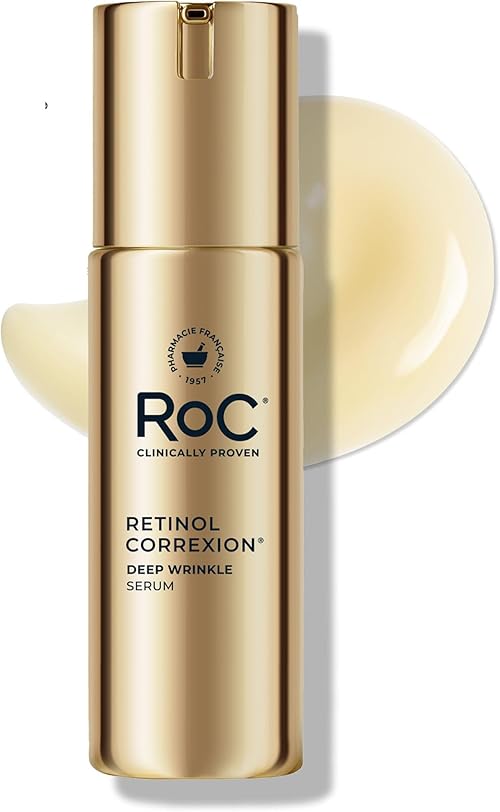
RoC
RoC Retinol Correxion Deep Wrinkle Retinol Face Serum
$21.97
"Retinol-side value representative with 4.4/5 across 15,362 visible Amazon ratings and a long-running mass-market retinol position."
What real Amazon buyers say
4.4★· 15,362 reviews"The serum is heavenly. It has a very light floral scent, is non greasy, goes on very smooth and dries quickly."
"It made my face softer. It is lightweight and goes on easily. Very good quality."

Herbivore
Herbivore Bakuchiol Retinol Alternative Face Serum
$47.60
"Bakuchiol-side prestige representative with 4.5/5 across 501 visible Amazon ratings and clear retinol-alternative positioning."
What real Amazon buyers say
4.5★· 501 reviews"I like this product for my face. I usually use it at night after washing my face before I go to sleep."
"A drop or two will cover, lasts a long time. Moisturizing, lightweight, works on wrinkles."

Paula's Choice
Paula's Choice Clinical 1% Retinol Face Treatment
$45.50
"Higher-strength retinol representative with peptides, vitamin C, and licorice; 4.3/5 across 5,439 visible Amazon ratings."
What real Amazon buyers say
4.3★· 5,439 reviews"Ordered this after reading reviews on top quality Retinol cream. It is very smooth, a small/pea sized amount can cover my whole face"
"This product has such a nice and lightweight feel to it! My skin tone is becoming more even and fine lines are coming less and less visible."

Good Molecules
Good Molecules Bakuchiol Oil for Dry Skin
$9.99
"Lower-price bakuchiol oil representative with 4.5/5 across 440 visible Amazon ratings, useful for dry skin that dislikes classic retinol."

SkinMedica
SkinMedica Retinol Complex 1.0
$76.80
"Prestige retinol representative with 4.6/5 across 2,805 visible Amazon ratings and a stronger-user positioning."

Beekman 1802
Beekman 1802 Dream Booster Bakuchiol Face Serum
$29
"Fragrance-free bakuchiol serum representative with 4.5/5 across 272 visible Amazon ratings and sensitive-skin positioning."