
Common Mistakes With LED Light Therapy Beds After 40
A practical guide to choosing and using LED light therapy beds after 40, with evidence-based timing, prep, skincare order, and safety checks.
Based on Lee et al. 2007 (n=76), Wunsch & Matuschka 2014 (n=136), FDA 510(k) guidance, and 3 Amazon US device listings, the biggest LED light therapy bed mistakes after 40 are overusing time, skipping eye protection, applying products first, and expecting laxity reversal.
Editor's top Amazon picks for this guide
Real Amazon products that match this protocol. Affiliate links — your purchases support BeautySift.

Comfytemp
Comfytemp 33 x 17 in Red Light Therapy Mat
$119.99
"Best starter-size mat for shoppers who want targeted back, neck, chest, or shoulder sessions before investing in a full-body LED bed."
What real Amazon buyers say
4.5★· 439 reviews"This covers my daughter's entire back, neck and abdomen as needed. She can sit on or put her legs across as she pleases."

Kaoudt
Kaoudt 72 x 33.3 in Red Light Therapy Mat
$299.99
"A full-body mat format for users comparing LED beds but needing a foldable setup for home storage and controlled session timing."
What real Amazon buyers say
4.6★· 31 reviews"I bought one of these and liked it enough that I bought a second. I wanted full body coverage and I'm getting it this way."
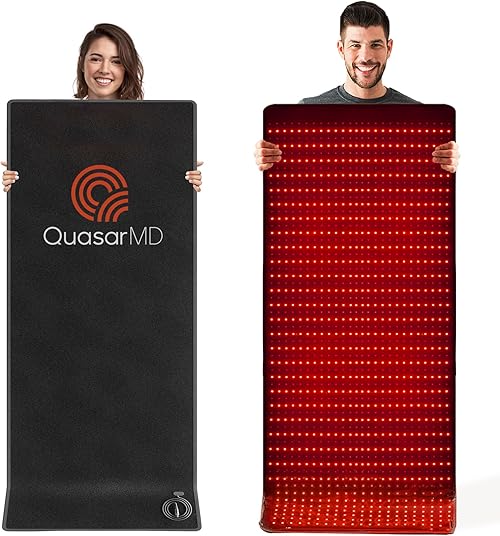
QuasarMD
QuasarMD Infrared Red Light Therapy Mat
$479
"A higher-priced mat with 660 nm and 850 nm positioning for shoppers prioritizing broad coverage and a firmer build-quality signal."
What real Amazon buyers say
4.8★· 31 reviews"Upon first opening this device I was impressed with the quality of materials and design. Lights fully cover the bed area."
What you'll learn
- The strongest cosmetic evidence supports repeated red and near-infrared sessions for skin quality, texture, and fine lines, not dramatic lifting.
- After 40, the safest LED bed routine starts with clean, dry skin, eye protection, conservative timing, and a calm skin barrier.
- Do not apply retinoids, acids, oils, sunscreen, or makeup before a session unless the device manual specifically allows it.
- Judge results over 8-12 weeks of consistent use, because key studies used repeated sessions rather than one long exposure.
Steps
-
1 Choose a device by clearance language, wavelength, and fit
Start with the device manual, exact wavelength claims, and any device-specific FDA 510(k) language. For cosmetic skin support, red and near-infrared ranges are the relevant categories in Lee et al. 2007 and Wunsch & Matuschka 2014. Mature-skin tip: prioritize stable positioning and easy entry over the largest possible bed, because consistency matters more than an oversized setup you avoid using.
-
2 Prep clean, dry skin and remove reflective layers
Cleanse first, dry fully, remove makeup, and do not apply sunscreen, body oil, shimmer lotion, thick balm, or retinoid before the session. A bare-skin setup reduces variables between sessions. Mature-skin tip: if your neck or chest is crepey or easily irritated, use lukewarm cleansing and skip scrubs before LED exposure.
-
3 Protect your eyes and follow the manual distance
Use the goggles or eye-protection instructions supplied by the device, and do not stare into LEDs. Mats, beds, and panels vary in irradiance, so copy the manual instead of copying another user's schedule. Mature-skin tip: if you have dry eye, cataract history, migraine sensitivity, or recent eye procedures, ask an eye-care clinician before using a bright bed-style device.
-
4 Start with shorter sessions before increasing frequency
Do not make the first week a daily marathon. Clinical evidence points to repeated exposure over weeks: Wunsch & Matuschka used 30 sessions, and Russell et al. used 9 treatments over 5 weeks. Mature-skin tip: post-40 skin can be more dryness-prone, so track warmth, redness, itch, and sleep disruption before adding minutes.
-
5 Apply skincare after the session in barrier-first order
After the device turns off, apply hydrating serum if you use one, then moisturizer, then sunscreen in the morning. Retinoids and exfoliating acids are better treated cautiously until your skin proves it tolerates the combined routine. Mature-skin tip: if your jawline or neck stings after actives, separate LED and retinoid nights for two weeks.
-
6 Measure results with photos and realistic endpoints
Take same-lighting photos at baseline, week 4, week 8, and week 12. Look for fine-line softness, smoother texture, more even skin feel, and a healthier-looking neck or chest. Mature-skin tip: do not grade jowls, deep folds, or neck bands as failures of the device; those concerns involve tissue position as well as skin quality.
Quick answer for the common mistakes
The biggest mistake with an LED light therapy bed after 40 is treating it like a stronger version of skincare: more minutes, more frequency, and more product layers. The published evidence is more conservative. Lee et al. 2007 studied 76 subjects using 633 nm red, 830 nm near-infrared, and combination LED phototherapy. Wunsch & Matuschka 2014 studied 136 volunteers over 30 sessions. Those numbers support consistency, not aggressive overuse.
Affiliate disclosure: we may earn a commission from Amazon links. Commission does not influence our evidence weighting, device-selection criteria, or safety guidance.
After 40, the skin conversation also changes. Fine lines, dryness, uneven texture, and early laxity often overlap. LED beds and full-body mats may fit a routine, but they should not be framed as a replacement for sunscreen, retinoids, procedures, or medical evaluation when a skin change looks suspicious.
Mistake 1: buying the biggest bed before checking the evidence
A full-size bed sounds efficient, but size is not the same as quality. Before comparing prices, look for three basics: stated wavelengths, a clear manual with session timing, and device-specific safety language. The peer-reviewed cosmetic studies most often cited for red and near-infrared skin support used defined treatment parameters. Lee et al. 2007 included 633 nm and 830 nm LED exposure in 76 subjects. Wunsch & Matuschka 2014 evaluated red and near-infrared light across 30 sessions in 136 volunteers. Those study designs are a better guide than a listing that only says “anti-aging” in large print.
FDA language also needs careful reading. FDA 510(k) clearance, per the FDA’s own clearance database guidance, means substantial equivalence for a specific device and indication. It is not a blanket endorsement of every wellness, pain, hair, wrinkle, or detox claim attached to every bed-style device online.
For mature skin, the practical device question is not “What is the largest bed I can fit?” It is “Can I lie still, protect my eyes, follow the timing, and repeat the routine without irritating my skin?” If the answer is no, a smaller mat or panel may be the more usable purchase.
Mistake 2: starting on fully loaded skincare
LED sessions should usually happen on clean, dry skin. Applying body oil, face oil, sunscreen, high-shine makeup, thick occlusive balm, shimmer lotion, or a fresh layer of retinoid before a session adds variables. Some layers may reflect, scatter, or simply make it harder to repeat the same setup each time. The more consistent approach is cleanse, dry, use the device, then apply skincare afterward.
This matters more after 40 because dryness and irritation can masquerade as “the device is working.” A tight, warm, flushed feeling is not a result metric. If your neck or chest is already reactive from acids, retinoids, fragrance, or a strong vitamin C, simplify before adding a bed. Use gentle cleansing, skip scrubs on device days, and keep the session environment cool enough that heat is not doing the work.
For morning sessions, finish with moisturizer and broad-spectrum sunscreen after the device. For evening sessions, follow with moisturizer first, then a retinoid only if your skin already tolerates it well.
Mistake 3: ignoring eyes, distance, and heat
A bed-style device surrounds more skin than a handheld tool, which makes eye protection and timing more important, not less. Use the supplied goggles or follow the manual’s eye-safety instructions. Do not stare into LEDs, and do not assume a dimmer-looking near-infrared setting is harmless because it is less visible.
Distance is another common error. With panels, irradiance changes as you move closer or farther away. With mats and beds, contact, angle, and body position can also vary. The manual should be the source of truth. Copying a Reddit routine or another brand’s timer can create a dose mismatch.
Heat should stay comfortable. Red and near-infrared photobiomodulation is not meant to feel like an aggressive thermal procedure. Avci et al. 2013 reviewed low-level laser and light therapy mechanisms in skin; the relevant concept is light signaling, not burning the skin into change. Stop if you feel burning, persistent redness, headache, dizziness, eye pain, or worsening pigmentation.
Mistake 4: using longer sessions to make up for missed weeks
LED routines reward boring consistency. The clinical pattern is repeated exposure over time: Wunsch & Matuschka 2014 used 30 sessions, and Russell, Kellett, and Reilly 2005 used 9 treatments over 5 weeks in 31 subjects. Those numbers do not support the idea that one long weekend session can replace several weeks of steady use.
After 40, overuse can be especially counterproductive if your skin is dry, hormonally reactive, or already adjusting to retinoids. A conservative first month is better than an irritated first week. Start with the shortest schedule allowed by the manual, track how your skin feels the next morning, and increase only if the device instructions permit it.
A simple tracking system works better than vague impressions. Take same-lighting photos at baseline, week 4, week 8, and week 12. Note session date, duration, skin products used afterward, and any redness or dryness. If the routine is making you inconsistent with sunscreen or sleep, it is not a net win.
Mistake 5: expecting an LED bed to lift sagging skin
Red and near-infrared light may support the appearance of smoother texture and better skin quality, but sagging is not just a skin-surface problem. Jowls, deep nasolabial folds, neck bands, and lower-face laxity involve fat pads, ligaments, bone structure, muscle tone, and collagen changes. A bed can be a supportive tool; it should not be sold to you as a nonsurgical facelift.
The stronger claim is fine-line and texture support over a measured trial. Lee et al. 2007 and Wunsch & Matuschka 2014 are relevant because they measured repeated red and near-infrared exposure in human subjects. Even then, the language should stay grounded: smoother-looking texture, softer fine lines, and healthier-looking skin feel. Avoid before-and-after promises that imply tissue repositioning.
For mature skin, set two separate goals. Goal one: skin quality, such as fine lines, crepiness, dullness, and roughness. Goal two: structural laxity, such as jowls or neck sagging. LED may belong under goal one. If goal two is your main concern, consider a consultation with a board-certified dermatologist or plastic surgeon before buying a large bed.
Mistake 6: combining too many devices and actives at once
LED beds often enter routines that already include retinoids, exfoliating acids, vitamin C, microneedling, radiofrequency, microcurrent, or peels. The problem is not that every combination is forbidden. The problem is adding several variables at the same time and then being unable to tell what caused redness, dryness, breakouts, or sensitivity.
Build the routine in layers. Keep sunscreen and moisturizer steady. Add the LED bed on bare skin. Hold frequency stable for two weeks. If skin stays calm, continue your usual retinoid schedule after sessions or on alternate nights. If you recently had laser, a peel, injectables, microneedling, or an in-office energy treatment, ask the treating clinician when to restart home devices.
A mature-skin-specific warning: the neck and chest often tolerate actives less well than the face. If you use an LED bed across the chest, do not automatically extend your strongest retinoid or acid there the same night.
A practical 8-12 week routine
Week 0 is setup. Read the manual, identify eye-protection steps, confirm contraindications, and take baseline photos in the same room and lighting. Check medications and health conditions that can increase photosensitivity. Ask a clinician first if you have a photosensitivity disorder, active skin cancer or precancer in the area, eye disease, are pregnant, or use photosensitizing medication.
Weeks 1-2 are tolerance weeks. Use the lowest manual-supported schedule. Keep skin bare during the session and simple afterward: moisturizer at night, moisturizer plus sunscreen in the morning. Do not change retinoid strength, start a peel, or add a new acid during this window.
Weeks 3-8 are consistency weeks. If skin is calm, continue the manual schedule and take a week 4 photo. Look for comfort, compliance, and early texture changes, not dramatic lifting. Weeks 8-12 are the fairer checkpoint for cosmetic judgment because the cited studies used repeated sessions across weeks.
If you see no change by week 12, decide whether the routine is still worth the time and cost. If you see irritation, scale back sooner. The correct response to irritation is not pushing through; it is simplifying the routine and checking the manual.
Product-selection notes from our Amazon scan
We included three Amazon US listings in featured products because this guide needs real affiliateable products without reusing capped ASINs. The Comfytemp mat had a 4.5/5 Amazon snapshot across 439 ratings and a $119.99 price, which makes it a lower-risk targeted entry point. The Kaoudt full-body mat had a 4.6/5 snapshot across 31 ratings and a $299.99 price, useful for shoppers comparing bed-like coverage in a foldable format. The QuasarMD mat had a 4.8/5 snapshot across 31 ratings and a $479.00 price, but the small rating count means we weight its user evidence lightly.
Those products are not proof that a bed will fix sagging. They are examples of the trade-offs US shoppers face: coverage, storage, price, rating volume, and whether the listing states red plus near-infrared positioning. For any device, confirm the current seller, return policy, manual, and safety language before buying.