Common Mistakes With Red Light Therapy Panels
An evidence-led guide to the red light therapy panel mistakes that waste time, raise irritation risk, or make fine-line results harder to judge.
Based on 2 randomized LED skin studies in PubMed and 3 Amazon panel listings with 3,536 combined ratings, the biggest red light therapy panel mistakes are inconsistent dosing, sitting too close, skipping eye protection, and expecting wrinkle changes before 8-12 weeks.
Editor's top Amazon picks for this guide
Real Amazon products that match this protocol. Affiliate links — your purchases support BeautySift.

Hooga
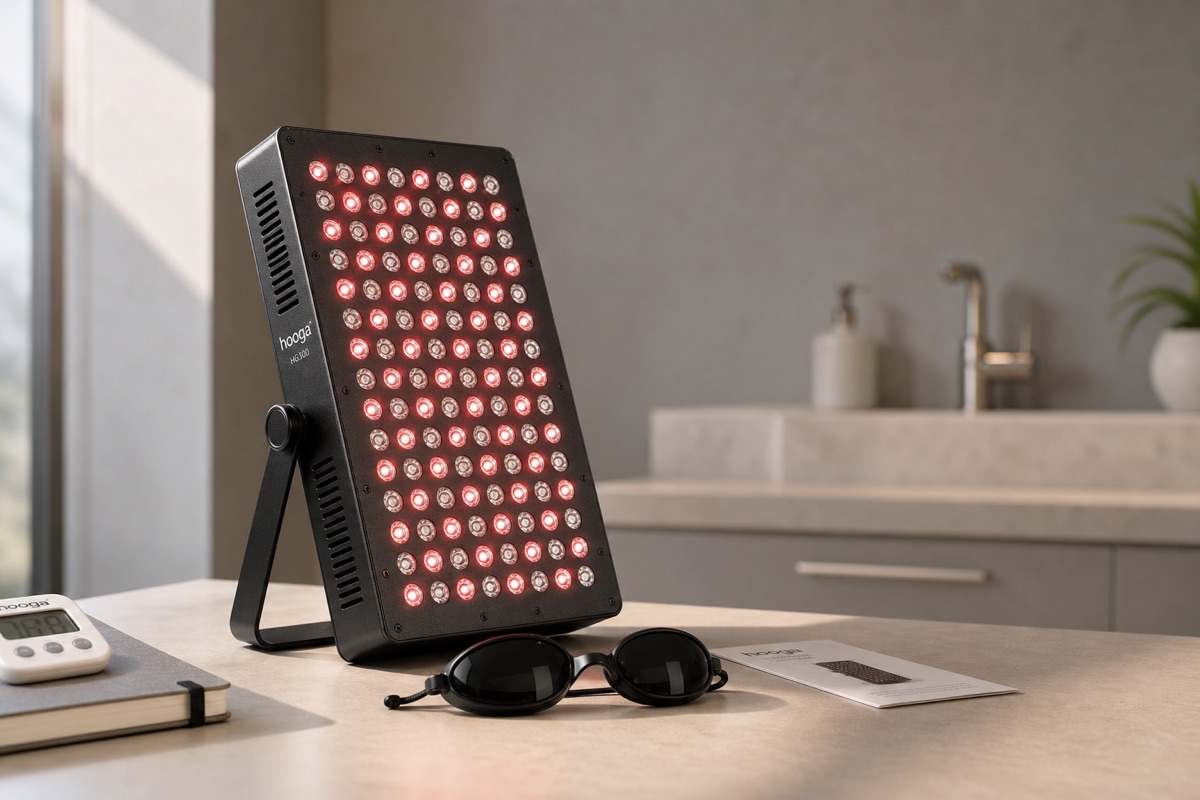
Hooga HG300 Red Light Therapy Panel
$199
"Compact 660nm red and 850nm near-infrared panel with 60 LEDs, integrated timer, 4.6/5 Amazon average, and enough coverage for face, neck, or chest sessions."
What real Amazon buyers say
4.6★· 1,082 reviews"I initially did 15 mins every other day, but switched over to 10 mins every day."
"The build quality feels very solid and durable, and it arrived extremely well packaged with everything protected."

Hooga
Hooga PRO300 Red Light Therapy Panel
$299
"Mid-size dual-chip 660nm and 850nm panel with timer, adjustable stand, 4.6/5 Amazon average, and stronger face-plus-torso coverage than smaller lamps."
What real Amazon buyers say
4.6★· 712 reviews"After about six weeks of consistent use, I can say that reputation is well earned."
"It took about a month to see a difference, but I'm noticing a brighter, more even complexion."

BestQool
BestQool Black 60 Red Light Therapy Panel
$189
"Budget-friendly 660nm and 850nm panel with three modes, tabletop or hanging setup, and the largest Amazon rating base among the panels analyzed here."
What real Amazon buyers say
4.6★· 1,742 reviews"It feels very high quality — sturdy, well-built, and stable. You can tell it's a solid machine with good support, not something flimsy at all."
What you'll learn
- Red light panel results are dose-dependent; most cosmetic studies use repeated sessions over weeks, not occasional long sessions.
- For fine lines and mild sagging, consistency, distance, and eye protection matter more than chasing the brightest panel.
- Do not stack strong retinoids, acids, heat, and near-infrared light on irritated skin on the same night.
- Panels are not a substitute for sunscreen, prescription care, or in-office dermatology procedures when skin changes are rapid or concerning.
Steps
-
1 Confirm the wavelength and intended area
Choose a panel that clearly states red and near-infrared wavelengths, then match the panel size to the face, neck, chest, or body area you actually plan to treat.
-
2 Set a repeatable distance and time
Use the brand's distance guidance, start conservatively, and keep sessions consistent. A timed 5-10 minute routine is easier to evaluate than occasional long exposure.
-
3 Protect eyes and sensitive skin
Use the supplied goggles or another appropriate eye shield, avoid staring into LEDs, and pause if heat, headaches, dryness, or irritation shows up.
-
4 Track results over 8-12 weeks
Take the same-lighting photo every 2-4 weeks and judge fine lines, tone, and skin texture over time instead of changing the routine after a few sessions.
Quick answer
Based on 2 randomized LED skin studies in PubMed and 3 Amazon panel listings with 3,536 combined ratings, the most common red light therapy panel mistakes are inconsistent dosing, sitting too close, skipping eye protection, and expecting fine-line changes before 8-12 weeks.
Red light therapy panels can be useful beauty-tech tools for women in their 40s and 50s who want a noninvasive routine for fine lines, mild laxity, neck texture, and chest crepiness. The problem is that panels are easy to overuse, underuse, or aim poorly. A device can have the right wavelengths and still disappoint if the routine is random.
We analyzed PubMed studies, FDA device guidance, and Amazon US data for three accessible panels: Hooga HG300, Hooga PRO300, and BestQool Black 60. The shared lesson is simple: treat red light like a skincare protocol, not like a heat lamp. Dose, distance, eye safety, and patience matter.
Mistake 1: Treating brightness as proof of better results
A brighter panel is not automatically a better skin-aging tool. Red light therapy depends on wavelength, irradiance, distance, session length, and consistency. PubMed-indexed LED studies commonly evaluate red wavelengths around 633nm and near-infrared wavelengths around 830nm, while the Amazon panels analyzed here use 660nm red and 850nm near-infrared.
Those numbers are close enough to the beauty-tech conversation to be relevant, but they do not make every at-home routine clinical. Lee et al. 2007 studied 76 patients using 633nm, 830nm, combined light, or sham treatment twice weekly for 4 weeks. Wunsch and Matuschka 2014 evaluated red and near-infrared light in a controlled photobiomodulation study for skin feel, fine lines, roughness, and collagen-density measures.
The takeaway is not that you need the highest-output panel on Amazon. It is that you need a device with transparent specs and a repeatable dose. A small, honest 660nm/850nm panel used correctly can be easier to manage than a powerful body panel used too close to the face.
For a starter routine, the Hooga HG300 is the cleanest fit among the three panels we analyzed. Its Amazon page lists 660nm red, 850nm near-infrared, 60 LEDs, a timer, and 73 mW/cm² at 6 inches. That specificity matters because vague product pages make it harder to avoid accidental overexposure.
Mistake 2: Sitting too close and turning the session into heat exposure
The biggest real-world mistake is treating a red light panel like a spa warmer. If your skin feels hot, tight, flushed, or headache-prone, the session is probably too aggressive for your face.
Near-infrared light is mostly invisible, so it can be easy to underestimate the exposure. A panel can feel comfortable for the first few minutes and still leave sensitive skin dry or warm by the end. That matters for US shoppers with rosacea tendency, melasma history, menopausal flushing, or barrier-compromised skin from retinoids.
A good rule is to begin farther away than the maximum-intensity marketing copy implies. Use the brand’s manual, start with shorter sessions, and keep notes. If a brand suggests a range, begin at the more conservative end for the face, neck, and chest. You can adjust after 2 weeks if the skin stays calm.
This is also where panel size matters. The Hooga PRO300 and BestQool Black 60 cover more area than a tiny wand, which can help with the neck and chest. But broader coverage does not mean you should crowd the panel. For beauty use, even exposure is more useful than a red-hot center spot.
Mistake 3: Skipping eye protection because the light does not hurt
Red and near-infrared panels can look less threatening than IPL or lasers, but the FDA still groups light-based cosmetic devices under a category that requires careful use. The absence of pain is not an eye-safety clearance.
Use the protective goggles supplied with the device or another suitable shield. Do not stare into the LEDs. If you are treating the neck or chest, angle the panel so the light is not aimed straight at your eyes. If you have a retinal condition, migraine history triggered by light, recent eye surgery, or prescription photosensitivity warnings, ask a clinician before making panels part of your routine.
This advice is especially relevant for women 35-55 who may already be juggling prescription skincare, hormone-related dryness, or eye procedures such as LASIK history. A conservative setup protects the routine you are trying to build.
Amazon review patterns support this practical point. Hooga HG300 reviewers mention included protective goggles and ease of setup; one verified Hooga HG300 reviewer wrote, “The build quality feels very solid and durable, and it arrived extremely well packaged with everything protected.” That is a useful feature note, not proof of clinical eye safety.
Mistake 4: Using the panel randomly instead of building a protocol
Photobiomodulation is not a one-night glow trick. The better evidence uses repeated sessions. Lee et al. 2007 used twice-weekly treatments for 4 weeks. Many at-home brands suggest several short sessions per week, but the exact plan depends on the device’s output and distance.
For a beginner face, neck, and chest protocol, choose a time you can repeat:
- Cleanse and dry skin.
- Apply no strong acid, retinoid, or fragranced treatment immediately before the session.
- Put on eye protection.
- Sit at the recommended distance for 5-10 minutes.
- Follow with moisturizer, and use sunscreen the next morning.
The key is not a perfect schedule. It is repeatability. A consistent 5-minute routine 4 times weekly is easier to interpret than one 25-minute session when you remember.
This is where panel controls matter. Built-in timers reduce guessing. The Hooga HG300, Hooga PRO300, and BestQool Black 60 all list timer or mode controls on Amazon, which is why they fit this guide better than generic lamps with unclear dosing.
Mistake 5: Expecting sagging or deep wrinkles to change like they would after a procedure
Red light therapy sits in the supportive-care category. It may help skin look smoother or more even over time, but it is not a facelift, RF microneedling session, laser resurfacing treatment, or injectable.
For fine lines, the most realistic goal is subtle improvement in texture and the appearance of crepiness after repeated use. For sagging, the realistic goal is support, not dramatic lifting. If jowling, eyelid laxity, or neck bands are the primary concern, a panel can be part of a broader plan, but it should not be the whole plan.
This is why before-and-after tracking matters. Take a front-facing and side-facing photo every 2-4 weeks in the same room, time of day, and lighting. Do not judge results after 3 sessions. The most useful question is: after 8-12 weeks, does skin texture, fine-line visibility, or chest roughness look meaningfully different in the same lighting?
If the answer is no, do not automatically increase time. Recheck distance, schedule consistency, skincare irritation, sleep, sun exposure, and whether the panel’s specs are transparent.
Mistake 6: Layering it with an already irritating routine
Red light panels are often marketed as gentle, but your full routine may not be gentle. Retinoids, glycolic acid, lactic acid, benzoyl peroxide, exfoliating devices, and heat exposure can all raise the chance that your skin feels dry or reactive.
If your skin is already peeling from retinol, do not use that night to add a longer red light session. Keep the panel on non-irritating nights until your barrier feels stable. For many mature-skin routines, that means panel first on clean, dry skin, then moisturizer. Save stronger actives for alternate nights.
This is particularly important in winter dryness or in air-conditioned indoor environments that make menopausal dryness worse. The panel is not the problem if the skin is already overtreated; the stack is the problem.
Red flags to pause for include persistent flushing, stinging, new dryness around the eyes, headaches, or melasma darkening. If those occur, stop, simplify skincare, and get medical guidance if symptoms persist.
Mistake 7: Buying the wrong panel size for the job
A tiny lamp can be fine for spot use, but it is annoying for face, neck, and chest coverage. A full body panel can be useful, but it may be too intense or cumbersome for a beginner. The best choice is the one that fits the area you will actually treat consistently.
Our evidence-weighted view of the three featured panels is practical, not brand-loyal. The Hooga HG300 scores best as a beginner panel because it has clear 660nm/850nm specs, a manageable 60-LED size, and 1,082 Amazon ratings at a 4.6/5 average. The Hooga PRO300 is the better choice if neck and chest coverage matter because its dual-chip panel and stand create a more convenient setup for larger areas. The BestQool Black 60 is the value pick because it combines a $189 Amazon price snapshot with 1,742 ratings at a 4.6/5 average.
Affiliate commission did not affect that ordering. We weighted wavelength transparency, timer support, review volume, price, and beginner usability. None of these panels should be treated as a medical device for disease treatment, and none replaces a dermatologist for changing lesions or unexplained skin symptoms.
A beginner protocol that avoids the common mistakes
Start with 3-4 sessions weekly for the first 2 weeks, unless your device manual is more conservative. Keep the face at the recommended distance, use goggles, and keep sessions short. If your skin feels normal after 2 weeks, continue for 8-12 weeks before deciding whether the device fits your routine.
For fine lines, aim the panel evenly at the face and neck rather than chasing one wrinkle. For chest crepiness, keep the skin dry and avoid fragrance-heavy body lotion immediately beforehand. For mild sagging, use the panel as a consistency tool alongside sunscreen, moisturizer, protein intake, and dermatologist-guided actives.
Do not combine a new panel with a new retinoid, new peel, and new vitamin C serum in the same week. If your skin improves, you will not know what helped. If your skin reacts, you will not know what caused it.
We may earn a commission on Amazon links, but the buying advice here is protocol-first: a less expensive panel used safely and consistently is more useful than a higher-output device used aggressively for 10 days and then abandoned.
FAQs
How long before a red light panel helps fine lines?
Expect weeks, not days. Lee et al. 2007 studied twice-weekly LED use over 4 weeks, and many cosmetic routines are judged over 8-12 weeks because fine-line and texture changes are gradual. If a product page promises instant wrinkle reversal, treat that as marketing.
Can I use a red light panel with retinol?
Yes, but not necessarily in the same session when your skin is adjusting. If retinol makes you peel or sting, use the panel on alternate nights and moisturize afterward. Once your barrier is stable, many users keep both in a routine, but irritation should set the pace.
Is near-infrared better than red light for sagging?
Near-infrared penetrates differently than visible red light, but deeper penetration does not automatically mean visible lifting. For mild sagging, red and near-infrared panels may support skin quality over time. They should not be framed as a substitute for in-office tightening procedures.
Who should skip at-home red light panels?
Skip or get medical guidance first if you have a photosensitivity disorder, take photosensitizing medication, have an active eye condition, recently had eye surgery, have unexplained skin lesions, or are treating melasma that worsens with heat.