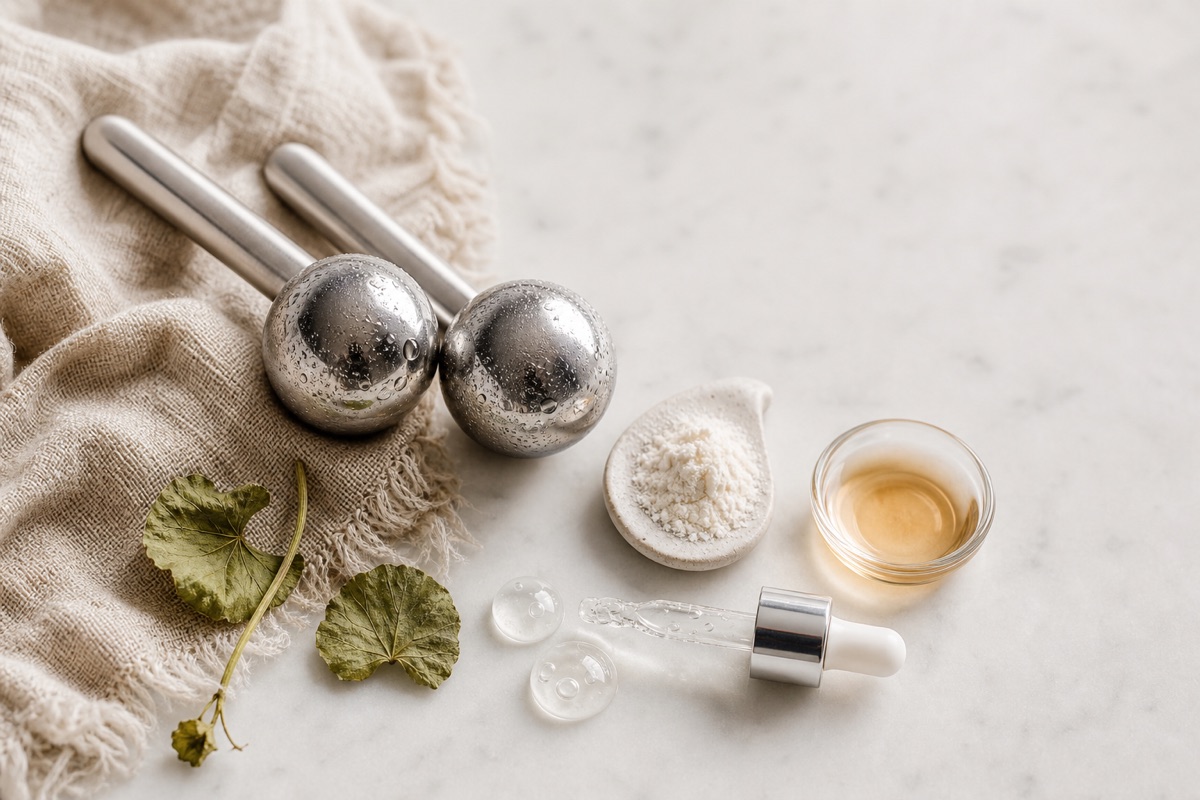
Cryo Balls and Facial Coolers: Ingredient Checklist for Mature Skin
A practical guide to pairing cryo balls, ice globes, and facial coolers with barrier-safe ingredients for under-eye puffiness and hot-flash flushing.
We analyzed 5 Amazon US facial-cooling listings with 8,144 combined ratings, PubMed cold-therapy literature, FDA cold-device safety language, and perimenopause data. Use cryo balls over bland hydrators, niacinamide, caffeine, or centella; skip strong acids, retinoids, and fragranced masks right before cooling.
Editor's top Amazon picks for this guide
Real Amazon products that match this protocol. Affiliate links — your purchases support BeautySift.

MonétBeauty
MonétBeauty Stainless Steel Ice Globes for Facials
$29.99
"Highest-review-count stainless-steel globe option in our Amazon snapshot, with 3,003 ratings and a 4.6/5 average."
What real Amazon buyers say
4.6★· 3,003 reviews"Using them cold in the morning helps reduce puffiness, calm my skin, and instantly makes my face feel refreshed."
"They glide smoothly and feel very soothing, especially after skincare or a long day."

Beauty by Earth
Unbreakable Steel Ice Globes for Facials
$17.99
"Lower-price stainless-steel globe format with 2,309 Amazon ratings and a 4.7/5 average in the May 2026 snapshot."
What real Amazon buyers say
4.7★· 2,309 reviews"Just got these ice globes and I already love them! Here is what I have to say about them."
"I love how versatile they are. Being able to use them hot or cold they serve many purposes."

Kitsch
Kitsch Stainless Steel Ice Roller for Face
$17.99
"A handle-and-roller format that may feel easier than two globes for jawline, neck, or hot-flash cheek cooling."
What real Amazon buyers say
4.5★· 2,592 reviews"I just wait a minute or so and give it a wipe before I start rolling it on my face."
"It is definitely cold at first, but your face adjusts pretty quickly."

EcoTools
EcoTools Stainless Steel Ice Roller
$10.84
"Budget-friendly stainless-steel roller with a small review base; useful as a low-commitment starter tool."

Skin Gym
Skin Gym Ice Roller for Face
$18
"A compact roller from a recognizable beauty-tool brand; best for shoppers who prefer a simple single-head design."
What you'll learn
- Cryo balls and facial coolers are best treated as short-contact cooling tools, not anti-aging devices that permanently tighten pores or erase wrinkles.
- For mature or perimenopausal skin, pair cooling with bland hydration, caffeine, niacinamide, centella, panthenol, or ceramides rather than strong exfoliants.
- Avoid using facial coolers immediately after retinoids, peels, benzoyl peroxide, fragranced masks, or any product that already stings.
- Stainless-steel tools are easier to inspect and clean than gel-filled globes, while rollers can be easier around the jawline and neck.
Steps
-
1 Start with a barrier-safe base
Cleanse with a non-scrubby cleanser, pat skin dry, and apply a thin layer of bland humectant or calming serum before the tool. Good pairings include glycerin, hyaluronic acid, panthenol, beta-glucan, centella, caffeine for the under-eye area, and low-to-moderate niacinamide if your skin already tolerates it. Avoid applying a cryo tool over fresh retinoid, AHA/BHA peel, benzoyl peroxide, strong vitamin C sting, or a fragranced mask. Cooling can make skin feel calmer, but it does not make an irritating formula safer.
-
2 Chill the tool without freezing your skin
Use the refrigerator for routine use, or a short freezer window only if the brand directions allow it. Let any very-cold stainless-steel tool sit at room temperature briefly, then wipe away condensation before it touches the face. The FDA's cold-device safety language is about body-contouring equipment rather than facial globes, but the conservative lesson still applies: cold exposure can injure skin when contact is too cold, too long, or used on numb areas.
-
3 Use light pressure and short passes
Glide from the inner under-eye area outward, then across the cheek and jaw with feather-light pressure. Keep each under-eye pass brief and avoid pressing on the eyeball. For hot-flash flushing, focus on the cheeks, temples, sides of the neck, and behind the ears for comfort rather than chasing redness with repeated pressure. PubMed literature on cold exposure supports short-term circulation and swelling effects; it does not support claims that facial coolers permanently shrink pores.
-
4 Seal with moisturizer and sunscreen if it is daytime
After cooling, apply a simple moisturizer with ceramides, cholesterol, fatty acids, petrolatum, dimethicone, or squalane if your barrier is dry. If it is morning, finish with broad-spectrum SPF 30 or higher. Skip the urge to add every active afterward; midlife skin often responds better to a calm barrier than to a stacked routine.
-
5 Clean and inspect before storage
Wash stainless steel with gentle soap and water, dry fully, and store in a clean pouch or sealed container. Discard gel-filled or glass tools if you see cracks, leaking, cloudiness, or rough seams. If you are prone to rosacea-like flushing, broken capillaries, cold urticaria, Raynaud's symptoms, or reduced facial sensation, ask a clinician before using repeated cold exposure on the face.
Quick Answer: We analyzed 5 Amazon US facial-cooling listings with 8,144 combined ratings, PubMed cold-therapy literature, FDA cold-device safety language, and perimenopause data. Use cryo balls over bland hydrators, niacinamide, caffeine, or centella; skip strong acids, retinoids, and fragranced masks right before cooling.
Cryo balls, ice globes, and facial coolers are simple tools: they put a cool surface against the skin for a short time. The complicated part is not the tool. It is what you put under it.
For women 35-55, the wrong pairing can turn a soothing step into a barrier problem. Midlife skin is often drier, more reactive, and more prone to visible flushing. Under-eye puffiness may sit next to fine lines. Hot-flash redness may show up on skin that also uses retinoids, acids, or brightening serums. A facial cooler can feel helpful in that setting, but it should be used like a comfort and depuffing tool, not like a device that permanently changes skin structure.
Our evidence-weighted read is conservative. Amazon US review snapshots show that facial coolers are widely used and generally well-liked: the 5 tools in this guide total 8,144 ratings, led by MonétBeauty stainless-steel globes at 4.6/5 across 3,003 ratings, the Beauty by Earth-style steel globes at 4.7/5 across 2,309 ratings, and the Kitsch ice roller at 4.5/5 across 2,592 ratings. PubMed cold-exposure literature supports short-term circulation and swelling effects, while the 2025 perimenopause review in Journal of Clinical Medicine keeps hot-flash framing in the comfort lane, not the cure lane.
What a facial cooler can and cannot do
Cold can temporarily constrict superficial vessels, change local blood-flow patterns, and make puffy skin feel calmer. A 2025 Frontiers in Physiology paper on cold-induced vasodilation in human glabrous skin is a useful reminder that cooling is a vascular stimulus, not a collagen treatment. A 2007 Journal of Periodontology review of cold therapy after intraoral procedures supports short-term swelling and discomfort framing, but that does not mean facial globes erase under-eye bags or permanently tighten pores.
That distinction matters for mature skin. If morning puffiness is fluid-related, cooling may help the area look less swollen for a few hours. If the under-eye concern is hollowing, pigment, or laxity, a cold tool will not rebuild volume. If hot-flash redness is driven by vasomotor symptoms, a facial cooler may feel relieving, but it will not address the underlying perimenopause pattern.
So the right question is not, “Do cryo balls work?” It is, “What are they useful for, and what should never go underneath them?”
The ingredient checklist: green light, yellow light, red light
Use this checklist before you pick up the tool.
Green-light ingredients are low-risk for most people: glycerin, hyaluronic acid, beta-glucan, panthenol, aloe in a fragrance-free base, centella, ceramides, cholesterol, fatty acids, dimethicone, petrolatum, mineral oil, squalane, and caffeine eye serum. These ingredients support slip, hydration, and barrier comfort without relying on a sting.
Yellow-light ingredients depend on your tolerance: niacinamide, azelaic acid, low-strength vitamin C derivatives, peptide serums, and mineral mists. Niacinamide is a good example. Many mature-skin routines tolerate it well, but high-percentage formulas can flush or tingle. If a product already makes your cheeks warm, do not use a cold tool to push through that feeling.
Red-light ingredients should not sit directly under a cryo session: retinoids, retinal, tretinoin, adapalene, AHA peels, BHA peel pads, benzoyl peroxide, high-strength L-ascorbic acid that stings, fragranced masks, essential-oil blends, and post-procedure actives unless a clinician gave instructions. Cooling can make irritation feel muted in the moment. That is not the same as reducing irritation.
Under-eye protocol for puffiness
For morning puffiness, keep the routine boring. Cleanse or rinse, apply a small amount of caffeine or humectant eye serum, then use chilled globes or a small roller with very light pressure. Move from the inner under-eye outward, then down toward the cheekbone. Do not press into the orbital rim, and never press the tool onto the eyeball.
A stainless-steel globe gives good control around the under-eye curve. The MonétBeauty listing had the largest review base in our Amazon snapshot, with 3,003 ratings and a 4.6/5 average. The lower-priced steel globe listing had a 4.7/5 average across 2,309 ratings. Those numbers are not clinical outcomes; they are consumer-sentiment signals for usability and satisfaction.
If your under-eye issue is mainly dark circles, be precise about the cause. Vascular darkness may look temporarily softer after cooling. Pigment will not fade from a cold tool. Hollowing will not be corrected by cooling. If puffiness is one-sided, painful, sudden, or associated with eye symptoms, skip the beauty tool and seek medical advice.
Hot-flash flushing protocol
Hot-flash flushing is different from ordinary morning puffiness. The 2025 Journal of Clinical Medicine perimenopause review places vasomotor symptoms in a broader midlife sleep and symptom context, which is why BeautySift treats facial coolers as comfort tools rather than treatment tools.
For a hot-flash routine, use the tool on clean skin or over a bland moisturizer. Focus on the cheeks, temples, sides of the neck, and behind the ears. Keep pressure minimal. If you are already flushed, rubbing hard can make redness look worse. A roller format may be easier here than two globes because you can sweep larger areas without concentrating pressure in one spot.
Avoid menthol-heavy gels unless you already know your skin tolerates them. Menthol can feel cooling, but it can also sting reactive midlife skin. Fragrance-free mineral water mist, centella serum, or a ceramide moisturizer is a safer pairing.
Choosing between globes and rollers
Globes are better for targeted work. They fit the under-eye area, cheekbone, and jawline with more precision. Rollers are better when you want a fast sweep across the face, neck, and chest. The Kitsch stainless-steel roller had 2,592 Amazon ratings and a 4.5/5 average in our snapshot, making it the strongest review-volume roller in this set.
Material matters. Stainless steel is easier to clean, less likely to shatter, and easier to inspect than glass. Gel-filled globes can feel elegant, but any crack, leak, cloudiness, or rough edge is a stop sign. If you store tools in the freezer, follow the brand’s directions and let the tool warm briefly before use. Too-cold metal on damp skin is not a better result; it is a higher irritation risk.
We weighted the product recommendations toward stainless-steel tools because they align better with a beginner protocol: clean surface, controlled cooling, no fragile glass, and easy storage.
When not to use a facial cooler
Skip facial cooling on broken skin, active dermatitis, sunburn, fresh peels, recent in-office procedures unless your clinician approves it, or any area with numbness. Be cautious if you have cold urticaria, Raynaud’s symptoms, rosacea-like flushing, broken capillaries, migraine triggers related to cold, or reduced facial sensation.
The FDA page on cold-based aesthetic technologies is not about beauty globes, but its risk framing is useful: cold exposure can cause unwanted tissue effects when misused. At-home facial coolers are much milder than professional cold equipment, but the common-sense rule is the same. Short, comfortable contact is the goal. Pain, numbness, welts, or lingering redness means stop.
A simple 5-minute routine
Morning under-eye routine: cleanse or rinse, apply caffeine or hydrating serum, glide a chilled globe outward for 30-60 seconds per side, moisturize, then apply sunscreen. Evening calming routine: cleanse, apply centella or ceramide serum, use a roller lightly over cheeks and jaw for 1-2 minutes, then seal with moisturizer. Do not combine this with a peel night.
Hot-flash comfort routine: keep a clean stainless-steel roller in the refrigerator, not loose next to food. When flushing hits, use it over moisturizer or clean skin on the cheeks, temples, sides of the neck, and behind the ears. Stop once the skin feels comfortable. Repeated hard passes are more likely to create irritation than better relief.
The best sign that your routine is working is not dramatic tightening. It is that the skin looks calmer, makeup sits better over the under-eye area, and your barrier does not feel tight afterward.