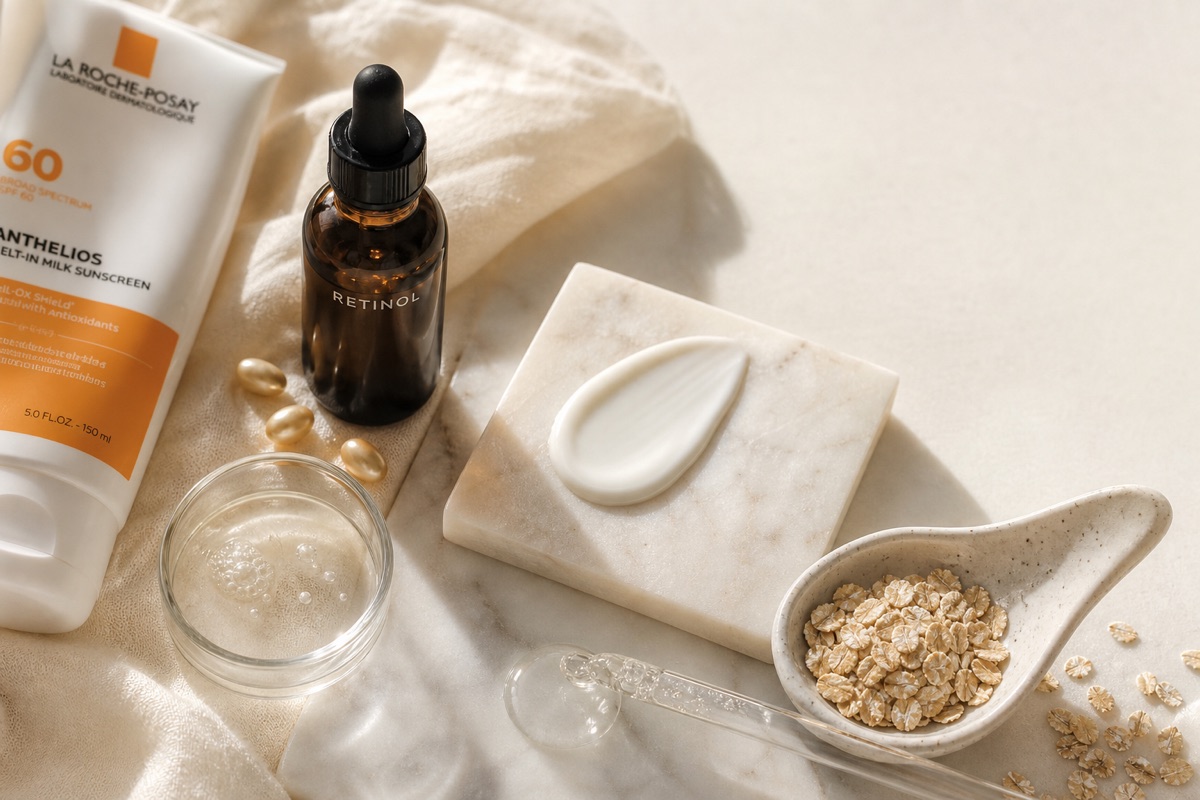
Decolletage Treatments Ingredient Checklist for Sun Damage and Fine Lines
A step-by-step decolletage treatment checklist for US women 35-55, covering SPF, retinoids, acids, peptides, moisturizers, and what to skip.
Based on FDA sunscreen guidance, 3 PubMed-indexed photoaging reviews, and Amazon review snapshots totaling 31,495 ratings across 5 products, the best decolletage ingredient checklist starts with daily broad-spectrum SPF, then adds retinoids or gentle acids slowly, plus barrier moisturizers to reduce irritation.
Editor's top Amazon picks for this guide
Real Amazon products that match this protocol. Affiliate links — your purchases support BeautySift.

La Roche-Posay
Anthelios Melt-In Milk Sunscreen SPF 60
$37.99
"Broad-spectrum SPF 60 fits the checklist's first requirement: protect the decolletage before adding retinoids or acids. Amazon snapshot: 4.6/5 across 13,511 ratings."
What real Amazon buyers say
4.6★· 13,511 reviews"This sunscreen feels much lighter than many high-SPF formulas I have tried and blends into the skin without leaving a heavy white cast."
"This is excellent and disappears on the skin. Smooth as silk."

Naturium
The Smoother Glycolic Acid Body Lotion
$17.99
"A 10% glycolic acid body lotion gives the protocol a texture-smoothing AHA option for nights when retinoids are not being used. Amazon snapshot: 4.6/5 across 9,086 ratings."
What real Amazon buyers say
4.6★· 9,086 reviews"No skin irritation, not greasy , fragrance is mild I love it , very lightweight , love the ingredients and it is very moisturizing use it mostly at night to protect my skin from sensitivity"
"I am literally on my 3rd bottle. Very gentle and moisturizing."

Gold Bond
Age Renew Crepe Corrector Body Lotion
$11.97
"A budget moisturizer step for crepey-looking chest skin, useful on off-nights when retinoids and acids would be too much. Amazon snapshot: 4.4/5 across 8,358 ratings."
What real Amazon buyers say
4.4★· 8,358 reviews"I have tried lots of different products and this one does seem to work really well."
"Gold Bond Age Renew Crepe Corrector Body & Face lotion works beautifully to smooth skin on hands (quite fast!) and face (a little bit slower, but still does the job)."

Paula's Choice
Skin Revealing Body Lotion 10% AHA
$17.87
"A 10% glycolic acid and shea butter lotion is an alternate AHA route for rough chest texture, especially when a richer feel is preferred. Amazon snapshot: 4.5/5 across 99 ratings."

Versed
Press Restart Retinol Body Lotion
$19.99
"A body-lotion format retinol option for the fine-line lane, best introduced slowly and never on the same night as an acid at the start. Amazon snapshot: 4.5/5 across 451 ratings."
What you'll learn
- Treat the decolletage like facial skin with more friction and sun exposure: broad-spectrum SPF is the non-negotiable first step.
- For fine lines and crepey texture, retinoids have stronger photoaging evidence than most cosmetic actives, but the chest often needs a slower schedule.
- For mottled tone and roughness, glycolic or lactic acid can help surface texture, but it should not be layered on the same night as retinol at the start.
- Barrier moisturizers, humectants, and fragrance-free formulas matter because irritation on the chest can linger and make discoloration look worse.
Steps
-
1 Check for broad-spectrum SPF before any treatment active
Start with daily broad-spectrum SPF 30 or higher on the neck, chest, and any open neckline. FDA guidance says sunscreen should be reapplied at least every 2 hours outdoors, and AAD guidance recommends broad-spectrum SPF 30 or higher. Without this step, retinoids, acids, and brightening ingredients are trying to repair a pattern that UV exposure keeps restarting.
-
2 Add one evening renewal ingredient, not three at once
Choose either a retinoid lane for fine lines and crepey texture or an alpha hydroxy acid lane for dull, rough surface texture. PubMed-indexed evidence supports retinoids in photoaging, including a 2007 retinol study and a 2022 tretinoin review, but the chest is often more reactive than the face. Begin 1 or 2 nights per week and increase only if the skin stays comfortable.
-
3 Use antioxidants and tone support in the morning
Vitamin C, niacinamide, and antioxidant moisturizers can support a sunscreen-first routine for uneven tone. A 2023 PubMed-indexed systematic review supports topical vitamin C in photoaging and pigment concerns, but the product still has to be tolerable on the thinner chest area. If a formula stings under sunscreen, reduce frequency or switch to a gentler antioxidant.
-
4 Protect the barrier on off-nights
On non-active nights, use a bland moisturizer with humectants, emollients, and barrier-supporting ingredients. This is not filler: irritation can make the decolletage look redder, drier, and more lined. Fragrance-free or low-fragrance body formulas often make more sense than perfumed firming creams when the routine already includes retinol or acids.
-
5 Reassess at 8 to 12 weeks with realistic endpoints
Look for fewer new tan lines, softer roughness, and less obvious crepiness before expecting dramatic wrinkle change. Cosmetic products may support visible texture and tone, but deep etched lines, suspicious lesions, or persistent rough scaly spots should be evaluated by a medical professional rather than treated as a beauty concern.
Why the decolletage needs its own checklist
The decolletage sits in an awkward skincare category. It gets face-level sun exposure, body-level friction from clothing and bras, and often less consistent sunscreen than the cheeks. For US women in their 35-55 range, that combination can show up as mottled brown patches, necklace-like lines, vertical sleep creases, rough texture, and crepey-looking skin across the upper chest.
BeautySift did not test this routine on a panel. We analyzed FDA and AAD sunscreen guidance, 3 PubMed-indexed photoaging sources, and Amazon review snapshots totaling 31,495 ratings across the featured products. The evidence points to a simple order of operations: protect first, add one renewal active slowly, support the barrier, then reassess after 8 to 12 weeks.
Affiliate disclosure: we may earn a commission on shopping links. Product inclusion does not change the ingredient sequence or scoring logic.
Step 1: make SPF the treatment base, not the optional finish
If your decolletage routine has only one product, make it sunscreen. FDA guidance says sunscreen should be applied before sun exposure and reapplied at least every 2 hours outdoors. The AAD recommends broad-spectrum SPF 30 or higher. Those 2 public-health sources matter because the chest is often exposed through V-necks, scoop necks, workout tanks, and car-window light without getting the same careful application as the face.
A practical SPF checklist:
- Broad-spectrum label.
- SPF 30 or higher.
- Comfortable enough to use on the neck and chest every exposed morning.
- Water resistance if you sweat, garden, walk, golf, or swim.
- Reapplication plan for outdoor days.
La Roche-Posay Anthelios Melt-In Milk SPF 60 ranks first in the featured products because it solves the first job: broad-spectrum daily coverage over a larger area. Its Amazon listing snapshot showed 4.6/5 across 13,511 ratings in May 2026. That review volume does not prove wrinkle reduction, but it does support usability, and usability is what keeps sunscreen consistent.
Step 2: decide whether your main concern is lines, texture, or discoloration
A good decolletage treatment should not begin with a product haul. It should begin with the visible pattern.
Fine lines and crepey texture point toward a retinoid lane. Retinoids have stronger photoaging evidence than most cosmetic ingredients. Kafi et al. reported improvement with topical retinol in naturally aged skin in a 2007 Archives of Dermatology study, and a 2022 PubMed-indexed systematic review evaluated topical tretinoin for photoaging. Over-the-counter retinol body lotions are not prescription tretinoin, so claims should stay modest, but the ingredient family has credible support.
Roughness, dullness, and bumpy texture point toward an alpha hydroxy acid lane. Glycolic acid and lactic acid can help exfoliate surface buildup, which may make chest skin look smoother and less shadowed. Naturium The Smoother and Paula’s Choice Skin Revealing Body Lotion both fit this lane because their Amazon product listings identify them as glycolic acid body lotions.
Uneven tone points toward sunscreen first, then antioxidants or pigment-supporting ingredients. A 2023 PubMed-indexed systematic review supports topical vitamin C in photoaging and pigment concerns, but irritation control still matters. Chest skin that is inflamed from too many actives can look redder and more uneven.
Step 3: use a two-night active schedule before going stronger
The neck and chest often tolerate less than the face. A reasonable beginner schedule is not nightly retinol. It is 1 or 2 active nights per week, separated by moisturizer-only nights.
Try this 4-week starter rhythm:
- Monday: retinol body lotion or AHA body lotion, not both.
- Tuesday: moisturizer only.
- Wednesday: moisturizer only.
- Thursday: repeat the same active only if Monday was comfortable.
- Friday through Sunday: moisturizer and sunscreen consistency.
If you choose Versed Press Restart Retinol Body Lotion, keep it in the retinol lane. If you choose Naturium The Smoother or Paula’s Choice 10% AHA, keep it in the acid lane. The product-comparison weighting favors this slower approach because efficacy is not useful if tolerability fails. Irritated chest skin can itch, peel, or stay blotchy under clothing.
For the first month, skip same-night combinations of retinol, glycolic acid, peel pads, and vitamin C body treatments. More active ingredients can look more serious on a label, but they also raise the chance that you quit the routine before the 8-week mark.
Step 4: moisturize like it is part of the treatment
Barrier care is not just the recovery step; it is the compliance step. The decolletage is exposed to seat belts, bra straps, perfume, laundry detergent residue, necklaces, and sleep folding. A bland moisturizer can make the difference between a useful active and a routine that leaves the chest looking irritated.
Gold Bond Age Renew Crepe Corrector Body Lotion is included as the budget barrier-support option because its Amazon snapshot showed 4.4/5 across 8,358 ratings and its body-lotion format makes it realistic for a larger area. It should not be read as a collagen-rebuilding treatment. In this protocol, its role is to reduce dryness, improve comfort, and make off-nights feel intentional.
Look for moisturizer language such as glycerin, petrolatum, dimethicone, shea butter, ceramides, urea, or squalane. Be more skeptical of heavily fragranced firming creams if you already use retinol or acids. Fragrance is not automatically unsafe, but it is one more variable on skin that may already be reactive.
Step 5: place antioxidants in the morning, not in the same-night pileup
Morning is the cleanest slot for antioxidant support because it sits under sunscreen. Vitamin C has PubMed-indexed review support for photoaging and pigment concerns, and niacinamide can be a practical option when pure ascorbic acid feels too sharp. The decolletage does not need a separate 7-step routine; it needs consistency.
A simple morning chest routine can be:
- Gentle cleanse or rinse.
- Optional antioxidant or lightweight moisturizer.
- Broad-spectrum sunscreen over the full exposed neckline.
- Reapply outdoors according to FDA guidance.
If your face vitamin C serum is expensive, you do not have to use several pumps on the chest. A more affordable antioxidant moisturizer or a sunscreen with antioxidant support may be more realistic. The ingredient checklist should fit the area size; otherwise, the habit fades after the first bottle.
Step 6: know what to skip
Skip harsh scrubs on lined or sun-damaged chest skin. Abrasion may make skin feel temporarily smoother, but it can worsen redness and irritation. Skip peel stacking, especially before a beach trip, outdoor wedding, or sunny vacation. Skip treating a changing spot as a cosmetic discoloration problem.
Also skip any product that makes the chest sting every time. Brief tingling from an acid can happen, but repeated burning, rash, swelling, or persistent itch is not a sign that the treatment is working harder. Stop the active, return to moisturizer and SPF, and consider asking a dermatologist if the reaction persists.
The most underrated skip: applying perfume directly over treated chest skin. Fragrance plus sun exposure plus exfoliation is a common irritation setup. Spray clothing or hair instead if you are using retinoids or acids on the decolletage.
Step 7: measure progress in 8 to 12 weeks
The decolletage changes slowly. At 2 weeks, success may simply mean you used sunscreen every exposed day and did not irritate your skin. At 4 weeks, roughness may feel softer. At 8 to 12 weeks, you can judge whether fine lines look less dry, chest texture is smoother, and new tanning lines are less obvious.
Use the same mirror, lighting, and neckline when you compare. Do not chase daily changes; chest skin can look different after hot showers, workouts, salty meals, or a night of side sleeping. If the pattern is deep etched wrinkling, prominent brown spots, or redness that does not settle, a dermatologist can discuss prescriptions, IPL, lasers, or whether a lesion needs medical evaluation.
Ingredient checklist by concern
For daily prevention:
- Broad-spectrum SPF 30 or higher.
- Reapplication plan for outdoor exposure.
- UPF clothing or higher necklines when practical.
For fine lines and crepey look:
- Retinol or retinal body lotion, started slowly.
- Barrier moisturizer on off-nights.
- Avoid same-night acids at the start.
For rough or bumpy texture:
- Glycolic or lactic acid body lotion 1 to 2 nights weekly.
- Moisturizer on alternate nights.
- No abrasive scrubs over irritated skin.
For uneven tone:
- Sunscreen every exposed morning.
- Optional morning vitamin C or niacinamide.
- Dermatology evaluation for changing or suspicious spots.