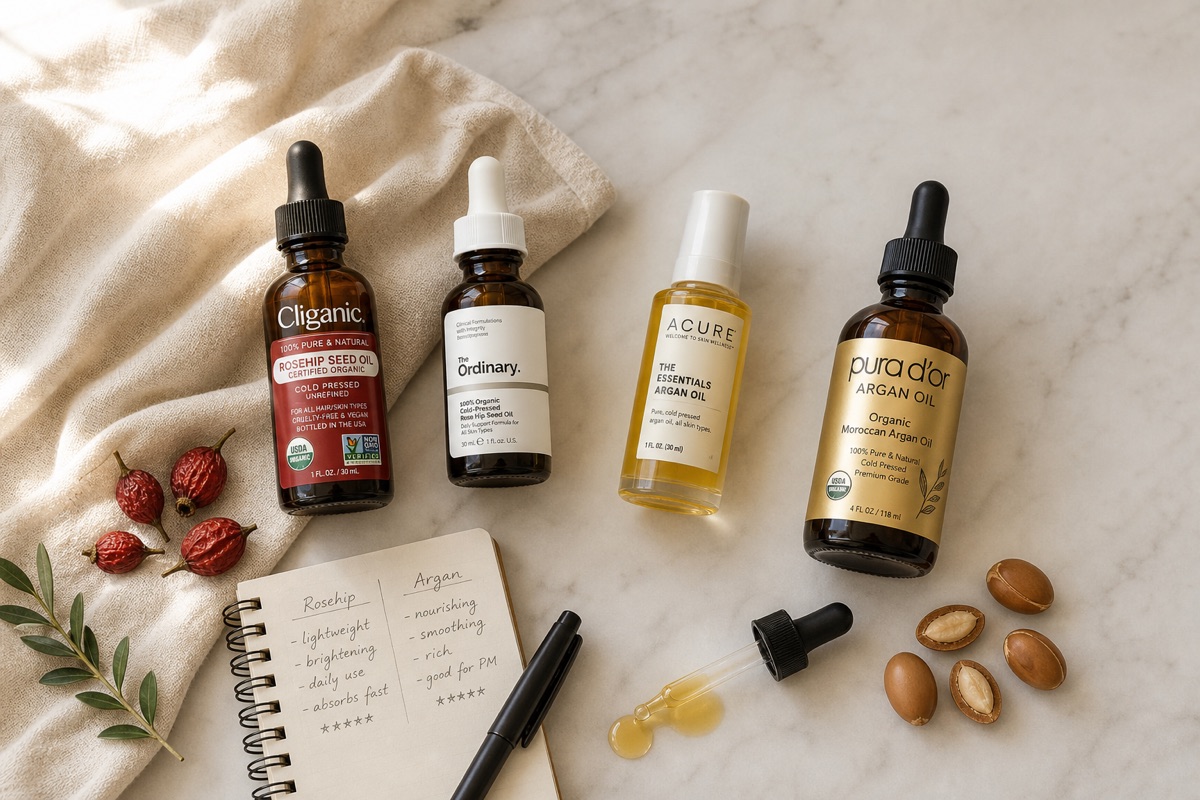
Face Oils for Beginners: Rosehip and Argan Starter Guide
A beginner-friendly, evidence-led guide to using rosehip and argan face oils for dryness, fine lines, and mature skin without over-layering.
We analyzed 4 Amazon US oil listings with 79,668 combined ratings, PubMed's 2015 argan-oil elasticity study in 60 postmenopausal women, and AAD dry-skin guidance. Beginners should start with 1 to 3 drops of rosehip or argan oil over moisturizer at night, not as a sunscreen or stand-alone cure.
Editor's top Amazon picks for this guide
Real Amazon products that match this protocol. Affiliate links — your purchases support BeautySift.

Cliganic
Cliganic Organic Rosehip Seed Oil
$9.98
"Best budget rosehip starting point: 4.6/5 across 28,467 Amazon ratings, single-oil format, and a light texture that suits a 1-drop beginner protocol."
What real Amazon buyers say
4.6★· 28,467 reviews"This rosehip oil from Cliganic is one of the best natural oils I've used. It absorbs quickly and doesn't feel greasy"

The Ordinary
The Ordinary 100% Organic Cold-Pressed Rose Hip Seed Oil
$10.90
"Best minimalist rosehip option from a widely recognized skincare brand: 4.6/5 across 5,931 Amazon ratings and official US positioning for visible signs of aging."
What real Amazon buyers say
4.6★· 5,931 reviews"My skin has become reactive to literally everything in my 40's. I can't use anything on it except for goat milk soap and this."
"i will probably forever repurchase this. it's an essential last step in my nightly skincare routine, right after my moisturizer."

Acure
Acure The Essentials Argan Oil
$18.99
"Best small-bottle argan pick for cautious beginners: 4.5/5 across 2,126 Amazon ratings, organic cold-pressed format, and a 1 oz size that discourages overuse."
What real Amazon buyers say
4.5★· 2,126 reviews"I've used different brands of argan oil on and off for many years, and Acure argan oil is high quality so I always go back to it."
"I've tried many expensive moisturizers, oils, and serums, and none compare to this product."

PURA D'OR
PURA D'OR Organic Moroccan Argan Oil
$16.99
"Best larger argan bottle for face, body, hair, and cuticles once you know you tolerate argan oil: 4.5/5 across 43,144 Amazon ratings."
What you'll learn
- Use face oil as the last night step over moisturizer, starting with 1 drop on damp or moisturized skin rather than applying a full dropper.
- Choose rosehip if you want a lighter, drier-feeling oil for uneven-looking tone and fine-line support; choose argan if dryness and cushion are the main issues.
- Do not use rosehip, argan, raspberry seed, coconut, or any other plant oil as sunscreen; PubMed's 2021 vegetable-oil SPF study found low UVB protection.
- For women 35-55, oils work best as a comfort layer around moisturizer, retinoids, and winter dryness, not as a replacement for sunscreen or barrier cream.
- Patch test for 3 nights, especially if you are breakout-prone, fragrance-reactive, or restarting retinoids after perimenopausal dryness.
Steps
-
1 Pick one oil role before buying
Choose rosehip when you want a lighter oil for dryness plus uneven-looking tone or fine lines. Choose argan when your skin feels tight, under-cushioned, or dry by morning. Do not start both in the same week because you will not know which one helped or irritated.
-
2 Patch test with 1 drop for 3 nights
Apply 1 drop along the jaw or behind the ear over a bland moisturizer for 3 nights. Stop if you see persistent burning, itchy bumps, swelling, or a rash pattern. A temporary oily feel is expected; stinging and swelling are not.
-
3 Apply oil after moisturizer at night
For a beginner routine, cleanse gently, apply moisturizer, then press 1 to 3 drops of oil over the driest areas. Keeping oil after moisturizer makes it a seal-in step instead of asking it to replace humectants, ceramides, or water-based hydration.
-
4 Use fewer drops on retinoid nights
If you use retinol or retinal, apply the retinoid as directed, wait until skin feels settled, moisturize, then add 1 drop of oil only if needed. More oil does not make retinoids safer; reducing frequency and using moisturizer are the bigger tolerance levers.
-
5 Keep sunscreen separate
Morning oil can make sunscreen slide or pill, and plant oils are not sunscreen. PubMed's 2021 vegetable-oil photoprotection study reported low UVB protection for rosehip seed oil, so use broad-spectrum SPF as its own step every morning.
-
6 Reassess after 14 nights
After 14 nights, judge dryness, flaking, makeup grip, and comfort. If pores feel congested, reduce to 2 nights weekly or switch texture. If skin still feels tight, the missing step may be a richer moisturizer, not more oil.
Bottom line
Face oils are easiest to use when you treat them as a small finishing step, not as a replacement for moisturizer. For a beginner, the most reliable protocol is simple: choose one oil, patch test it, apply moisturizer first, then press 1 to 3 drops over the driest areas at night. That is enough for most people to judge whether the oil improves comfort without turning the routine greasy.
BeautySift did not test these oils on a panel. We analyzed Amazon US rating snapshots for four widely available rosehip and argan oils, PubMed-indexed literature on argan oil and vegetable-oil photoprotection, AAD dry-skin guidance, official brand positioning, and ingredient-pattern analysis. We may earn a commission from Amazon links, but affiliate status does not influence product selection or evidence weighting.
For US women 35-55, the useful question is not whether face oil is trendy. It is whether your skin needs more comfort around menopause-related dryness, retinoid use, indoor heating, Southwest dryness, or Midwest winter cold. Oils can help with that surface comfort. They do not replace sunscreen, prescription care, or a well-built moisturizer.
Rosehip vs argan: the practical difference
Rosehip oil is usually the lighter, drier-feeling choice. It is popular in fine-line and uneven-tone routines because rosehip seed oil naturally contains fatty acids and plant compounds associated with skin-conditioning use. The Ordinary’s US product page positions its 100% Organic Cold-Pressed Rose Hip Seed Oil around visible signs of aging and uneven tone, and its Amazon listing showed 4.6/5 across 5,931 ratings in our snapshot.
Argan oil usually feels a little more cushioning. It is rich in oleic and linoleic fatty acids and is often used when the face feels under-moisturized, especially at night. The strongest age-relevant clinical signal we found was not a cosmetic brand claim: a 2015 Clin Interv Aging study indexed on PubMed followed 60 postmenopausal women and evaluated dietary and topical argan oil over 60 days. The study reported significant improvements in skin elasticity parameters, including R2, R5, and R7, in that controlled setting. We treat that as supportive evidence for argan’s relevance to mature-skin dryness and elasticity, not as proof that every bottle will erase lines.
The short version: choose rosehip when you want a light oil that fits a fine-line and tone routine. Choose argan when dryness, tightness, or a lack of cushion is the more obvious problem.
Step 1: start with one oil, not a shelf of oils
Beginners often make face oils confusing by buying rosehip, argan, jojoba, squalane, marula, and a fragranced blend at the same time. That makes it impossible to isolate the cause if skin gets bumpy or irritated. Start with one single-oil formula for 14 nights.
Cliganic Organic Rosehip Seed Oil is the budget rosehip pick in this guide because Amazon listed it at 4.6/5 across 28,467 ratings and $9.98 in our snapshot. The reason it works as a starter product is not magic; it is simple, inexpensive, and easy to ration. A beginner can use 1 drop on cheeks or around the mouth without feeling pressured to cover the entire face.
The Ordinary 100% Organic Cold-Pressed Rose Hip Seed Oil is another logical starter if you prefer a skincare-brand format and a smaller, routine-specific bottle. Amazon listed it at 4.6/5 across 5,931 ratings, and the official US page describes it as a water-free face oil for visible signs of aging and uneven tone. It is still an oil, not an active treatment serum, so keep the expectations realistic.
If your main complaint is that moisturizer disappears by morning, start with argan instead. Acure The Essentials Argan Oil is a 1 oz bottle, which is helpful for beginners because it encourages measured use. Amazon listed it at 4.5/5 across 2,126 ratings.
Step 2: patch test for 3 nights
Patch testing sounds fussy until you are dealing with an inflamed jawline before work. Use 1 drop over moisturizer behind the ear or along the jaw for 3 nights. Do not add retinol, exfoliating acids, or a new vitamin C serum in the same patch-test window. You want the oil to be the only new variable.
Stop if you see persistent itching, swelling, a rash pattern, or painful bumps. A mild oily feel is not a warning sign by itself. A slightly nutty scent from unrefined argan or a natural earthy scent from rosehip can also be normal, but strong perfume is a separate issue. If fragrance tends to trigger you, avoid fragranced oil blends and choose plain formulas.
This is where mature skin needs a little patience. Perimenopausal dryness can make a once-tolerated routine feel unpredictable, and retinoids can make the barrier less forgiving. The AAD’s dry-skin guidance prioritizes gentle cleansing, fragrance-free products, and prompt moisturizing. That aligns with the starter protocol here: bland base first, oil second, no pile-on.
Step 3: apply oil after moisturizer
Use face oil after moisturizer at night. Moisturizers usually bring the water-binding and barrier-support pieces that oil does not: glycerin, hyaluronic acid, ceramides, panthenol, or other humectant and emollient systems. Oil can soften and reduce the tight feeling, but it does not hydrate the way a water-based product does.
A beginner night routine can be this short: cleanse gently, apply moisturizer, wait a minute, then press 1 drop of oil onto cheeks, smile lines, or dry patches. If that feels comfortable after a week, increase to 2 or 3 drops. More is not automatically better. Too much oil can make hairline pores feel congested, cause sunscreen pilling the next morning, or leave pillowcases greasy.
If you use retinol, keep the oil as a comfort layer rather than a hack. Retinol irritation is usually managed by reducing frequency, using moisturizer, and avoiding extra exfoliation. One drop of oil can make the routine feel less tight, but it cannot cancel out a retinoid schedule that is too aggressive.
Step 4: do not use oil as SPF
This point deserves its own section because plant oils are often promoted online as if they can stand in for sunscreen. PubMed’s 2021 study on the real UVB photoprotective efficacy of vegetable oils looked at commonly promoted oils and found low protection for rosehip seed oil and several other oils. The study’s reported in vivo SPF values for promoted oils, including rosehip seed oil, were far below what a US shopper should expect from a broad-spectrum sunscreen.
That means rosehip oil can be a nighttime comfort step, but it is not a morning UV-defense step. If you want to use oil in the morning, use less than you think and allow time before sunscreen. For most beginners, oil is cleaner at night because it will not interfere with sunscreen film formation, makeup grip, or reapplication.
Fine-line routines still need sunscreen. UV exposure is a major driver of visible aging, so replacing SPF with oil undermines the reason many shoppers add rosehip oil in the first place.
Step 5: choose the product by skin feel
For light dryness and uneven-looking tone, start with rosehip. Cliganic is the budget path; The Ordinary is the more skincare-routine-coded path. Both were 4.6/5 in our Amazon snapshots, but the Cliganic listing had the larger rating base at 28,467 ratings compared with 5,931 ratings for The Ordinary.
For dryness that feels deeper or more persistent, choose argan. Acure is the smaller starter bottle; PURA D’OR is the larger multi-use option. PURA D’OR had the largest Amazon rating footprint in this article at 43,144 ratings, but its 4 oz size makes more sense if you also plan to use argan on cuticles, elbows, hair ends, or body dryness. Beginners who only want face use may waste less with Acure’s 1 oz bottle.
Our evidence-weighted product scoring used the same dimensions across the four products: ingredient simplicity, rating footprint, beginner value, texture role, mature-skin relevance, and evidence fit. Rosehip products scored higher for light, fine-line-adjacent routines; argan products scored higher for dry comfort and multi-use value. None of the oils scored as a complete moisturizer replacement because they do not provide the humectant and barrier-lipid architecture of a cream.
A simple 14-night starter plan
Nights 1 to 3: patch test with 1 drop over moisturizer. Do not add other new products.
Nights 4 to 7: use 1 drop on the face after moisturizer, focusing on cheeks, smile lines, and dry patches. Skip the T-zone if it gets oily easily.
Nights 8 to 14: increase to 2 or 3 drops only if skin still feels tight. If the oil feels heavy, use it every other night. If you see bumps, stop and return to moisturizer only for a week.
At the end of 14 nights, ask specific questions: Is flaking reduced? Does foundation cling less? Do cheeks feel less tight by morning? Did pores feel more congested? That kind of audit is more useful than chasing a before-and-after promise. Face oils are not high-drama products. Their best role is making a dry routine feel wearable enough that you stay consistent.
Common mistakes to avoid
Do not put oil on dry, freshly cleansed skin and expect it to hydrate. Apply moisturizer first or mist lightly and use moisturizer before oil. Oil on bare dry skin can feel slick while the skin underneath still feels tight.
Do not use a full dropper. Most droppers release far more product than a face needs. For many beginners, 1 drop on each cheek and a half drop around the mouth is plenty.
Do not mix oil directly into sunscreen. Sunscreen is a regulated product, and altering the film can reduce reliability. Apply sunscreen as directed, and keep oil mainly for night.
Do not treat breakouts, rashes, or dermatitis-like symptoms with more oil. If your skin is painful, swollen, crusted, bleeding, or persistently itchy, shopping for a face oil is not the right next step.