Gua Sha Tools for Beginners: A Starter Guide
A practical, evidence-led beginner guide to choosing a gua sha tool, using gentle pressure, and setting realistic expectations for puffiness, dullness, and facial tension.
Based on Nielsen et al. 2007 (n=11), Tashiro et al. 2021 (n=6), and Amazon US review snapshots totaling 74,535 ratings across 3 beginner tools, gua sha is best treated as a low-risk massage ritual for temporary puffiness, glow, and tension relief, not a proven nonsurgical lift.
Editor's top Amazon picks for this guide
Real Amazon products that match this protocol. Affiliate links — your purchases support BeautySift.

Kitsch
Kitsch Stainless Steel Gua Sha Facial Tool
$12.99
"Best beginner pick for easy cleaning and durability; Amazon US shows 4.7/5 across 1,292 ratings in the May 2026 snapshot."
What real Amazon buyers say
4.7★· 1,292 reviews"This gua sha is really good quality and feels sturdy in your hand. I love that it's stainless steel because it stays cold for a long time"
"The material stays naturally cool, which makes it really refreshing to use, especially in the morning or after a long day."

BAIMEI
BAIMEI IcyMe Gua Sha & Jade Roller Set
$7.99
"Best starter set if you want both a gua sha stone and roller; Amazon US shows 4.5/5 across 38,140 ratings in the May 2026 snapshot."
What real Amazon buyers say
4.5★· 38,140 reviews"The roller feels smooth on the skin, and I like using it in the morning to help with puffiness-it's especially refreshing if you keep it in the fridge."
"I had also never tried the Gua Sha stone and it's quite nice. It's thin and smoothe, and just glides along your jaw line"

Rena Chris
Rena Chris Jade Stone Gua Sha Tool
$2.99
"Lowest-cost single-tool option in this guide; Amazon US shows 4.6/5 across 35,103 ratings in the May 2026 snapshot."
What real Amazon buyers say
4.6★· 35,103 reviews"The quality is great - the stone feels smooth, sturdy, and naturally cool on the skin, which makes the massage even more relaxing."
"The stone itself feels smooth, cool, and really well-made, and the shape works perfectly for gliding along the jawline, cheeks, and forehead without tugging or discomfort."
What you'll learn
- Use gua sha for temporary depuffing, glow, and facial-tension relief; current evidence does not support facelift-style lifting claims.
- Beginners should choose a smooth, rounded tool that is easy to clean and inexpensive enough to replace if it chips, bends, or cracks.
- Always use slip from a serum, moisturizer, or facial oil, and keep pressure light enough that the skin does not bruise or sting.
- Five minutes, 3-5 times weekly, is a more realistic starter plan than aggressive daily scraping.
- Skip gua sha over active acne, sunburn, broken capillaries, recent injectables, or irritated retinoid-treated skin until a clinician clears you.
Steps
-
1 Choose a beginner-friendly material and shape
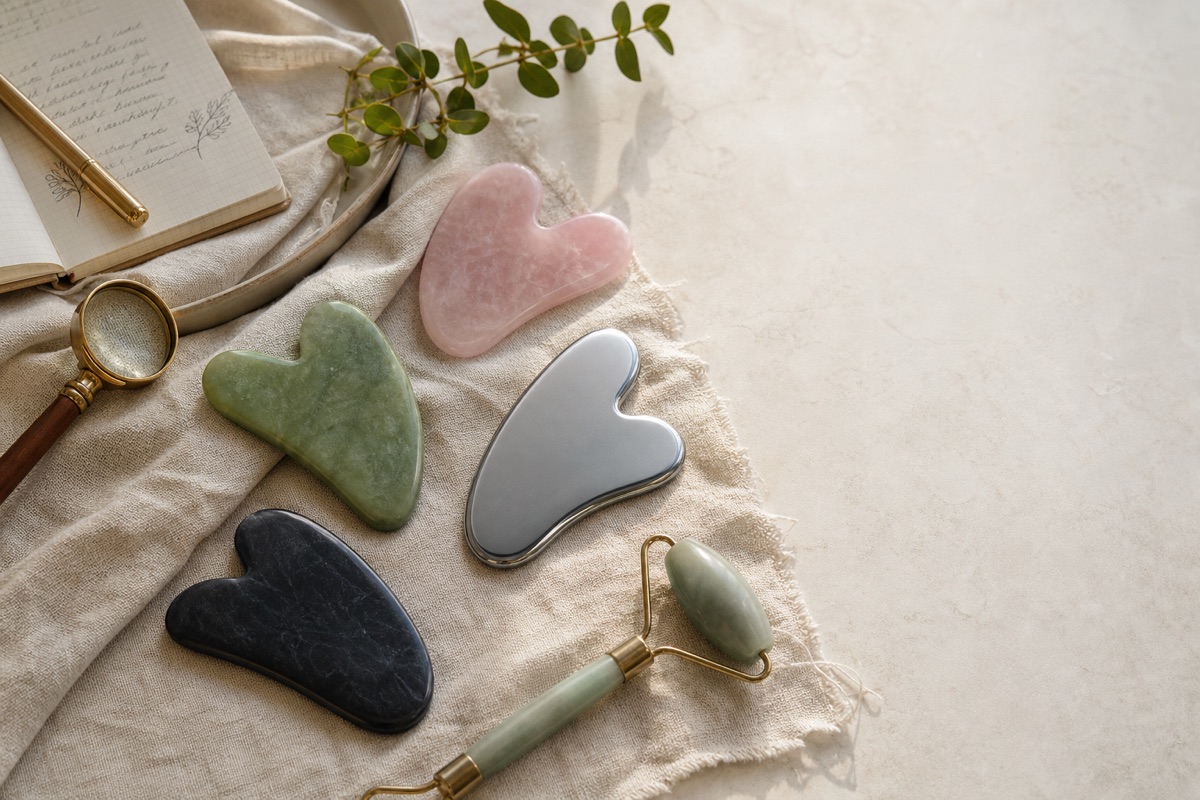
Start with a tool that has rounded edges, no chips, and enough curve to sit comfortably along the jaw, cheek, and neck. Stainless steel is easiest to sanitize and less likely to break. Jade-style stones feel cool and are inexpensive, but they can chip if dropped. The Amazon US snapshots we analyzed show three accessible beginner routes: Kitsch stainless steel at 4.7/5 across 1,292 ratings, BAIMEI's tool-and-roller set at 4.5/5 across 38,140 ratings, and Rena Chris jade at 4.6/5 across 35,103 ratings.
-
2 Apply slip before the tool touches skin
Gua sha should glide, not drag. After cleansing, apply a few drops of facial oil, a serum with enough cushion, or a moisturizer that stays slick for several minutes. If you use retinoids or exfoliating acids, do not use the tool over stinging or freshly irritated skin. For mature skin, the practical goal is to avoid tugging thin, dry areas around the eyes, mouth, and neck.
-
3 Use light pressure and move outward
Hold the tool nearly flat against the face, around a 15-degree angle, and use slow outward strokes. Work from the center of the face toward the hairline, then from under the chin toward the ear, and finish with gentle downward strokes along the sides of the neck. A light flush can happen, but redness should fade quickly. Bruising is a sign that pressure is too strong for a cosmetic routine.
-
4 Keep the first month simple
For the first 4 weeks, use the tool for about 5 minutes, 3-5 times per week, then judge whether it fits your routine. Nielsen et al. 2007 found a fourfold microcirculation increase after body gua sha in 11 subjects, but that was a short-term physiology finding on the back, not proof of permanent facial lifting. Track morning puffiness, skin glow, and jaw tension instead of expecting structural sagging reversal.
-
5 Clean, dry, and store the tool after every use
Wash the tool with gentle soap and water, dry it completely, and store it away from the sink edge. Stainless steel tolerates frequent cleaning well. Stone tools need more care because small chips can create rough edges that scratch. Replace any tool that feels sharp, cracked, or uneven. If you may earn a commission through affiliate links, the product still needs to pass this basic safety-and-ergonomics screen before it belongs in a beginner guide.
The beginner answer: gua sha is a massage tool, not a facelift
Gua sha is popular because it gives immediate feedback: a cooler cheek, a less puffy morning face, or a jaw that feels less clenched. The evidence is narrower than the social-media claims. Nielsen et al. 2007, a PubMed-indexed pilot study of 11 healthy subjects, found that gua sha performed on the back produced a fourfold increase in local microcirculation for the first 7.5 minutes and elevated surface microcirculation during the 25-minute observation window. That is useful physiology, but it is not proof that a home facial tool permanently lifts sagging skin.
For a US shopper in her 35-55 range, the right expectation is more practical: gua sha can be a low-cost facial massage ritual that may temporarily reduce the look of puffiness, improve the look of dullness through massage-related circulation, and help you slow down at night. It should not replace sunscreen, retinoids, moisturizer, LED, radiofrequency, or professional care if your main concern is significant laxity.
We analyzed 74,535 Amazon US ratings across three beginner-friendly tools in the May 2026 snapshot: Kitsch Stainless Steel Gua Sha at 4.7/5 across 1,292 ratings, BAIMEI IcyMe Gua Sha & Jade Roller Set at 4.5/5 across 38,140 ratings, and Rena Chris Jade Stone Gua Sha at 4.6/5 across 35,103 ratings. Those numbers tell us more about accessibility and user satisfaction than clinical outcomes, so we weight them below PubMed evidence and safety logic.
What gua sha can realistically help with
The strongest case for facial gua sha is temporary change: morning puffiness, a more awake look, and facial tension around the jaw. Nielsen et al. 2007 supports the idea that scraping-style manual therapy can increase local microcirculation in the short term, although that study used the back, not the face. Tashiro et al. 2021, a pilot study using cadaveric analysis and CT imaging in 6 healthy volunteers, examined facial soft-tissue mobility and suggested that vertical mobility helps explain why facial massage can change the appearance of cheek position temporarily.
That still leaves a major gap. There is not strong peer-reviewed evidence showing that a $3-$13 home gua sha tool reverses collagen loss, replaces volume, or tightens the platysma. If a product page or influencer says it will sculpt your face permanently, treat that as marketing. If the claim is that a cold, smooth tool can make a puffy face look calmer before work, that is more plausible.
For mature skin, the pressure question matters more than the stone mythology. Skin can be drier in midlife, especially during perimenopause, and a tool dragged across under-oiled skin can create irritation. The protocol below is deliberately conservative: more glide, less force, fewer passes.
Step 1: pick the material for your habits
Stainless steel is the easiest beginner material because it is nonporous, smooth, and harder to break. The Kitsch Stainless Steel Gua Sha is the cleanest pick in this guide for anyone worried about dropping a stone tool on tile. Amazon US shows it at 4.7/5 across 1,292 ratings in the May 2026 snapshot, and the Kitsch official product page positions the tool around stainless-steel durability and cooling.
Stone tools have a different appeal: they feel traditional, are inexpensive, and naturally hold a cool temperature. The BAIMEI IcyMe set is useful if you want to compare a roller and gua sha tool without buying two separate products; Amazon US shows 4.5/5 across 38,140 ratings. The Rena Chris Jade Stone Gua Sha is the lowest-cost option here; Amazon US shows 4.6/5 across 35,103 ratings. With any stone tool, inspect the edges before every use. A chip is not a cosmetic flaw; it can scratch.
Shape should be simple. Look for a heart or wing shape with a long smooth edge for cheeks and neck, a curved notch for the jawline, and no sharp corners. Avoid comb teeth or aggressive body-scraping edges for a beginner facial routine.
Step 2: prep skin so the tool glides
Cleanse first, then apply slip. Slip can be a facial oil, a milky serum, or a moisturizer that stays cushiony for several minutes. You do not need an expensive oil. You do need enough product that the tool moves without pulling.
If you use retinol, exfoliating acids, benzoyl peroxide, or prescription topicals, build the routine carefully. Do not use gua sha on a night when your skin is already warm, flaky, or stinging. A practical routine is: cleanse, apply a bland moisturizer or oil, use gua sha lightly, then stop. Save retinoid for a separate night until your barrier is steady.
For dullness, the goal is a fresh, temporary look from massage and hydration. Do not scrape harder to chase glow. Nielsen et al. 2007 measured increased microcirculation after treatment, but the study also describes traditional gua sha as frictioning that can raise petechiae on the body. That is not the target for a cosmetic facial routine.
Step 3: learn the pressure scale
Use a 1-to-3 pressure level on a 10-point scale. The tool should feel like a firm hand applying serum, not like a deep-tissue scraper. Hold it almost flat against the skin, around a 15-degree angle, and move slowly. If the edge is perpendicular to the face, you are more likely to drag and mark the skin.
A basic sequence:
- Neck: glide down the sides of the neck 3-5 times per side, avoiding the front of the throat.
- Jaw: start at the center of the chin and glide toward the ear 3-5 times.
- Cheeks: start beside the nose and glide outward toward the hairline 3-5 times.
- Brows: use very light pressure from the inner brow outward 2-3 times.
- Forehead: glide upward from the brows to the hairline 3-5 times.
Redness should be mild and brief. Bruising, broken capillaries, tenderness, or a hot sensation means the pressure is too high or the skin is not a good candidate that day.
Step 4: set a 4-week starter plan
Begin with 5 minutes per session, 3-5 times weekly, for 4 weeks. That plan is easy enough to repeat and short enough to avoid overworking the skin. Take a front-facing photo in the same light on day 1 and week 4 if you want to judge change. Look for three things: morning puffiness, how rested the face appears, and whether jaw tension feels lower.
Do not measure success by whether your cheekbones look permanently higher. Tashiro et al. 2021 gives a scientific reason to think facial soft tissue can move with posture and massage, but the study included 6 healthy volunteers for CT evaluation and does not prove durable lifting from home gua sha. That distinction matters for women shopping around sagging concerns: temporary contour is plausible; structural tightening is not well established.
If your skin responds well after 4 weeks, you can continue. If you see irritation, simplify. Gua sha should make the routine easier to maintain, not add another source of inflammation.
Step 5: keep hygiene boring and consistent
Wash the tool after every use with gentle soap and water. Dry it completely. Store it in a pouch, drawer, or clean tray rather than loose on the sink. Stainless steel is the lowest-maintenance choice, which is why it ranks first for beginners in our evidence-weighted comparison. Stone tools need more visual inspection because cracks and chips can hide along the edge.
Do not share your tool unless it has been thoroughly washed. Do not use it over active breakouts, open cuts, cold sores, infected skin, or dermatitis flares. Pause after facial waxing, laser, peels, microneedling, or injectables until your clinician says massage is safe again.
If you take blood thinners, bruise easily, have a clotting disorder, or have fragile capillaries, ask a clinician before using gua sha. The same caution applies if you recently had filler or neurotoxin treatment; facial massage can be inappropriate during the settling period.
How the 3 beginner tools compare
Our product-comparison weighting is conservative: 35% beginner ergonomics, 25% cleaning and durability, 20% Amazon user-review signal, 10% value, and 10% evidence fit with a gentle protocol. Clinical evidence is attached to the massage technique, not to any one Amazon listing.
Kitsch Stainless Steel Gua Sha ranks first because stainless steel solves two beginner problems: breakage and cleaning. Its Amazon US snapshot shows 4.7/5 across 1,292 ratings, and the representative reviews we captured repeatedly mention cooling feel, smooth glide, and sturdy hand feel. Skip it if you specifically want a traditional stone feel or a two-piece set.
BAIMEI IcyMe Gua Sha & Jade Roller Set ranks second because it is the easiest low-cost starter kit. The Amazon US snapshot shows 4.5/5 across 38,140 ratings, which is the largest review base in this guide. The roller is useful for quick under-eye cooling, while the gua sha tool is better for jaw and cheek strokes. Skip it if you do not want to store two tools or if you know you will drop stone tools.
Rena Chris Jade Stone Gua Sha ranks third because it is extremely inexpensive and has a large Amazon review base: 4.6/5 across 35,103 ratings in the May 2026 snapshot. It is the best pick if you want to learn the motions before upgrading. Skip it if inconsistent stone quality or breakage risk will bother you.
Common beginner mistakes
The first mistake is pressing too hard. Traditional body gua sha can intentionally create visible marks; cosmetic facial gua sha should not. For a mature-skin routine, gentle pressure protects the barrier and reduces the risk of broken-looking capillaries.
The second mistake is using the tool dry. Without slip, you are dragging skin rather than massaging it. This is especially unhelpful around the mouth, eyes, and neck, where dryness and laxity concerns are common.
The third mistake is expecting device-level results from a manual tool. If sagging is your primary concern, gua sha can sit alongside sunscreen, retinoids, LED, radiofrequency, or professional options, but it should not carry the whole plan. For dullness and puffiness, it can be a useful low-cost ritual.
FAQ
Does gua sha really lift sagging skin?
Not permanently based on current evidence. Nielsen et al. 2007 reported a fourfold short-term microcirculation increase after gua sha on the back in 11 healthy subjects, and Tashiro et al. 2021 studied facial soft-tissue mobility in 6 healthy volunteers. Those studies support short-term circulation and massage concepts, not a durable lift for jowls or loose neck skin.
How often should I use gua sha as a beginner?
Start with 5 minutes, 3-5 times per week. If your skin stays calm after 4 weeks, continue at that pace. More pressure and longer sessions are not automatically better. If redness lasts, bruising appears, or your skin stings afterward, stop and restart with less pressure only after the skin is calm.
Should I use gua sha in the morning or at night?
Morning is better for temporary puffiness; evening is better for jaw tension and a slower routine. The clock matters less than slip, light pressure, and consistency. If you use retinoids at night, consider using gua sha in the morning or on non-retinoid nights to avoid compounding irritation.
What should I put on my face before gua sha?
Use a product with glide: facial oil, a cushiony serum, or a moisturizer that does not dry down immediately. Avoid using the tool over strong exfoliating acids, irritated retinoid skin, sunburn, or active breakouts. The tool should slide with minimal tugging.
Is gua sha safe around the eyes?
Use extra caution. The skin around the eyes is thin, and heavy pressure can irritate it. If you use the tool near the brow bone or under-eye area, use the lightest pressure and keep the tool moving outward. Do not use gua sha directly on eyelids.