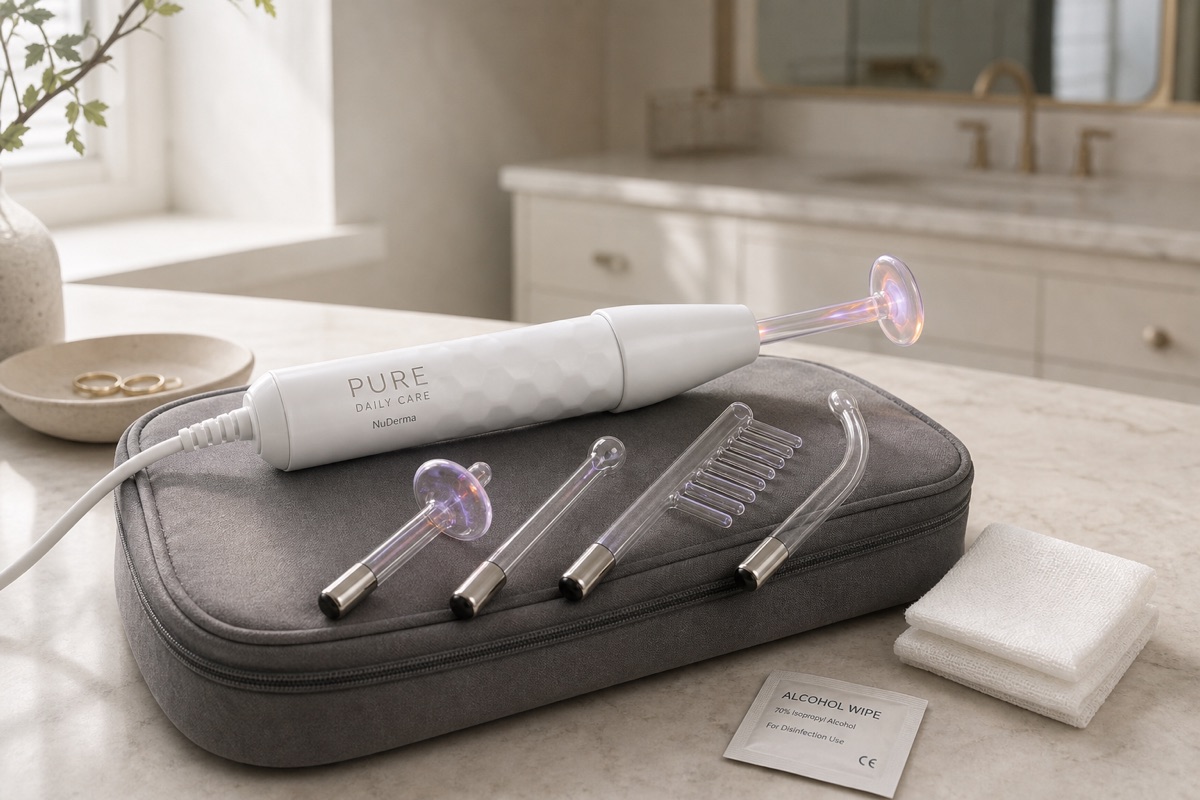
High-Frequency Wands for Beginners: A Starter Guide
A cautious, evidence-led starter guide to at-home high-frequency facial wands for hormonal breakouts, mature skin, and US shoppers new to beauty devices.
Based on Frommherz et al. 2022 in vitro acne data, 34,241 Amazon ratings across 3 verified wand listings, and FDA device-clearance guidance, beginners should use high-frequency wands cautiously: clean, dry skin, low intensity, short contact, and no claims beyond cosmetic support.
Editor's top Amazon picks for this guide
Real Amazon products that match this protocol. Affiliate links — your purchases support BeautySift.

Pure Daily Care
Pure Daily Care NuDerma Handheld Skin Therapy Wand
$69.95
"Best fit for a conservative beginner protocol because it includes four neon applicators, a lower entry price, and 4.4/5 across 21,198 Amazon ratings."
What real Amazon buyers say
4.4★· 21,198 reviews"Purchased 2 months ago. I am extremely critical and have high standards. I absolutely love this wand and would buy it again in a heartbeat."
"Immediately after, my skin felt great and it just looked radiant... I couldn't quite put my finger on it but it de-puffed my face and it kind of evened out my tone"

Pure Daily Care
NuDerma Professional Skin Therapy Wand
$99.95
"A stronger step-up option with six neon and argon applicators for users who want face, neck, and spot attachments after learning the basics."
What real Amazon buyers say
4.4★· 7,339 reviews"Since incorporating the NuDerma Wand into my daily skincare routine, I've noticed a significant enhancement in my skin's tightness and overall clarity."
"So I have been using this every day for a week and I've been using it on several different things. I have seen pimples (I get one once in a while) go away faster"

Pure Daily Care
Pure Daily Care NuDerma Clinical Portable Skin Therapy Wand
$169.95
"A higher-priced option with fusion neon and argon applicators; best reserved for committed users because the 4.3/5 Amazon rating trails the lower-cost models."
What real Amazon buyers say
4.3★· 5,704 reviews"The device feels sturdy, is easy to use, and comes with a nice variety of attachments for different areas of the face and different skin concerns."
"I would not say this is an instant miracle product, but with regular use, my skin does seem to look a little more even and balanced."
What you'll learn
- High-frequency wands have a plausible acne-support mechanism, but the strongest acne-specific citation we found is in vitro, not a human clinical trial.
- Beginners should start with clean, dry skin, the lowest comfortable setting, and short sessions instead of copying aggressive social-media routines.
- Avoid using a wand over broken skin, active irritation, recent procedures, metal jewelry in the treatment area, or without reading the device contraindications.
- For hormonal chin breakouts, treat the wand as an adjunct to a consistent routine, not a replacement for dermatologist care when acne is painful or scarring.
Steps
-
1 Decide whether a high-frequency wand belongs in your routine
Start with your concern, not the device trend. High-frequency wands make the most sense for adults who already have a gentle cleanser, moisturizer, and daily sunscreen in place and want a short, cosmetic add-on for occasional chin or jawline breakouts. Frommherz et al. 2022 supports a plausible antimicrobial mechanism in vitro, including reduced P. acnes colony-forming units, but the authors also noted that in vivo clinical studies are still needed. If your acne is painful, scarring, widespread, or suddenly new in midlife, prioritize a dermatologist visit.
-
2 Choose a beginner-friendly wand and read the contraindications
Pick a device with clear instructions, multiple simple glass attachments, and a long enough Amazon review history to reveal durability complaints. We weighted the NuDerma Standard highest for beginners because Amazon lists 21,198 ratings at 4.4/5 and Pure Daily Care lists 214 first-party reviews on its US product page. Before the first session, read the manual for contraindications, remove metal jewelry near the treatment area, and avoid use if you have an implanted electronic device unless your clinician says otherwise.
-
3 Prep skin conservatively
Cleanse, rinse well, and dry completely. Do not start over freshly exfoliated skin, a chemical peel, a retinoid burn, sunburn, open acne lesions, or a picked spot. If the manual recommends gauze or a specific glide method, follow the manual rather than a social-media shortcut. Keep alcohol-based toners, strong acids, and retinoids out of the immediate pre-wand step because irritated mature skin is less forgiving, especially around the mouth and chin.
-
4 Use low intensity and short contact first
For the first week, use the lowest setting that produces a tolerable sensation and keep movement slow but brief. The goal is a controlled introduction, not maximum buzzing. Avoid holding the electrode in one spot for long periods, do not use directly over the eyelid, and stop if you feel burning, persistent stinging, headache, or unusual redness. Beginners with hormonal chin breakouts can focus on the jaw and chin area while avoiding broken or freshly picked blemishes.
-
5 Separate the wand from strong actives until tolerance is clear
After the session, apply a bland moisturizer. If you use retinoids, benzoyl peroxide, salicylic acid, or exfoliating acids, keep them on alternate nights at first. This is especially relevant for women 35-55, because perimenopausal dryness and barrier sensitivity can make a routine that once worked feel suddenly harsh. Reintroduce actives only when the skin stays calm after several wand sessions.
-
6 Judge results at 4, 8, and 12 weeks
Track the same area in the same bathroom lighting at baseline, week 4, week 8, and week 12. Look for fewer angry-looking spots, less post-breakout picking, and whether the device is easy enough to keep using. Do not treat a single user review or brand claim as proof that a wand can replace acne prescriptions. If breakouts worsen, pigmentation darkens, or cystic lesions continue, stop the device and get medical guidance.
Quick answer: High-frequency wands are beginner-friendly only when expectations stay conservative. We analyzed Frommherz et al. 2022, FDA device-clearance context, Pure Daily Care first-party information, and 34,241 Amazon ratings across three US listings. The evidence supports a plausible antimicrobial mechanism, but not a guaranteed hormonal-acne cure.
Affiliate disclosure: we may earn a commission from Amazon links. Commission does not affect product selection, evidence weighting, or safety guidance.
What a high-frequency wand actually is
A high-frequency facial wand is a handheld beauty device that sends a mild electrical current through a sealed glass electrode. Depending on the gas inside the electrode, the tube may glow violet, orange, or red. Consumer listings often describe these as argon, neon, or fusion applicators.
The traditional beauty-school use case is brief contact over oily or breakout-prone areas, especially around the chin, jaw, and T-zone. For a US shopper in her late 30s, 40s, or 50s, the appeal is obvious: hormonal chin breakouts can show up at the same time as dryness, slower healing, and more visible post-breakout marks. A wand sounds like a neat way to avoid adding another drying topical.
The evidence is narrower than the marketing. The most relevant acne-specific citation we found is Frommherz et al. 2022 in Anais Brasileiros de Dermatologia. That study exposed skin flora and P. acnes to high-frequency treatment in vitro and reported significant reductions compared with controls. The authors explicitly framed the work as mechanistic support and noted that clinical in vivo studies are still needed.
That is the right expectation: plausible support, not a stand-alone acne treatment.
Who should consider one first
A high-frequency wand is most reasonable if your routine is already stable. Daily sunscreen, a cleanser that does not leave your skin tight, and a moisturizer that keeps barrier stinging down matter more than any device. If those basics are not in place, a wand will not fix the routine.
For hormonal acne, the best candidate is someone with occasional jaw or chin breakouts, not severe cystic acne that leaves scars. The device may be a helpful adjunct when used briefly and consistently, especially if you are trying to avoid piling benzoyl peroxide, exfoliating acids, and retinoids onto already dry midlife skin.
Skip the device-first mindset if your acne is sudden, painful, widespread, or scarring. In that case, the better evidence usually sits with dermatology care, prescription options, and hormonal assessment. At-home beauty tech should not delay medical care when the pattern changes quickly.
What the evidence does and does not say
Frommherz et al. 2022 is useful because it directly addresses the high-frequency-acne question. The study found significant reductions in multiple bacterial and fungal species and significantly decreased P. acnes colony-forming units after high-frequency exposure. That supports the mechanism many estheticians describe when they discuss high-frequency devices for blemish-prone skin.
The limitation is just as important. It was an in vitro study. Skin on a person is not an agar plate. Oil, barrier health, hormones, inflammation, product residue, device technique, and treatment consistency all change the result. This is why BeautySift does not describe high-frequency wands as proven acne treatment devices.
Amazon review data adds real-world sentiment, but it has its own limits. The NuDerma Standard listing showed 4.4/5 across 21,198 Amazon ratings in our snapshot; the Professional showed 4.4/5 across 7,339 ratings; the Clinical showed 4.3/5 across 5,704 ratings. Those numbers suggest broad consumer interest and repeatable satisfaction for many shoppers, but they are not clinical endpoints.
How we compared the starter devices
We used the same evidence-weighted approach we use for beauty-tech comparisons: user sentiment, price, beginner fit, attachment practicality, safety clarity, and whether the device matched a conservative protocol. We did not reward dramatic anti-aging language or claims that outran the evidence.
The Pure Daily Care NuDerma Handheld Skin Therapy Wand ranked first because it is the simplest fit for a starter routine. At $69.95 in the Amazon snapshot and 4.4/5 across 21,198 ratings, it offers enough review history to surface common praise and common complaints. Its four neon applicators are plenty for a beginner who mostly needs face, spot, and scalp-style attachments.
The NuDerma Professional ranked second. It costs more at $99.95, but the six neon and argon attachments may make sense if you want more shapes for the face, neck, and spot use. It is not necessary for someone who is still deciding whether high-frequency belongs in her routine.
The NuDerma Clinical ranked third because it is the most expensive option at $169.95 and its Amazon snapshot showed 4.3/5 across 5,704 ratings. It may fit a committed user who wants fusion neon and argon attachments, but beginners should not assume the highest-priced wand is the safest starting point.
A conservative first-month protocol
For week one, keep it simple. Cleanse, dry your skin, insert the attachment before turning the device on, and start at the lowest setting. Treat only one small area at first, such as the chin or jawline, and watch how your skin behaves over the next 24 hours.
Do not use a wand over broken skin, a freshly picked blemish, sunburn, a retinoid peel, or an irritated patch. Mature skin can be more reactive than it used to be, especially during perimenopause, so a routine that seems harmless on social media can feel harsh in real life.
For weeks two through four, follow the manual’s frequency and time limits rather than escalating quickly. If you use retinol, benzoyl peroxide, salicylic acid, or exfoliating acids, separate them from wand nights until your skin is clearly calm. A bland moisturizer afterward is the safer default.
Take baseline, week-4, week-8, and week-12 photos in the same lighting. Judge whether blemishes look less inflamed, whether the routine is sustainable, and whether your barrier feels normal. Stop if you get persistent redness, worsening pigmentation, burning, swelling, headaches, or eye discomfort.
Safety notes for women 35-55
Midlife skin often combines two problems that do not play well together: hormonal breakouts and dryness. That combination is why a slow introduction matters. If you already use a prescription retinoid, acne medication, or post-procedure routine, ask your clinician how to fit a device in, if at all.
Remove metal jewelry near the treatment area. Do not use the electrode over eyelids. Do not use the wand while touching another electronic device. Several Amazon reviewers mentioned phone or laptop interference, which is practical user evidence worth taking seriously even though it is not clinical research.
Be especially cautious if you have an implanted electronic device, seizure history, active infection, unexplained rash, recent laser, peel, microneedling, injectable treatment, or severe inflammatory acne. FDA 510(k) language should also be read carefully: a clearance is specific to a device and indication, not a blanket endorsement of every consumer beauty claim.
How to pair a wand with skincare
Think of the wand as the device step, not the whole routine. Cleanser, moisturizer, sunscreen, and evidence-backed actives still do the daily work. For daytime, sunscreen remains non-negotiable because post-breakout marks can look darker with UV exposure.
If your skin is dry, use the wand before a simple moisturizer and skip exfoliating acids that night. If your skin is oily but reactive, resist the urge to stack every acne active after the wand. More irritation can mean more picking, more redness, and more visible marks.
If your hormonal breakouts cluster around your period or perimenopause-related cycle changes, track timing. A device may help you feel more in control of small flare-ups, but persistent jawline cysts often need medical evaluation.