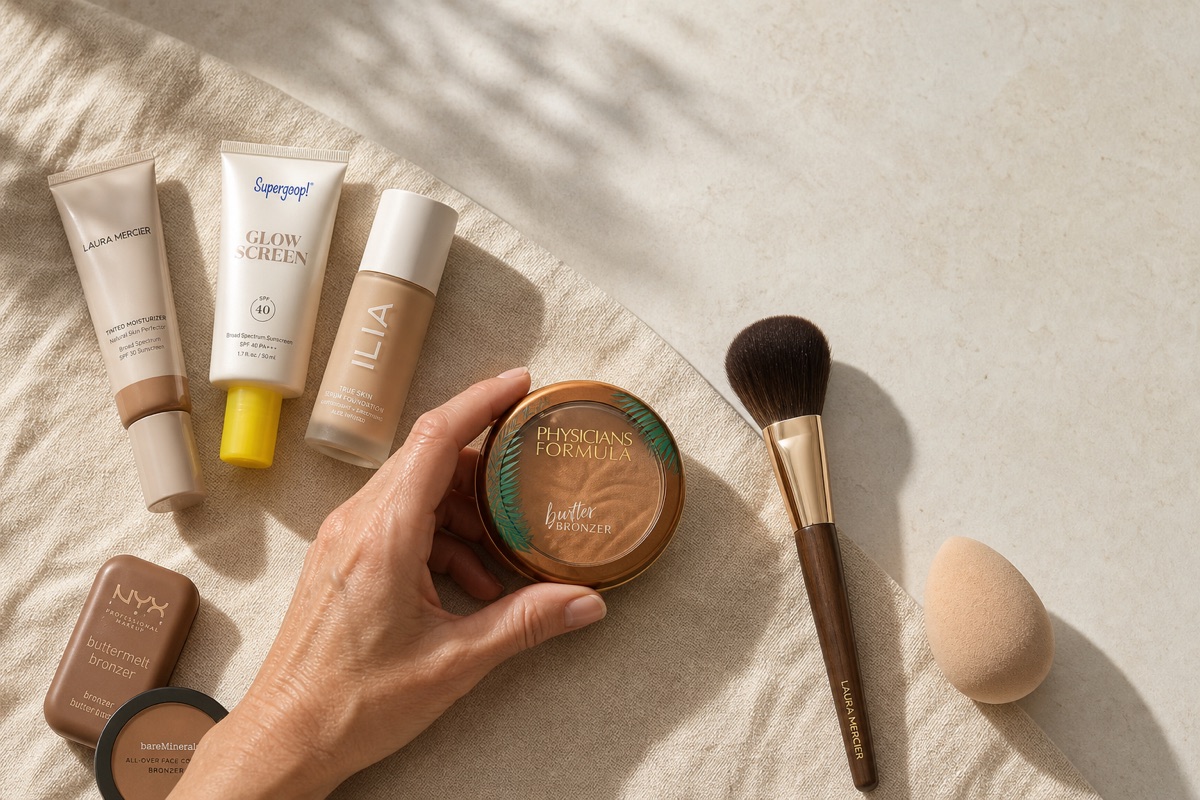
How to Apply Bronzer Powder Without Settling in Fine Lines
A mature-skin guide to powder bronzer application, from prep and shade choice to brush pressure, placement, and line-safe blending.
We analyzed 55,728 Amazon ratings across 3 powder bronzers, Amazon review excerpts, AAD dry-skin guidance, FDA sunscreen guidance, and Allure/Byrdie bronzer editor coverage. To keep powder bronzer out of fine lines, hydrate first, use a satin or soft-matte formula, load less powder, and blend on the high cheek perimeter instead of directly into creases.
Editor's top Amazon picks for this guide
Real Amazon products that match this protocol. Affiliate links — your purchases support BeautySift.

Physicians Formula
Physicians Formula Murumuru Butter Bronzer
$13.48
"Soft-glow powder bronzer example with a 4.6/5 Amazon snapshot across 42,412 ratings; listing describes murumuru, cupuacu, and tucuma butter blend, useful when powder needs slip on mature skin."
What real Amazon buyers say
4.6★· 42,412 reviews"This is my go to bronzer and sometimes hard to find in stores. I have tried so many powdered bronzers and always go back to this one."
"This is such soft and easy to build powder. It smells delicious and the color builds well. Lasts forever with how much is in the pot."

NYX Professional Makeup
NYX Professional Makeup Matte Buttermelt Bronzer
$9.97
"Best budget matte lane: Amazon snapshot shows 4.5/5 across 8,075 ratings, 8 shades, and an up-to-12-hour wear claim; choose shade carefully because matte warmth can read orange if too deep."
What real Amazon buyers say
4.5★· 8,075 reviews"It’s very soft and silky. No orange hue! It’s buildable. It has a subtle glow, just a bit and perfect for my oily skin."
"Looks very natural and a little goes a long way if you are doing a natural look."

bareMinerals
bareMinerals All-Over Face Bronzer
$22.10
"Loose mineral bronzer example with a 4.7/5 Amazon snapshot across 5,241 ratings; listing calls out 6 mineral ingredients, talc-free positioning, and synthetic-fragrance-free claims."
What real Amazon buyers say
4.7★· 5,241 reviews"As always, Bare Minerals are reliable and the pigment is very concentrated. Just the tiniest amount is needed and then tap the brush on the edge of the lid."
"Goes on nice and blends great!"
What you'll learn
- Fine-line-safe bronzer starts with skin prep: moisturizer, sunscreen, and enough dry-down time before powder touches the face.
- Use less powder than you think, tap off the brush, and build in thin layers on the high cheek perimeter instead of sweeping through expression lines.
- For women 35-55, satin or soft-matte bronzers are usually easier than flat matte, glittery, or very red-orange formulas.
- Bronzer adds cosmetic warmth and can reduce the look of dullness, but FDA tanning guidance is clear that cosmetic color is not UV protection.
- If bronzer catches in lines, fix the prep and placement before buying a darker shade or applying more powder.
Steps
-
1 Prep skin so powder has an even surface
Apply moisturizer, sunscreen, and complexion products first, then wait several minutes before bronzer. Mature-skin tip: press moisturizer over the outer cheek and temple where bronzer sits, but avoid leaving a wet film that makes powder grab in patches.
-
2 Choose a fine-line-aware bronzer formula
Look for finely milled powder, satin or soft-matte finish, and an undertone that reads beige, neutral, or golden rather than orange. Mature-skin tip: avoid obvious glitter on textured cheeks because reflective particles can make fine lines look sharper in daylight.
-
3 Use a large soft brush and remove excess powder
Swirl once, tap the ferrule, and start with a sheer veil. Mature-skin tip: a dense contour brush deposits too much pigment in one stripe; a loose, tapered brush diffuses color before it can settle.
-
4 Place bronzer higher than the deepest crease
Blend from the upper cheekbone toward the temple, then lightly touch the hairline and jaw if needed. Mature-skin tip: skip heavy bronzer directly beside smile lines or under the cheek hollow, where powder can pool as the face moves.
-
5 Finish by pressing, not buffing endlessly
Use a clean sponge or clean brush to press edges into foundation, then stop. Mature-skin tip: over-buffing can lift base makeup and create dry texture, especially during perimenopause-related dryness or Midwest winter indoor heat.
Bottom line
Powder bronzer settles into fine lines when the surface is too dry, the base is too tacky, the brush is too dense, or the placement runs directly through mobile creases. The fix is not more bronzer. It is a lighter layer, a softer brush, better dry-down time, and placement that warms the high cheek perimeter instead of filling smile lines.
BeautySift did not test bronzers on a panel. We analyzed 55,728 Amazon ratings across three powder bronzer examples, verified-purchase Amazon review excerpts, the American Academy of Dermatology’s dry-skin guidance, FDA tanning-risk guidance, PubMed aging-skin literature, and Allure and Byrdie bronzer editor coverage. We may earn a commission from Amazon links, but affiliate status does not influence product selection or technique advice.
For US women 35-55, the mature-skin goal is specific: add warmth and reduce the look of dullness without adding a dry stripe. That means picking a bronzer that is not too orange, not too sparkly, and not so matte that it turns texture into a feature.
Why powder bronzer settles after 35
Powder collects where texture and movement meet. Smile lines, cheek creases, enlarged-looking pores, and the outer-eye area all move repeatedly through the day. If the skin underneath is dehydrated or the foundation layer remains wet, bronzer pigment can cling unevenly, then migrate into those lines as your face moves.
Aging-skin literature supports the broader context: Ganceviciene et al. reviewed intrinsic and extrinsic skin-aging changes in 2012, including dryness, surface texture, and visible lines. That does not mean makeup causes aging or that bronzer treats it. It means application has to account for a skin surface that may be drier, less bouncy, and less forgiving than it was at 25.
The AAD’s public dry-skin guidance emphasizes moisturization and gentle skin care. Translated to makeup, that means powder bronzer should go over comfortable skin, not tight skin. But there is a second half: moisturizer needs time to settle. Powder on wet moisturizer turns patchy; powder on parched skin looks dusty.
Step 1: prep skin, then wait
Start with skin care that leaves the cheek comfortable but not slippery. Use moisturizer where your skin feels tight, then sunscreen if it is daytime. Give the layers several minutes to dry down before foundation or bronzer. If you use a hydrating primer, use it sparingly on the outer cheek and temple, not in a heavy layer around smile lines.
Mature-skin tip: press, do not rub, moisturizer over the cheekbone and temple. Rubbing can leave uneven skin-care film, especially over sunscreen. If your sunscreen pills, bronzer will catch on the pills and make texture look worse. Fix the sunscreen-base pairing before blaming the bronzer.
If you wear foundation, keep the bronzer zone thin. A heavy foundation layer under powder bronzer can crease first and carry the bronzer with it. For dullness, consider sheering foundation on the outer cheek and letting bronzer bring back warmth. That usually looks fresher than full-coverage base plus heavy bronze.
Step 2: choose shade and finish before intensity
Bronzer should be close to the color your skin naturally warms to, not a contour shadow and not a self-tanner replacement. Fair-to-light skin usually needs beige, honey, or light neutral bronze. Medium skin can often wear golden or caramel bronze. Tan-to-deep skin may need richer neutral-brown warmth with enough depth to show up without turning red-orange.
Undertone matters more after 35 because facial redness, melasma, sun spots, and dullness can all distort how color reads. If your neck is neutral but your cheeks flush warm, an orange bronzer may exaggerate redness. If your skin is olive, a red bronze can look muddy. Check bronzer in daylight on the outer cheek, not just on the wrist.
Finish matters too. A satin or soft-matte powder is the safest starting point for fine lines. Flat matte can look dry if layered. High shimmer can emphasize texture because mica reflection catches raised lines. A soft-glow product like Physicians Formula Murumuru Butter Bronzer has a 4.6/5 Amazon snapshot across 42,412 ratings, while its listing describes soft-focus pigments and a butter blend. That makes it a useful example of a powder category built for slip, although fragrance-sensitive users should still read the ingredient list.
Step 3: pick the right brush and load less powder
Use a large, soft, slightly tapered brush. The brush should bend when it touches the face. A dense contour brush deposits too much pigment in a narrow stripe, which then has to be buffed aggressively. Aggressive buffing is exactly what lifts foundation and pushes powder into lines.
Load the brush once, then tap off visible excess. If you are using a loose mineral bronzer, follow the tiny-amount rule. The bareMinerals All-Over Face Bronzer Amazon snapshot showed 4.7/5 across 5,241 ratings, and one verified reviewer wrote, “Just the tiniest amount is needed and then tap the brush on the edge of the lid.” That is the right mental model for mature skin: sheer veil first, intensity second.
Mature-skin tip: hold the brush near the end of the handle. This reduces pressure and keeps the bristles gliding over texture rather than grinding pigment into it. If the bronzer disappears after one pass, add another sheer layer. Do not solve low payoff by pressing harder.
Step 4: place bronzer above the crease zone
Start at the outer upper cheekbone, roughly where the sun would hit if you were wearing sunglasses. Blend back toward the temple and hairline. Keep the first deposit away from the center of the face, nose-to-mouth folds, and the deepest cheek hollow. Those areas have more movement and more shadow; extra powder there can read as dryness.
Then use the residue on the brush for the hairline and jaw. This order matters. The first brush touch carries the most pigment, so it should land where you want the most warmth and the least fine-line risk. For many women 35-55, that is high and outside, not low and central.
If your bronzer is matte, be even more restrained. NYX Professional Makeup Matte Buttermelt Bronzer has an Amazon snapshot of 4.5/5 across 8,075 ratings, 8 shades, and an up-to-12-hour wear claim on the listing. That makes it a strong budget example, but matte formulas still require a lighter hand around texture. Choose your depth carefully; too-deep matte bronzer can look like a stripe before you have time to blend.
Step 5: press the edges and stop on time
After bronzer is placed, use a clean fluffy brush or a barely damp sponge to press the edge where bronzer meets foundation. Pressing softens the transition without moving product into lines. Endless circular buffing can lift base makeup, create dry flakes, and make the cheek look more textured than it did before bronzer.
If you went too heavy, do not add more foundation on top. That can create a muddy stack. Instead, use a clean brush with a tiny amount of your finishing powder or leftover foundation on a sponge and press along the edge. The goal is to diffuse, not erase.
Mature-skin tip: stop before the face looks fully bronzed in bathroom lighting. Indoor light often hides warmth that daylight reveals. Step near a window. If the bronzer looks soft in daylight and only slightly visible indoors, you are closer to a fine-line-safe application than if it looks dramatic under warm bulbs.
Common mistakes that make lines look deeper
The first mistake is applying bronzer onto wet skin care. Hydration is good; a wet film is not. Give moisturizer, sunscreen, and primer time to settle, especially in humid Florida summer weather when dry-down takes longer.
The second mistake is using bronzer as contour. Contour belongs in shadow zones and often uses cooler, grayer tones. Bronzer belongs where warmth would naturally hit. When warm powder is dragged under the cheek hollow, it can sit near smile lines and make the lower face look heavier.
The third mistake is choosing sparkle to fix dullness. Dullness often improves visually with warmth, but obvious shimmer over texture can backfire. If you want more radiance, use a satin bronzer on the perimeter and place a separate, very subtle highlighter only on smooth high points.
The fourth mistake is forgetting sunscreen. FDA tanning-risk guidance is clear that UV exposure carries skin risks. Bronzer is the safer cosmetic route to a sun-kissed look, but it is not SPF. Use broad-spectrum sunscreen separately and let it dry before makeup.
Product roles in this technique
Physicians Formula Murumuru Butter Bronzer is the soft-glow powder lane. The Amazon listing cites a butter blend and soft-focus pigments, and the rating snapshot is the largest in this guide at 42,412 ratings. It is useful if flat matte powders make your cheeks look dry, but fragrance-sensitive or hot-flash-flushing readers should patch test because scent appears in user review language.
NYX Professional Makeup Matte Buttermelt Bronzer is the budget matte lane. Its 8-shade range is helpful for undertone matching, and the Amazon listing claims up to 12 hours of wear. Use it with a loose brush and a small amount; matte payoff is easiest to overdo on fine lines.
bareMinerals All-Over Face Bronzer is the loose mineral lane. The Amazon listing describes 6 mineral ingredients, talc-free positioning, and synthetic-fragrance-free claims. Loose powder requires discipline: swirl, tap, and use a tiny amount. It can look seamless when controlled and dusty when overloaded.
You do not need all three. Pick the formula lane that solves your actual problem: slip if powder looks dry, shade range if bronzer turns orange, or loose-mineral control if pressed powders deposit too much at once.
FAQ
Should powder bronzer go before or after setting powder?
Usually after a very light set. If foundation is still tacky, bronzer can grab and streak. Set only the bronzer zone with a sheer veil of translucent powder, then apply bronzer. Avoid a heavy powder base because stacked powder is more likely to settle into fine lines by afternoon.
Is cream bronzer better than powder bronzer for mature skin?
Cream bronzer can be easier on very dry skin, but powder is not off-limits. A finely milled satin or soft-matte powder applied in sheer layers can look smoother than a cream bronzer that never sets and migrates into lines. If you have very dry cheeks, use cream on the center face and powder only at the perimeter.
How do I stop bronzer from looking orange?
Use undertone matching. Fair-to-light skin often needs beige or neutral bronze, medium skin often suits golden or caramel bronze, and deeper skin needs enough brown depth so the color shows as warmth rather than red-orange. Test in daylight and compare against your neck and chest, not just your flushed cheek.
Can bronzer replace sunscreen or self-tanner?
No. Bronzer is temporary cosmetic color. It can give a sun-warmed look without deliberate tanning, but it does not protect against UV exposure unless the product is labeled with SPF. Keep sunscreen as a separate morning step and let it dry before makeup.
Why does bronzer settle into my smile lines?
The most common causes are too much product, a dense brush, a wet base, or placement that starts too close to the nose-to-mouth fold. Move the first brush touch higher and farther back, use less powder, and press the edges instead of buffing over the crease repeatedly.