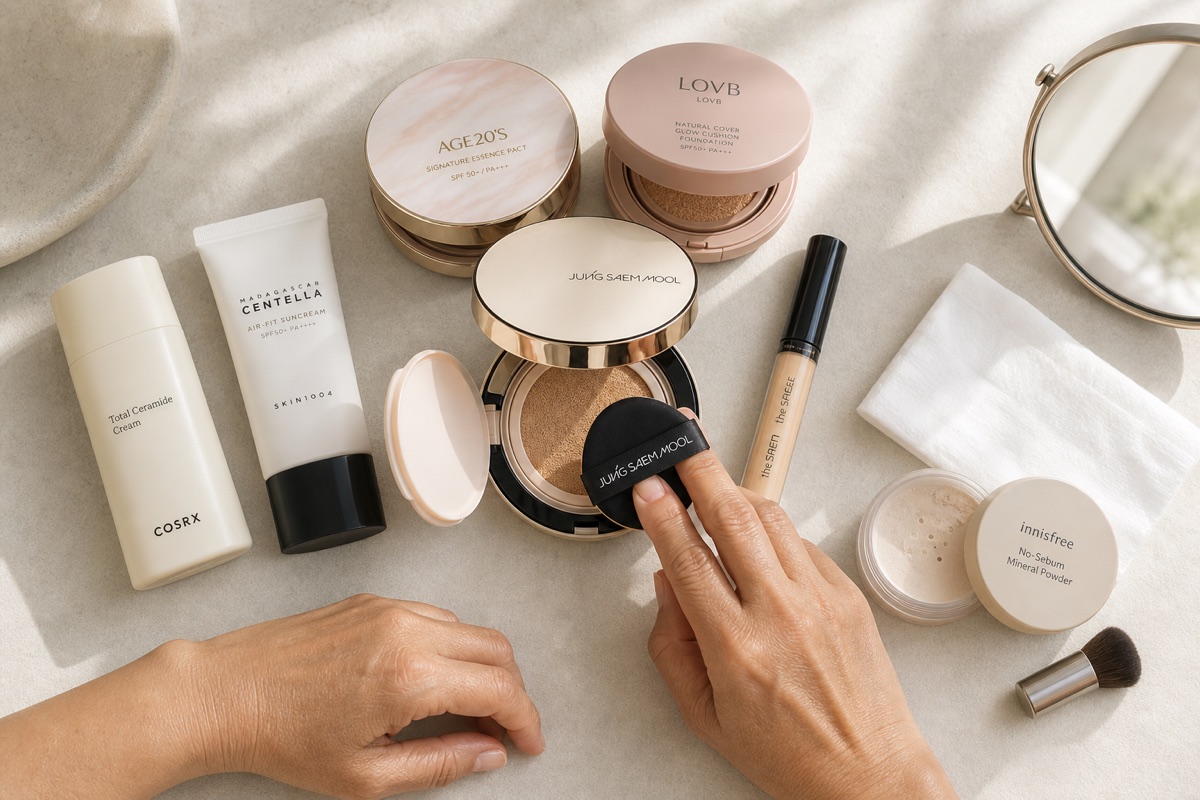
How to Apply Cushion Foundation Without Settling in Fine Lines
A fine-line-aware cushion foundation guide for mature skin, covering prep, tapping technique, shade choice, setting, SPF limits, and clean puff care.
We analyzed 3 Amazon US cushion listings totaling 7,718 global ratings, Allure and Byrdie mature-skin foundation advice, FDA cosmetic safety pages, and 4 PubMed dermatology reviews. The fine-line-safe method is hydrated prep, one light puff press, tap-off, thin layers, and minimal powder.
Editor's top Amazon picks for this guide
Real Amazon products that match this protocol. Affiliate links — your purchases support BeautySift.

JUNG SAEM MOOL
JUNG SAEM MOOL Essential Skin Nuder Cushion 21W Medium
$32
"Best skin-like technique anchor: Amazon lists 4.2/5 across 3,409 global ratings, and reviewer language repeatedly cites light coverage, glow, and easy puff application."
What real Amazon buyers say
4.2★· 3,409 reviews"Absolutely love this cushion foundation! It gives such a natural, smooth finish and makes my skin look fresh and even without feeling heavy."
"A little too thick and sticky. Great coverage. Easy to apply. The pad in the same box as the foundation is a good design. No allergy and no smell is great."

AGE20'S
AGE20'S Signature Essence Pact SPF 50+ 27C Honey
$28.99
"Best dewy pact example for dry-looking skin: Amazon lists 4.2/5 across 3,765 global ratings and SPF 50+ in the product title."
What real Amazon buyers say
4.2★· 3,765 reviews"People are always remarking about my skin, because I am 67yrs. old and it doesn't look like I have foundation on at all."
"It leaves my dry skin feeling dewy and doesn't emphasize my fine lines. It covers my red areas but still looks like skin and blends perfectly with my face."

LOVB LOVB
LOVB LOVB Natural Cover Glow Cushion Foundation 23N Natural Beige
$28
"Best glow-finish comparison point: Amazon lists 4.1/5 across 544 global ratings, with polarized reviews that make thin-layer application important."
What real Amazon buyers say
4.1★· 544 reviews"One layer and my skin looked radiant! I bought this foundation 3x already and it's my favorite. Easy to apply, dries quickly and friendly with any blush-on."
"No glow , did not like at all . Not a good quality in my opinion ."
What you'll learn
- Fine-line control starts before foundation: hydrate, let skincare settle, and remove excess slip before the puff touches skin.
- Use one light press into the cushion, tap off excess, then press and roll instead of dragging across smile lines or crow's feet.
- Build coverage only where you need it; thick all-over cushion layers are more likely to collect in folds by midday.
- Treat cushion SPF as helpful backup, not your full sunscreen dose, because most people apply far less makeup than labeled SPF testing requires.
- Clean or replace cushion puffs often, and do not share them, especially if you tap product near the eye area.
Steps
-
1 Prep with hydration, then remove surface slip
Apply moisturizer and sunscreen first, then wait until the surface feels cushioned but not wet. Press a tissue over smile lines, sides of the nose, and under-eyes before foundation. Mature-skin tip: dryness makes pigment catch, but excess emollient makes cushion foundation slide into folds.
-
2 Choose the cushion finish for your failure mode
For dry or dull skin, start with satin, radiant, or skin-like finishes. For hot-flash shine or an oily T-zone, use a semi-matte cushion only through the center face. Mature-skin tip: avoid high-coverage matte cushions around crow's feet unless you are willing to apply half a layer.
-
3 Load the puff lightly and tap off excess
Press the puff into the cushion once, then tap it on the compact lid or back of your hand before your face. The puff should look damp, not saturated. Mature-skin tip: the first overloaded stamp is the one most likely to settle into nasolabial folds.
-
4 Press and roll over texture instead of swiping
Use small taps on cheeks and a gentle press-roll motion near lines. Do not drag the puff across the mouth, under-eye, or forehead. Mature-skin tip: smooth the skin with a relaxed face, not a stretched grin, so foundation settles where your face actually rests.
-
5 Build only on discoloration, not across every line
Add a second thin layer on redness, dark spots, or uneven tone, then stop before mobile areas look opaque. Use concealer for pinpoint coverage. Mature-skin tip: more foundation over a line rarely hides it; it usually creates a visible edge inside the crease.
-
6 Set by zone and audit at four hours
Use a small brush with a trace of powder only on the T-zone, sides of the nose, and outer under-eye if needed. Check the face after four hours in daylight. Mature-skin tip: if product has gathered in lines, blot and smooth before adding anything else.
Bottom line
Cushion foundation is not automatically better for fine lines, but the format can help because the puff controls dose. The mistake is treating a cushion like a stamp pad: pressing hard, loading the puff until it is glossy, then dragging the wet layer across smile lines. That creates the exact problem mature-skin shoppers are trying to avoid.
BeautySift did not test these foundations. We analyzed 3 Amazon US cushion listings totaling 7,718 global ratings, Allure and Byrdie mature-skin foundation advice, FDA cosmetic safety pages, official brand materials, and PubMed dermatology reviews. The evidence points to a practical routine: hydrated but settled skin, one light press into the cushion, tap off excess, build only on discoloration, and set only the places that move or shine.
We may earn a commission from Amazon links. Affiliate status does not change the technique or evidence weighting.
Why cushion foundation settles on mature skin
Settling is usually a layer problem, not a cushion problem. Foundation gathers where there is movement, dryness, oil, or a fold in the skin. Around 35-55, those variables can show up together: drier cheeks, more visible smile lines, thinner under-eye skin, hot-flash shine through the center face, and dullness that makes full matte coverage look flatter.
The dermatology evidence supports taking dryness seriously. The PubMed review “Estrogens and aging skin” reports about 1.13% skin thickness loss and 2% collagen loss per postmenopausal year. Rittie and Fisher’s 2015 PubMed review describes intrinsically aged skin as thin, dry, and finely wrinkled. That does not mean foundation causes aging; it means heavier pigment layers have more texture to catch on.
Cushion compacts can be helpful because they encourage thin, portable, tapped-on coverage. The puff is also the risk: if it is dirty, overloaded, or dragged, it can make base makeup look patchy. FDA eye cosmetic safety guidance is relevant because many shoppers tap cushion foundation close to the under-eye and crow’s-foot area. Keep the puff clean, do not share it, and stop using any product that irritates the eye area.
Step 1: prep skin until it is hydrated, not slippery
Start with skincare and sunscreen, not foundation. A cushion foundation looks smoother when the skin underneath has enough moisture to reduce flaking but not so much surface slip that makeup migrates. Apply moisturizer, apply broad-spectrum sunscreen, then wait a few minutes until the face no longer feels wet.
Before opening the cushion, press a clean tissue over the sides of the nose, the nasolabial folds, the chin crease, and the under-eye area. This is not to remove your skincare; it is to lift the extra film that would otherwise mix with pigment. If you skip this, the first cushion layer can look fresh for 20 minutes and then collect in the exact folds you wanted to soften.
Mature-skin-specific tip: treat smile lines as a low-product zone. Hydrate them, let them settle, and keep foundation sheer there. If you need coverage beside the line, apply it next to the fold rather than inside the fold.
Step 2: pick the cushion finish for your skin’s failure mode
Finish matters as much as shade. A radiant or satin cushion can help dull skin look more flexible because it leaves some light on the face. A matte cushion can be useful if you have a shiny T-zone or hot-flash breakthrough, but it is less forgiving over dry cheeks and crow’s feet. A high-coverage cushion can look polished in photos and still settle badly if applied like a second skin mask.
The Amazon examples show why the choice should be tied to behavior, not brand hype. JUNG SAEM MOOL Essential Skin Nuder Cushion is listed at 4.2/5 across 3,409 global ratings and is a useful skin-like finish reference. AGE20’S Signature Essence Pact is listed at 4.2/5 across 3,765 global ratings and works as a dewy pact reference. LOVB LOVB Natural Cover Glow Cushion Foundation is listed at 4.1/5 across 544 global ratings and is a glow-finish comparison point with more polarized user language.
Shade also matters. Cushion lines often run lighter or narrower than liquid foundation lines, so match depth and undertone before you judge texture. Cool, neutral, warm, olive, and golden undertones can all react differently to a beige cushion. If a shade looks gray, peach, or too pale in daylight, no application trick will make it look seamless.
Step 3: load the puff once, then tap off
Open the compact and press the puff into the cushion once. Do not pump repeatedly. Do not twist the puff into the sponge. The surface should look lightly damp, not saturated. Then tap the puff on the inside lid, a clean palette, or the back of your hand. This off-loads the first heavy deposit so your face gets the thinnest layer.
Amazon reviewer language supports this dose-control issue. A verified JUNG SAEM MOOL reviewer wrote, “Absolutely love this cushion foundation! It gives such a natural, smooth finish and makes my skin look fresh and even without feeling heavy.” Another reviewer called the same product “A little too thick and sticky” while still noting easy application. Those two reactions can both be true when the same format is applied at different thicknesses.
Mature-skin-specific tip: if the puff makes a visible wet stamp on your cheek, you loaded too much. Fold the puff gently or tap off again before moving near fine lines.
Step 4: press and roll, but do not swipe over lines
Apply foundation to the broadest, smoothest areas first: center cheek, outer cheek, forehead center, and chin. Use small taps. Around the mouth, under-eyes, and crow’s feet, switch to a press-and-roll motion with almost no fresh product on the puff. The goal is not to fill the line. The goal is to leave the thinnest veil over it so the line can move without creating a stripe.
Avoid stretching your face into a wide smile while applying. It feels logical because the line looks flatter, but the product then settles into a position your face does not hold. Apply with a relaxed expression, gently smooth any visible crease with a fingertip, and use the last residue on the puff for mobile areas.
If your under-eye area needs coverage, use a separate small amount of concealer only where darkness is strongest. Cushion foundation under the full eye can look fresh at first but crease by lunch, especially if you also powder it heavily.
Step 5: build coverage only on discoloration
Cushion foundation is best built in micro-layers. Let the first layer sit for a minute. Look at the face in daylight or near a window. Then add a second light press only on redness, hyperpigmentation, broken-capillary areas, or uneven tone. Do not add a full second layer across the whole face just because one spot needs more help.
This is where color correction can reduce settling. If blue-brown under-eye darkness or brown spots are driving you to overapply foundation, a thin corrector under cushion foundation can be cleaner than three layers of base. The same logic applies to redness around the nose: correct locally, then cushion lightly.
Mature-skin-specific tip: build coverage beside fine lines, not inside them. For nasolabial folds, tap product on the cheek side and blend outward. Keep the deepest part of the fold nearly bare.
Step 6: treat cushion SPF as backup, not sunscreen
Many cushion foundations list SPF, and several Amazon examples in this research set include SPF in the product title. AGE20’S Signature Essence Pact lists SPF 50+ in the Amazon title; MISSHA Magic Cushion listings commonly appear with SPF 50+/PA+++ language. That is useful, but it does not replace sunscreen.
The reason is dose. SPF testing uses a controlled amount of product, while most people apply foundation much more thinly, especially when they are trying to avoid fine-line settling. If you applied enough cushion foundation to get the full labeled SPF, the layer would likely look heavy and crease-prone.
Use a dedicated broad-spectrum sunscreen first. Let it settle. Then apply cushion foundation for tone, finish, and extra incidental coverage. If you touch up outdoors, a cushion can improve the look of your base, but it should not be your only sun-protection plan.
Step 7: set only where movement requires it
Powder can reduce transfer, but too much powder makes fine lines look sharper. Use a small brush, not a giant powder puff, and set only the zones that break down: sides of the nose, center forehead, chin, and maybe the outer under-eye. Leave the inner under-eye, crow’s feet, and smile-line crease nearly unset unless they are very oily.
If you need more longevity, try a fine mist of setting spray from a distance instead of packing on powder. For dry skin, a flexible setting spray can keep the surface from looking chalky. For hot-flash shine, blot first and powder only after the surface is dry.
At the four-hour mark, look in natural light. If foundation has gathered in lines, do not add more foundation. Blot, smooth the crease with a clean fingertip or sponge, and add a pinhead amount only if coverage disappeared.
Common pitfalls that make settling worse
The biggest pitfall is overloading the first press. A cushion compact is designed to dispense a thin layer; pressing hard defeats the format. The second pitfall is dragging the puff like a flat sponge. Swiping pulls product into texture and can lift sunscreen underneath.
The third pitfall is choosing a finish that fights your skin. A matte cushion on dry cheeks may make dullness look worse. A dewy cushion on an oily T-zone may migrate into folds unless you set strategically. The fourth pitfall is expecting foundation to do concealer’s job. Use foundation for overall tone and concealer for pinpoint coverage.
Also watch fragrance and sensitivity. If a cushion has a strong scent and your skin flushes easily, patch test first. If your eyes water, keep foundation lower on the orbital area and follow FDA advice to avoid eye-area cosmetics that irritate.
Evidence-weighted product examples
Use the featured products as technique references, not universal winners. JUNG SAEM MOOL Essential Skin Nuder Cushion is the best skin-like example in this set because its Amazon page shows 4.2/5 across 3,409 global ratings and user quotes repeatedly mention smoothness, glow, and easy application. It is still not foolproof; one reviewer in our source capture called it “too thick and sticky,” which is exactly why tap-off matters.
AGE20’S Signature Essence Pact is the dewy pact example, listed on Amazon at 4.2/5 across 3,765 global ratings. Two verified reviewer excerpts were especially relevant to mature skin: one 67-year-old reviewer wrote that it did not look like foundation, and another wrote that it did not emphasize fine lines. Those are user reports, not clinical proof, but they align with the thin-layer, dewy-finish approach.
LOVB LOVB Natural Cover Glow Cushion Foundation is the glow-finish comparison at 4.1/5 across 544 global ratings. The useful lesson is the spread in reviews: one buyer praised one-layer radiance, while another disliked the glow claim. For BeautySift scoring, that makes it a more technique-dependent option. Apply less than you think, check shade in daylight, and avoid using glow finish to cover texture.