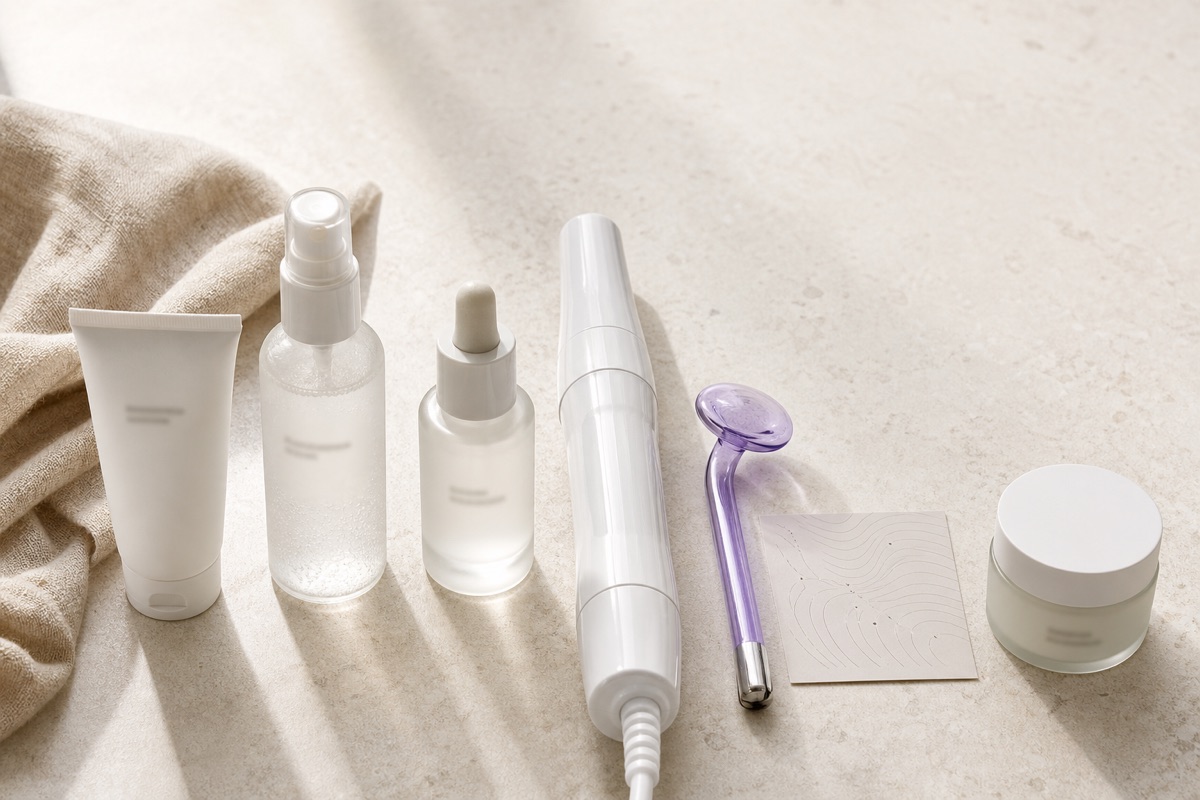
How to Apply a High-Frequency Device Without Settling in Fine Lines
A mature-skin guide to using a high-frequency facial wand with enough glide, spacing, and aftercare to avoid emphasizing fine lines.
Based on 34,241 Amazon ratings across 3 high-frequency wand listings, AAD adult-acne guidance, and FDA device-clearance language, use a high-frequency wand on clean, dry skin with gauze or a water-based slip layer, keep passes moving, and avoid drying actives before the device.
Editor's top Amazon picks for this guide
Real Amazon products that match this protocol. Affiliate links — your purchases support BeautySift.

Pure Daily Care
Pure Daily Care NuDerma Handheld Skin Therapy Wand Machine w/Neon
$69.95
"Highest rating volume in our Amazon snapshot, with 21,198 ratings and a simple neon-electrode format for beginners who want face and scalp attachments."
What real Amazon buyers say
4.4★· 21,198 reviews"After a week of using it, I noticed a difference in my skin quality, and after 2 weeks I noticed a huge difference."
"Purchased 2 months ago. I am extremely critical and have high standards. I absolutely love this wand and would buy it again in a heartbeat."

Pure Daily Care
NuDerma Professional Skin Therapy Wand with 6 Neon and Argon Wands
$99.95
"Six neon and argon attachments make it more flexible for spot work, broader cheek passes, and scalp sections than a basic four-tube kit."
What real Amazon buyers say
4.4★· 7,339 reviews"I use it daily for 5 minutes. You can use gauze between to actually increase it's power and oxygen absorbed by skin."
"They are fragile so be careful."

Pure Daily Care
Pure Daily Care NuDerma Clinical Portable Skin Therapy Wand
$169.95
"The higher-priced kit adds fusion neon and argon electrodes for shoppers who want one device set for face, blemish-prone areas, and scalp use."
What real Amazon buyers say
4.3★· 5,704 reviews"The device feels sturdy, is easy to use, and comes with a nice variety of attachments for different areas of the face and different skin concerns."
"I would not say this is an instant miracle product, but with regular use, my skin does seem to look a little more even and balanced."
What you'll learn
- Fine-line settling usually comes from drag, dryness, and overworking one area, not from the wand being too weak.
- Use clean skin, a light gauze buffer or water-based slip layer if your manual allows it, and short moving passes over lined areas.
- Do not apply retinoids, exfoliating acids, strong benzoyl peroxide, or drying masks immediately before a high-frequency session.
- For mature skin, stop the device before the skin feels tight; moisturize after while the skin is calm, not hot or stinging.
- High-frequency wands have stronger Amazon user evidence than clinical wrinkle evidence, so treat them as adjunct devices, not line-erasing tools.
Steps
-
1 Choose the lowest-friction device setup
Pick a wand with a broad mushroom electrode for cheeks and forehead, a smaller bent or spot electrode for blemish-prone areas, and a comb attachment only if scalp use is part of your plan. Across the three Amazon listings BeautySift analyzed, the strongest practical difference was not a clinical wrinkle endpoint; it was attachment range, review volume, and ease of keeping the electrode moving. Mature-skin tip: do not start with a tiny electrode on crow's feet or marionette lines, because the smaller contact point encourages repeated passes in the same crease.
-
2 Prep skin so the wand glides instead of tugging
Cleanse gently, pat fully dry, and remove makeup, sunscreen, and heavy oil. If your device manual allows gauze, place one thin layer over the treatment area or wrap it around the electrode to reduce skipping. If your manual recommends a conductive or hydrating product, choose a water-based gel texture, not a greasy balm. Mature-skin tip: if your cheeks feel tight before you begin, apply moisturizer, skip the device that day, and restart when the barrier no longer feels papery or reactive.
-
3 Use the device before drying actives
A conservative order is cleanse, dry, high-frequency device, hydrating serum or moisturizer, then sunscreen in the morning or a tolerated treatment at night. Avoid applying retinoids, glycolic acid, salicylic acid, strong benzoyl peroxide, or alcohol-heavy toners immediately before the wand because stinging can make users press harder or repeat passes. Mature-skin tip: if you use a prescription retinoid or exfoliating acid, schedule the device on alternate nights until you know your skin stays calm.
-
4 Anchor the electrode, then keep it moving
Insert the glass electrode fully before turning the wand on, set the intensity low, touch the electrode to the skin, then raise intensity only to a comfortable level. Glide in slow, overlapping movements rather than parking over fine lines. Use the broad electrode across cheeks, forehead, and jaw, and reserve brief spot contact for isolated blemishes if your manual describes it. Mature-skin tip: around the mouth and eyes, think feather-light contact and fewer passes; those zones crease easily when skin is dehydrated.
-
5 Shorten sessions around fine lines
Use the device manual as the maximum, not a challenge. Many Amazon reviewers describe 5-10 minute routines, but those are user reports, not a universal prescription. Start with 2-3 minutes total for the face or a few small zones, then build only if the skin remains comfortable the next morning. Mature-skin tip: end a pass as soon as a line looks more visible from dryness or pressure. A shorter calm session is more useful than a longer session that leaves creasing, redness, or a tight finish.
-
6 Rehydrate immediately after the device
After turning the wand off and removing the electrode from the skin, follow with a simple hydrating layer and a moisturizer. Look for glycerin, hyaluronic acid, panthenol, squalane, ceramides, or petrolatum in the rest of the routine if your skin is very dry. Mature-skin tip: avoid powder makeup immediately after a session if fine lines are the concern; give moisturizer time to settle so makeup does not catch on temporarily dehydrated texture.
-
7 Protect scalp and hairline use from face-routine mistakes
Some kits include a comb electrode and Amazon reviews mention scalp use, but scalp and face techniques are not interchangeable. Use the comb only on clean, dry hair and scalp, keep oils and sprays away from the electrode while the device is on, and follow the manual's sectioning instructions. Mature-skin tip: if your hairline is thinning during perimenopause, avoid dragging face serums into the scalp; use the comb attachment separately so fragrance, acids, or sticky styling products do not irritate the hairline.
Why fine lines can look more obvious after a high-frequency wand
High-frequency facial wands are often marketed for blemishes, texture, “tightening,” and scalp stimulation, but the mature-skin problem is more basic: friction. If the glass electrode skips, presses into a crease, or passes over dehydrated skin for too long, fine lines can look sharper even when the session itself was brief.
Affiliate disclosure: we may earn a commission from Amazon links. Commission does not affect evidence weighting, product inclusion, or safety guidance.
BeautySift analyzed three Amazon US high-frequency wand listings totaling 34,241 ratings in May 2026: Pure Daily Care NuDerma Handheld Skin Therapy Wand at 4.4/5 across 21,198 ratings, NuDerma Professional at 4.4/5 across 7,339 ratings, and NuDerma Clinical at 4.3/5 across 5,704 ratings. That is useful user-sentiment evidence, but it is not the same as a controlled wrinkle study.
That distinction matters. For this category, the strongest practical guidance comes from three places: real device listings, conservative dermatology acne guidance, and the mechanics of mature skin. FDA 510(k) language is device-specific, not a blanket endorsement of every at-home high-frequency claim. The American Academy of Dermatology also frames adult acne as multifactorial, which is relevant for women dealing with hormonal chin or jawline breakouts in midlife.
Step 1: choose the right electrode before you touch your face
Start with the broad mushroom electrode for areas where fine lines settle: cheeks, forehead, jawline, and the sides of the mouth. A smaller spot electrode can be useful for a single blemish, but it is easier to overwork creases with a small tip. A comb electrode belongs on the scalp only, not on the face.
This is where product selection matters more than prestige. The NuDerma Professional kit includes six neon and argon attachments, while the entry NuDerma Handheld listing has fewer attachments but much higher Amazon rating volume. Our scoring favored the basic wand for beginners because 21,198 Amazon ratings give a broader user-sentiment snapshot, while the Professional and Clinical kits scored better for attachment range.
Mature-skin tip: do not chase the most intense setting or the most elaborate attachment set on day one. Choose the electrode that gives the largest smooth contact area. Larger contact means fewer repeated passes inside the same fine line.
Step 2: prep for glide, not squeaky-clean tightness
The goal is clean skin, not stripped skin. Use a gentle cleanser, rinse thoroughly, and pat dry. If your skin feels tight before the device turns on, the session is already set up to emphasize lines. Mature skin often loses that cushiony look quickly when it is over-cleansed, especially in Midwest winter cold, Southwest dryness, or air-conditioned indoor air.
If your device manual allows a gauze buffer, use one thin layer. Gauze can help the glass move more evenly and reduce the stop-start dragging that makes fine lines look etched. Some users prefer a light water-based gel for slip, but avoid oils, balms, occlusive masks, and thick creams before the electrode unless your device manual specifically instructs otherwise.
Do not use gritty scrubs, strong peels, or alcohol-heavy toners immediately before the device. If you need exfoliation in your routine, put it on a different night until you know the wand does not trigger redness or dryness.
Step 3: put the wand before retinoids, acids, and acne spot treatments
Order is the simplest way to prevent settling. For most shoppers, the conservative sequence is cleanse, dry, device, hydrating serum, moisturizer, then sunscreen if it is morning. If you use retinol, tretinoin, glycolic acid, lactic acid, salicylic acid, or benzoyl peroxide, do not apply those before the wand.
Why this matters for women 35-55: the same routine may be trying to address hormonal acne, fine lines, and dryness. Collier et al. 2008 evaluated acne in 1,013 adults aged 20 and older, and adult women continued to report acne beyond teen years. That does not mean a high-frequency wand treats hormones; it means the midlife routine often combines acne actives and anti-aging actives, which raises irritation risk.
Mature-skin tip: if your chin breaks out but your cheeks are dry, split the routine by zone. Use the device briefly on the blemish-prone area, then moisturize the whole face. Do not drag a drying acne routine across the cheeks just because the wand is already in your hand.
Step 4: turn it on only after the electrode is seated
Insert the glass electrode fully into the wand before powering on. Touch the electrode to the skin first, then slowly increase intensity. The sensation should be controlled and tolerable, not sharp enough to make you flinch. If the electrode sparks aggressively, lower the setting or stop.
Keep the electrode moving in slow, overlapping passes. Around fine lines, especially crow’s feet, nasolabial folds, and vertical lip lines, use fewer passes and lighter contact. Think of polishing the surface, not ironing a crease. Pressing harder does not make the device more precise; it usually creates more drag.
A practical beginner pattern is cheeks first, forehead second, jawline third, then tiny spot work only if needed. Skip the eyelids, lips, and broken or irritated skin. If your manual gives a distance, time, or contraindication, follow that over any internet routine.
Step 5: keep the first sessions shorter than the manual maximum
Amazon reviews for the NuDerma listings include users describing 5-10 minute routines, but user routines are not clinical dosing instructions. For a first week, keep the total facial session short: a few minutes across the full face or less if you are treating only the chin and jawline. Watch the next-morning response before increasing.
Fine-line settling is often delayed. Skin may look smooth immediately after a device session, then dry down into creasing once water evaporates or makeup is applied. That is why the checkpoint is not just “did it hurt?” It is also “did my concealer, foundation, or sunscreen catch in lines later?”
Mature-skin tip: stop before tightness. If your skin starts feeling shiny, taut, hot, or papery, end the session, moisturize, and reduce time next time. A device routine that makes skin look calmer after 24 hours is more valuable than a longer routine that looks impressive for ten minutes.
Step 6: moisturize to prevent the dry-down effect
After the session, turn the wand off before lifting it away, then apply a hydrating serum or moisturizer. Glycerin, hyaluronic acid, panthenol, ceramides, squalane, and petrolatum can all be useful depending on how dry your skin is. Keep the post-device routine boring: hydrate, moisturize, and protect.
If you plan to wear makeup, give moisturizer time to settle. Powder, matte foundation, and long-wear concealer can make fine lines look more obvious if applied while the skin is temporarily dehydrated. A satin sunscreen or flexible skin tint is usually more forgiving than a dry matte base immediately after device use.
Mature-skin tip: treat the area around the mouth as the danger zone. That is where talking, smiling, dryness, and device pressure combine. Use fewer passes there, then add a richer moisturizer before applying lipstick or complexion makeup.
Step 7: separate face sessions from scalp sessions
The topic brief includes hair thinning because many high-frequency kits include comb electrodes and Amazon reviewers mention scalp use. Keep that use case separate. Use the comb on clean, dry hair and scalp only. Do not apply rosemary oil, scalp serum, dry shampoo, hair spray, or styling cream before using an electrical glass attachment unless the manual explicitly allows it.
For women in perimenopause, hairline thinning can happen at the same time as jawline acne and facial dryness. That makes it tempting to turn one device session into a whole head-to-face routine. Resist that shortcut. Finish the face, clean or swap attachments as directed, then treat the scalp as a separate zone.
Mature-skin tip: avoid letting scalp oils or fragranced hair products migrate onto the temples and jawline after a face session. That can irritate the hairline, trigger cosmetic acne, or make fine lines around the temples look shiny and creased.
Common mistakes that make fine lines settle
The biggest mistake is using the wand on skin that already feels tight. The second is applying strong actives first, then wondering why the device stings. The third is repeating tiny circles over one crease because you want that line to disappear. High-frequency wands are not line fillers.
Another common pitfall is copying someone else’s intensity. The NuDerma Handheld listing has 21,198 Amazon ratings, but that does not mean every reviewer used the same pressure, products, schedule, or skin-care actives. Use those ratings as evidence that the product is widely purchased and reviewed, not as proof that aggressive daily use suits mature skin.
Be especially cautious if you have rosacea-prone flushing, active eczema, a compromised barrier, recent injectables, recent laser or peel, or a medical device such as a pacemaker. At-home beauty tools are still electrical devices. When in doubt, ask a dermatologist or your treating clinician.
A simple 2-week starter schedule
Week 1: use the wand twice, at least two days apart. Keep each session short, choose the mushroom electrode for broad areas, and use a gauze buffer if your manual allows it. Do not combine with exfoliating acids or retinoids on the same night if your skin is reactive.
Week 2: if there was no redness, stinging, unusual dryness, or line settling the next day, add one more short session. If you are mainly using the wand for hormonal-looking chin breakouts, keep treatment focused on the chin and jawline instead of doing unnecessary passes over dry cheeks.
Track the result in practical terms: fewer angry blemishes, calmer-looking texture, less post-session tightness, and makeup that still sits smoothly. If your skin looks more lined after sessions, reduce time, add more moisturizer after, or stop the device.