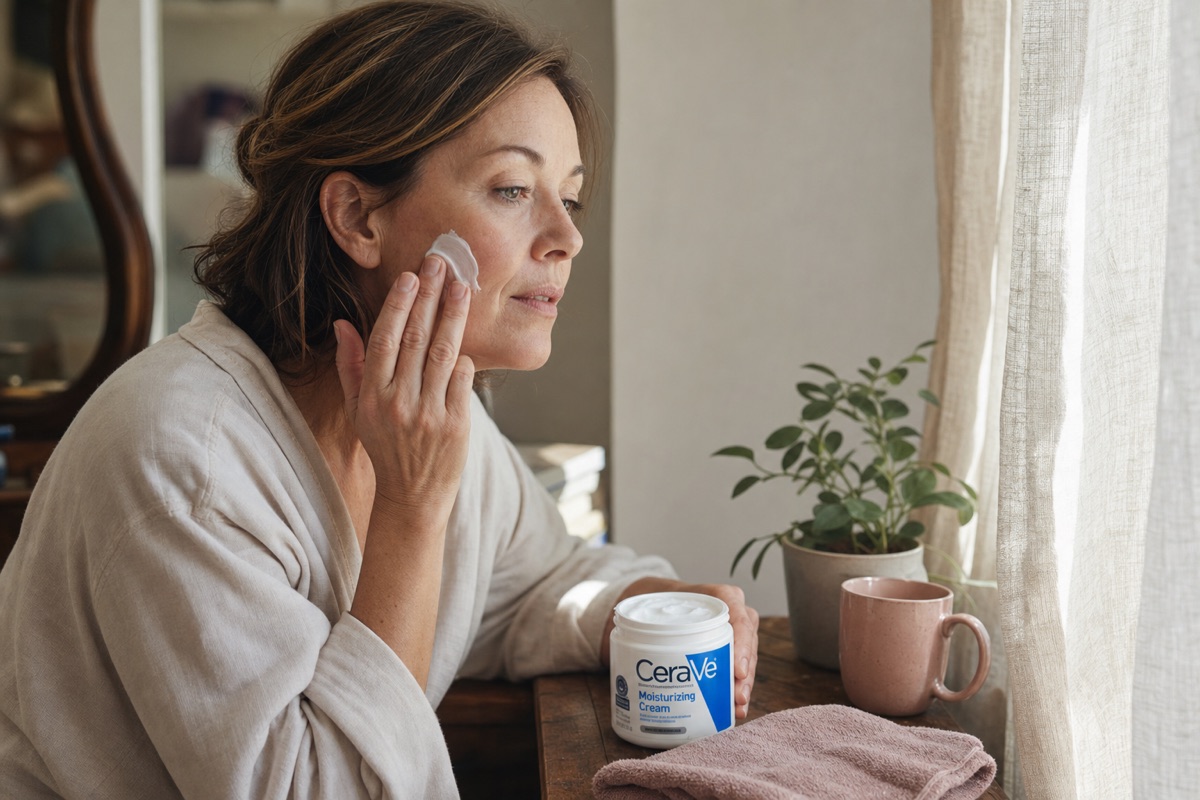
How to Build a Starter Skincare Routine for Perimenopause
A beginner AM and PM skincare routine for perimenopause, with what to keep, what to pause, and how to add actives without overwhelming dry or sensitive skin.
Based on 7 sources, including a 2021 PubMed menopause-skin review, AAD dry-skin guidance, and FDA OTC skin-protectant rules, a starter perimenopause routine should stay simple: gentle cleanse, moisturize, use daily sunscreen, and add retinoid or exfoliating steps only after 14 calm days.
Editor's top Amazon picks for this guide
Real Amazon products that match this protocol. Affiliate links — your purchases support BeautySift.

Cetaphil
Cetaphil Rich Hydrating Night Cream
$13.88
"A lower-priced, no-added-fragrance face cream option when perimenopausal dryness needs a hyaluronic-acid moisturizer that feels less like a body-and-face tub cream."

Aveeno
Aveeno Calm + Restore Oat Gel Facial Moisturizer
$19.97
"A fragrance-free oat gel-cream alternative for sensitive, dryness-prone skin when a lighter formula is preferable to a petrolatum-rich tub cream."

Aquaphor
Aquaphor Healing Ointment Advanced Therapy
$17.59
"Useful as a targeted occlusive over moisturizer on cracked lips, nose corners, hands, or retinoid-dry patches."

La Roche-Posay
La Roche-Posay Toleriane Double Repair Face Moisturizer
$24.99
"A lighter face moisturizer option when tub creams feel too heavy under sunscreen or daytime makeup."
What you'll learn
- A perimenopause starter routine should protect the skin barrier first, because dryness and stinging can make stronger anti-aging actives harder to tolerate.
- The safest AM template is gentle cleanse or rinse, moisturizer, and broad-spectrum SPF 30 or higher before makeup or outdoor exposure.
- The simplest PM template is gentle cleanse, moisturizer, and optional targeted occlusive; add retinoids only after the routine feels calm for 14 days.
- Keep products that reduce tightness, sunscreen avoidance, and irritation; drop scrubs, strong acid toners, fragrance-heavy products, and nightly active stacking.
- Evidence-weighted product selection favors fragrance-free barrier creams and simple occlusives before expensive serums or aggressive resurfacing treatments.
Steps
-
1 Step 1: Start with a two-week skin audit
For 14 days, track four practical signals: tightness after cleansing, stinging when moisturizer goes on, flakes under sunscreen, and redness or warmth after active products. The 2021 PubMed review on estrogen-deficient skin supports the idea that menopause-stage skin can change in hydration and repair behavior, so treat new sensitivity as useful data rather than a reason to buy a larger routine.
-
2 Step 2: Build the AM template around protection
Morning should be short: rinse or use a gentle cleanser only if needed, apply moisturizer while skin is slightly damp, then use broad-spectrum SPF 30 or higher. AAD sunscreen guidance supports SPF 30 or higher, and AAD dry-skin guidance emphasizes fragrance-free products and prompt moisturizing. If sunscreen stings, fix the moisturizer and cleanser steps before adding exfoliating serums.
-
3 Step 3: Build the PM template around recovery
Evening should remove sunscreen and makeup without leaving skin squeaky. Use a gentle cleanser, apply a barrier-supporting cream, and add a tiny amount of petrolatum-based ointment only on cracked corners, lips, or dry patches. FDA OTC skin-protectant rules list petrolatum and dimethicone among recognized skin-protectant actives, which is why ointment formats make sense as a final seal rather than a complete moisturizer replacement.
-
4 Step 4: Decide what to keep
Keep products that make the routine easier to repeat: a non-stripping cleanser, a moisturizer that does not sting, sunscreen you will actually apply, and one optional active that has a clear job. If a product reduces tightness, helps sunscreen sit better, or lets you use a retinoid less painfully, it has routine value even if it is not the most expensive product in the cabinet.
-
5 Step 5: Decide what to drop for now
Pause physical scrubs, peel pads, strong acid toners, fragranced oils, daily retinoid use, and duplicate serums that all promise glow. During perimenopause, the product-comparison framework gives tolerability extra weight because a high-strength active loses practical value if it causes burning, flaking, or sunscreen avoidance. Reintroduce only one paused product at a time after the baseline routine feels calm.
-
6 Step 6: Add fine-line actives slowly
If fine lines are a priority, consider a retinoid or retinal product only after 14 calm days on the basic routine. The 2006 PubMed review on retinoids summarizes clinical efficacy and safety in skin aging, but tolerance matters. Start 1 night weekly, use a moisturizer buffer, avoid using exfoliating acids on the same night, and stop if burning or peeling persists.
-
7 Step 7: Adjust for climate and flare patterns
In Midwest winter cold or Southwest dryness, the same routine may need a richer moisturizer or a targeted ointment layer at night. In Florida summer humidity, a lighter day moisturizer may sit better under sunscreen while the richer cream stays in the PM routine. If dryness is sudden, painful, itchy with rash, or paired with persistent flushing, get medical advice instead of treating it as a cosmetic routine problem.
The starter routine should be boring on purpose
A good perimenopause skincare routine does not begin with the strongest anti-aging serum. It begins with a baseline your skin can repeat without stinging, tightness, or sunscreen avoidance. BeautySift did not test this routine on a panel. We analyzed public dermatology literature, AAD guidance, FDA skin-protectant rules, ingredient patterns, and verified Amazon product listings to build an evidence-weighted starter plan for US shoppers.
Affiliate disclosure: we may earn a commission from Amazon links. Affiliate status does not influence routine order, source weighting, or featured product selection.
AM template: protect before treating
Use this as the default morning routine for 14 days:
- Rinse with water, or cleanse only if you wake up oily.
- Apply a fragrance-free moisturizer while skin is slightly damp.
- Apply broad-spectrum SPF 30 or higher.
- Add makeup only after sunscreen has settled.
The main goal is to prevent the cycle where dry skin makes sunscreen sting, sunscreen gets skipped, and fine-line or dark-spot concerns become harder to manage. If a moisturizer pills under sunscreen, try using less product, waiting longer between layers, or moving the richer cream to night.
PM template: cleanse, moisturize, seal only where needed
Use this evening routine as your reset:
- Cleanse gently to remove sunscreen and makeup.
- Apply a barrier-supporting moisturizer.
- Use a tiny amount of ointment on cracked or stinging patches.
- Skip exfoliating acids and retinoids until the baseline is calm.
Ointment is not mandatory for the whole face. It is most useful on lips, nostril corners, dry hand patches, or areas that crack after wind, cold, or retinoid use. If you are acne-prone, keep heavy occlusion away from congested areas unless a clinician has advised otherwise.
What to keep
Keep the products that make the routine more repeatable:
- A gentle cleanser that does not leave skin squeaky.
- A moisturizer that calms tightness within a few minutes.
- A sunscreen you can apply every morning without burning.
- One active product with a clear purpose, used at a tolerable frequency.
For many perimenopausal routines, a ceramide or bland cream deserves more priority than another treatment serum. It supports comfort, helps makeup sit more evenly, and makes future retinoid use more realistic.
What to drop for 14 days
Pause these first if skin is dry, hot, flaky, or newly reactive:
- Physical scrubs and cleansing brushes.
- Strong glycolic, lactic, or salicylic acid toners.
- Peel pads used more than occasionally.
- Fragrance-heavy facial oils, balms, or sleeping masks.
- Retinoids used nightly without a moisturizer buffer.
- Multiple brightening serums layered in the same routine.
After 14 calmer days, reintroduce one product at a time. If stinging returns, the routine is telling you which category is too much.
Where fine-line products fit
Retinoids remain one of the better-supported cosmetic categories for visible photoaging, but the best product is the one you can use consistently without disrupting the barrier. Start with 1 night weekly, sandwich with moisturizer if needed, and avoid pairing with exfoliating acids the same night. If your skin tolerates that for several weeks, increase slowly.
Vitamin C can fit in the morning for dullness and uneven tone, but it is optional in the first two weeks. If the routine is already stinging, fix cleanser, moisturizer, and sunscreen tolerance before adding a low-pH active.
Evidence-weighted product roles
Using the BeautySift product-comparison framework, starter routine products were weighted toward tolerability, formulation logic, US accessibility, and value. That is why the featured products are basic barrier-support steps rather than a full shelf of treatments.
- CeraVe Moisturizing Cream: best as the barrier anchor when skin feels tight or dry.
- Vanicream Moisturizing Cream: best when sensitive skin needs a simpler formula.
- Aquaphor Healing Ointment: best as a targeted seal on cracked or irritated patches.
- La Roche-Posay Toleriane Double Repair: best when you want a lighter face cream under sunscreen.
When to get medical input
See a board-certified dermatologist or qualified clinician if dryness is painful, bleeding, suddenly severe, widespread, or paired with rash, scaling, swelling, intense itch, persistent flushing, or eye irritation. A skincare routine can support comfort, but it should not delay evaluation for eczema, allergic contact dermatitis, rosacea, psoriasis, thyroid changes, medication effects, or other medical causes.
Related BeautySift reading
Guide: Barrier repair routine for perimenopause dryness -> /guides/barrier-repair-routine-perimenopause-dryness-2026/
Guide: How to layer vitamin C, niacinamide, and retinol -> /guides/how-to-layer-vitamin-c-niacinamide-retinol-2026/
Guide: Bakuchiol vs retinol for sensitive 40-plus skin -> /guides/bakuchiol-vs-retinol-sensitive-40plus-2026/