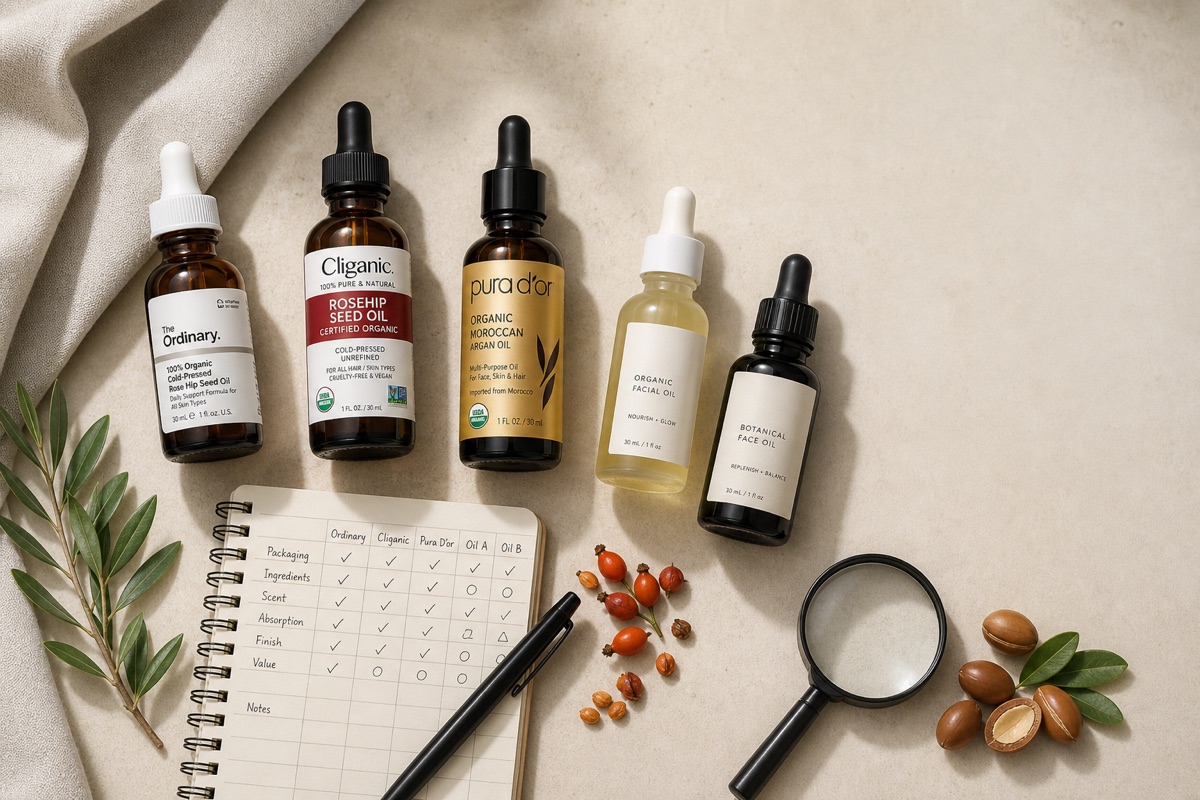
How to Choose the Right Face Oil: Rosehip, Argan, and Barrier-Safe Pairings
An evidence-led guide to choosing rosehip or argan face oil for dry, mature skin, with texture cues, ingredient logic, and routine steps.
We analyzed 77,542 visible Amazon ratings across 3 US-available face oils, 1 PubMed postmenopausal argan-oil study, and INCI evidence on plant oils. Choose rosehip if uneven tone and lighter texture matter; choose argan if dry, tight skin needs richer lipid support.
Editor's top Amazon picks for this guide
Real Amazon products that match this protocol. Affiliate links — your purchases support BeautySift.

The Ordinary
The Ordinary 100% Organic Cold-Pressed Rose Hip Seed Oil
$10.90
"Best lightweight rosehip starting point: 4.6/5 across 5,931 visible Amazon ratings, with a simple single-oil INCI profile."
What real Amazon buyers say
4.6★· 5,931 reviews"My skin has become reactive to literally everything in my 40's. I can't use anything on it except for goat milk soap and this."
"i will probably forever repurchase this. it's an essential last step in my nightly skincare routine, right after my moisturizer."

Cliganic
Cliganic Organic Rosehip Seed Oil
$9.98
"Best value rosehip pick: 4.6/5 across 28,467 visible Amazon ratings and a cold-pressed, single-oil positioning."
What real Amazon buyers say
4.6★· 28,467 reviews"This rosehip oil from Cliganic is one of the best natural oils I've used."
"The rosehip oil has a slight naturally accusing scent. Its not too bad."

PURA D'OR
PURA D'OR Organic Moroccan Argan Oil
$16.99
"Best richer oil for dry skin: 4.5/5 across 43,144 visible Amazon ratings and aligned with PubMed argan-oil elasticity research."
What real Amazon buyers say
4.5★· 43,144 reviews"It does an excellent job keeping both beard hair and skin moisturized without feeling heavy or greasy."
"The oil is lightweight and not overly thick, which makes it easy to apply and distribute evenly."
What you'll learn
- Rosehip oil is usually the better first pick when you want a lighter face oil for dullness, uneven tone, and dry fine lines.
- Argan oil is usually the better first pick when skin feels tight, flaky, or depleted and you want a richer sealing step.
- Face oils do not replace moisturizer; use them after water-based serum and cream, or mix 1 drop into moisturizer.
- For women 35-55, the safest buying filter is fragrance-free, single-ingredient or short-INCI oil in dark packaging.
- Skip heavy oil layering if you are acne-prone, currently irritated, or already using strong retinoids and exfoliating acids.
Steps
-
1 Start with the skin problem, not the trend
Choose rosehip for lightweight comfort, dullness, and uneven tone; choose argan for dry, tight, flaky skin that needs a richer final layer. If you cannot describe the problem in one sentence, start with moisturizer repair before adding oil.
-
2 Read the INCI list before the marketing copy
Look for Rosa canina seed oil, rosehip seed oil, Argania spinosa kernel oil, or a short fragrance-free blend. Avoid essential-oil-heavy formulas if your skin is reactive, because scent components add irritation risk without improving barrier support.
-
3 Match texture to your climate and routine
Use rosehip when you want a lighter night oil or live with humid summers. Use argan when Midwest winter cold, indoor heating, or Southwest dryness makes moisturizer disappear too fast. Start with 1 to 2 drops, not a full dropper.
-
4 Layer oil after moisturizer
Apply toner or serum first, moisturizer second, and oil last. If that feels too shiny, mix 1 drop into your moisturizer in your palm. Face oil seals and softens; it does not supply the water-binding humectants that dry mature skin still needs.
-
5 Audit results after 2 weeks
After 14 nights of use, judge comfort, shine, clogged pores, and whether makeup sits better the next morning. Stop or reduce frequency if you see new congestion, stinging, or persistent redness.
Quick answer
Choose rosehip oil when your main concern is dry-looking fine lines, dullness, or uneven tone and you want a lighter finish. Choose argan oil when your skin feels tight, flaky, or under-nourished and you want a richer sealing step over moisturizer. Based on 77,542 visible Amazon ratings across the three products above, rosehip has the stronger lightweight-user signal, while argan has the stronger dryness-support logic.
Face oils are not treatment serums in the prescription sense, and they are not moisturizers by themselves. The U.S. FDA’s anti-aging cosmetic guidance is a useful guardrail: a cosmetic can improve the look and feel of skin, but it should not be treated as a drug-like wrinkle treatment. For women 35-55, the practical win is comfort, less tightness, and a smoother-looking surface under sunscreen or makeup.
Use this guide as a selection protocol, not a promise that any oil will erase lines. The goal is to choose the least complicated formula, apply the smallest useful amount, and know within 14 nights whether your skin is calmer or simply shinier.
Why rosehip and argan are the two face oils worth comparing
Rosehip and argan sit in different routine lanes. Rosehip oil, usually listed as Rosa canina seed oil or rosehip seed oil, is often chosen for a lighter feel and for routines focused on dullness or uneven tone. The Ordinary’s US product page positions its rosehip oil around visible signs of aging and uneven tone, and its Amazon listing showed 4.6/5 across 5,931 visible ratings in our May 2026 source capture.
Argan oil, listed as Argania spinosa kernel oil, is richer and more cushiony. It makes more sense when your skin feels depleted after indoor heating, frequent cleansing, retinoid use, or cold weather. PubMed-indexed evidence is more specific for argan than for rosehip in mature-skin context: Boucetta et al. published a 2015 randomized study in Clin Interv Aging on dietary and/or cosmetic argan oil and postmenopausal skin elasticity.
That does not mean argan is automatically better. It means the evidence lane is different. Rosehip is a lighter cosmetic oil with strong user demand and simple-formula appeal. Argan has a richer texture and at least one directly relevant postmenopausal-skin study. Your skin type decides which one belongs in your cart.
Step 1: Start with your skin problem, not the trend
If your skin is dry but not flaky, rosehip is usually the lower-risk first choice. It is lighter, easier to use at 1 to 2 drops, and less likely to make daytime skincare feel slick. Amazon user language for The Ordinary’s rosehip oil repeatedly centers on softness, night routine use, and a non-heavy feel; the listing showed 4.6/5 across 5,931 visible ratings.
If your skin is tight, flaky, or looks crinkled by midday, argan is the more logical first choice. It has a richer cushion and can help a moisturizer feel more complete, especially in Midwest winter cold or Southwest dryness. The PURA D’OR argan listing showed 4.5/5 across 43,144 visible ratings, the largest Amazon rating base in this guide.
If your skin is oily, acne-prone, or easily congested, do not start with a full-face oil habit. Use a small amount only on dry zones, or try mixing 1 drop into moisturizer two or three nights weekly. New closed comedones after 1 to 2 weeks are a clear signal to reduce frequency or stop.
Step 2: Read the INCI list before the marketing copy
The cleanest face-oil choice is often boring: one oil, no fragrance, no essential-oil blend, no long perfume list. Look for Rosa canina seed oil, rosehip seed oil, or Argania spinosa kernel oil. A short formula is easier to troubleshoot because you know what caused the improvement or the irritation.
Cold-pressed and organic claims can be useful shopping filters, but they should not outrank tolerance. A scented botanical blend can look more premium and still be a worse choice for reactive skin. Reddit skincare discussions around facial oils often cluster around the same friction points: greasiness, breakouts, rancid smell, and confusion about whether oil goes before or after moisturizer.
Packaging matters too. Plant oils can oxidize, especially when exposed to heat, light, and air. A dark bottle, tight cap, and small size are practical advantages. Store oil away from a sunny windowsill, and discard it if the smell changes from nutty or earthy to sour, paint-like, or sharply rancid.
Step 3: Match the oil to your routine texture
Rosehip is the better match if you dislike shine or wear makeup most days. Apply 1 drop after moisturizer at night, press it over cheeks and outer face, then stop. More oil does not mean more benefit. It usually means more shine and more transfer to your pillowcase.
Argan is better when your moisturizer feels like it disappears after an hour. Use 1 drop on the driest zones, or 2 drops if your face and neck are both dry. A richer oil can help reduce the tight feeling that shows up with perimenopause-related dryness, indoor heating, and retinoid routines, but it still needs a water-based moisturizer underneath.
A useful test: apply your normal moisturizer to one side of the face and moisturizer plus 1 drop of oil to the other side for three nights. If the oil side feels calmer in the morning without new bumps, the product has a role. If both sides feel the same, you may need a better moisturizer rather than an oil.
Step 4: Layer face oil after moisturizer
The order should be simple: cleanse, use any water-based serum, apply moisturizer, then finish with oil. Oil goes late because it slows water loss from the surface and adds slip. It does not replace humectants such as glycerin or hyaluronic acid, and it does not replace barrier-supporting cream ingredients such as ceramides.
With retinol, keep oil as a comfort layer, not a way to push through irritation. Apply retinol on dry skin, moisturize, then add 1 drop of oil only if your skin still feels tight. If your face is burning, peeling, or visibly inflamed, do not add more products. Pause strong actives and rebuild the basics.
With vitamin C, most users will prefer oil at night and vitamin C in the morning. Oil under morning sunscreen can be fine for very dry skin, but too much can make sunscreen pill or foundation move. For a polished daytime finish, mix half a drop into moisturizer rather than applying a separate glossy layer.
Step 5: Audit after 14 nights
Give the oil a fair but limited trial. Fourteen nights is long enough to learn whether your skin feels softer, whether makeup sits better, and whether pores are getting congested. It is not long enough to claim structural wrinkle changes, and this guide does not make that claim.
Track four signals: morning tightness, visible flaking, new bumps, and shine level. If tightness and flaking improve without congestion, keep using the oil. If the oil looks good for two nights but creates bumps by week two, it is not your face oil. Use it on cuticles or body skin instead of forcing it into a facial routine.
The most common mistake is using too much. A 1-ounce bottle should last a long time when used on the face. If you are finishing it quickly, you are probably using hair-oil amounts on facial skin.
Product lanes that match this protocol
The Ordinary 100% Organic Cold-Pressed Rose Hip Seed Oil is the best first rosehip lane for a user who wants a small, inexpensive, single-oil product. Its 4.6/5 Amazon snapshot across 5,931 visible ratings gives it a meaningful user base without pushing the richer feel of argan.
Cliganic Organic Rosehip Seed Oil is the value rosehip lane. At $9.98 in the Amazon snapshot and 4.6/5 across 28,467 visible ratings, it fits shoppers who want a budget-friendly night oil and do not need prestige packaging.
PURA D’OR Organic Moroccan Argan Oil is the dryness lane. It costs more than the 1-ounce rosehip options in this guide, but it also comes in a larger 4-ounce format and has the strongest rating-count base here: 43,144 visible Amazon ratings at 4.5/5. It is the product to consider when your problem is tightness, not just dullness.
When to skip face oil
Skip face oil during an active rash, after a peel, after waxing, or when your barrier is already stinging from too many products. Also skip it if your sunscreen or foundation is slipping and you cannot reduce the amount enough to fix the problem.
If you have persistent acne, rosacea flares, eczema, or a changing rash, use clinician guidance instead of experimenting with oils. Face oil can support comfort in a cosmetic routine, but it is not a treatment plan for medical skin conditions.