How to Choose the Right Lipstick for Mature Skin in 2026
A mature-skin guide to choosing lipstick in 2026, with finish, shade, prep, liner, and wear-time checks for dry lips and fine lines.
We analyzed 102,654 Amazon ratings across 5 US lipstick and tinted-balm examples, plus FDA cosmetic-labeling guidance, PubMed menopause-skin reviews, and brand shade claims. For mature skin in 2026, choose satin, balm, or creamy formulas first; use matte only when transfer resistance matters more than lip-line softness.
Editor's top Amazon picks for this guide
Real Amazon products that match this protocol. Affiliate links — your purchases support BeautySift.

Clinique
Clinique Almost Lipstick Tinted Lip Balm in Black Honey
$25
"Sheer, glossy balm-lipstick lane for dry or line-prone lips; Clinique lists 3 flexible shades, and Amazon shows 4.6/5 across 16,633 ratings."
What real Amazon buyers say
4.6★· 16,633 reviews"I absolutely love this lip balm! The color is so pretty and natural it gives just the right amount of tint without being too much."
"Goes on smooth, and lays down more color than expected. It feels similar to a lip balm, but a tad more sticky."

Revlon
Revlon Super Lustrous Lipstick in Rum Raisin
$6.87
"Cream lipstick value lane with 72 published shades and 80% conditioning-ingredient positioning from Revlon; Amazon shows 4.6/5 across 40,560 ratings."
What real Amazon buyers say
4.6★· 40,560 reviews"Great formula, great price and great shades. I really like the darker reds and brown colors! It feels nice on the lips and doesn't dry them out."
"I got both the shades Candid rose and Primrose. As expected the quality is excellent!"

L'Oreal Paris
L'Oreal Paris Colour Riche Satin Lipstick in Worth It Medium
$7.97
"Satin lipstick lane for shoppers who want more polish than balm; Amazon shows 4.4/5 across 27,003 ratings, and the listing cites argan oil and vitamin E."
What real Amazon buyers say
4.4★· 27,003 reviews"Nice lipstick. Doesn't dry out my lips. Easy application. Creamy formula. The color is pretty."
"Beautiful color; beautiful fragrance; goes on smoothly; lasts for hours. The only lipstick to keep lips moist for hours."

Neutrogena
Neutrogena MoistureSmooth Color Stick in Cherry Pink
$11
"Crayon-balm lane for easy reapplication; Neutrogena publishes 16 shades, while Amazon shows 4.5/5 across 7,078 ratings for this pack."

CoverGirl
CoverGirl Clean Fresh Tinted Lip Balm
$5.98
"Budget tinted-balm lane for very dry lips; CoverGirl cites 4 colorful tints and up to 24-hour hydration, while Amazon shows 4.4/5 across 11,380 ratings."
What you'll learn
- For mature lips, finish matters as much as color: satin, balm, and creamy textures usually blur dryness better than flat matte lipstick.
- Start shade selection with undertone and contrast, not trend color; rose-brown, berry-balm, and soft brick often read softer than pale beige.
- Lip prep should be thin and timed: over-slippery balm can make lipstick migrate into vertical lip lines faster.
- Use liner as a boundary, not a hard outline; a close-to-lip shade helps reduce feathering without shrinking the mouth visually.
- Transfer-proof liquid matte is a specialty lane for events, masks, or long meals, not the default for dry perimenopause-era lips.
Steps
-
1 Pick the finish before the shade
Choose satin, cream, glossy balm, or sheer tint first if dryness, vertical lip lines, or dullness are the main concerns. Use matte only when transfer resistance is the top priority, because flat pigments can make lip texture more visible.
-
2 Map your undertone and contrast
Look for shades that echo your skin's undertone and natural lip depth. Cool-neutral skin often handles berry, rose, mauve, and blue-red shades; warm-neutral skin often handles peach, caramel rose, terracotta, and brick. Very pale beige can flatten mature lips, especially when natural lip pigment has faded.
-
3 Check the formula for mature-skin comfort flags
Prioritize balmy waxes, oils, butters, or creamy emollients when your lips are dry. Treat fragrance, strong mint, cinnamon-like flavor, and very fast-setting film formers as patch-test flags if you flush easily or have sensitive lips.
-
4 Prep lips without making them slippery
Apply a plain balm early in the routine, blot before color, and avoid heavy scrub pressure on thin or cracked lips. The goal is flexible skin, not a glossy base that breaks down liner and lets pigment bleed.
-
5 Use liner to hold the border
Choose a liner close to your natural lip color or the lipstick family, then sketch the cupid's bow and outer corners with light pressure. Softly fill the outer third of the lips if feathering is common.
-
6 Apply in thin layers and reset the center
Use one thin coat, press lips together once, blot, then add color to the center only if you need more intensity. This keeps the border lighter and lowers the chance of pigment collecting in fine lines.
-
7 Audit wear after coffee, not just in the mirror
A mature-skin-friendly lipstick should fade evenly after coffee or lunch. If the outer border bleeds, switch to a waxier liner or softer finish. If the center cracks, choose a cream or balm formula instead of a long-wear matte.
The mature-skin lipstick problem is usually texture first, color second
Lipstick gets harder to choose after 35 because the lip surface and the skin around the mouth are less forgiving. The issue is not that women 35-55 need a narrower color wardrobe. The issue is that the wrong finish can announce dryness, feather into vertical lip lines, or leave a hard ring after coffee.
BeautySift’s read of the 2026 US lipstick shelf is simple: start with finish, then undertone, then wear setting. We analyzed 102,654 Amazon ratings across five accessible lipstick and tinted-balm examples, official brand claims from Clinique, Revlon, and CoverGirl, FDA cosmetic-labeling guidance, and PubMed menopause-skin literature. That evidence does not prove one lipstick works for every mature lip, but it shows why creamy, satin, and balm textures are safer defaults than very dry liquid matte formulas.
The PubMed menopause-skin review by Lephart (Dermatol Ther (Heidelb), 2021) is not a lipstick study. It matters here because estrogen-deficient skin is discussed in relation to dryness, collagen change, and barrier shifts. On lips, that translates editorially into a more cautious formula lens: less drag, less sting, more even fading, and less pigment collecting at the border.
Step 1: Choose a finish that matches your main lip concern
If your main concern is dryness, choose balm, cream, satin, or glossy sheer color. Clinique’s US product page describes Almost Lipstick as sheer, buildable, glossy, lightweight, allergy tested, and 100% fragrance free in three shades; Amazon’s May 2026 snapshot shows 4.6/5 across 16,633 ratings for ASIN B0032RMX3U. That combination makes it a useful example of the sheer-balm lane, not a universal winner.
If your main concern is lip lines, satin and cream are usually easier than flat matte. Revlon says Super Lustrous Lipstick uses 80% conditioning ingredients and comes in 72 shades; Amazon’s snapshot shows 4.6/5 across 40,560 ratings for Rum Raisin. A cream lipstick still transfers, but the trade-off is often worth it when the alternative is a matte film that cracks through the center of the mouth.
If your main concern is dullness, avoid shades that are too pale, too gray, or too close to your concealer depth. Mid-depth rose, berry, warm rose-brown, soft brick, and translucent plum can restore contrast without feeling severe. L’Oreal Paris Colour Riche in the Worth It family is an example of the satin-drugstore lane: the Amazon listing shows 4.4/5 across 27,003 ratings and cites argan oil and vitamin E.
Step 2: Match undertone before chasing a trend shade
Undertone is the difference between a lipstick that wakes up the face and one that makes foundation look off. Cool-neutral skin usually handles berry, mauve, blue-red, rose, and soft plum. Warm-neutral skin usually handles peach rose, caramel rose, terracotta, brick, and warm brown. Neutral skin can often wear both, but the depth still matters.
For mature lips, depth is as important as temperature. Very pale beige can erase the mouth, especially if lip pigment has faded or the face has less natural contrast than it did at 30. Very dark matte brown can look chic, but it also creates a sharper edge; if the border feathers, the contrast makes it more obvious.
A practical rule: choose one feature to emphasize. If the finish is glossy, keep the shade closer to your natural lip depth or use liner. If the shade is bold, choose satin or cream before high gloss. If the formula is matte, soften the shade slightly or keep the layer thin.
Step 3: Read formula claims like a mature-skin shopper
Brand claims can be useful, but they are marketing language unless they are tied to ingredients, shade range, or wear behavior. The FDA Cosmetic Labeling Guide is the reason BeautySift treats ingredient lists and cosmetic claims conservatively: lipstick can make lips look smoother or more colorful, but it is still a cosmetic, not a treatment for skin aging.
Look for comfort cues: balm, cream, satin, shea butter, oils, waxes, hyaluronic complex, or vitamin E. CoverGirl says Clean Fresh Tinted Lip Balm includes hyaluronic complex and pomegranate oil, offers up to 24-hour hydration, and comes in 4 colorful tints; Amazon shows 4.4/5 across 11,380 ratings. That is a good example of a comfort-first lane for dry lips, with the caveat that a very sheer balm will not give the same face-framing polish as a cream lipstick.
Also look for sensitivity flags. Fragrance is not automatically bad, but it is a patch-test cue if your lips sting easily, you have rosacea-like flushing, or hot flashes make your face reactive. Strong mint, cinnamon-like flavor, and plumping tingle can feel uncomfortable on already dry lips. Fast-setting liquid matte formulas can be useful, but they are the first formulas to question if the center of the lip cracks by midday.
Step 4: Prep lips early, then blot before color
The most common application mistake is applying balm right before lipstick and expecting the color to stay put. Heavy balm under lipstick can dissolve liner and encourage pigment to slide into fine lines around the mouth.
Use balm earlier in your routine instead. Apply it before base makeup, let it sit, then blot before lip color. If flakes are visible, use a damp washcloth with light pressure rather than a gritty scrub. Thin lip skin does not need aggressive exfoliation, and cracked lips need repair, not friction.
If you use sunscreen or foundation around the mouth, keep it light at the lip edge. Product buildup at the border can mix with lipstick and create a fuzzy line. A tiny amount of translucent powder around the outer lip line can help some users, but too much powder can make the area look dry. For fine-line-aware makeup, restraint usually beats extra layers.
Step 5: Use liner as a soft fence, not a hard outline
Liner is useful for mature lips because it creates a waxy boundary. The most modern version is not a dark outline. Choose a liner close to your natural lip color, or one shade deeper than the lipstick family. Trace the cupid’s bow, outer corners, and lower center with light pressure, then soften with a fingertip or brush.
If lipstick bleeds mostly at the upper lip, line only the upper border and the corners. If the bottom lip loses shape, line the lower center and outer thirds. If every lipstick migrates, try a clear liner outside the lip border; it acts like an invisible fence and avoids shade-matching issues.
For thin lips, do not overdraw the full perimeter. Overdrawing can work in photos, but in daylight it often catches texture. A better mature-skin method is to slightly brighten the center with a satin or balm texture while keeping the border controlled.
Step 6: Apply less product at the edge than the center
A thick lipstick layer at the border is more likely to feather. Apply one thin coat, press lips together once, blot with tissue, then add a small amount only to the center. This keeps the mouth dimensional while lowering pigment load near vertical lines.
Bullet lipstick gives the most control when applied from the tube to the center and with a brush or fingertip near the border. Crayon sticks, such as the Neutrogena MoistureSmooth Color Stick lane, are convenient because they combine color and a defined edge; Amazon shows 4.5/5 across 7,078 ratings for ASIN B0BW2Z8XDV, and Neutrogena publishes 16 shades for the line.
For a stronger lip, build in two thin layers rather than one heavy pass. For a softer lip, tap color on with a fingertip and keep the edges diffused. This is especially flattering when lip borders are uneven but you still want color.
Step 7: Judge wear by the fade pattern
Do not judge lipstick only when freshly applied. Judge it after coffee, after talking, and after lunch. A mature-skin-friendly lipstick fades evenly, leaves the border tidy, and does not form a dry ring.
If the lipstick disappears only in the center, the formula may be too creamy for the meal or you may need a stain underneath. If it bleeds outside the lip line, add liner or choose a less slippery formula. If it cracks, the formula is probably too matte or the lips were not hydrated enough before application.
Wear time should be realistic. A balm tint may need reapplication every few hours, but it can look softer and fresher on dry lips. A satin lipstick may handle coffee better but still transfer. A liquid matte may last through dinner, but it may also make texture more visible. The right choice depends on the day’s trade-off, not an abstract promise of long wear.
Example product lanes for 2026 US shoppers
These are not the only good lipsticks. They are evidence-weighted examples that help define the shopping lanes.
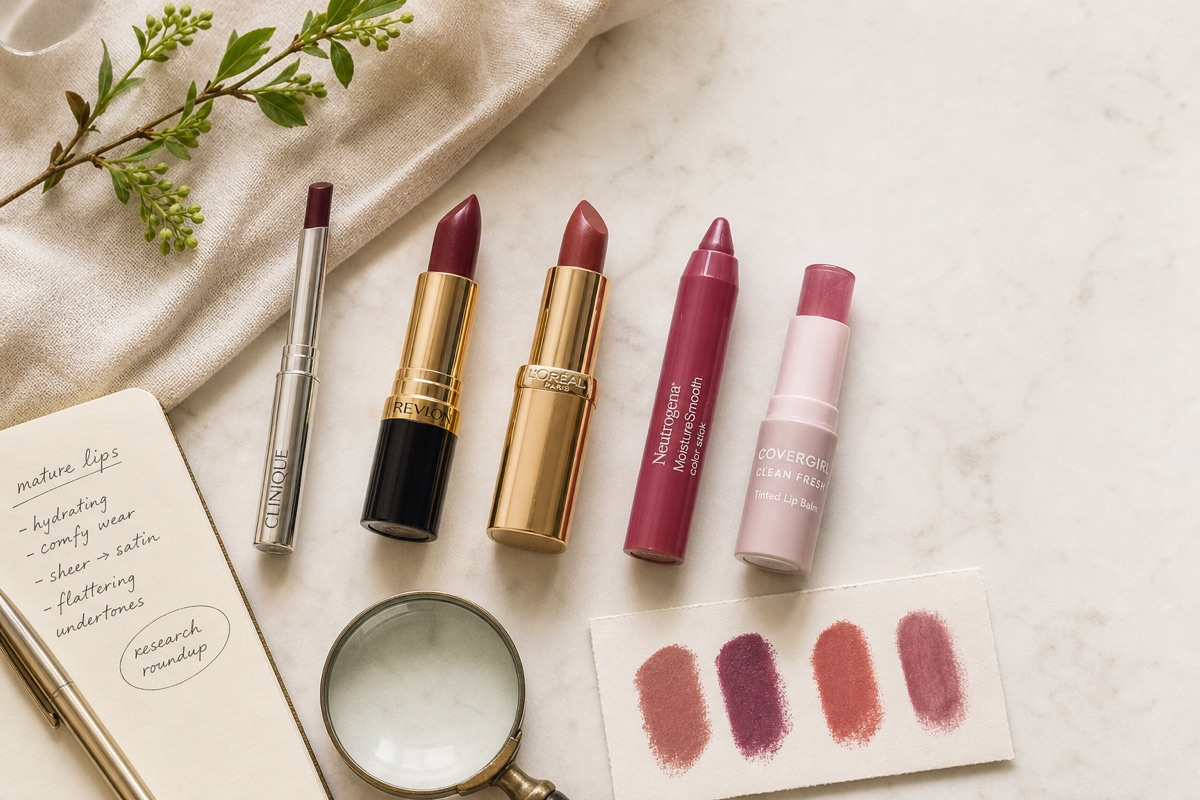
Clinique Almost Lipstick in Black Honey is the sheer-balm lane: flexible color, glossy finish, and fragrance-free positioning from Clinique. It is best for dry lips, low-maintenance makeup, and shoppers who want color that does not require a perfect edge. Skip it if you want opaque coverage or a transfer-resistant red.
Revlon Super Lustrous in Rum Raisin is the value cream lane: a classic mid-depth shade family, broad shade count from Revlon, and the largest rating sample in our source set at 40,560 Amazon ratings. It is best for shoppers who want a true lipstick feel without a prestige price. Skip it if you need mask-proof wear.
L’Oreal Paris Colour Riche Satin in Worth It Medium is the satin-polish lane: more color payoff than a balm, softer finish than a matte, and a drugstore price. It is best for dullness and everyday polish. Skip it if fragrance in lip products bothers you; one visible Amazon review specifically praised fragrance, which is a positive for that reviewer but a sensitivity flag for others.
Neutrogena MoistureSmooth Color Stick is the crayon-balm lane: easy to carry, easy to reapply, and useful for people who dislike the precision demands of a bullet lipstick. CoverGirl Clean Fresh Tinted Lip Balm is the budget hydration lane: sheer, soft, and lowest commitment, but not the best choice for a fully made-up lip.
Common pitfalls to avoid
The first pitfall is choosing a pale nude because it looks elegant in the tube. On mature lips, a nude that is lighter than the natural lip can make the mouth look flatter. Choose a nude with rose, peach, caramel, berry, or brown warmth instead.
The second pitfall is using too much balm immediately before application. Balm is helpful; excess slip is not. Let it absorb and blot.
The third pitfall is overcorrecting feathering with a dark liner. A hard outline can make the mouth look smaller and more severe. Use a softer shade, a clear liner, or a liner that matches your natural lip edge.
The fourth pitfall is expecting one lipstick to do every job. The most practical mature-skin wardrobe is usually three products: a tinted balm for low-makeup days, a satin or cream bullet for polish, and a longer-wear option for events.