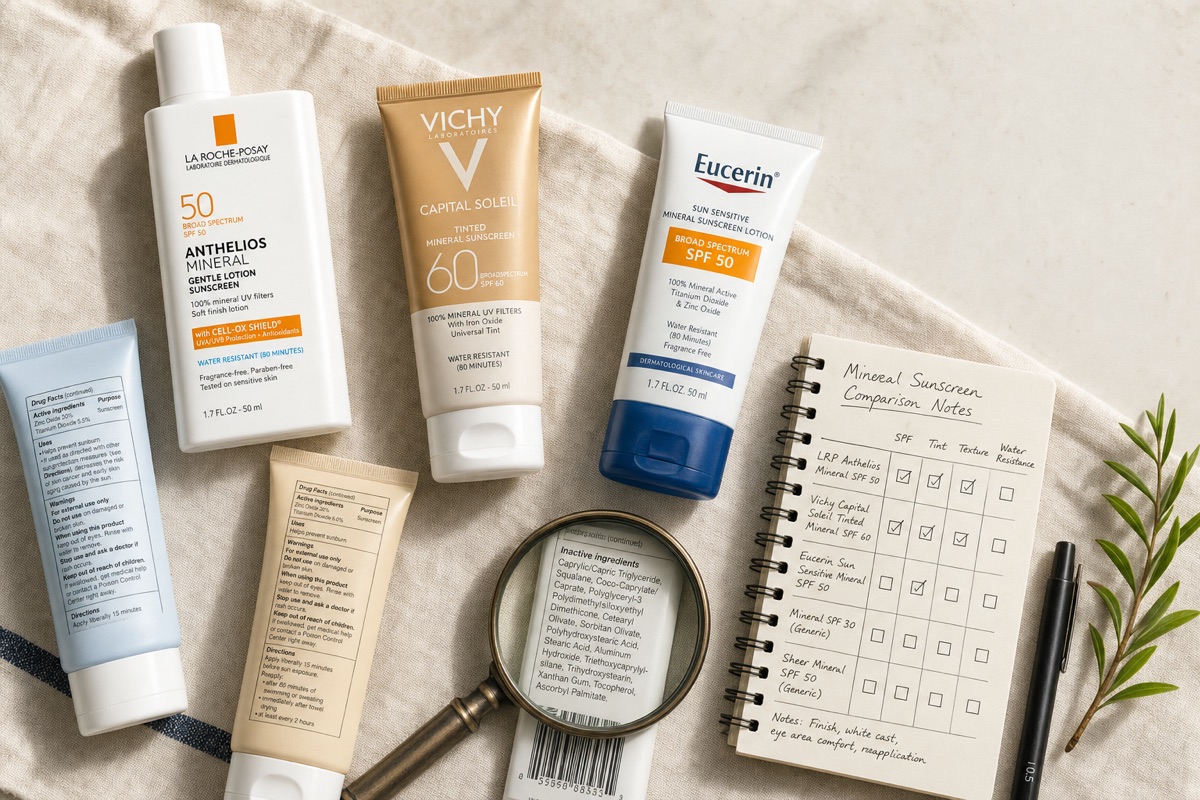
How to Choose the Right Mineral Sunscreen for Mature Skin
An evidence-led guide to choosing mineral sunscreen, with zinc oxide and titanium dioxide basics, white-cast fixes, texture cues, and Amazon product examples.
We analyzed 3 Amazon US mineral sunscreen listings with 6,910 visible ratings, FDA sunscreen guidance, AAD application guidance, and the 2013 Hughes randomized sunscreen-aging trial. Choose broad-spectrum SPF 30+, then match tint, texture, and water resistance to how you will actually wear it.
Editor's top Amazon picks for this guide
Real Amazon products that match this protocol. Affiliate links — your purchases support BeautySift.

La Roche-Posay
Anthelios Mineral Sunscreen SPF 50 Gentle Lotion
$31.99
"Best face-and-body mineral example in this guide: zinc oxide and titanium dioxide positioning, SPF 50, and 3,553 visible Amazon ratings."
What real Amazon buyers say
4.2★· 3,553 reviews"Really impressed with this sunscreen. It’s a bit thick going on, but a little goes a long way. Once applied, it feels lightweight, not greasy or oily at all."
"Great coverage and texture! However, it left a white cast over olive toned skin. I looked sick. But looked perfect on my pasty redhead daughter."

Vichy
Capital Soleil Tinted Mineral Sunscreen for Face SPF 60
$34.99
"Tinted mineral face option with SPF 60, titanium dioxide positioning, and 1,807 visible Amazon ratings for shoppers avoiding a white cast."
What real Amazon buyers say
4.4★· 1,807 reviews"It’s so difficult to find a mineral sunscreen that doesn’t leave a white cast. So, I decided to try this product even though I was somewhat skeptical about the tint."
"It’s moisturizing, but not greasy. It settles into a satin/natural finish on my face. The texture is thin and silky, feels lovely on."

Eucerin
Sun Sensitive Mineral Sunscreen Lotion SPF 50
$14.99
"Budget-sensitive mineral SPF 50 option with zinc oxide positioning, fragrance-free cues, and 1,550 visible Amazon ratings."
What real Amazon buyers say
4.4★· 1,550 reviews"The sunscreen is not scented which is always a plus. The yellow tint was not noticeable on my deep bronze skin."
"And yes, *at first* it does leave a bit of white cast. But this isn't an issue for me because if you rub it in good and wait just a couple minutes it's gone."
What you'll learn
- Start with the label: broad-spectrum SPF 30 or higher matters more than prestige pricing or a perfect-looking package.
- Mineral sunscreens use zinc oxide, titanium dioxide, or both; zinc oxide is especially common when brands emphasize broad UVA and UVB coverage.
- For mature skin, texture and tint are compliance issues: a drying, chalky sunscreen is less useful if you avoid applying enough.
- Choose water resistance for sweating, gardening, beach days, and outdoor exercise; it still needs reapplication every 2 hours outdoors.
- A tinted mineral sunscreen can reduce visible white cast and may be more wearable over discoloration, but shade fit is still personal.
Steps
-
1 Step 1: Confirm broad-spectrum SPF 30 or higher
Use the front label first. The AAD recommends broad-spectrum, SPF 30 or higher, and water-resistant sunscreen when sweating or swimming. FDA consumer guidance also centers broad-spectrum protection and repeated application. For daily face use, SPF 30 is the floor; SPF 50 or 60 can be useful if you apply imperfectly, spend time outdoors, or manage visible sun damage.
-
2 Step 2: Identify the mineral active filters
Turn the package over and look for zinc oxide, titanium dioxide, or both in the active ingredients box. FDA sunscreen materials discuss zinc oxide and titanium dioxide as mineral sunscreen active ingredients. Zinc oxide is often favored for broad UVA and UVB coverage; titanium dioxide can make textures feel lighter, but it may be paired with zinc oxide for broader coverage.
-
3 Step 3: Match tint to your white-cast risk
White cast is the main reason many shoppers abandon mineral sunscreen. If your skin is medium, olive, tan, brown, or deep, prioritize tinted formulas, flexible-shade formulas, or yellow-beige tints over stark white creams. If you are very fair or redness-prone, an untinted mineral lotion may be easier to blend. Amazon reviews for La Roche-Posay and Eucerin show the trade-off clearly: some users praise comfort while others flag cast on olive or deeper skin.
-
4 Step 4: Pick texture by skin type and climate
Dry mature skin often does better with lotion, cream, or hydrating fluid textures. Oily or hot-flash-prone skin may prefer thin fluids, matte tints, or powder-set finishes. In Florida summer humidity, a satin or water-resistant formula may wear better than a rich cream; in Southwest dryness or Midwest winter cold, a more emollient lotion can feel less tight. Texture is not vanity here. It determines whether you apply the labeled amount.
-
5 Step 5: Choose water resistance for real outdoor exposure
Water-resistant sunscreen is for sweating, swimming, gardening, hiking, long walks, and outdoor sports. It does not mean waterproof. FDA guidance says sunscreen should be reapplied at least every 2 hours, and sooner after swimming, sweating, or towel drying. If your mineral sunscreen is only for a short commute and indoor workday, water resistance is less important than comfort and reliable morning use.
-
6 Step 6: Check review patterns, not just star ratings
A 4.4-star sunscreen can still be wrong for you if the negative reviews repeat the same problem: eye sting, pilling, white cast, dryness, or staining collars. BeautySift weighs review volume and recurring language more heavily than one enthusiastic review. For the three Amazon examples in this guide, we looked for mineral-filter clarity, visible rating counts, repeated texture comments, and white-cast warnings.
-
7 Step 7: Buy enough to apply enough
The best mineral sunscreen is not the most elegant one if the tube is so expensive that you ration it. For face, neck, ears, and chest, daily use goes quickly. If you use a pricier tinted mineral sunscreen for the face, consider a lower-cost mineral body lotion for neck, chest, hands, and arms. That split routine often works better than under-applying a prestige face SPF everywhere.
Bottom line
Choosing the right mineral sunscreen is a label-reading exercise first and a texture-matching exercise second. BeautySift did not test these sunscreens in a lab. We analyzed FDA and AAD sunscreen guidance, the 2013 Hughes randomized sunscreen-aging trial in Annals of Internal Medicine, official US brand pages, and Amazon US listings for representative mineral sunscreens.
Affiliate disclosure: we may earn a commission on shopping links. Product inclusion does not change the guidance: broad-spectrum SPF 30 or higher, enough product, and reapplication outdoors matter more than brand prestige.
For US women 35-55, the right mineral sunscreen usually solves three practical problems at once: it gives broad-spectrum coverage, it does not make mature skin look dry or chalky, and it fits the way you spend time outside. A mineral sunscreen that looks perfect in a small swatch but pills under makeup, settles into lines, or leaves a lavender-gray cast will not help if it sits unused in a drawer.
What mineral sunscreen means on a US label
Mineral sunscreen refers to sunscreens that use zinc oxide, titanium dioxide, or both as active filters. You will see those names in the Drug Facts active ingredients box. Do not rely only on front-label phrases like clean, reef-conscious, sensitive, or physical. The active ingredient box is the reliable part.
The FDA sunscreen proposed order discusses zinc oxide and titanium dioxide as mineral sunscreen active ingredients. FDA consumer guidance also emphasizes broad-spectrum sunscreen use, applying before sun exposure, and reapplying at least every 2 hours when outdoors. For a shopper, that means the mineral label is only step one. You still need the sunscreen to be broad-spectrum, high enough SPF, wearable, and used in the right amount.
The peer-reviewed anti-aging evidence is not limited to mineral formulas, but it supports daily sunscreen as a category. Hughes MCB et al. published a randomized trial in Annals of Internal Medicine in 2013 following 903 adults for 4.5 years; regular sunscreen use was associated with less skin aging than discretionary use. That is the kind of evidence worth prioritizing over influencer texture claims.
Step 1: Start with broad-spectrum SPF 30 or higher
The AAD recommends selecting broad-spectrum, SPF 30 or higher, and water-resistant sunscreen when sweating or swimming. Broad-spectrum means the product is designed to cover both UVA and UVB exposure. UVB is strongly associated with sunburn; UVA is relevant to photoaging and can pass through window glass more than UVB.
For most daily face routines, SPF 30 is the minimum. SPF 50 can be sensible if you apply less than the measured test amount, spend meaningful time outside, have a history of visible sun damage, use retinoids or exfoliating acids, or live somewhere with frequent high UV exposure. Higher SPF does not give permission to apply a rice-grain amount. It is still a coverage product.
Look for these label cues:
- Broad-spectrum.
- SPF 30, 40, 50, or 60.
- Zinc oxide, titanium dioxide, or both in active ingredients.
- Water resistant 40 minutes or 80 minutes if you sweat or swim.
- Fragrance-free if your skin is reactive.
Step 2: Decide whether you need zinc oxide, titanium dioxide, or both
Many mineral sunscreens use zinc oxide alone or a zinc oxide plus titanium dioxide blend. Zinc oxide is common in formulas positioned around broad UVA and UVB coverage. Titanium dioxide can help create lighter textures and opacity, though it is often paired with zinc oxide in face-and-body formulas.
For sensitive, redness-prone, or eye-sting-prone skin, mineral filters may be appealing because many shoppers find them less irritating around the eyes. That is not a guarantee. Reviews still matter because a formula can be mineral and still feel drying, greasy, thick, or difficult to remove.
A practical filter guide:
- Zinc oxide only: often a good place to start for sensitive-skin routines and broad coverage priorities.
- Titanium dioxide only: may feel lighter in some tinted fluids, but check whether the sunscreen is broad-spectrum.
- Zinc oxide plus titanium dioxide: common in face-and-body lotions where coverage and SPF strength are both priorities.
If you are choosing for mature skin, the filter is not the whole story. Vehicle matters: lotion, cream, fluid, stick, or tinted serum-style formulas behave differently over texture, pores, and fine lines.
Step 3: Solve white cast before you buy
White cast is not a minor aesthetic issue. It is a compliance issue. If a mineral sunscreen makes your complexion look gray, lavender, ashy, or chalky, you are more likely to under-apply or skip it.
Amazon reviews in our May 2026 capture show this split clearly. La Roche-Posay Anthelios Mineral SPF 50 Gentle Lotion had 4.2/5 across 3,553 visible ratings, but one verified reviewer praised its lightweight feel while another said it left a white cast on olive-toned skin. Vichy Capital Soleil Tinted Mineral SPF 60 had 4.4/5 across 1,807 visible ratings, and review language repeatedly centered tint, satin finish, and avoiding white cast.
Choose untinted mineral sunscreen if:
- Your skin is fair to light and white cast blends out easily.
- You dislike beige transfer on collars.
- You plan to layer foundation over it.
- You need one face-and-body product.
Choose tinted mineral sunscreen if:
- Untinted zinc formulas look gray, purple, or dusty on you.
- You have visible discoloration and prefer sheer tone-evening.
- You want to wear less foundation.
- You are choosing mineral SPF for the face rather than body.
The limitation is shade range. A single universal tint is rarely universal. For deeper skin tones, look for brands that offer multiple tint depths or flexible shade options, not one beige shade described as universal.
Step 4: Match texture to mature skin and daily routine
A mineral sunscreen can have the right filters and still be wrong for your face. Mature skin often has several competing needs: dryness around cheeks, texture around pores, makeup settling around lines, and sometimes oiliness or hot-flash-related shine. Texture determines whether the formula becomes a daily habit.
For dry or tight skin, look for mineral lotions and hydrating fluids. If your sunscreen emphasizes matte finish too aggressively, it can make makeup look cracked or emphasize flaky patches. For oilier skin, look for fluids, gel-cream textures, or tints that set down without a heavy balm feel.
Climate also matters. In Florida summer humidity, a rich mineral cream may feel slippery by noon. In Southwest dryness, a thin matte fluid may look flat unless you moisturize first. In Midwest winter cold, a creamier mineral lotion may be more comfortable on cheeks and neck.
Do not mix sunscreen with moisturizer in your palm to improve texture. Layer moisturizer first if needed, let it settle, then apply sunscreen generously. Mixing can make coverage uneven.
Step 5: Choose water resistance by activity, not aspiration
Water resistance is valuable when you sweat, swim, garden, hike, play outdoor sports, or spend long days at the beach or pool. It is less critical for a short commute and indoor workday.
FDA guidance says to reapply sunscreen at least every 2 hours, and more often after swimming, sweating, or towel drying. Water-resistant does not mean waterproof. A mineral sunscreen can still rub off on towels, collars, hands, and masks.
A simple decision rule:
- Workday, mostly indoors: prioritize texture and makeup compatibility.
- Long commute or window exposure: prioritize broad-spectrum SPF and comfortable reapplication.
- Outdoor exercise: choose water-resistant SPF and consider a stick for high points.
- Beach or pool: choose water-resistant SPF, apply before exposure, and reapply after swimming or towel drying.
- Gardening or walking: use water-resistant SPF if you sweat, plus a hat and sunglasses.
Step 6: Read review patterns like an analyst
Star ratings are useful, but the repeated complaint pattern is more useful. A mineral sunscreen with thousands of reviews may average 4.4/5 and still have a predictable weakness. BeautySift weights patterns such as white cast, eye sting, pilling, greasiness, dryness, transfer, and staining more heavily than one glowing quote.
For the three Amazon examples in this guide, the product fit is different:
La Roche-Posay Anthelios Mineral SPF 50 Gentle Lotion is the all-purpose face-and-body mineral lotion. It is best if you want a classic mineral SPF 50 and can tolerate a thicker lotion format. Skip it if white cast usually shows up strongly on your skin tone.
Vichy Capital Soleil Tinted Mineral SPF 60 is the tint-forward face option. It is best if you want a thin mineral fluid and prefer a satin finish. Skip it if one universal tint rarely matches you or you need a lower-cost per-ounce body option.
Eucerin Sun Sensitive Mineral SPF 50 is the value-sensitive zinc oxide lotion. It is best if you want fragrance-free mineral protection at a lower price. Skip it if you dislike thicker lotions or worry about possible clothing transfer.
Step 7: Build a face, neck, and body plan
Many women apply a careful layer to the face, then forget neck, ears, chest, and backs of hands. That pattern matters because those areas show cumulative sun exposure and are often uncovered during driving, errands, and outdoor weekends.
A practical mineral sunscreen wardrobe can be simple:
- Tinted mineral SPF for face if white cast is your main barrier.
- Untinted mineral lotion for neck, chest, arms, and hands.
- Mineral stick for ears, part line, and outdoor reapplication.
- UPF hat or wide-brim hat for long exposure.
If you use retinoids, vitamin C, exfoliating acids, or treatments for discoloration, sunscreen consistency becomes more important. Those products can support a routine, but they do not replace UV protection. A daily sunscreen habit is the base layer.
Common mistakes when choosing mineral sunscreen
Buying only by SPF number. SPF matters, but texture, tint, and reapplication determine real-world use.
Ignoring undertone. Beige tints can pull orange, pink, yellow, or gray. Check review photos when available and read comments from people who mention similar skin tone.
Choosing a tiny prestige bottle for body use. If the cost makes you ration product, use it for face only and choose a larger-value mineral lotion for body.
Assuming mineral means invisible. Mineral filters can be elegant, but many still leave cast. Tinted or flexible-shade options usually reduce that risk.
Skipping reapplication. Mineral sunscreen still wears off. Follow FDA guidance: reapply at least every 2 hours outdoors and after swimming, sweating, or towel drying.