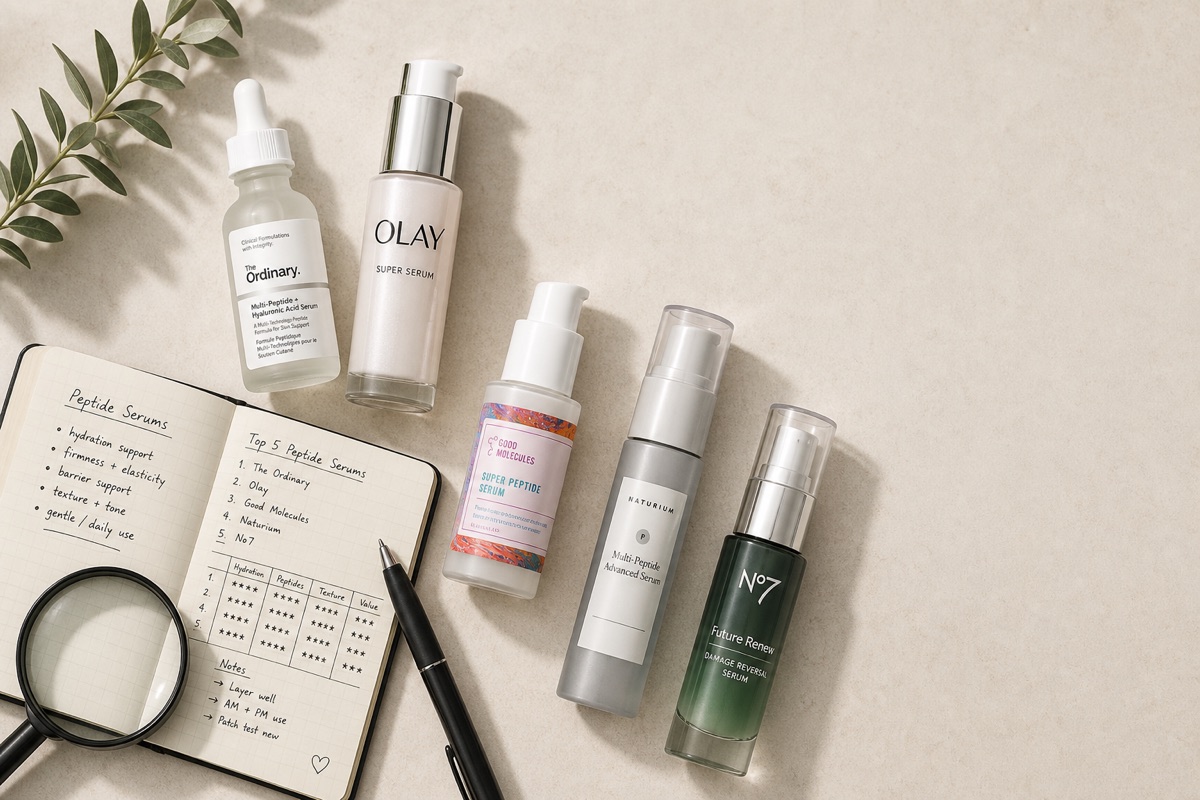
How to Choose the Right Peptide Serum for Fine Lines and Firmness
An evidence-led guide to choosing peptide serums for fine lines and early firmness changes, with PubMed context and Amazon US product examples.
We analyzed 4 PubMed peptide studies and reviews plus 5 Amazon US peptide-serum listings totaling 26,902 ratings. For fine lines and early firmness, choose a fragrance-free peptide serum with disclosed peptide families, barrier-friendly humectants, and a realistic 8- to 12-week trial window before judging results.
Editor's top Amazon picks for this guide
Real Amazon products that match this protocol. Affiliate links — your purchases support BeautySift.

The Ordinary
The Ordinary Multi-Peptide + Hyaluronic Acid Serum
$19.90
"Multi-peptide and hyaluronic-acid example with strong Amazon US sentiment: 4.7/5 across 3,648 ratings in the May 2026 listing snapshot."
What real Amazon buyers say
4.7★· 2,276 reviews"I love this product line. I have ridiculous sensitive skin and it took a long time for me to find a product that didn't irritate my skin."
"The texture is lightweight and smooth, and it absorbs nicely without feeling heavy. My skin feels instantly more hydrated and looks noticeably plumper after application."

Olay
Olay Super Serum
$29.94
"Mass-retail peptide blend example with niacinamide, vitamin C, vitamin E, collagen peptide, and 4.5/5 across 4,383 Amazon ratings."
What real Amazon buyers say
4.5★· 7,484 reviews"Have been using this for a few months and no it does not make you 20 years younger (nothing will), but it does help hydrate your skin and does help make your fine lines not so noticeable."
"It’s nice to have a serum that solves a multitude of skin issues in one product. Goes on easy and absorbs easily."

Good Molecules
Good Molecules Super Peptide Serum
$12
"Low-cost peptide and copper-tripeptide example with broad user base: 4.6/5 across 16,451 Amazon ratings in the listing snapshot."
What real Amazon buyers say
4.6★· 3,415 reviews"I bought this serum to use in my evening routine, and by morning my skin looks more hydrated and “filled”."
"The price is phenomenal, I love the ingredients, I have sensitive skin with mild rosacea on my cheeks, and it does not aggravate my skin whatsoever."

Naturium
Naturium Multi-Peptide Advanced Serum
$24.88
"Firming-and-smoothing multi-peptide example with 4.6/5 across 2,163 Amazon ratings and a simple 1 oz serum format."

No7
No7 Future Renew Damage Reversal Serum
$12.99
"Peptide-serum example positioned for visible photoaging concerns, with hyaluronic acid and niacinamide and 4.5/5 across 257 Amazon ratings."
What you'll learn
- Peptide serums are better framed as gradual support for visible fine lines and texture, not as a substitute for sunscreen, retinoids, procedures, or prescriptions.
- The most useful labels name peptide families such as palmitoyl peptides, acetyl hexapeptides, copper peptides, or multi-peptide complexes rather than using only marketing language.
- For women 35 to 55, the best peptide serum is usually the one that layers well with moisturizer and sunscreen without increasing irritation.
- Judge a peptide serum over 8 to 12 weeks because the better human studies and most cosmetic routines evaluate visible changes over weeks, not days.
- Avoid stacking a new peptide serum with several new actives in the same week; irritation can make a tolerable formula look ineffective.
Steps
-
1 Step 1: Decide what job you want the peptide to do
Start with the visible change you are trying to support. For fine lines around the eyes or mouth, look for formulas built around palmitoyl peptides, acetyl hexapeptide, or multi-peptide blends. For a dull, dehydrated surface, prioritize peptides paired with glycerin, hyaluronic acid, panthenol, or niacinamide. For early sagging, keep expectations conservative: topical peptides may support a smoother, better-hydrated look, but they will not lift tissue like an in-office procedure.
-
2 Step 2: Read the ingredient list before the front label
A useful peptide serum should name at least one peptide or peptide complex in the ingredient list. Stronger examples include palmitoyl pentapeptide-4, palmitoyl tripeptide-1, palmitoyl tetrapeptide-7, acetyl hexapeptide-8, copper tripeptide-1, or a clear brand peptide complex. Be more cautious with products that say peptide on the front but hide the active story behind fragrance, essential oils, or many exfoliating acids.
-
3 Step 3: Match the texture to your current routine
Peptide serums usually work best as the calm treatment layer after cleansing and before moisturizer. If your skin is dry from retinoids or perimenopause changes, choose a hydrating serum and seal it with cream. If you are oily or breakout-prone, choose a lightweight water-gel texture and avoid heavy fragranced oils. The goal is daily consistency, so pilling under sunscreen is a real reason to switch formulas.
-
4 Step 4: Choose compatible actives, not the longest active list
Peptides can usually sit in the same routine as niacinamide, hyaluronic acid, ceramides, glycerin, and barrier creams. If you already use retinoids, exfoliating acids, or strong low-pH vitamin C, add the peptide serum on alternate nights at first. A peptide serum does not need to sting to be useful; stinging often means the supporting formula or the rest of the routine is too aggressive.
-
5 Step 5: Run an 8- to 12-week evidence-style trial
Use the peptide serum once daily for two weeks, then increase only if the skin stays calm. Keep sunscreen, moisturizer, and cleanser steady so you can judge the serum instead of judging a completely new routine. Take photos in the same light every 4 weeks. Expect the most realistic changes to be surface smoothness, hydration, makeup laydown, and softer-looking fine lines rather than dramatic lifting.
-
6 Step 6: Know when to skip peptides
Skip or delay a peptide serum if your barrier is actively burning, peeling, or reacting to plain moisturizer. Repair the barrier first. Also skip if the formula relies heavily on fragrance and your skin is rosacea-prone, eczema-prone, or recently irritated by retinoids. If sagging is your main concern and you want a visible lifting effect, peptides can be a supportive step, but energy devices, injectables, or surgical options are the categories with stronger structural effects.
Bottom line
A peptide serum is most useful when it fills a specific gap: a lower-irritation treatment step for fine lines, dehydration-linked creasing, and early loss of bounce. It is least useful when it is expected to replace sunscreen, a well-tolerated retinoid, or an in-office lifting procedure.
BeautySift did not test these serums on a panel. We analyzed PubMed-indexed peptide evidence, Amazon US listing snapshots, ingredient-role logic, and a product-comparison rubric that weights evidence, tolerability, texture, value, and accessibility. We may earn a commission from Amazon links, but affiliate status does not influence product scoring or article placement.
What peptides can realistically do
Peptides are short chains of amino acids used in cosmetic formulas for several roles: signal peptides, carrier peptides, neurotransmitter-inspired peptides, and blended complexes. The strongest consumer-friendly way to think about them is not “collagen in a bottle.” It is “a topical support ingredient that may help the skin look smoother and better conditioned over time.”
The human evidence is more modest than retinoid evidence, but it is not empty. Palmitoyl pentapeptide has PubMed-indexed human photoaging data, and a 2023 double-blind randomized trial evaluated acetyl hexapeptide-3 and palmitoyl pentapeptide-4 creams for crow’s feet. That supports a cautious routine role: peptides can be reasonable for shoppers who want fine-line support with less irritation than many exfoliating or retinoid-heavy approaches.
How we weighted the featured products
Using the product-comparison skill framework, we gave the most credit to formulas with clear peptide positioning, barrier-friendly support ingredients, strong Amazon US user sentiment, reasonable price per ounce, and low routine-conflict risk. We did not give extra credit for luxury pricing or broad anti-aging language.
Evidence-weighted role scores:
- The Ordinary Multi-Peptide + Hyaluronic Acid: 8.4/10 for value, peptide clarity, and hydration support.
- Good Molecules Super Peptide Serum: 8.2/10 for low price, copper-tripeptide positioning, and a large Amazon rating base.
- Olay Super Serum: 8.0/10 for broad accessibility and multi-active convenience, with a higher chance of routine overlap for users already on vitamin C or acids.
- Naturium Multi-Peptide Advanced Serum: 7.9/10 for firming-focused positioning and texture-friendly serum format.
- No7 Future Renew Damage Reversal Serum: 7.3/10 as a small-size trial option with fewer Amazon ratings in the verified snapshot.
Best formula signals to look for
Look for one of these patterns:
- A multi-peptide serum with hyaluronic acid or glycerin for a smoother, hydrated surface.
- A copper-peptide formula if you want a carrier-peptide angle and your skin is not easily irritated by active-heavy routines.
- A peptide plus niacinamide formula if tone, barrier comfort, and fine lines are all concerns.
- A fragrance-free or low-fragrance formula if your skin is reactive, rosacea-prone, or newly sensitive in perimenopause.
Avoid judging only by the front label. “Peptide” can mean a thoughtful complex, or it can mean a very small supporting ingredient in a formula dominated by fragrance and texture agents.
Where peptide serums fit in a routine
Morning option:
- Gentle cleanse or rinse.
- Peptide serum.
- Moisturizer if needed.
- Broad-spectrum sunscreen.
Evening option:
- Cleanse without a squeaky finish.
- Peptide serum on slightly damp or dry skin, depending on the formula directions.
- Moisturizer.
- Retinoid on alternate nights if your skin already tolerates it.
If you use a strong vitamin C serum in the morning and retinoid at night, place the peptide serum on non-retinoid nights first. This makes irritation easier to trace.
When the label is overpromising
Be skeptical of claims that imply an over-the-counter peptide serum will lift sagging skin, rebuild collagen dramatically, or work like an injectable. Cosmetic peptide serums can support the appearance of smoother, firmer-looking skin, but visible sagging involves deeper structural changes. For that concern, peptides are a supportive maintenance step, not the main intervention.
Also be careful with before-and-after photos that do not disclose lighting, time frame, other routine steps, or whether the brand funded the study. A brand-funded study can still be useful, but it should not outweigh peer-reviewed evidence and broad user sentiment.
A simple 12-week peptide plan
Weeks 1 to 2: Use the serum once daily, preferably at night, and keep all other products stable.
Weeks 3 to 8: Continue daily if there is no stinging, new rash, or persistent pilling. Track hydration, texture, and makeup laydown rather than expecting lifting.
Weeks 9 to 12: Compare photos taken in the same lighting. If the skin is calmer, smoother, and less creased-looking, the serum is doing its likely job. If nothing changed and the formula annoys your routine, switch categories rather than adding more peptide products.
Related BeautySift reading
Guide: How to layer vitamin C, niacinamide, and retinol -> /guides/how-to-layer-vitamin-c-niacinamide-retinol-2026/
Guide: How to firm sagging skin without injectables -> /guides/how-to-firm-sagging-skin-without-injectables-2026/
More fine-line content -> /concerns/fine-lines/