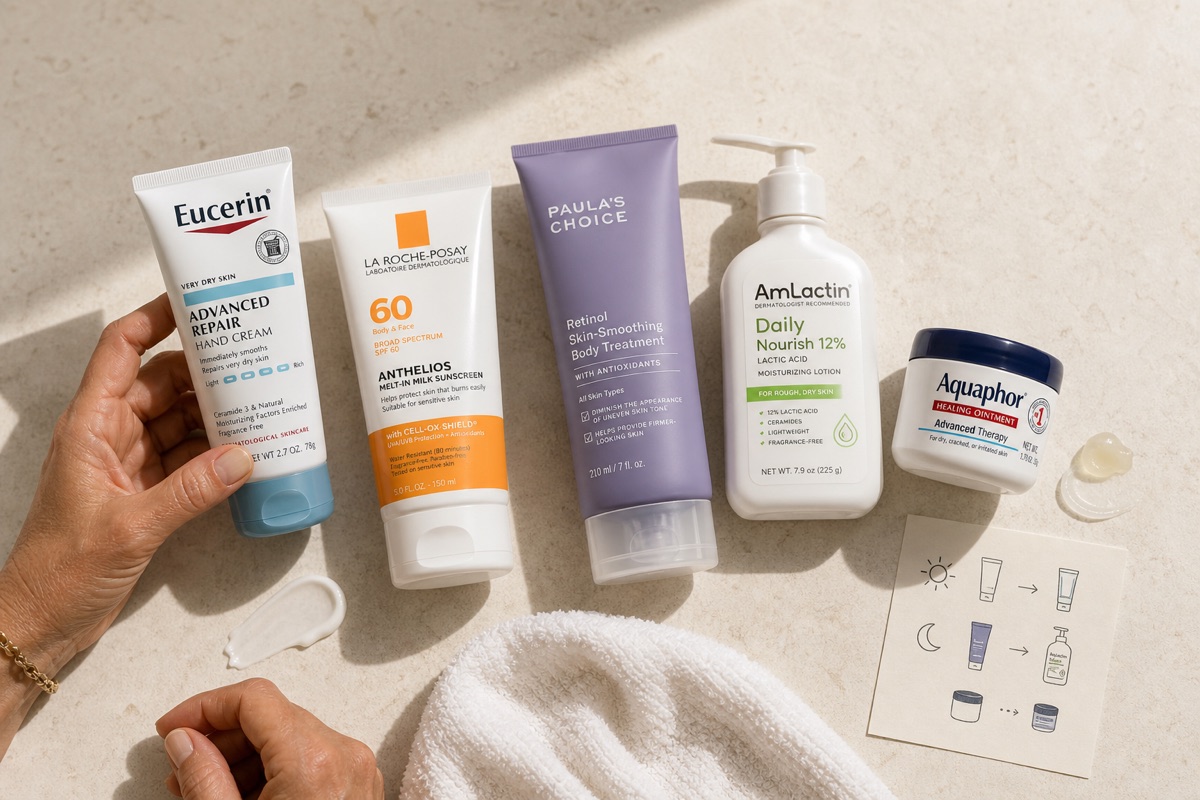
How to Layer Hand Creams With Retinol, Acids, SPF, and Other Actives
An evidence-led hand-care layering guide for dry, fine-lined hands, including when to use humectant cream, retinol, lactic acid, sunscreen, and ointment.
We analyzed 38,873 Amazon ratings across 5 US hand-care products, PubMed studies on urea, retinoids, colloidal oatmeal, and sunscreen, plus FDA sunscreen guidance. Layer hand actives thinnest to richest: treatment at night, hand cream over it, SPF every morning, and ointment only on cracked spots.
Editor's top Amazon picks for this guide
Real Amazon products that match this protocol. Affiliate links — your purchases support BeautySift.

Eucerin
Eucerin Advanced Repair Hand Cream
$19.74
"Best base layer for dry hands before SPF or nighttime actives: 4.7/5 across 10,450 Amazon ratings and a fragrance-free hand-cream format."
What real Amazon buyers say
4.7★· 10,450 reviews"One of the best handcreams ever! Light and not too greasy but offers exceptional moisturisation to skin"
"I keep this at work and it makes my hands so soft and moisturized without being sticky or greasy. There is no scent."
La Roche-Posay
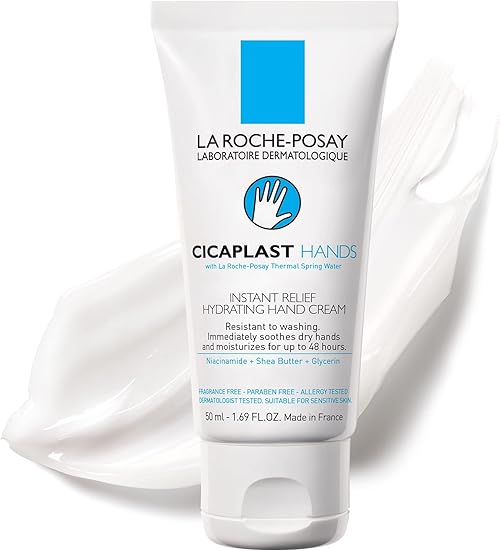
La Roche-Posay Cicaplast Hand Cream
$12.99
"Best comfort layer for frequent washing days: 4.7/5 across 20,993 Amazon ratings, fragrance-free positioning, and a non-greasy hand-cream role."
What real Amazon buyers say
4.7★· 20,993 reviews"I really like this brand. Their products never disappoint. This hand cream is great for helping my dry hands and doesn’t have a scent. It feels wonderful and is not sticky."
"Best lotion I’ve ever used because I’ve used a lot. It’s creamy and not overly greasy and my skin feels so moisturized."

Paula's Choice
Paula's Choice Retinol Skin-Smoothing Body Treatment
$22.40
"Best retinol step to use sparingly on the backs of hands at night: 4.3/5 across 275 Amazon ratings and a body-lotion format that can be layered under hand cream."
What real Amazon buyers say
4.3★· 275 reviews"I have been using this for 6 months and I get compliments my skin is glowing. It’s soft and lightweight feeling. It is unscented which is a bonus."
"It's really really good - but its really really hard to get it out of the container. The pump does not really work well."

AmLactin
AmLactin Daily Nourish Therapeutic Body Lotion
$19.99
"Best rough-texture acid option for non-retinol nights: 4.4/5 across 5,067 Amazon ratings and 12% lactic acid disclosed on the product title."

Aquaphor
Aquaphor Healing Ointment
$17.59
"Best final spot-seal for cracked fingertips and cuticles: 4.8/5 across 3,941 Amazon ratings and a petrolatum ointment format."
What you'll learn
- Treat hand care like face care: water-binding cream first, active treatments on planned nights, SPF every morning, and ointment only where skin is cracked.
- Do not stack retinol and lactic acid on the same hand-care night if your hands are dry, splitting, recently sanitized often, or already stinging.
- For fine-looking lines on mature hands, sunscreen is the daily non-negotiable; retinol and acids belong in a slower nighttime schedule.
- A urea or glycerin hand cream can buffer dryness from actives, but it cannot cancel irritation from overuse, fragrance sensitivity, or broken skin.
- If hands are rashy, bleeding, swollen, or intensely itchy, pause cosmetic actives and consider medical advice rather than adding more layers.
Steps
-
1 Start with the condition of your hands
Before layering an active, check whether your hands are simply dry, visibly cracked, sun-exposed, or irritated. Dry-but-intact hands can usually tolerate a humectant hand cream and slow active schedule. Cracked, bleeding, hot, or rashy hands should get bland barrier care first, not retinol or acid.
-
2 Use hand cream as the base layer
After washing, apply a fragrance-free hand cream while skin is slightly damp. Urea, glycerin, shea butter, dimethicone, and similar humectant-emollient blends help reduce the tight feeling that makes actives harder to tolerate. Let the cream settle before sunscreen in the morning or before a nighttime treatment.
-
3 Put sunscreen on hands every morning
Use broad-spectrum SPF on the backs of hands as the last morning step, especially before driving, gardening, walking, or errands. The 2013 Annals of Internal Medicine randomized sunscreen trial supports daily sunscreen for photoaging prevention; the FDA also emphasizes broad-spectrum protection from UVA and UVB exposure.
-
4 Reserve retinol for two or three nights a week
If fine lines and crepey texture are the concern, use a retinol body or hand-compatible treatment at night only. Start two nights weekly, avoid the knuckles and cuticles at first, and sandwich with hand cream if dryness appears. Do not apply retinol to cracked skin.
-
5 Use lactic acid or urea on different nights
Lactic acid and higher-urea formulas can smooth rough texture, but they can sting when hands are compromised. Use them on non-retinol nights, then follow with hand cream. Skip acids for several days after heavy sanitizing, cold-weather chapping, or any open splits.
-
6 Seal only the damaged spots
At bedtime, use a petrolatum ointment as a final layer on fingertips, cuticles, or cracked patches that need protection. Full-hand ointment under cotton gloves can help some people, but spot-sealing is less messy and less likely to interfere with retinol or acid tolerance.
Bottom line
Layer hand creams with other actives by assigning each product one job. A daily hand cream handles water-binding and comfort. Sunscreen protects the backs of hands every morning. Retinol and lactic acid belong on separate nights if fine lines and rough texture are the goals. Petrolatum ointment goes last, and usually only on cracked fingertips, cuticles, or splits.
BeautySift did not test these products in a lab or on a panel. We analyzed 38,873 Amazon ratings across five US-available products, FDA sunscreen guidance, PubMed studies on urea moisturizers, retinoids, colloidal oatmeal, and daily sunscreen, plus INCI-level role analysis. We may earn a commission from Amazon links, but affiliate status does not change product selection or evidence weighting.
Skill level: beginner. The hard part is not the number of steps; it is resisting the urge to use every active every night.
Why hands need a different layering strategy
Hands age and dry out differently from the face because they are washed often, exposed to sanitizer, hit with UV through car windows, and usually moisturized only after they already feel tight. For women 35-55, the visible complaints tend to overlap: dryness after washing, fine lines on the backs of hands, crepey texture, rough knuckles, and cuticles that split in winter.
That overlap is why a single “anti-aging hand cream” label can be misleading. Fine lines need photoprotection and slow active use. Roughness may respond to lactic acid or urea. Cracked fingertips need barrier protection, not exfoliation. A retinol lotion can support a smoother look over time, but it is the wrong first move on stinging, split skin.
The PubMed evidence supports the broad roles, not a miracle-hand claim. A 2021 randomized biometric study evaluated urea-based moisturizers and skin barrier function. A 2019 randomized double-blind trial compared bakuchiol and retinol for facial photoaging. A 2013 Annals of Internal Medicine randomized trial linked daily sunscreen with prevention of skin aging. Those studies help shape the protocol, while the Amazon snapshots help identify practical US products that fit each step.
Morning order: cream first, sunscreen last
The simplest morning hand routine is: wash, pat mostly dry, hand cream, then broad-spectrum sunscreen on the backs of hands. If you use a face sunscreen and can tolerate it on your hands, that is acceptable. The important behavior is placement: SPF is the final morning layer because it needs an even film over skin.
Eucerin Advanced Repair Hand Cream is our preferred base-layer example because the Amazon listing shows 4.7/5 across 10,450 ratings, and the product is positioned as fragrance-free, non-greasy, and fast absorbing. In layering terms, that means it can sit under SPF without turning the morning routine into a slippery mess. Its role is not to erase sun damage; its role is to reduce tightness so you can wear sunscreen consistently.
The FDA’s sunscreen guidance focuses on broad-spectrum protection from UVA and UVB exposure. For hands, that matters during driving, outdoor errands, walks, gardening, and patio time. If you only apply SPF to your face, the backs of the hands can still receive repeated daily exposure. A hand cream underneath can improve comfort, but it does not replace sunscreen.
Night order: active, hand cream, optional spot seal
At night, choose one active lane. If fine lines and crepey texture are the priority, choose a retinol night. If roughness and thick dry patches are the priority, choose a lactic-acid or higher-urea night. If the hands are irritated, choose a recovery night with hand cream only.
Paula’s Choice Retinol Skin-Smoothing Body Treatment is the retinol example in this protocol. Amazon lists it at 4.3/5 across 275 ratings, and the body-lotion format makes more sense for the backs of hands than a tiny facial serum. Use a pea-size amount for both hands, avoid broken skin, and follow with a bland hand cream. If the skin feels dry by morning, reduce frequency rather than adding lactic acid on top.
La Roche-Posay Cicaplast Hand Cream fills the comfort-layer role after active nights or frequent washing days. Amazon lists it at 4.7/5 across 20,993 ratings, and recent review excerpts emphasize dry-hand comfort without a sticky finish. In practical use, it belongs over a retinol treatment after the treatment settles, or by itself on recovery nights.
Aquaphor Healing Ointment is not an all-over active. It is the final seal for cracks, ragged cuticles, and fingertips that lose moisture quickly. Amazon lists it at 4.8/5 across 3,941 ratings. Use a rice-grain amount per damaged spot. If you coat the whole hand before retinol absorbs, you can make the routine messier and harder to repeat.
Where lactic acid and urea fit
Lactic acid and urea are useful because dry hands are often rough, not just dehydrated. AmLactin Daily Nourish Therapeutic Body Lotion is listed on Amazon as a 12% lactic acid lotion and has 4.4/5 across 5,067 ratings. That makes it a reasonable rough-texture option for the backs of hands, but it is not the product to use on split knuckles or sanitizer-burned skin.
Use acid nights once or twice weekly at first. Apply a thin layer to the backs of hands, avoid cuts and the webbing between fingers if sensitive, then follow with hand cream. Keep retinol and lactic acid on different nights for the first month. If your hands never sting and roughness remains, you can consider a third acid night, but the ceiling is tolerance, not ambition.
Urea works differently depending on concentration and formula context. Lower urea levels tend to support hydration; higher levels can feel more smoothing and may tingle. The 2021 urea moisturizer study in PubMed supports urea as a barrier-relevant moisturizer ingredient, but it does not mean every urea product should be layered with every active. If a hand cream already contains exfoliating or smoothing ingredients, go slower with separate retinol or lactic acid.
A practical weekly schedule
For a beginner routine, use hand cream after every wash whenever realistic, SPF every morning, and active nights only two or three times a week. Monday can be retinol, Tuesday recovery, Wednesday lactic acid, Thursday recovery, Friday retinol, and the weekend based on how your hands feel. That schedule gives fine-line and texture goals a place without turning damaged skin into a nightly experiment.
If you work in healthcare, food service, hair color, gardening, caregiving, or any job with frequent washing, bias toward recovery nights. Your hands are already getting repeated detergent and friction exposure. More active does not automatically mean better results.
If you live with Midwest winter cold or Southwest dryness, keep a richer hand cream near the sink and an ointment by the bed. If you live in Florida summer humidity, you may prefer lighter daytime hand cream and reserve ointment for bedtime. Climate changes texture preference, but it does not change the core order: moisturize, protect by day, treat slowly by night.
What not to layer
Do not layer retinol, 12% lactic acid, and an occlusive glove routine on the same night when your hands are already dry. Do not apply acid to cracked fingertips and then seal it under ointment. Do not judge a hand active after one use unless it burns; smoothing and fine-line benefits are gradual, while irritation can show quickly.
Also avoid fragranced hand creams if your main issue is stinging or repeated washing. Fragrance is not automatically harmful for everyone, but it is an unnecessary variable when you are already layering retinol or acids. The same caution applies to essential oils, scrubby hand treatments, and strong cuticle removers used on the same night as retinol.
Finally, separate cosmetic concerns from medical patterns. Dryness, roughness, and fine-looking lines fit a cosmetic protocol. Persistent rash, swelling, bleeding, painful fissures, intense itch, or scaling that spreads deserves medical input. A smarter hand-care routine should reduce avoidable irritation, not cover up a problem that needs diagnosis.
Quick protocol recap
Keep the routine visible and easy. A tube near the sink, a small cream in a work bag, and sunscreen where you keep car keys will usually matter more than adding a sixth active. For mature hands, the most reliable protocol is the one repeated after washing, before daylight exposure, and on planned treatment nights without chasing irritation.
Morning: wash, hand cream, broad-spectrum SPF on the backs of hands. Reapply after washing if you will be outdoors or driving for meaningful time.
Retinol night: retinol treatment on the backs of hands, hand cream over it, ointment only on cracked spots if needed. Start two nights weekly.
Texture night: lactic acid or a smoothing urea product, hand cream over it, no retinol the same night.
Recovery night: hand cream only, with petrolatum ointment on fingertips, cuticles, or cracks. This is the night to use after excessive handwashing, winter chapping, or any stinging.