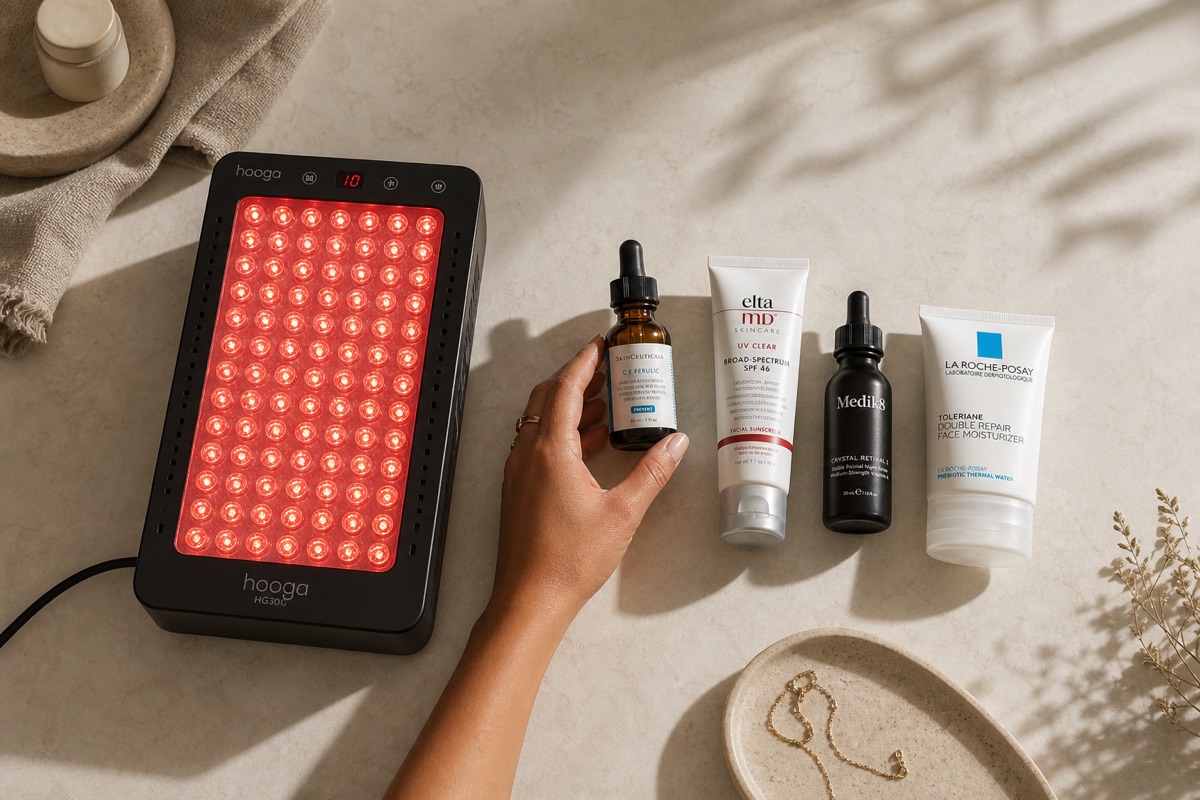
How to Layer Red Light Therapy Panels With Retinol, Vitamin C, and Other Actives
A practical, evidence-led routine for using red and near-infrared panels with retinol, vitamin C, acids, sunscreen, and moisturizers.
Based on Lee et al. 2007 (n=76), Wunsch & Matuschka 2014 (n=136), and Amazon US review snapshots for 3 panel ASINs, use red light on clean, dry skin before leave-on actives. Keep vitamin C and SPF in the morning, retinoids at night, and separate acids if irritation appears.
Editor's top Amazon picks for this guide
Real Amazon products that match this protocol. Affiliate links — your purchases support BeautySift.

Hooga
Hooga HG300 Red Light Therapy Panel
$199
"Compact 660 nm red and 850 nm near-infrared panel with enough face, neck, and chest coverage for the clean-skin protocol."
What real Amazon buyers say
4.6★· 1,082 reviews"The machine itself is super sturdy and easy to use anywhere. Overall, I don't have anything bad to say about it!"
"Overall, this panel feels thoughtfully designed and well made."

Hooga
Hooga PRO300 Red Light Therapy Panel
$299
"A midrange dual-chip 660 nm and 850 nm panel with an adjustable stand for users who want more controlled distance and angle."
What real Amazon buyers say
4.6★· 712 reviews"Setup is straightforward. The adjustable stand is sturdy, the built in timer is genuinely useful, and the cooling fans keep it from running hot."
"After a rabbit hole of research on red light and finding masks claustrophobic, limiting, and annoying to have to charge, I bought this panel."

Hooga
Hooga HG200 Red Light Therapy Panel
$149
"A smaller 660 nm and 850 nm panel for users who want a lower-cost, lower-footprint way to keep the routine consistent."
What real Amazon buyers say
4.6★· 487 reviews"Definitely improving my skin. Love that it's a bigger size than the Lume and at a great price. I'd recommend."
"Am totally impressed with the quality and effectiveness of this small panel and would highly recommend to anyone looking for a small, affordable yet effective panel for travel or even at home."
What you'll learn
- Use a red or near-infrared panel on clean, dry skin before leave-on serums, creams, oils, sunscreen, or makeup.
- Keep vitamin C and sunscreen in the morning, and keep retinoids at night unless your skin is already highly tolerant.
- Separate exfoliating acids from panel sessions when your skin is dry, flushed, peeling, or newly sensitized.
- Judge results after repeated use over 8-12 weeks, because peer-reviewed LED studies used multi-session protocols rather than one-off exposure.
- Treat red light as supportive care for fine lines and skin quality, not as a replacement for sunscreen, retinoids, or professional laxity treatments.
Steps
-
1 Start with bare skin, not a product sandwich
Cleanse, dry the skin completely, and use the panel before leave-on products. This keeps the routine simple and avoids asking a thick moisturizer, facial oil, sunscreen film, or makeup pigment to sit between the LEDs and skin. Lee et al. 2007 studied red and near-infrared LED exposure as a device intervention in 76 subjects; it was not a trial of LED through cosmetic layers. For a home protocol, clean dry skin is the clearest default.
-
2 Place vitamin C in the morning lane
For most users, vitamin C belongs after the panel if you use the panel in the morning, followed by moisturizer and broad-spectrum sunscreen. If your vitamin C stings, choose a lower-frequency panel schedule or move the panel to evening. Do not assume that applying vitamin C before the device improves results; the peer-reviewed red and near-infrared studies cited here evaluate light exposure, not a combined vitamin C delivery system.
-
3 Keep retinoids at night and buffer if needed
If you use a retinol, retinal, adapalene, or prescription tretinoin, the conservative order is cleanse, dry skin, panel, moisturizer, then retinoid if already tolerated. Sensitive users can moisturize after the panel and apply retinoid on alternate nights. The goal is consistency without barrier collapse. Wunsch & Matuschka 2014 used 30 red and near-infrared sessions in 136 volunteers, which supports repeated exposure over time, not aggressive stacking with every active on the same night.
-
4 Separate acids when the barrier is talking back
AHA, BHA, and peel-pad routines are the first actives to separate if your skin flushes, peels, stings, or feels tight. Use the panel on a non-acid night or earlier in the day, then keep the aftercare bland: moisturizer, ceramides, and sunscreen if it is daytime. This matters for women 35-55 because perimenopause and menopause can make dryness and reactivity more noticeable even when an old acid routine used to feel easy.
-
5 Protect eyes and follow distance exactly
Panels vary more than masks because distance changes exposure. Use the manual for inches from skin, minutes per area, goggles, and whether near-infrared is optional. FDA 510(k) language is device-specific and should not be read as blanket approval for every panel claim. If the device says 10 minutes at a stated distance, do that; do not double the time because you missed a session.
-
6 Run an 8-12 week consistency check
Use the same room, same lighting, and same camera angle at baseline, week 4, week 8, and week 12. Track fine-line softness, texture, redness, and whether neck or chest skin looks healthier. Russell, Kellett, and Reilly 2005 studied 31 subjects over 9 treatments, while Wunsch & Matuschka 2014 used 30 sessions; both point toward repeated use rather than instant change. For sagging, use conservative expectations: improved skin quality, not a reliable lift.
Quick protocol for layering red light with actives
Use the panel first, then apply products. That is the cleanest answer for a routine that includes vitamin C, niacinamide, peptides, retinoids, exfoliating acids, moisturizers, sunscreen, or makeup.
Affiliate disclosure: we may earn a commission from Amazon links. Commission does not affect evidence weighting, product inclusion, or safety guidance.
The evidence base for red and near-infrared light is strongest when the device is used consistently over time. Lee et al. 2007 evaluated LED phototherapy in 76 subjects, Wunsch & Matuschka 2014 evaluated 136 volunteers across 30 sessions, and Russell, Kellett, and Reilly 2005 studied 31 subjects over 9 treatments. Those are not product-layering trials, but they do support a practical rule: do not let a complicated skincare stack get in the way of consistent exposure.
For US women 35-55, the common routine conflict is not whether red light can be used with actives. It is how to keep the barrier calm while using the actives that already matter: sunscreen, a retinoid if tolerated, vitamin C if it agrees with your skin, and moisturizer that can keep dryness under control.
The order that creates the fewest problems
Think of the panel as a bare-skin device step, not another serum. Cleanse, pat dry, use the panel according to the manual, then apply products from thinnest to thickest. In the morning, that usually means vitamin C or another antioxidant, moisturizer if needed, and broad-spectrum sunscreen. At night, it usually means hydrating serum, moisturizer, and retinoid if your skin already tolerates one.
This order is conservative because thick creams, oils, mineral sunscreen, and makeup can create a film between the device and the skin. We did not find a peer-reviewed cosmetic study showing that using a facial oil or sunscreen underneath a red/NIR panel improves outcomes. Avci et al. 2013 describes photobiomodulation mechanisms in skin, but the mechanism discussion does not translate into permission to layer every active underneath the light.
If your skin is dry, use the panel for the manual-directed time and moisturize immediately afterward. If your skin is oily, resist the urge to add exfoliating pads before every session. The panel step should feel boring and repeatable.
Morning routine: vitamin C, niacinamide, moisturizer, SPF
Morning layering is the easiest if your schedule allows it. Cleanse or rinse, dry fully, use the panel, then apply vitamin C. Follow with moisturizer if you need it and finish with sunscreen. Sunscreen is not optional in a routine built around fine lines, pigmentation, or skin quality.
Vitamin C can stay in the routine, but it does not need to be under the light. If L-ascorbic acid already stings, switch to every-other-morning vitamin C or use a gentler antioxidant on panel mornings. Niacinamide is usually easier to layer because many formulas are less acidic, but individual products still vary.
Peptides and barrier serums also belong after the panel. Their job is leave-on care. The panel’s job is timed exposure. Keeping those jobs separate makes troubleshooting easier if your skin starts feeling tight or hot.
Evening routine: retinoids without over-irritating
Retinoids and red light can live in the same broader routine, but they do not need to be forced into the same high-intensity night. The conservative evening order is cleanse, dry skin, panel, moisturizer, then retinoid. If you are using prescription tretinoin, adapalene, or a strong retinal, consider retinoid on alternate nights until your skin proves it can handle both.
This matters because the cosmetic goal is cumulative. Wunsch & Matuschka 2014 used 30 sessions in 136 volunteers; the lesson is not to do everything every night, but to build a schedule you can repeat. If your face is peeling from a retinoid, more light time is not the fix. Reduce the irritation load, simplify the aftercare, and return to the device when the barrier is calm.
A practical weekly schedule for a tolerant user might be panel 3-5 times weekly, retinoid 2-4 nights weekly, and acids once weekly or less. A sensitive user might start with panel 2-3 times weekly and retinoid on separate nights. The device manual outranks any generic schedule.
Where acids and exfoliants fit
AHA, BHA, PHA, enzyme masks, and peel pads are the actives most likely to make layering messy. They can be useful, but they are not required before a red light session. If your skin is calm, you can use an acid on a different night. If your skin is dry, flushed, or newly reactive, pause acids before you blame the panel.
Women in their late 30s, 40s, and 50s often notice that the routine that worked at 32 feels harsher now. Hormonal dryness, seasonal cold, and prescription retinoids can all narrow your tolerance window. The panel should not be used as a reason to keep stacking exfoliation.
A simple acid-night structure is cleanse, acid, moisturizer, and no panel if you tend to flush. If you are very tolerant and the manual allows your usual schedule, you can use the panel earlier in the day and the acid at night. Keep notes for 2 weeks so you can see which combination causes redness.
Choosing a panel for this protocol
We selected featured products by protocol fit: real Amazon US ASINs, panel-style use rather than tiny spot treatment only, visible 660 nm red and 850 nm near-infrared positioning on the Amazon listing, and enough review volume to assess common user complaints. The three Hooga options above cover different setups: HG200 for smaller spaces, HG300 for a compact face-neck-chest routine, and PRO300 for an adjustable midrange option.
This is not a claim that one Amazon panel has the same evidence level as the peer-reviewed studies. The studies support red and near-infrared light as a category; an Amazon listing verifies product availability, price, image, ratings, and advertised specifications. That distinction matters. If a brand claims FDA clearance, read the exact device and indication. FDA 510(k) clearance is not a blanket endorsement of every anti-aging phrase on a product page.
Also check practical details before buying: the stand, fan noise, return window, eye protection, warranty, treatment distance, and whether the panel is comfortable to store. The best device is the one you will use correctly for 8-12 weeks.
Safety boundaries and when to pause
Stop using the device if you get burning, persistent redness, swelling, headaches, eye discomfort, or worsening pigmentation. Ask a clinician first if you take photosensitizing medications, have a photosensitivity disorder, have active skin cancer or precancer in the area, recently had an in-office procedure, or are pregnant and unsure about device use.
Do not stare into bright LEDs. Use goggles if the manual recommends them, and be especially conservative with near-infrared because it is less visible than red light. More brightness does not automatically mean better facial results.
For fine lines, texture, and mild firmness concerns, the best routine is usually simple: panel on bare skin, moisturizer afterward, retinoid only as tolerated, vitamin C and SPF in the morning, acids used sparingly. For sagging, keep the claim realistic. Red and near-infrared light may support the look of better skin quality, but it should not be sold as a substitute for procedures that physically lift tissue.
A weekly layering template
Use this as a starting framework, then adjust downward if your skin is reactive. On Monday morning, use the panel on clean skin, then vitamin C, moisturizer, and sunscreen. On Monday night, use moisturizer and retinoid only if your barrier feels calm. On Tuesday, skip the device or use a short manual-directed session, then keep the night routine bland. On Wednesday morning, repeat the panel plus antioxidant routine. On Thursday night, use retinoid if tolerated. On Friday, use the panel again and avoid acids if your skin feels dry.
If you want an exfoliating acid, place it on Saturday night instead of retinoid, and skip the panel that evening if you flush easily. Sunday can be a barrier night: gentle cleanse, moisturizer, and no active that makes your face tingle. This type of rotation gives each category a job. Vitamin C supports the daytime antioxidant lane, sunscreen manages UV exposure, retinoid supports long-term texture and fine-line goals, and the panel stays a consistent device step rather than a trigger for over-layering.
The template is intentionally modest. Lee et al. 2007, Russell et al. 2005, and Wunsch & Matuschka 2014 all used repeated sessions, but none of those PubMed-indexed studies proves that a higher-stress skincare stack produces better cosmetic results. If your skin improves with less exfoliation and more barrier support, that is not a failure of the routine; it is often the reason the routine becomes sustainable.
For readers using multiple prescription or dermatologist-directed products, the same principle applies with a lower risk tolerance. Keep the device schedule steady, change only one active at a time, and give each change at least 2 weeks before judging redness or dryness patterns. That slower pace makes it easier to identify whether the panel, retinoid, acid, or weather shift is the real problem.
Related reading
Best New RF Radiofrequency Device Launches for 2026
Best LED Light Therapy Beds for Hyperpigmentation in 2026
ZIIP HALO Review 2026: Microcurrent Evidence, Reviews, and Caveats