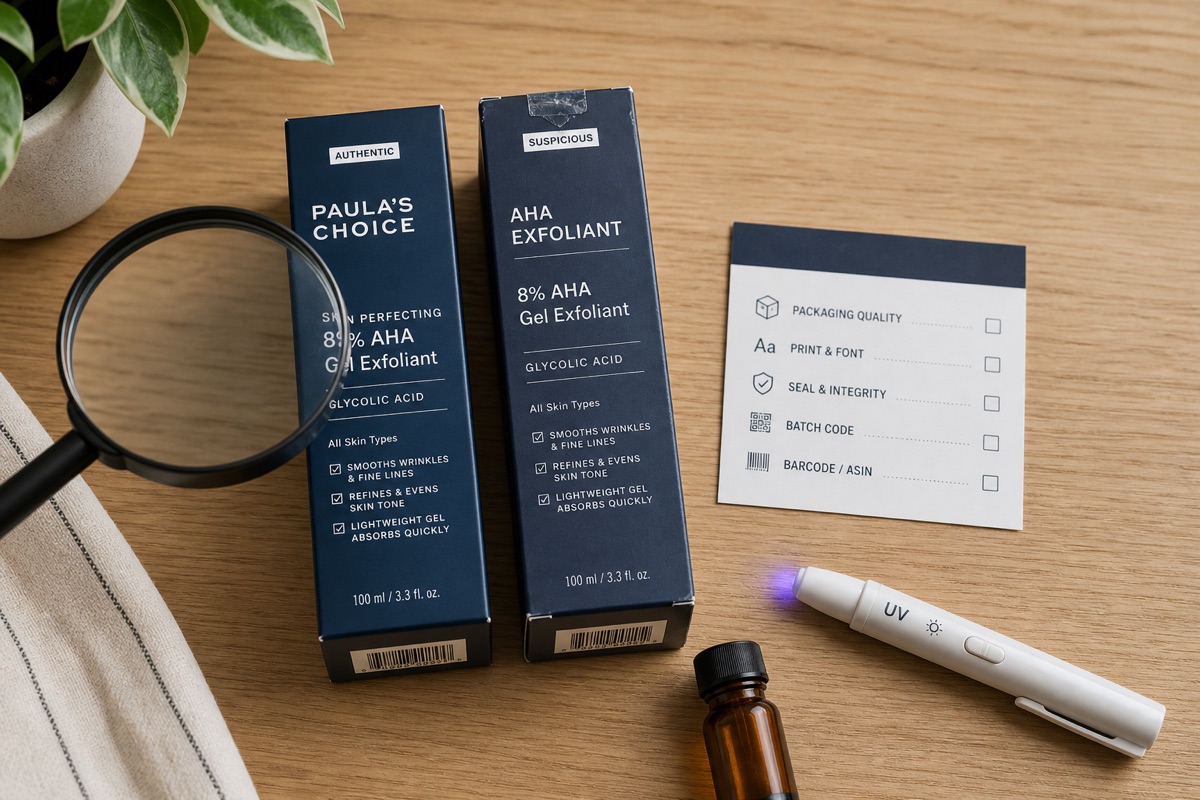
How to Spot Fake AHA Exfoliants on Amazon
An evidence-led checklist for buying AHA exfoliants on Amazon without ending up with diluted, expired, diverted, or counterfeit acid skincare.
We analyzed 18,747 Amazon ratings across 4 AHA exfoliants, FDA AHA safety guidance, PubMed photoaging research, Amazon anti-counterfeiting policies, and brand ingredient pages. The fastest fake-spotting check is: verify the ASIN, seller, seal, acid percentage, pH clues, and review pattern before applying it.
Editor's top Amazon picks for this guide
Real Amazon products that match this protocol. Affiliate links — your purchases support BeautySift.

Paula's Choice
Paula's Choice Skin Perfecting 8% AHA Gel Exfoliant
$37
"Best recognizable leave-on AHA benchmark: disclosed 8% glycolic acid positioning, official US brand reference, and 4.4/5 across 3,691 Amazon ratings."
What real Amazon buyers say
4.4★· 3,691 reviews"I absolutely adore this stuff. I have had skin issues and blemishes for over a decade and my skin is finally much clearer than I ever thought possible and that is completely thanks to chemical exfoliation."
"Seems to work well, but pay attention to the size of the purchase. Picture can be a little misleading."

Good Molecules
Good Molecules Overnight Exfoliating Treatment
$5.93
"Best budget AHA/BHA example for listing checks: official brand reference, clear acid positioning, and 4.6/5 across 6,396 Amazon ratings."
What real Amazon buyers say
4.6★· 6,396 reviews"It is the perfect strength exfoliant, its strong, but not so strong that its irritating. Its perfect to use 1-3 times per week and see good results."
"This is such an easy overnight exfoliating serum at a great price point. If you don't over-do it, only use it 2-3 times a week, don't use other acids, and moisturize/sunscreen well"

COSRX
COSRX 7% Glycolic Acid Whitehead Removing Power Liquid
$15.13
"Best low-fragrance toner-style AHA example: 7% glycolic acid positioning, official product-page reference, and 4.4/5 across 2,949 Amazon ratings."
What real Amazon buyers say
4.4★· 2,949 reviews"I have been using this for awhile now, and purposely waited a month or better to review this product to give a more accurate review."
"Oh man, it's like a love and hate relationship with this product. The first month of using this product, I broke out on places that I never broke out before."

Pixi
Pixi Glow Tonic 5% Glycolic Acid
$28.99
"Best familiar 5% glycolic-acid toner example for checking size, seller, and package consistency; 4.6/5 across 5,711 Amazon ratings."
What you'll learn
- A fake-looking AHA listing usually fails more than one check: seller identity, ASIN consistency, label details, seal condition, review pattern, or price logic.
- Do not patch-test a product that arrives unsealed, leaking, relabeled, oddly scented, separated, or packaged differently from the brand's current US listing.
- AHA strength matters because FDA guidance says alpha hydroxy acids can increase sun sensitivity, so vague or altered labels are not a small detail.
- For women 35-55 managing dullness and hyperpigmentation, the safer Amazon path is to buy recognizable AHA products from stable listings and introduce them slowly.
Steps
-
1 Check the exact ASIN and product title before price
Start with the 10-character ASIN in the Amazon URL, then compare the product title, size, acid type, and brand spelling against the official US brand page. A suspiciously cheap bottle is not a deal if the listing swaps glycolic acid for a vague exfoliating toner, changes the size, or bundles an unfamiliar variation under the same review history.
-
2 Verify the seller and fulfillment trail
Prefer listings sold by Amazon, the brand, or an obvious authorized storefront. Fulfillment by Amazon only means Amazon handles shipping; it does not automatically prove the inventory source. If the seller name is a random marketplace shop, the recent reviews mention old packaging, or the product page has mixed sizes and formulas, treat that as a risk signal.
-
3 Compare the label, seal, and acid details before opening
AHA products need clear identity: glycolic acid, lactic acid, mandelic acid, or another alpha hydroxy acid; directions; warnings; and a batch or lot code. Do not use a bottle that arrives without an intact seal, has a crooked relabel, smells rancid, has sediment that the brand does not mention, or lacks the sun-sensitivity warning expected on an acid exfoliant.
-
4 Read review patterns like an evidence analyst
Look past the star average. Stronger signals include long-term verified-purchase reviews, consistent texture and packaging descriptions, and complaints that match a real product's known tradeoffs. We down-weight listings where many reviews discuss unrelated products, where the review dates cluster unnaturally, or where five-star language is generic and says nothing about the acid, texture, seal, or use frequency.
-
5 Patch-test only after the listing passes the audit
If the product passes the Amazon checks, use it like a new acid: patch-test, then start 1 to 2 nights weekly, separate it from retinol at first, moisturize, and use sunscreen daily. If the first application burns sharply, causes swelling, or feels unlike a previous bottle of the same product, rinse and stop.
Bottom line
Fake or questionable AHA exfoliants on Amazon are not always obvious. The bottle may look close enough, the price may look plausible, and the listing may carry thousands of reviews. The safer approach is a repeatable audit: verify the ASIN, seller, official product details, seal, acid information, and review pattern before the product touches your face.
BeautySift did not test these products in a lab. We analyzed 18,747 Amazon ratings across four AHA exfoliant listings, visible verified-purchase review excerpts, FDA alpha hydroxy acid guidance, PubMed-indexed AHA research, Amazon anti-counterfeiting policy pages, official brand product pages, and ingredient-level acid logic. We may earn a commission from Amazon links, but affiliate status does not influence product selection or evidence weighting.
For US women 35-55, the stakes are practical. AHAs can be useful for dullness, rough texture, and uneven-looking tone, but mature skin is often drier, more retinoid-exposed, and less forgiving of mystery formulas. A counterfeit, old, or diverted acid product is not just an annoying purchase; it can create burning, barrier disruption, and weeks of routine repair.
Why AHA authenticity matters more than a normal moisturizer check
Alpha hydroxy acids are active exfoliants. Glycolic acid, lactic acid, mandelic acid, and related AHAs work partly by loosening dead surface-cell buildup. That is why they show up in routines for dullness, rough patches, and visible uneven tone. It is also why the label details matter.
The FDA’s consumer page on alpha hydroxy acids states that AHA products can increase sun sensitivity and should be used with sun protection. That is a numeric-adjacent safety issue in real life: even a mild 5% glycolic toner belongs in a sunscreen-aware routine, while an unverified bottle with unclear acid strength is not something to casually try on a Tuesday night.
PubMed adds context for why shoppers seek AHAs in the first place. Ditre et al. published a 1996 Journal of the American Academy of Dermatology pilot study on AHAs and photoaged skin, while Van Scott, Ditre, and Yu published a 1996 Clinical Dermatology review on AHAs for signs of photoaging. BeautySift treats that evidence as support for the category, not proof that every Amazon listing is authentic or appropriate for every face.
Step 1: Start with the ASIN, not the discount
Every Amazon product detail page has a 10-character ASIN. In the four product examples we analyzed, the ASINs were B00949CO66 for Paula’s Choice Skin Perfecting 8% AHA Gel Exfoliant, B08TMDRF1L for Good Molecules Overnight Exfoliating Treatment, B00OZ9WOD8 for COSRX 7% Glycolic Acid Whitehead Removing Power Liquid, and B00KH6QX08 for Pixi Glow Tonic 5% Glycolic Acid.
That ASIN should match the exact product, size, and formula you intended to buy. A common Amazon confusion point is a listing that combines multiple sizes, old packaging, or related products under one review umbrella. That does not automatically mean the item is fake, but it does mean you should slow down. If the title says glycolic acid, the image says AHA/BHA, and the variation menu quietly changes the size or product family, you are no longer making a clean purchase decision.
Price is a later check. Good Molecules showed a $5.93 Amazon snapshot in our review, while Paula’s Choice showed $37.00. A low price can be legitimate for a budget brand, a sale, or a small bottle. A suspicious price becomes more concerning when the seller is unfamiliar, the size is unclear, or the reviews describe packaging that no longer matches the brand’s US page.
Step 2: Treat seller identity as evidence
Look for who sells the product, not only who ships it. Amazon’s Brand Registry and Counterfeit Crimes Unit pages show that Amazon has formal systems for brand protection and counterfeit enforcement. Those programs matter, but they do not remove your job as a shopper: a marketplace with many sellers still requires listing-level judgment.
A safer AHA purchase usually has one of three seller signals: sold by Amazon, sold by the brand, or sold by an obvious authorized storefront. Fulfilled by Amazon is useful for shipping, but it is not the same as sold by the brand. If the seller name looks random, has little store history, or changes between visits, that is a reason to pause.
For products with strong brand recognition, cross-check the official US product page. Paula’s Choice lists its Skin Perfecting 8% AHA Gel Exfoliant on its official site. Good Molecules lists Overnight Exfoliating Treatment on its official site. COSRX lists AHA 7 Whitehead Power Liquid on its official site. If the Amazon page makes claims, sizes, or ingredient promises that do not line up with the official brand page, the Amazon listing has to earn back your trust before you buy.
Step 3: Inspect the label before you break the seal
Do this while the product is still returnable. A legitimate AHA exfoliant should make the acid identity reasonably clear: glycolic acid, lactic acid, mandelic acid, citric acid, or a branded AHA blend. It should also include directions, warnings, ingredients, and a lot or batch code. You do not need to be a cosmetic chemist to notice a crooked relabel, missing seal, leaking cap, scratched-off batch code, or box that looks like it was reopened.
Scent and texture are secondary checks, not proof by themselves. Acid products can smell a little sharp, and brands do update packaging. But a rancid odor, unusual separation, gritty sediment not mentioned by the brand, watery texture in a product that should be a gel, or a bottle that looks previously handled should be treated as a stop sign.
Do not rationalize the warning away because you want the brightening benefits. Dullness and hyperpigmentation are slow concerns; a questionable acid can create a fast barrier problem. If you are already using retinol, prescription acne medication, benzoyl peroxide, or strong vitamin C, your margin for error is smaller.
Step 4: Read Amazon reviews for product-specific detail
Star averages help, but they are not enough. In our product snapshot, Pixi Glow Tonic carried 4.6/5 across 5,711 Amazon ratings, Good Molecules Overnight Exfoliating Treatment carried 4.6/5 across 6,396 ratings, COSRX AHA 7 carried 4.4/5 across 2,949 ratings, and Paula’s Choice 8% AHA Gel carried 4.4/5 across 3,691 ratings. Those numbers tell you the listings have volume; they do not prove that every seller on every day is equally safe.
Read the most recent verified-purchase reviews first. Useful reviews mention concrete details: the seal, size, texture, how often the reviewer used it, whether it stung, whether the bottle matched prior purchases, and whether the formula seemed too strong or too weak. BeautySift down-weights generic five-star comments that could describe any toner.
Also read the one-star and two-star reviews. You are not looking for drama; you are looking for patterns. One complaint about shipping damage is different from ten recent complaints about broken seals, missing boxes, unusual smell, old stock, or a product that looks different from prior orders. For acids, consistency matters more than optimism.
Step 5: Know what a reasonable AHA routine looks like after 35
Once the listing passes the audit, introduce the product slowly. AHA exfoliants do not need daily use to be useful. Good Molecules review excerpts visible on Amazon repeatedly referenced 1 to 3 times weekly use; that aligns with a cautious beginner rhythm even though individual tolerance varies.
Use the acid at night, moisturize, and wear sunscreen every morning. The FDA’s AHA guidance is the reason BeautySift treats sunscreen as part of the purchase decision, not a nice extra. If you are not willing to use SPF consistently, an AHA is the wrong brightening tool for now.
For women 35-55, separate irritation from progress. A little transient tingle can happen with AHAs. Sharp burning, swelling, welts, persistent redness, or new raw patches are not a glow phase. Stop, rinse, moisturize, and let the barrier recover. If symptoms are severe or persistent, contact a clinician.
Product examples that fit the audit protocol
Paula’s Choice Skin Perfecting 8% AHA Gel Exfoliant is the most useful audit benchmark because the acid percentage, product role, and official brand page are easy to compare. Amazon showed 4.4/5 across 3,691 ratings. The downside is price: at a $37.00 snapshot, it is expensive enough that counterfeit or diverted-stock concerns deserve attention. Check seller identity and size before buying.
Good Molecules Overnight Exfoliating Treatment is the budget example. Amazon showed 4.6/5 across 6,396 ratings and a $5.93 snapshot price. The low price is not automatically suspicious because Good Molecules is a budget brand, but it makes the size, seller, and packaging checks more important. Use it as a reminder that inexpensive can be legitimate when the listing details line up.
COSRX 7% Glycolic Acid Whitehead Removing Power Liquid is a toner-style AHA example. Amazon showed 4.4/5 across 2,949 ratings, and the official COSRX page gives a brand reference point for product identity. Because imported K-beauty products can have packaging updates, compare the formula name, size, and seal rather than assuming every visual difference means fake.
Pixi Glow Tonic 5% Glycolic Acid is the familiar drugstore-style toner example. Amazon showed 4.6/5 across 5,711 ratings. Its popularity is helpful for review volume, but popularity can also attract confusing marketplace listings. Check that the bottle size, seller, and product name match the 5% glycolic acid toner you intended to buy.
Red flags that should make you skip the bottle
Skip the product if the seller is random and the price is far below the brand norm, the title and image disagree, the listing combines unrelated formulas, the box arrives without a seal, the batch code is missing or scratched off, or recent reviews mention old stock. One red flag may have an innocent explanation. Three red flags are enough to move on.
Also skip if the acid details are vague. Phrases like brightening toner or resurfacing liquid are not enough if you cannot identify the acid, the product type, and the intended use. For hyperpigmentation and dullness, patience is safer than mystery strength.
If you already own the product and something feels off, do not patch-test your way through doubt. Amazon returns are easier than repairing an irritated barrier. Photograph the issue, contact Amazon, report the listing if appropriate, and buy from a cleaner source.