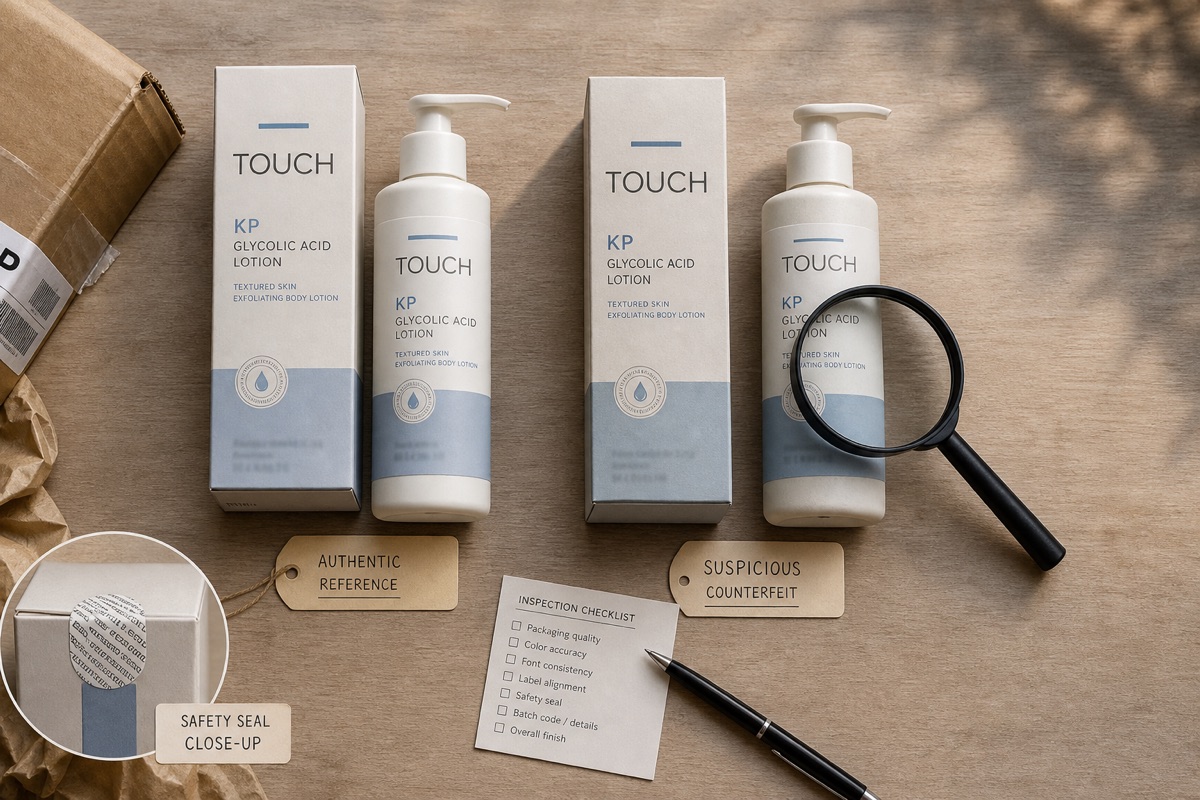
How to Spot Fake KP Body Exfoliants on Amazon
A step-by-step US shopper guide to spotting counterfeit or risky KP body exfoliants on Amazon before you put acids on dry, bumpy skin.
We analyzed 39,496 Amazon ratings across 4 KP-focused body exfoliants, Amazon's anti-counterfeiting policy, FDA cosmetic-label guidance, and 2 PubMed KP reviews. To spot a fake, verify the ASIN, seller, packaging photos, active-acid claims, return pattern, and review history before buying.
Editor's top Amazon picks for this guide
Real Amazon products that match this protocol. Affiliate links — your purchases support BeautySift.

TOUCH
TOUCH Glycolic Acid Lotion
$29.95
"Best leave-on example for verifying acid claims: the Amazon snapshot lists 4.3/5 across 24,171 ratings and the page identifies glycolic-acid KP body lotion."

DERMAdoctor
DERMAdoctor KP Bump Eraser Body Scrub
$23.86
"Best physical-plus-acid scrub example: the Amazon snapshot lists 4.5/5 across 1,361 ratings and the brand positions it around 10% AHAs plus PHAs."

CeraVe
CeraVe Body Wash with Salicylic Acid
$13.99
"Best fragrance-free wash example for cautious routines: the Amazon snapshot lists 4.6/5 across 12,631 ratings and clear salicylic-acid positioning."

AmLactin
AmLactin Bright and Smooth Resurfacing Serum
$19.99
"Best lactic-acid-adjacent routine example: the Amazon snapshot lists 4.4/5 across 1,333 ratings for a resurfacing body serum."
What you'll learn
- Start with the exact Amazon ASIN and seller line; counterfeit risk rises when the page mixes similar-looking bottles, bundles, or unknown third-party sellers.
- KP exfoliants use acids, urea, or physical scrub particles, so packaging, seal, ingredient-list, and texture changes deserve more caution than a basic body wash.
- A too-low price, no recent verified-review pattern, altered label, misspelled brand name, or vague active-acid claim is enough reason to skip the listing.
- For dry mature skin, the safer protocol is gentle consistency: exfoliate less often, moisturize more often, and stop if burning or rash appears.
- Use Amazon only as one evidence point; compare the listing against the brand's US site and FDA-style cosmetic labeling basics before ordering.
Steps
-
1 Match the product name, ASIN, size, and seller before reading reviews
Open the Amazon listing and verify four basics before judging the star rating: exact product name, 10-character ASIN, bottle or tube size, and the seller line near the buy button. Counterfeit and gray-market risk often starts when a familiar product name is attached to a different size, a bundle page, or a seller that is not Amazon or the brand's authorized storefront.
-
2 Compare the label against the brand's US product page
Use the brand's US site as the reference photo. Check logo placement, front-label claims, net quantity, ingredient order, warnings, and directions. The FDA Cosmetics Labeling Guide describes basic cosmetic labeling expectations; a misspelled label, missing business information, or blurry ingredient panel is a practical red flag.
-
3 Interrogate acid claims instead of trusting the word KP
KP-focused exfoliants often use glycolic acid, lactic acid, salicylic acid, urea, PHA, or physical scrub particles. If a listing says 20% acid but the brand page does not, treat the Amazon claim as suspect. If the active type is missing entirely, do not assume the product is equivalent to the original.
-
4 Read the review pattern, not just the average star rating
Look for recent verified-purchase reviews that mention packaging, seal, scent, texture, and irritation. A high average rating can still hide seller changes, old stock, or unrelated review pooling. Prioritize reviews from the last 6 to 12 months and compare them with the rating count shown on the current ASIN.
-
5 Check delivery condition before applying it to bumpy or dry skin
When the package arrives, inspect the outer box, safety seal, lot code, expiration or period-after-opening mark, color, scent, and texture. Do not use a body acid if the seal is broken, the product smells rancid, the texture separates oddly, or the label does not match the product page.
-
6 Patch test and use the lowest reasonable frequency
KP-prone skin is often dry and easily over-exfoliated. Patch test on a small body area, wait 24 hours, then start 1 to 3 times weekly depending on the formula and your skin tolerance. Stop if burning, swelling, rash, cracking, or persistent stinging appears.
Bottom line
Fake or questionable KP body exfoliants are not just an annoyance. They are a higher-stakes beauty purchase because the category often includes glycolic acid, lactic acid, salicylic acid, urea, PHA, or scrub particles used on already dry, rough, bumpy skin. A counterfeit lipstick may be disappointing; a mislabeled body acid can sting, over-exfoliate, or make a barrier problem worse.
BeautySift did not test these products on a panel. We analyzed Amazon US rating snapshots for four KP-relevant products, Amazon’s anti-counterfeiting guidance, FDA cosmetic-label guidance, official brand positioning, INCI patterns, and PubMed-indexed keratosis pilaris literature. We may earn a commission on Amazon links, but affiliate status does not affect which red flags we include.
The practical answer: do not start with the star rating. Start with the listing identity. Confirm the ASIN, seller, product size, brand photos, ingredient panel, active-acid claim, and review pattern before you put the product on your arms, thighs, or legs.
Why KP exfoliants require more scrutiny than ordinary body lotion
Keratosis pilaris is commonly discussed as rough, bumpy texture around hair follicles, often on upper arms, thighs, cheeks, or buttocks. PubMed-indexed reviews in 2023 and 2025 describe keratolytics such as alpha hydroxy acids, beta hydroxy acids, and urea as common topical strategies, though evidence quality varies by ingredient and study design. That matters for Amazon shopping because the products are not all interchangeable.
A KP body scrub can combine friction with acids. A KP body lotion may be leave-on and used several nights a week. A salicylic-acid body wash has shorter contact time but can still dry skin if overused. For US women 35-55, this overlaps with a skin reality many shoppers already know: body skin can feel drier, itchier, or slower to recover than it did in the 30s, especially in Midwest winter air, Southwest dryness, or after frequent shaving.
The FDA Cosmetics Labeling Guide is not a counterfeit detector, but it gives shoppers a useful baseline. Cosmetic labels should identify the product, net quantity, manufacturer or distributor, and ingredients. If an Amazon listing shows a bottle with missing business information, an oddly cropped ingredient panel, or wording that does not match the brand’s US product page, treat that as a stop sign.
Step 1: Verify the exact ASIN and seller line
Every Amazon product detail page has a 10-character ASIN. The ASIN in the URL should match the product you intend to buy, not a bundle, refill, travel size, old packaging page, or unrelated variation. This is especially important when a listing has many options under one parent page. Review pooling can make a page look stronger than the exact item deserves.
Next, check the seller line near the buy button. Prefer “Sold by Amazon” or the brand’s official Amazon storefront when available. If the seller is an unfamiliar third party, pause. Third-party sellers are not automatically fake, but the burden of proof is higher for acid body care. Search the seller name, review their storefront history, and check whether the same product is available from the brand’s official storefront.
Amazon’s own anti-counterfeiting overview says the company uses brand protection and enforcement systems, but shoppers still see multiple sellers, marketplace pages, and changing inventory. That is why the protocol is practical rather than paranoid: verify the seller before the star rating.
Step 2: Compare packaging against the brand’s US page
Open the brand’s US product page in a second tab. Compare the front label, cap color, size, direction text, warning language, ingredient panel, and claims. A real package may change over time, but the listing should not show a random collage of old and new labels without explanation.
Pay attention to acid percentages. DERMAdoctor’s KP Bump Eraser Body Scrub, for example, is positioned around 10% AHAs plus PHAs, and the Amazon snapshot we reviewed listed 4.5/5 across 1,361 ratings. If a different listing claims a stronger percentage, a different acid blend, or a miracle timeframe the brand does not support, do not treat that as an upgrade. Treat it as a mismatch.
Also check size. A product sold as 8 fl oz should not arrive looking like a travel tube. A listing that hides the size in fine print, uses stock photos from several products, or has inconsistent ounce claims is not worth the savings.
Step 3: Interrogate the active ingredient story
KP exfoliants usually fall into a few buckets. Glycolic and lactic acids are alpha hydroxy acids used for surface exfoliation. Salicylic acid is a beta hydroxy acid often used in body washes and acne-adjacent body care. Urea can support smoothing and water binding at cosmetic strengths. PHA formulas tend to be positioned as gentler acid options. Physical scrubs rely on particles and friction, sometimes paired with acids.
TOUCH Glycolic Acid Lotion is a useful leave-on example because the Amazon page we analyzed listed 4.3/5 across 24,171 ratings and clearly positioned the product as a glycolic-acid KP body lotion. That does not prove every seller is equally safe forever; it tells you what to verify. The acid story should be clear, consistent, and aligned with the brand’s own product identity.
Be skeptical of listings that overpromise. Cosmetic body exfoliants can help skin feel smoother, but they should not claim to cure a medical condition, erase bumps overnight, or replace medical care. PubMed literature supports keratolytics as common KP strategies, not as instant cures. If the listing language sounds more like a miracle treatment than a cosmetic exfoliant, skip it.
Step 4: Read reviews for seller and packaging clues
A star rating is a starting point, not proof of authenticity. CeraVe Body Wash with Salicylic Acid had the highest rating snapshot in our featured set, 4.6/5 across 12,631 Amazon ratings. That large footprint is useful, but you still need to read recent reviews for packaging, seal, scent, texture, and seller changes.
Filter for recent reviews. Look for phrases such as “seal was missing,” “smells different,” “watery,” “old packaging,” “not the same as the bottle from Target,” or “arrived leaking.” One or two shipping complaints are not definitive. A pattern across recent verified reviews is more serious.
Also watch for review pooling. If a page includes reviews for body wash, lotion, scrub, and bundle variations, the average may not represent the exact item in your cart. That is why the ASIN and variation choice matter more than the headline number.
Step 5: Avoid the too-cheap-to-be-real trap
Price alone does not prove a fake, but extreme discounting should slow you down. Compare Amazon with the brand’s US site and major US retailers. If a KP acid lotion normally sits around a midrange body-care price and one seller offers it for a fraction of that without clear brand authorization, ask why.
The better value move is not always the lowest sticker price. A questionable acid product can cost more if it irritates your skin, forces a return, or makes you stop exfoliating altogether. For dry mature skin, predictability is worth something.
AmLactin Bright and Smooth Resurfacing Serum, with 4.4/5 across 1,333 Amazon ratings in our snapshot, is an example of a body resurfacing product where shoppers should compare active positioning, size, and bottle identity carefully. Lactic-acid-adjacent body care is popular because it feels practical for rough texture, but popularity also creates copycat incentives.
Step 6: Inspect the product before the first patch test
When the package arrives, do not apply it immediately after a shower. Inspect it first. Check whether the seal is intact. Look for a lot code, expiration date if provided, or period-after-opening symbol. Compare the scent and texture with what the brand describes. A separated acid lotion, rancid smell, broken seal, or label that differs from the listing photos is enough reason to stop.
Patch test on a small body area, not on freshly shaved skin and not on already irritated skin. Wait 24 hours. If the area burns, swells, develops rash, or stays tender, do not proceed. If it passes, start slowly: 1 to 3 times weekly for leave-on acids or scrubs, less often if your skin is dry or reactive.
Do not stack every smoothing product at once. A salicylic-acid wash plus glycolic lotion plus scrub plus retinol body lotion is too much for many people. KP routines work better when exfoliation is consistent and boring, with a plain moisturizer used more often than the acid.
Product examples that fit the safer-shopping protocol
Use these as verification examples, not as proof that every marketplace seller is safe forever.
TOUCH Glycolic Acid Lotion is the strongest leave-on acid example in this set because the Amazon snapshot showed 24,171 ratings at 4.3/5, and the listing clearly identifies a glycolic-acid lotion for rough and bumpy skin. It is the kind of product where ASIN, seller, and ingredient-claim consistency matter because it stays on the body.
DERMAdoctor KP Bump Eraser Body Scrub is the best scrub verification case. The Amazon snapshot showed 1,361 ratings at 4.5/5, and the official positioning centers on AHA and PHA exfoliation. Scrubs are especially important to verify because fake or altered textures can create too much friction.
CeraVe Body Wash with Salicylic Acid is the cautious wash example. The Amazon snapshot showed 12,631 ratings at 4.6/5, and the formula is positioned as fragrance-free. A wash is not automatically gentler for everyone, but shorter contact time can be easier to control than a nightly leave-on acid.
AmLactin Bright and Smooth Resurfacing Serum is a resurfacing-serum example for shoppers who want a lotion-style body step. The Amazon snapshot showed 1,333 ratings at 4.4/5. As with any body active, compare the bottle, size, label language, and seller before adding it to cart.
When to skip Amazon and buy elsewhere
Skip the Amazon listing if the seller is unclear, the product page mixes multiple formulas, recent reviews mention broken seals or changed scent, the price is dramatically below normal, or the ingredient panel conflicts with the brand’s US site. Also skip if you cannot confirm the ASIN in the URL or if the listing relies on vague language such as “professional strength” without matching brand support.
Buy from the brand site, Sephora, Ulta, Target, Walmart, or another major US retailer when authenticity matters more than speed. That is especially sensible if you have sensitive skin, a history of eczema, a compromised barrier, or a recent bad reaction to acids.
The point is not to avoid Amazon entirely. The point is to treat Amazon as a marketplace that requires verification, particularly for acid body care used on dry, bumpy, or easily irritated skin.