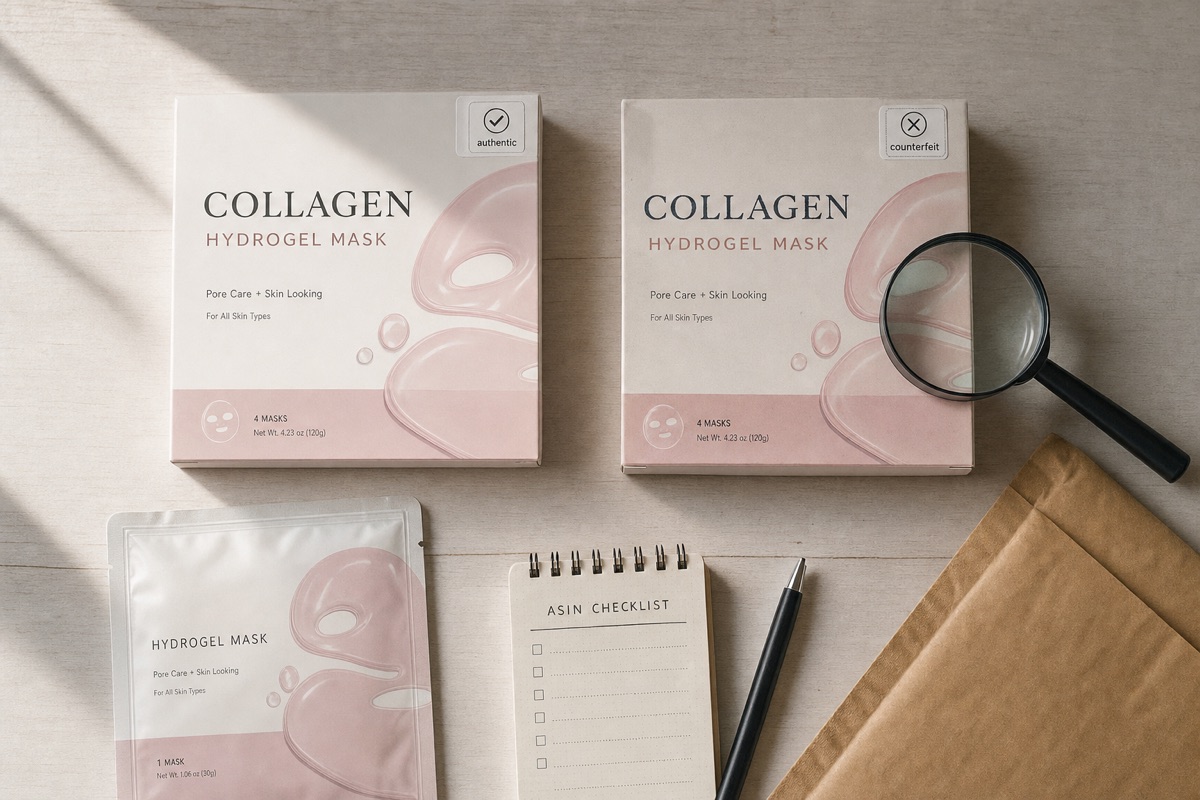
How to Spot Fake Collagen Masks on Amazon Before You Buy
A practical US shopper guide to checking collagen face masks on Amazon, with FDA labeling rules, Amazon review signals, and safer product examples.
To spot fake collagen masks on Amazon, verify the ASIN, seller, label, reviews, and price against FDA cosmetic-labeling basics and the brand listing. We analyzed 52,066 Amazon ratings across 3 collagen mask ASINs plus FDA labeling guidance and PubMed skin-hydration literature.
Editor's top Amazon picks for this guide
Real Amazon products that match this protocol. Affiliate links — your purchases support BeautySift.

BIODANCE
Bio-Collagen Real Deep Mask, 4 Count
$19
"High-volume Amazon listing with 4.5/5 across 44,146 ratings in our May 2026 snapshot; best for checking a popular hydrogel mask with seller visibility."
What real Amazon buyers say
4.5★· 44,146 reviews"These lovely face masks are such a treat! They’re refreshing, non irritating, easy to put on and make my 61 year old skin smooth and glowy!"
"It leaves my skin feeling soft, plump, and refreshed by morning with a nice healthy glow. Great for a quick moisture boost and smoother-looking skin!"

Mediheal
Collagen Essential Face Mask, 10 Sheets
$14.99
"Amazon snapshot showed 4.6/5 across 1,580 ratings and a named seller, making it a useful comparison point for brand and pack-count verification."
What real Amazon buyers say
4.6★· 1,580 reviews"I've been using face masks since I was little. I've tried lots of different brands and ingredients. This is my self care item"
"This Mediheal Collagen Essential Face Mask is a total skin reset in a pouch. From the first use, my skin felt noticeably firmer, smoother, and deeply hydrated."

Ebanel
10 Pack Collagen Face Mask with Hyaluronic Acid
$13.99
"Amazon snapshot showed 4.4/5 across 6,340 ratings and brand seller visibility; useful for evaluating ingredient-photo and review-specificity signals."
What real Amazon buyers say
4.4★· 6,340 reviews"I keep these sheet masks on hand for days when my skin feels tired and I don’t want to overthink my routine."
"These masks are just wonderful! The thick hydrogel hugs your face snugly, holds more liquid and stays moister far longer than the paper type sheet masks"
What you'll learn
- A real-looking Amazon listing can still be risky if the seller name, ASIN history, label details, and review pattern do not line up.
- Collagen masks are mainly hydration and temporary plumping products; PubMed literature does not support treating them like wrinkle procedures.
- For skin after 40, skip suspiciously cheap multipacks, missing ingredient photos, medical claims, and listings with review hijacking signals.
- Buying from a brand storefront or clearly named brand seller lowers risk, but you should still check packaging and return eligibility.
Steps
-
1 Check the ASIN, seller, and brand storefront first
Open the Amazon listing, copy the 10-character ASIN from the URL, and confirm that the product title, brand, and pack count match the brand page or storefront. Give more weight to listings sold by the brand, Amazon, or a clearly named authorized distributor. If the same photos appear under multiple unrelated brands, or the seller name looks unrelated to the beauty brand, treat the mask as higher risk.
-
2 Compare the label to FDA cosmetic-labeling basics
FDA cosmetic-labeling guidance says US cosmetics must not be misbranded and should provide accurate identity, quantity, business, warning, and ingredient information. For collagen masks, look for a full ingredient list, net contents, distributor details, and usage directions in listing images or packaging photos. Missing label photos are not proof of a fake, but they reduce confidence.
-
3 Read the review pattern, not just the star average
A high average can hide review hijacking or formula swaps. Sort reviews by most recent, look for repeated wording, mismatched product photos, sudden changes in product type, and complaints about leaking, scent, burning, or packaging that differs from the listing image. We give more confidence to listings with thousands of category-specific reviews and recent verified-purchase comments that mention the exact mask.
-
4 Question claims that sound medical or too permanent
A collagen sheet or hydrogel mask can support temporary hydration and a smoother look, but it should not claim to rebuild dermal collagen, erase deep wrinkles, or treat skin disease. PubMed reviews describe topical collagen as helpful for hydration while being unlikely to replace endogenous collagen. Treat aggressive anti-aging claims as a shopping red flag.
-
5 Inspect the item when it arrives before applying it
Before the first use, compare the box, pouch, lot code, scent, texture, expiration date, and seal with listing photos. Do not apply a mask from a damaged pouch, leaking package, missing lot code, or product that smells rancid or unusually perfumed. If you suspect a fake, photograph the listing and package, contact Amazon, and avoid patch-testing a product you already distrust.
Quick answer
Fake collagen masks on Amazon usually reveal themselves through mismatched seller details, vague packaging photos, review patterns that do not match the product, or claims that go beyond what a cosmetic mask can do. We analyzed 52,066 Amazon ratings across three collagen-mask ASINs, FDA cosmetic-labeling guidance, and two PubMed reviews. The safest approach is not to hunt for the cheapest collagen mask; it is to verify the seller, label, ASIN, reviews, and claims before the mask touches your face.
This matters more for women 35-55 because mature skin is often drier, more reactive, and less forgiving of mystery fragrance, poorly preserved essence, or damaged packaging. A counterfeit or diverted mask is not just a wasted purchase. It can mean an unknown formula sitting under occlusion for 10 minutes, 30 minutes, or overnight.
Why collagen masks are easy to fake
Collagen masks are visually simple: a pouch, a wet sheet or hydrogel, and a beauty claim. That makes them easier to copy than a pump bottle with complex molding or a prestige jar with batch engraving. A fake or low-quality lookalike can borrow a brand’s colors, mimic a product title, and compete mainly on price.
The other problem is expectation. Collagen sounds like structure, firmness, and fine-line repair. But PubMed-listed review literature is more cautious. Sen et al. 2025 states that topical collagen can improve skin hydration but is unlikely to replace endogenous collagen. In plain English: a good collagen mask may make skin look plumper because it hydrates the surface; it should not promise to rebuild the collagen network in your dermis.
That distinction is your first authenticity filter. A legitimate cosmetic mask usually talks about hydration, comfort, glow, and temporary plumping. A questionable listing may claim permanent wrinkle removal, medical repair, or results that sound closer to injectables than skincare.
Step 1: Verify the ASIN and seller before the price
Start with the Amazon URL. A real Amazon product detail page contains a 10-character ASIN after /dp/ or /gp/product/. Copy it, then look at the product title, brand, size, and pack count. If a listing title says one brand but the store name, seller name, or images suggest another, slow down.
For this guide, the three product examples had visible ASINs and Amazon review snapshots: BIODANCE B0B2RM68G2 showed 4.5/5 across 44,146 ratings, Mediheal B09XWHB1HR showed 4.6/5 across 1,580 ratings, and Ebanel B01N37AK8V showed 4.4/5 across 6,340 ratings. Those numbers do not guarantee authenticity. They do give you a baseline to compare against a suspicious duplicate listing with only a handful of reviews, an altered title, or a seller that changes month to month.
Look for the seller box, not just the blue Buy Now button. Prefer listings sold by the brand, Amazon, or a named distributor that appears consistently across the brand’s Amazon storefront. A third-party seller is not automatically bad, but a seller with no beauty-brand connection deserves more scrutiny.
Step 2: Compare the label to FDA cosmetic basics
FDA cosmetic-labeling guidance says cosmetics marketed in the US must comply with the FD&C Act and the Fair Packaging and Labeling Act. For shoppers, that translates into a simple checklist: product identity, net quantity, ingredient list, business information, directions, and any needed warnings should be clear.
On Amazon, zoom into every packaging image. A trustworthy collagen-mask listing should show the pouch or box clearly enough that you can see the product name, pack count, and at least a plausible ingredient panel. If the listing only shows a model image, a floating mask, or heavily edited packaging with no back-of-pack view, your confidence should drop.
The label should also match the product type. A mask that claims collagen, retinol, vitamin C, peptides, and every trending active in one ultra-cheap pouch is not automatically fake, but it is a formula-positioning warning. More ingredients create more chances for irritation, especially around the eyes, nasolabial folds, and the neck.
Step 3: Read reviews like a fraud analyst
Do not stop at the star average. Sort by most recent and read the words. A healthy review pattern for a collagen mask includes comments about fit, dripping, scent, hydration, tackiness, pouch quality, and whether the mask irritated skin. A suspicious pattern includes generic one-line praise, repeated phrases, reviews that mention an unrelated product, or photos of packaging that does not match the current listing.
Amazon review snapshots in this guide show why specificity matters. BIODANCE reviewers mentioned overnight wear, glow, smoothness, and hydration. Mediheal reviewers discussed the 10-count collagen sheet format. Ebanel reviewers described the mask being well-soaked, cooling, and easy to keep stocked. Those details align with the product category.
Also read one-star and two-star reviews. Counterfeit or storage problems often show up there first: leaking pouches, unusual odor, burning, missing seals, dried-out sheets, or packaging that looks different from previous orders. A few complaints are normal in a high-volume beauty listing. Repeated complaints about packaging changes or skin burning are different.
Step 4: Watch for claim inflation
A collagen mask can be useful without being magical. For mature skin, hydration alone can make fine lines look softer because dehydrated skin creases more visibly. Lephart and Naftolin’s 2021 PubMed review connects estrogen-deficient skin with wrinkles, hydration changes, and barrier issues, which is one reason a comforting mask can feel especially appealing after 40.
But a mask is still a rinse-off or leave-on cosmetic sheet. It is not a medical treatment, not a filler, and not a collagen replacement procedure. Treat these phrases as red flags: “erases deep wrinkles,” “rebuilds collagen overnight,” “clinically cures sagging,” “works like injections,” or “guaranteed permanent lifting.”
If the claim sounds too aggressive for a $14.99 or $19.00 mask pack, compare it with the FDA framing of cosmetics. Cosmetics can cleanse, beautify, promote attractiveness, or alter appearance. They should not drift into drug-like disease or structure-function promises unless properly regulated for that use.
Step 5: Inspect the package before it touches your skin
Your final check happens at home. Before opening the pouch, compare the product to the Amazon listing images: logo placement, spelling, pack count, lot code, expiration date, seal, and pouch material. Look for leaking, swelling, broken seals, inconsistent printing, or a scent that seems rancid or unusually strong.
If you bought a product before and this shipment looks different, do not assume the brand simply changed packaging. Search the brand storefront, current Amazon images, and recent reviews to see whether other shoppers mention the same change. If you still feel unsure, contact Amazon and the seller before applying it.
For reactive skin, a patch test is sensible when the product seems legitimate but new to you. Apply a small amount of essence near the jaw or behind the ear and wait. But if you suspect the product is counterfeit, do not patch test it. Unknown preservation, contamination, or mislabeled fragrance is not worth the risk.
Safer product examples to use with this checklist
These are not lab-tested BeautySift picks. They are examples of Amazon listings that let you practice the protocol because they had identifiable ASINs, current rating snapshots, and enough review volume to analyze.
BIODANCE Bio-Collagen Real Deep Mask is the high-volume hydrogel example. Its Amazon snapshot showed 44,146 ratings and a $19.00 price for a 4-count pack. The reason to study this listing is popularity: fake-adjacent duplicates often try to imitate high-demand products, so you should be especially strict about seller, packaging, and review recency.
Mediheal Collagen Essential Face Mask is the sheet-mask comparison example. Its Amazon snapshot showed 1,580 ratings and a $14.99 price for 10 sheets. Use this kind of listing to compare pack count, seller naming, and whether reviewers mention the same format shown in the product title.
Ebanel 10 Pack Collagen Face Mask is the budget-check example. Its Amazon snapshot showed 6,340 ratings and a $13.99 price. Budget does not automatically mean fake, but the lower the price per mask, the more carefully you should review ingredient photos, seller continuity, and recent packaging complaints.
What to do if you suspect a fake
Do not apply it, even “just to see.” Photograph the Amazon listing, the shipping label, the seller name, the ASIN, the package front and back, the lot code, and any damage. Start with Amazon customer service and request a return or refund. If the product appears to be impersonating a real brand, send the photos to the brand’s customer-service email as well.
If you already used the mask and developed burning, swelling, eye irritation, or a rash, remove it immediately and rinse with cool water. Avoid retinoids, exfoliating acids, benzoyl peroxide, or vitamin C until skin feels normal again. Seek medical advice if symptoms persist or involve the eyes.
The point is not to become afraid of every Amazon skincare listing. The point is to buy like an evidence-led shopper: verify the product identity, question inflated claims, and never let a mystery pouch sit on your face because the discount looked good.