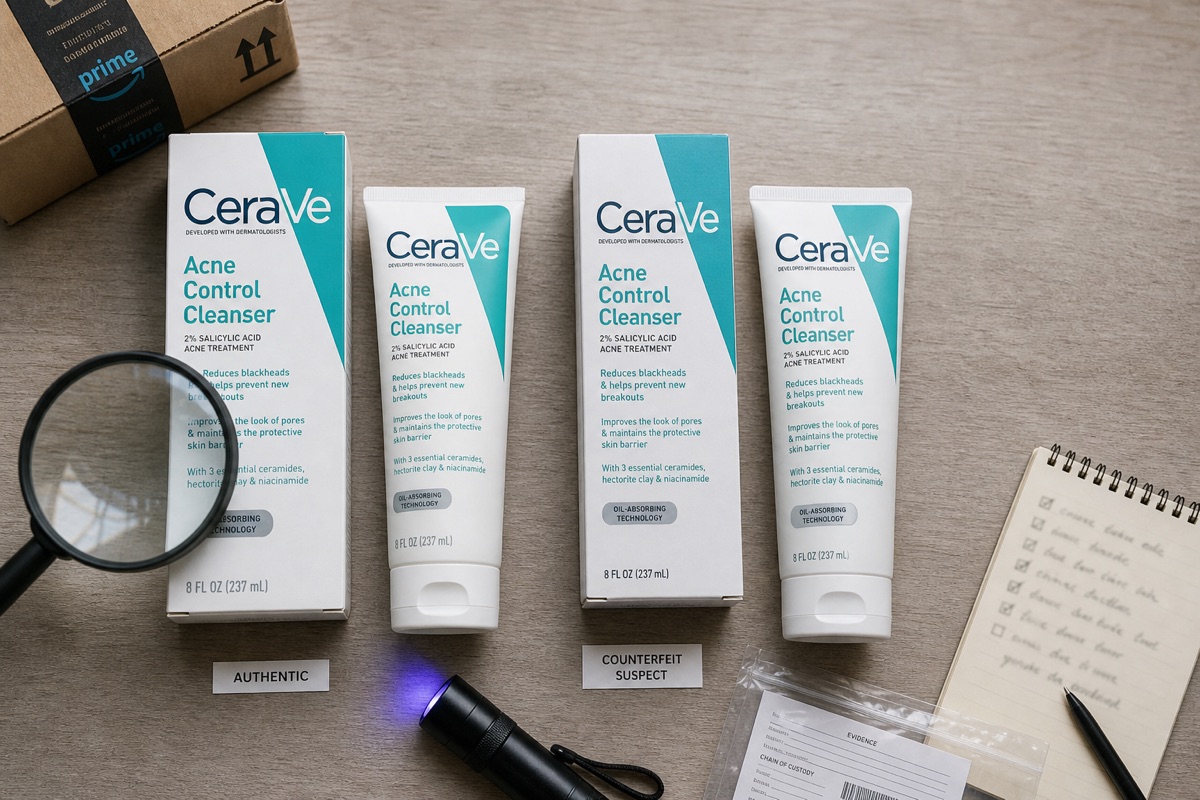
How to Spot a Fake Gel Face Cleanser on Amazon
A practical US shopper guide to spotting fake or unauthorized gel face cleansers on Amazon, with evidence checks, red flags, and safer acne-prone picks.
We analyzed 48,805 Amazon ratings across 3 acne-prone gel cleansers, Amazon Brand Registry guidance, FDA cosmetics safety pages, and CeraVe's authorized-seller advice: the safest buy is the listing with a real ASIN, brand store, intact seal photos, consistent packaging, and clear Ships from/Sold by details.
Editor's top Amazon picks for this guide
Real Amazon products that match this protocol. Affiliate links — your purchases support BeautySift.

CeraVe
CeraVe Acne Control Cleanser
$17.24
"Fragrance-free 2% salicylic acid gel cleanser with ceramides and niacinamide; Amazon snapshot shows 4.7/5 across 22,304 ratings."
What real Amazon buyers say
4.7★· 22,304 reviews"It foams nicely and leaves my skin feeling clean without that tight, stripped feeling."
"What she likes most is that it actually helps with acne without drying her skin out too much, which was her main issue with other cleansers."

La Roche-Posay
La Roche-Posay Effaclar Medicated Gel Cleanser
$18.99
"2% salicylic acid gel cleanser positioned for excess oil and breakouts; Amazon snapshot shows 4.6/5 across 19,573 ratings."
What real Amazon buyers say
4.6★· 19,573 reviews"I love this product and cannot rave about it enough! I have very sensitive skin and it has started to spot break out the older I get."
"I've been using this cleanser for oily and acne-prone skin, and it does a really good job removing excess oil without making my face feel overly dry."

Paula's Choice
Paula's Choice CLEAR Pore Normalizing Facial Cleanser
$16.78
"Fragrance-free acne-focused cleanser with a review snapshot of 4.6/5 across 6,928 Amazon ratings; useful for checking seal and packaging consistency."
What real Amazon buyers say
4.6★· 6,928 reviews"It was sealed on the outside, which is really important to me when dealing with skincare products."
"I've tried countless acne cleansers over the years, and this is the first one that strikes the perfect balance between effective and gentle."
What you'll learn
- Start with the seller box, not the star rating: brand-store links and Ships from/Sold by details matter more than a discount.
- Compare the bottle, pump, seal, lot code, ingredient list, and texture against the brand's US site before opening a gel cleanser.
- For hormonal-acne routines, a suspect cleanser is not worth the risk because the FDA notes cosmetics can be unsafe if contaminated.
- Keep screenshots and packaging photos before returning or reporting a suspicious Amazon skincare order.
Steps
-
1 Check the seller and ASIN before you look at the price
Open the product page, confirm the 10-character ASIN in the URL, then inspect the seller box for Ships from and Sold by details. CeraVe's US Where to Buy page specifically advises Amazon shoppers to buy CeraVe products designated Ships from and Sold by Amazon.com and says it cannot guarantee products shipped or sold by third parties. A low price is not enough evidence of a fake, but a steep discount plus an unfamiliar marketplace seller should move the listing into your skip pile.
-
2 Compare packaging against the brand's current US page
Use the brand's US website or Amazon Brand Store as your reference, not a random image search. Match size, cap color, pump style, claims, drug-facts or cosmetic labeling, fragrance-free wording, and the back-panel ingredient order. Gel cleansers often change packaging gradually, so one mismatch is not proof of a counterfeit. Multiple mismatches on a high-volume acne cleanser are a stronger warning sign.
-
3 Inspect the seal, lot code, and formula before using it
When the box arrives, photograph the front, back, seal, lot code, and seller label before opening. Do not use a cleanser if the safety seal is broken, the bottle leaks, the scent is unexpectedly strong, the gel is separated, or the label looks blurry. The FDA notes cosmetics may be unsafe if contaminated with harmful microorganisms, so do not patch-test a product that already looks tampered with.
-
4 Read reviews for authenticity clues, not just skin results
Sort recent Amazon reviews and search within reviews for terms such as fake, seal, expired, smell, bottle, texture, watery, and seller. Treat Reddit threads as anecdotal consumer signals, not proof about a specific listing. A pattern of recent packaging complaints is more useful than one angry review; a clean recent history is helpful but still not a guarantee.
-
5 Report, return, and restart with an authorized channel
If the product looks wrong, stop before use, save screenshots of the listing and seller, photograph the package, request an Amazon return, and report the listing through Amazon's product-page reporting tools. The FTC recommends keeping records for online-shopping problems and reporting unresolved issues at ReportFraud.ftc.gov. If your skin is already irritated, restart with a cleanser from the brand's authorized US retailer list.
Quick answer
We analyzed 48,805 Amazon ratings across CeraVe Acne Control Cleanser, La Roche-Posay Effaclar Medicated Gel Cleanser, and Paula’s Choice CLEAR Pore Normalizing Facial Cleanser, plus Amazon Brand Registry, FDA cosmetics safety pages, FTC online-shopping guidance, and CeraVe’s US seller advice. To spot a fake gel face cleanser on Amazon, check the seller, ASIN, packaging, seal, lot code, and recent review language before the price persuades you.
For women 35-55 managing hormonal acne, the risk is not only wasting money. A cleanser that is diluted, old, contaminated, or mislabeled can disrupt a routine built around retinoids, azelaic acid, benzoyl peroxide, or salicylic acid. The FDA notes that cosmetics can be unsafe if contaminated with harmful microorganisms, and cosmetics do not receive FDA premarket approval in the way many shoppers assume. That makes front-end verification part of skin-barrier protection.
Why fake gel cleansers are harder to spot than fake devices
A fake LED mask usually looks obviously wrong: missing charger, off-color lights, wrong controller, no manual. A gel face cleanser is quieter. The bottle can be copied, the gel can be clear, and a counterfeit or unauthorized item may still foam. Many shoppers only notice after the product smells different, stings unexpectedly, arrives without a seal, or does not match a previous bottle.
Amazon also groups offers around a single ASIN. That makes the ASIN useful, but it does not replace seller verification. A product page can show thousands of historic ratings while the current buy box points to a seller you have never used. In our May 2026 Amazon snapshot, the three cleanser examples in this guide carried 48,805 combined ratings, but the rating count alone does not authenticate the exact unit arriving at your door.
The fair way to shop is evidence-weighted. Give the most weight to seller authorization and packaging consistency. Give moderate weight to recent reviews. Give lower weight to price, social-media popularity, and one-off anecdotes. Reddit threads can flag consumer concerns, but they do not prove a specific Amazon listing is fake.
Step 1: Verify the seller box before the discount
Start on the product page and find the Ships from and Sold by lines. If both point to Amazon.com or to an obvious official brand store, the listing is usually lower risk than a marketplace seller with a generic name. This is especially important for acne cleansers because formulas often include salicylic acid, benzoyl peroxide-adjacent routine positioning, fragrance-free claims, or barrier-support ingredients where label accuracy matters.
CeraVe gives unusually direct US guidance: on Amazon, it advises shoppers to buy CeraVe items designated Ships from and Sold by Amazon.com and says it cannot guarantee products shipped or sold by third parties. That is brand-specific advice, but the logic applies broadly. If a brand offers a Where to Buy page, compare the seller against it before buying.
Next, check the ASIN. The URL should contain a 10-character code after /dp/. The featured products above use verified ASINs: B0C7JJG6BB for CeraVe Acne Control Cleanser, B00LO1DNXU for La Roche-Posay Effaclar Medicated Gel Cleanser, and B06ZYNQZKF for Paula’s Choice CLEAR Pore Normalizing Facial Cleanser. A strange redirect, a listing that swaps product sizes mid-page, or a title that mixes multiple brands should slow you down.
Step 2: Compare the bottle against the brand’s current US page
Do not authenticate a cleanser by memory. Packaging changes, especially on drugstore and derm-backed brands, and Amazon product images can lag behind a brand refresh. Use the brand’s US site or Amazon Brand Store as your reference.
Check the visible details in this order: brand name, product name, fluid ounces, active ingredient callout, fragrance-free language, cap or pump color, front-label claims, back-label ingredient order, and any drug-facts panel if the cleanser is marketed with an acne active. If two details are off, keep investigating. If five details are off, do not use it.
Gel cleansers have a few practical telltales. A familiar product that suddenly smells perfumed, feels watery, separates in the pump, turns cloudy when it should be clear, or leaves a residue that does not match your previous bottle deserves caution. None of those signs prove counterfeiting by themselves, but they are enough to return the product rather than applying it to acne-prone skin.
Step 3: Treat the seal and lot code as part of the formula
The package inspection should happen before the bottle goes near the sink. Photograph the unopened box, the seal, the lot code, and the seller label. Keep those images until you know the product is acceptable.
A missing seal is not always a counterfeit sign because brands package products differently. It is still a meaningful risk signal when the product page or reviews repeatedly mention sealed packaging and your unit arrives opened, leaking, or sticky. One verified Amazon reviewer on the Paula’s Choice CLEAR cleanser page wrote, “It was sealed on the outside, which is really important to me when dealing with skincare products.” That kind of review is useful because it tells you what recent buyers are seeing, not just whether the cleanser helped their skin.
If a lot code is printed, it should look crisp and intentional, not smeared or placed over damaged labeling. If you cannot find one, check the brand’s packaging images before assuming the worst. If the brand offers customer support, send photos and ask whether the lot format looks current.
Step 4: Read reviews for fake-product clues, not just acne outcomes
Most shoppers sort by top reviews. For authenticity checks, sort by recent reviews and search within reviews. Use terms such as “fake,” “counterfeit,” “seal,” “expired,” “watery,” “smell,” “different,” “bottle,” “pump,” “label,” and “seller.”
This is where review volume helps, but only if you read the right slice. In our Amazon snapshot, CeraVe Acne Control Cleanser showed 4.7/5 across 22,304 ratings, La Roche-Posay Effaclar Medicated Gel Cleanser showed 4.6/5 across 19,573 ratings, and Paula’s Choice CLEAR Pore Normalizing Facial Cleanser showed 4.6/5 across 6,928 ratings. Those numbers support broad user familiarity, not individual-unit authenticity.
Look for clusters. One recent complaint about scent may reflect irritation, preference, or a reformulation. Ten recent complaints about broken seals, watery texture, and a seller name you do not recognize are different. Also check photo reviews when available. Blurry labels, mismatched caps, and different bottle shapes are easier to compare visually than through star ratings.
Step 5: Know when not to use it
Do not use a gel cleanser if the seal is broken, the bottle looks used, the formula smells rancid or unexpectedly fragranced, the texture is separated, the label is misspelled, or the product arrived from a seller that disappeared from the listing after purchase. For hormonal-acne routines, the downside is higher than the discount is worth.
If you already applied it and notice burning, swelling, rash, eye irritation, or a sudden breakout pattern that feels unlike your usual acne, stop the product and simplify your routine. Use a plain cleanser you trust, moisturize, and pause optional actives. If symptoms are intense or spreading, contact a dermatologist or other US clinician. BeautySift is not diagnosing a reaction; this is a safety-first shopping guide.
When you return or report, keep records. The FTC recommends saving online-shopping documentation and reporting unresolved problems. Amazon Brand Registry also describes tools such as Report a Violation, Project Zero, Counterfeit Crimes Unit, and Transparency. Amazon says its Transparency program has verified more than 2.5 billion product units as genuine, which is a reminder to look for brand-protection signals when available.
Product examples that fit the safer-shopping protocol
CeraVe Acne Control Cleanser is the strongest baseline example for acne-prone skin because the brand publishes explicit US Amazon buying guidance. Its Amazon snapshot shows 4.7/5 across 22,304 ratings, and the product page lists a fragrance-free 2% salicylic acid cleanser with ceramides, niacinamide, and oil-absorbing clay. For women dealing with jawline breakouts and midlife dryness, that combination is relevant because the cleanser is acne-focused without relying on fragrance.
La Roche-Posay Effaclar Medicated Gel Cleanser is a medicated gel option with 4.6/5 across 19,573 Amazon ratings in our snapshot. The listing describes 2% salicylic acid, LHA, and glycerin. The authenticity check here is packaging consistency: match the Effaclar name, the medicated gel language, the bottle size, and the active-ingredient callouts before use.
Paula’s Choice CLEAR Pore Normalizing Facial Cleanser is useful for seal awareness because recent Amazon review text referenced outside sealing. Its Amazon snapshot shows 4.6/5 across 6,928 ratings. Paula’s Choice products also tend to have precise naming, so mismatched labels, misspelled claims, or odd bottle proportions should be easier to catch.
A 60-second checklist before you buy
Before checkout, answer these six questions:
- Does the URL show a real 10-character ASIN after
/dp/? - Do the Ships from and Sold by lines point to Amazon.com or a clearly authorized brand seller?
- Does the product title match the exact brand and cleanser name, not a keyword-stuffed mashup?
- Do the bottle size, active callout, and packaging images match the brand’s US site?
- Do recent reviews mention intact seals and normal texture more often than broken seals or odd smells?
- Is the discount believable compared with the brand’s US retail price?
If you cannot answer at least five with confidence, buy from the brand’s US site, a named drugstore, Sephora, Ulta, Target, Walmart, or another authorized retailer instead. BeautySift may earn a commission from Amazon links, but commission does not change the recommendation: authenticity beats a lower price.